Tag: Careers+jobs

Research briefs, news, and event recaps related to careers and jobs.

  • How Crime Events Affect Employment Discrimination Against Black Men

    How Crime Events Affect Employment Discrimination Against Black Men

    [fusion_builder_container admin_label=”” hundred_percent=”no” equal_height_columns=”no” menu_anchor=”” hide_on_mobile=”small-visibility,medium-visibility,large-visibility” class=”” id=”” background_color=”” background_image=”” background_position=”center center” background_repeat=”no-repeat” fade=”no” background_parallax=”none” enable_mobile=”no” parallax_speed=”0.3″ video_mp4=”” video_webm=”” video_ogv=”” video_url=”” video_aspect_ratio=”16:9″ video_loop=”yes” video_mute=”yes” video_preview_image=”” border_size=”” border_color=”” border_style=”solid” margin_top=”20″ margin_bottom=”” padding_top=”” padding_right=”” padding_bottom=”” padding_left=””][fusion_builder_row][fusion_builder_column type=”3_4″ type=”3_4″ layout=”3_4″ spacing=”” center_content=”no” hover_type=”none” link=”” min_height=”” hide_on_mobile=”small-visibility,medium-visibility,large-visibility” class=”” id=”” background_color=”” background_image=”” background_position=”left top” background_repeat=”no-repeat” border_size=”0″ border_color=”” border_style=”solid” border_position=”all” padding_top=”” padding_right=”” padding_bottom=”” padding_left=”” margin_top=”” margin_bottom=”” animation_type=”” animation_direction=”left” animation_speed=”0.3″ animation_offset=”” last=”false” first=”true”][fusion_text columns=”” column_min_width=”” column_spacing=”” rule_style=”default” rule_size=”” rule_color=”” hide_on_mobile=”small-visibility,medium-visibility,large-visibility” class=”” id=”” animation_type=”” animation_direction=”left” animation_speed=”0.3″ animation_offset=””]

    Summary

    How does hiring managers’ exposure to violent crime events affect employment discrimination? This study sent 368 hypothetical job applications from men to 184 employers in Oakland, California, and tested the effect of race, criminal record, and exposure to violent crime on callback rates. Data show that Black applicants had an 11.6% lower callback rate than white or Hispanic applicants did. Applicants with criminal records (of all races) had an 11.9% lower callback rate than those without one. Employers that had recent exposure to violent crimes in their neighbourhood reduced callback rates for all Black applicants by 10%, regardless of whether they had a criminal record or not. White and Hispanic applicants did not experience this effect, even those with a criminal record. These results suggest that social context – both time and place – have an important impact on employment discrimination, specifically racism against Black applicants.

    Research

    Research suggests that having a criminal record affects callback rates for job applicants, particularly if the applicant is Black. However, the time and place in which employment discrimination happens is rarely examined. This research investigates how the social context of employers impacts callback rates for job applicants who are often subject to discrimination. Specifically, the author argues managers’ exposure to violent crime events amplifies negative stereotypes.

    The study used an original field experiment and archival data. From August 2014 to December 2014, the author sent 368 hypothetical resumes to 184 real job postings and measured employer callbacks. Jobs were all in the food, beverage and hospitality industry in Oakland, California, and were found through Craigslist. Two applications were sent per posting. The author randomly assigned two dimensions to job applications: first, the perceived race of the job applicant was adjusted through the applicant’s name, and second, the applicant indicated whether he had a criminal record. Otherwise, resumes showed virtually identical employment-relevant characteristics, such as work experience, education, and gender (applicants were characterized as men).

    The author also varied employers’ recent exposure to violent crime (such as assault and robbery) through the use of archival data of over 5000 crime events in Oakland. Data analysis counted an employer as recently exposed to a violent crime if the employer was located within 450m of a violent crime event that occurred up to 70 days before the job applicant’s resume submission. Some employers had higher counts of exposure compared to others, allowing for comparison.

    Findings

    The findings show that in general, employers’ callback rates for Black job applicants was 11.6% lower than for white or Hispanic applicants. Further, having a criminal record reduced callback rates by 11.9% for job applicants, regardless of race.

    When employers were exposed to a greater than average level of violent crime, the callback rate was reduced by 10% for Black applicants, irrespective of whether they had a criminal record. In comparison, employers’ high exposure to crime did not significantly affect white or Hispanic job applicants’ callback rates, even for those with a criminal record.

    Specifically, after high exposure to violent crime:

    • Employers’ callback rates for Black job applicants were 10.4% for someone with a criminal record and 11.4% for those without.
    • In contrast, for white applicants without a criminal record, the callback rate was 48.1%. For white applicants with a criminal record, the callback rate was 26.0%, more than twice that of Black applicants without a criminal record.

    For white applicants with a criminal record, the callback rate was still 26.0%, more than twice that of Black applicants without a criminal record.

    This suggests that employers in neighbourhoods with more violence preferred white applicants. Further, it suggests racist stereotypes linking Blackness and criminality are closely connected: Black job seekers in this study were disadvantaged because of their race by the events that occurred in proximity to employers. Note, however, that this effect did not hold for crime occurring over a longer time horizon (e.g., one year prior) and at further distances (e.g., a kilometer or more away).

    Implications

    Hiring managers must actively recognize how current and local events may activate discriminatory practices—This study shows that indirect exposure to violent crime may cause hiring managers to enact racism against Black applicants. To achieve equity and inclusion, hiring managers should understand how current and/or local events can activate their own discriminatory behaviours and actively work to counteract these effects.

    Employment discrimination does not happen in a bubble, but is influenced by social contexts—While research has shown that Black job seekers consistently face employment discrimination, this study suggests that the manifestation of racial discrimination in hiring is affected by time and location. To eliminate racism, then, it is vital to address not only workplace practices, but also public policy, media, and other areas that perpetuate racial stereotyping.

    __________________________

    Research brief prepared by: CARMINA RAVANERA

    [/fusion_text][fusion_separator style_type=”none” hide_on_mobile=”small-visibility,medium-visibility,large-visibility” class=”” id=”” sep_color=”” top_margin=”20″ bottom_margin=”20″ border_size=”” icon=”” icon_circle=”” icon_circle_color=”” width=”” alignment=”center” /][fusion_button link=”https://www.gendereconomy.org/research-briefs/” text_transform=”” title=”” target=”_blank” link_attributes=”” alignment=”” modal=”” hide_on_mobile=”small-visibility,medium-visibility,large-visibility” class=”” id=”” color=”custom” button_gradient_top_color=”#62bd19″ button_gradient_bottom_color=”#62bd19″ button_gradient_top_color_hover=”#00c2e2″ button_gradient_bottom_color_hover=”#00c2e2″ accent_color=”” accent_hover_color=”” type=”” bevel_color=”” border_width=”” size=”” stretch=”yes” icon=”” icon_position=”left” icon_divider=”no” animation_type=”” animation_direction=”left” animation_speed=”0.3″ animation_offset=”” border_radius=””]See more research briefs[/fusion_button][fusion_separator style_type=”none” hide_on_mobile=”small-visibility,medium-visibility,large-visibility” class=”” id=”” sep_color=”” top_margin=”20″ bottom_margin=”20″ border_size=”” icon=”” icon_circle=”” icon_circle_color=”” width=”” alignment=”center” /][fusion_recent_posts layout=”default” hover_type=”none” columns=”3″ number_posts=”3″ offset=”0″ pull_by=”category” cat_slug=”research-briefs” exclude_cats=”” tag_slug=”” exclude_tags=”” thumbnail=”yes” title=”yes” meta=”no” meta_author=”no” meta_categories=”no” meta_date=”yes” meta_comments=”yes” meta_tags=”no” content_alignment=”” excerpt=”no” excerpt_length=”35″ strip_html=”yes” scrolling=”no” hide_on_mobile=”small-visibility,medium-visibility,large-visibility” class=”” id=”” animation_type=”” animation_direction=”left” animation_speed=”0.3″ animation_offset=”” /][/fusion_builder_column][fusion_builder_column type=”1_4″ type=”1_4″ layout=”1_4″ spacing=”” center_content=”no” hover_type=”none” link=”” min_height=”” hide_on_mobile=”small-visibility,medium-visibility,large-visibility” class=”” id=”” background_color=”” background_image=”” background_position=”left top” background_repeat=”no-repeat” border_size=”0″ border_color=”” border_style=”solid” border_position=”all” padding_top=”” padding_right=”” padding_bottom=”” padding_left=”” margin_top=”” margin_bottom=”” animation_type=”” animation_direction=”left” animation_speed=”0.3″ animation_offset=”” last=”true” first=”false”][fusion_title title_type=”text” rotation_effect=”bounceIn” display_time=”1200″ highlight_effect=”circle” loop_animation=”off” highlight_width=”9″ highlight_top_margin=”0″ before_text=”” rotation_text=”” highlight_text=”” after_text=”” hide_on_mobile=”small-visibility,medium-visibility,large-visibility” class=”briefsummary” id=”” content_align=”left” size=”3″ font_size=”” animated_font_size=”” fusion_font_family_title_font=”” fusion_font_subset_title_font=”” fusion_font_variant_title_font=”” line_height=”” letter_spacing=”” margin_top=”” margin_bottom=”” margin_top_mobile=”” margin_bottom_mobile=”” text_color=”” animated_text_color=”” highlight_color=”” style_type=”none” sep_color=”” animation_type=”” animation_direction=”left” animation_speed=”0.3″ animation_offset=””]

    Title

    Race, Place, and Crime: How Violent Crime Events Affect Employment Discrimination

    Authors

    Sanaz Mobasseri

    Source

    American Journal of Sociology

    Published

    2019

    DOI

    10.1177/0019793919843508

    Link

    https://journals.aom.org/doi/10.5465/amj.2016.1215

    Research brief prepared by

    Carmina Ravanera

    [/fusion_title][fusion_widget_area name=”avada-custom-sidebar-researchbriefsidebar” title_size=”” title_color=”” background_color=”” padding_top=”” padding_right=”” padding_bottom=”” padding_left=”” hide_on_mobile=”small-visibility,medium-visibility,large-visibility” class=”” id=”” /][/fusion_builder_column][/fusion_builder_row][/fusion_builder_container]

  • Industry Partner Workshop | February 2020

    Industry Partner Workshop | February 2020

    [fusion_builder_container hundred_percent=”no” equal_height_columns=”no” menu_anchor=”” hide_on_mobile=”small-visibility,medium-visibility,large-visibility” class=”” id=”” background_color=”” background_image=”” background_position=”center center” background_repeat=”no-repeat” fade=”no” background_parallax=”none” parallax_speed=”0.3″ video_mp4=”” video_webm=”” video_ogv=”” video_url=”” video_aspect_ratio=”16:9″ video_loop=”yes” video_mute=”yes” overlay_color=”” video_preview_image=”” border_size=”” border_color=”” border_style=”solid” padding_top=”” padding_bottom=”” padding_left=”” padding_right=””][fusion_builder_row][fusion_builder_column type=”1_1″ layout=”1_1″ background_position=”left top” background_color=”” border_size=”” border_color=”” border_style=”solid” border_position=”all” spacing=”yes” background_image=”” background_repeat=”no-repeat” padding_top=”” padding_right=”” padding_bottom=”” padding_left=”” margin_top=”0px” margin_bottom=”0px” class=”” id=”” animation_type=”” animation_speed=”0.3″ animation_direction=”left” hide_on_mobile=”small-visibility,medium-visibility,large-visibility” center_content=”no” last=”true” min_height=”” hover_type=”none” link=”” first=”true”][fusion_text columns=”” column_min_width=”” column_spacing=”” rule_style=”default” rule_size=”” rule_color=”” hide_on_mobile=”small-visibility,medium-visibility,large-visibility” class=”” id=”” animation_type=”” animation_direction=”left” animation_speed=”0.3″ animation_offset=””]

    Inviting new conversations to disrupt change…

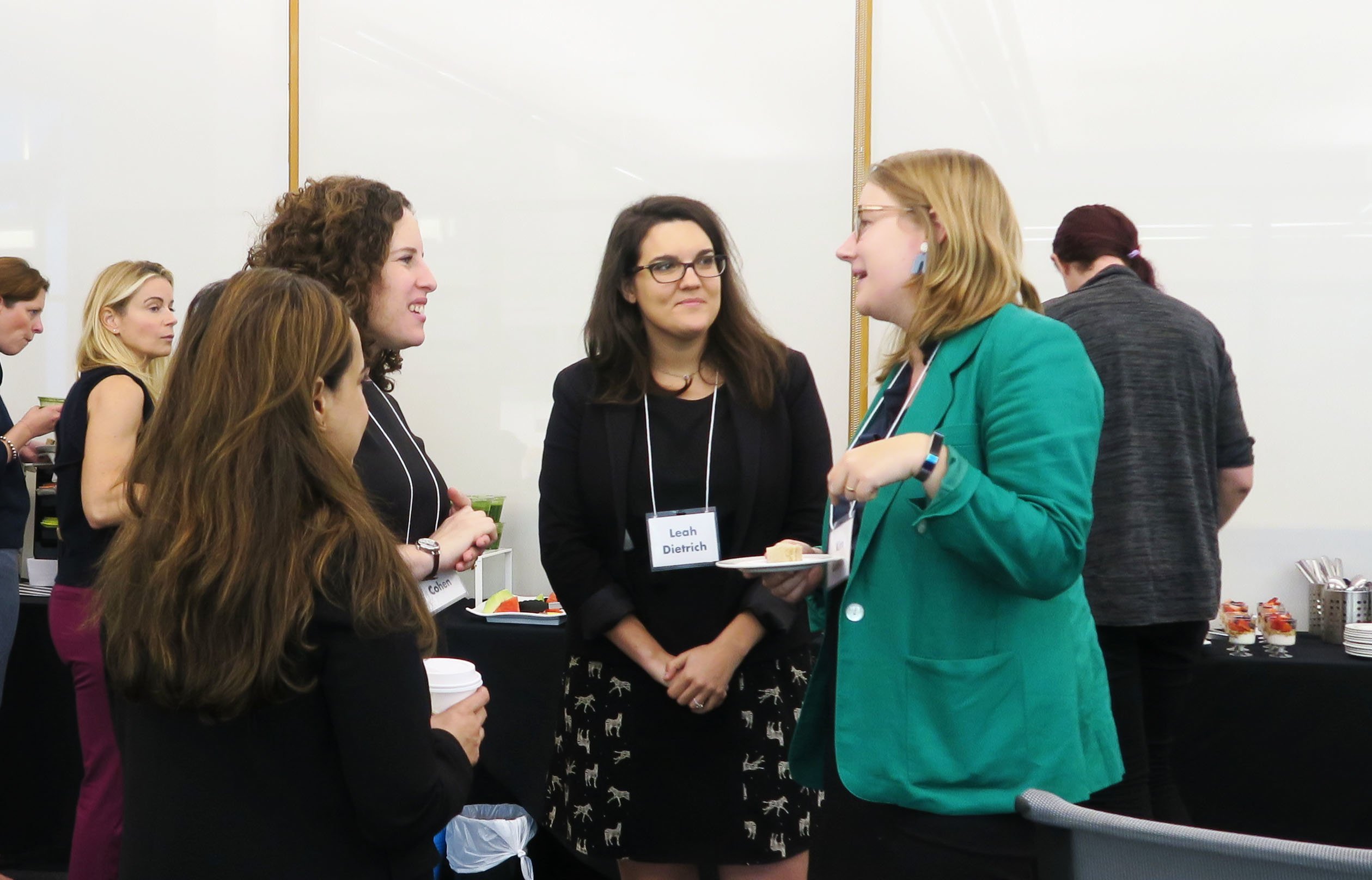
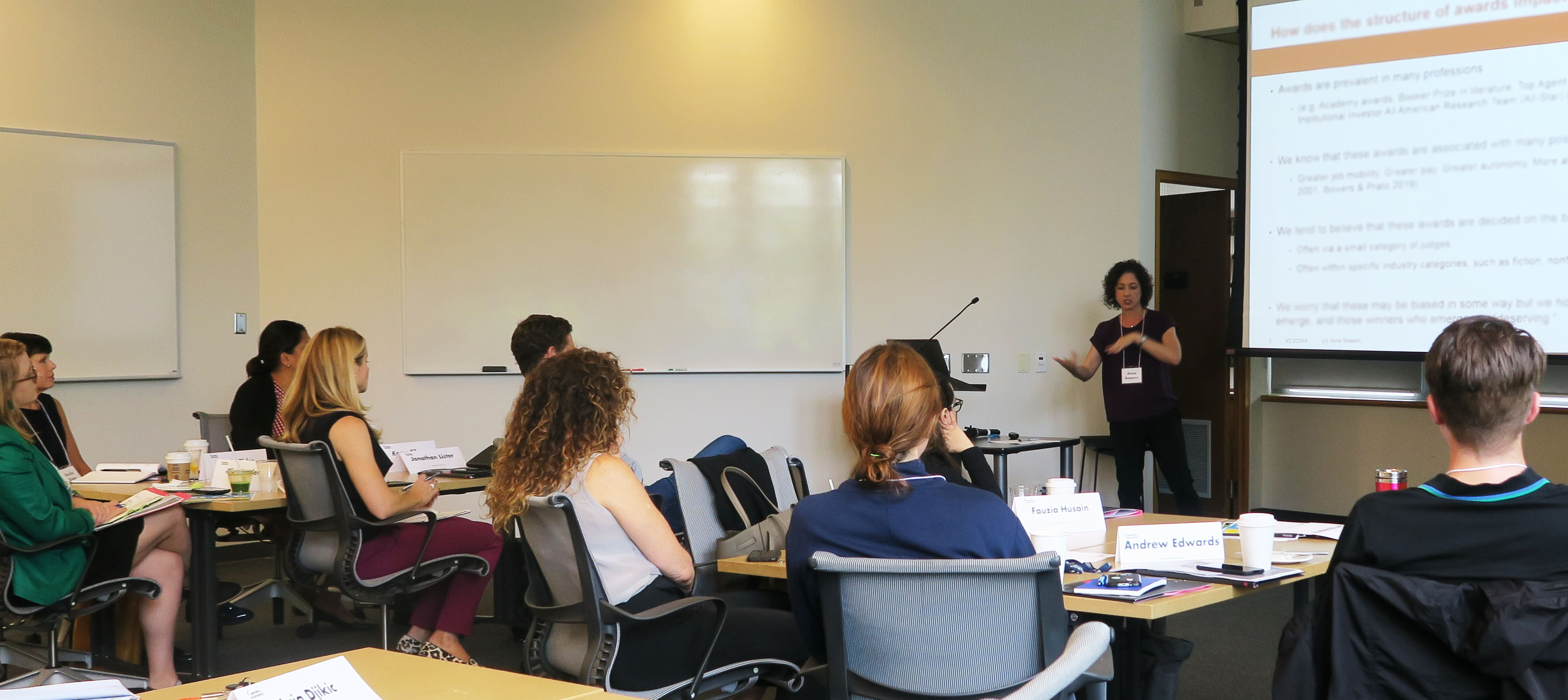
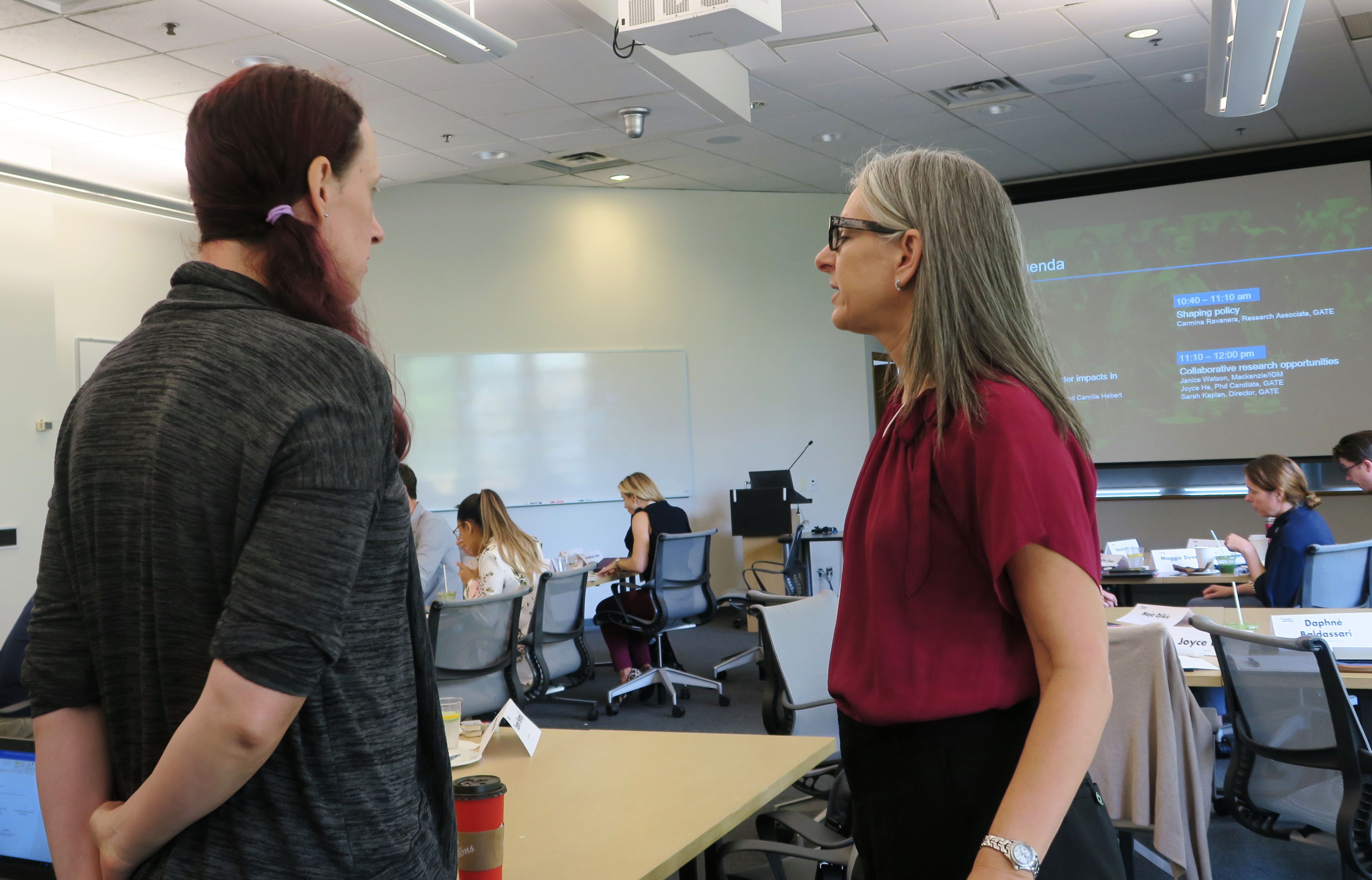
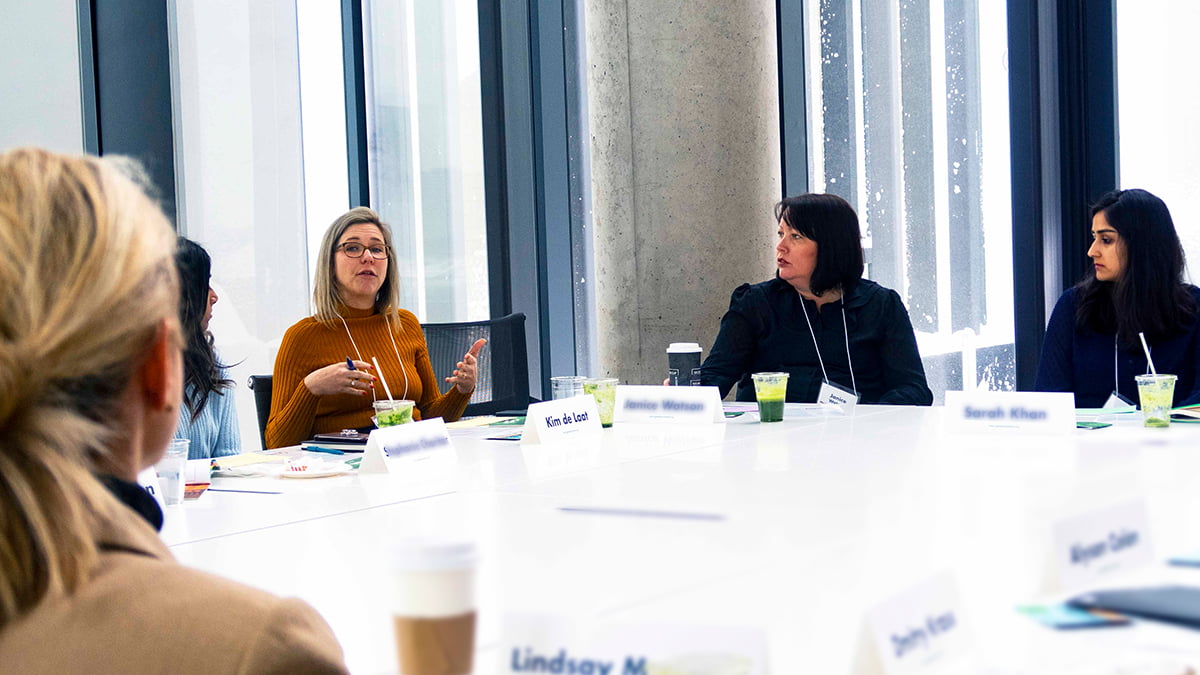
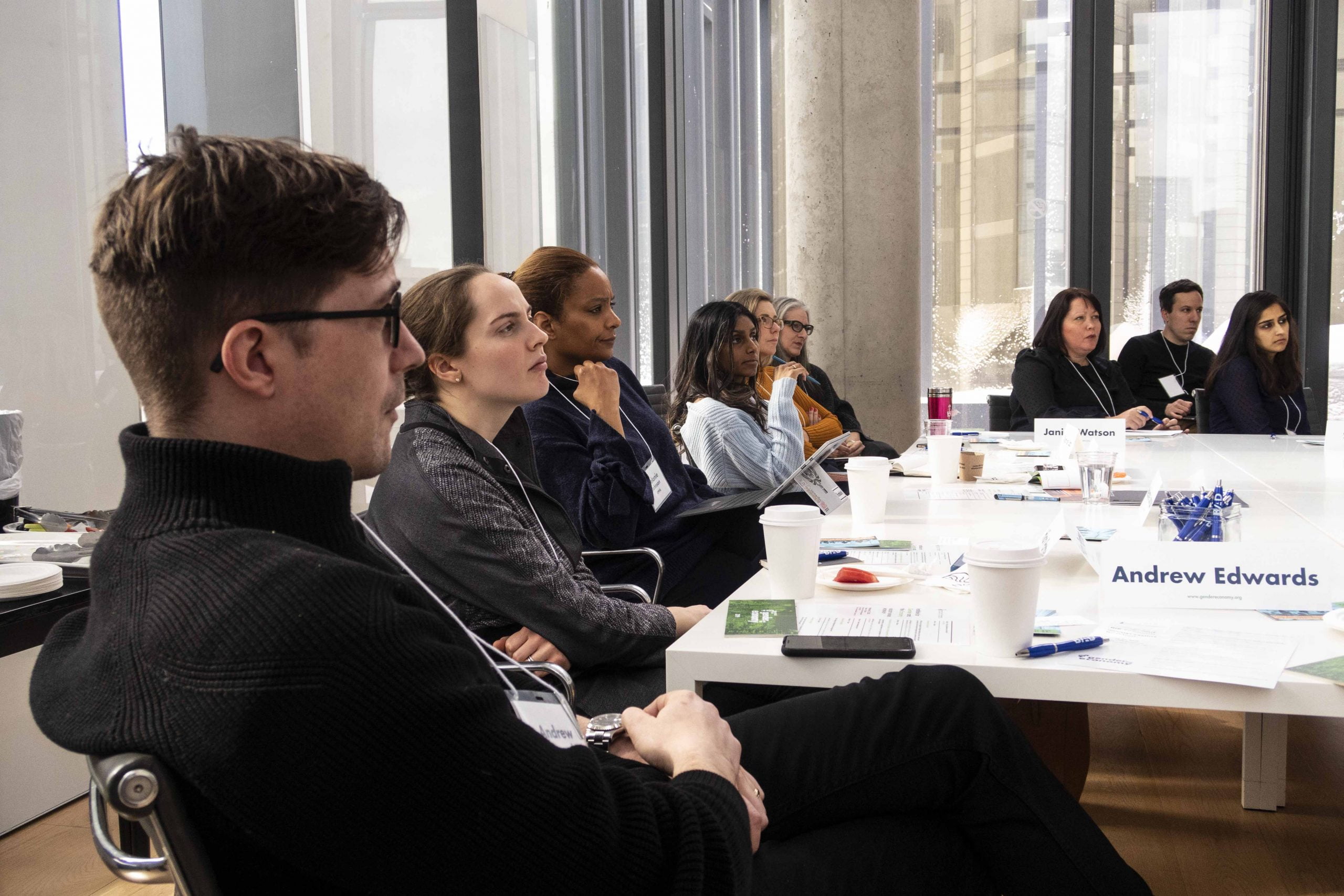
    GATE was as thrilled to once again engage with Industry Partners on the cutting-edge topics of the day. Partners and Power Circle members get a chance to learn about in-progress research before it gets published and interact with our researchers. In our fifth Industry Partner Workshop, researchers shared their latest insights on how gender norms shape team leadership especially in conditions of uncertainty and how work design (such as the introduction of agile work practices) can impact the uptake of flexible work policies.

    We also showcased Rotman’s Masters of Management Analytics (MMA) degree, offering a unique opportunity for Industry Partners to host student teams in their workplaces through the program’s analytics practicum projects.

    Download key insights from the workshop and a resource list, here.
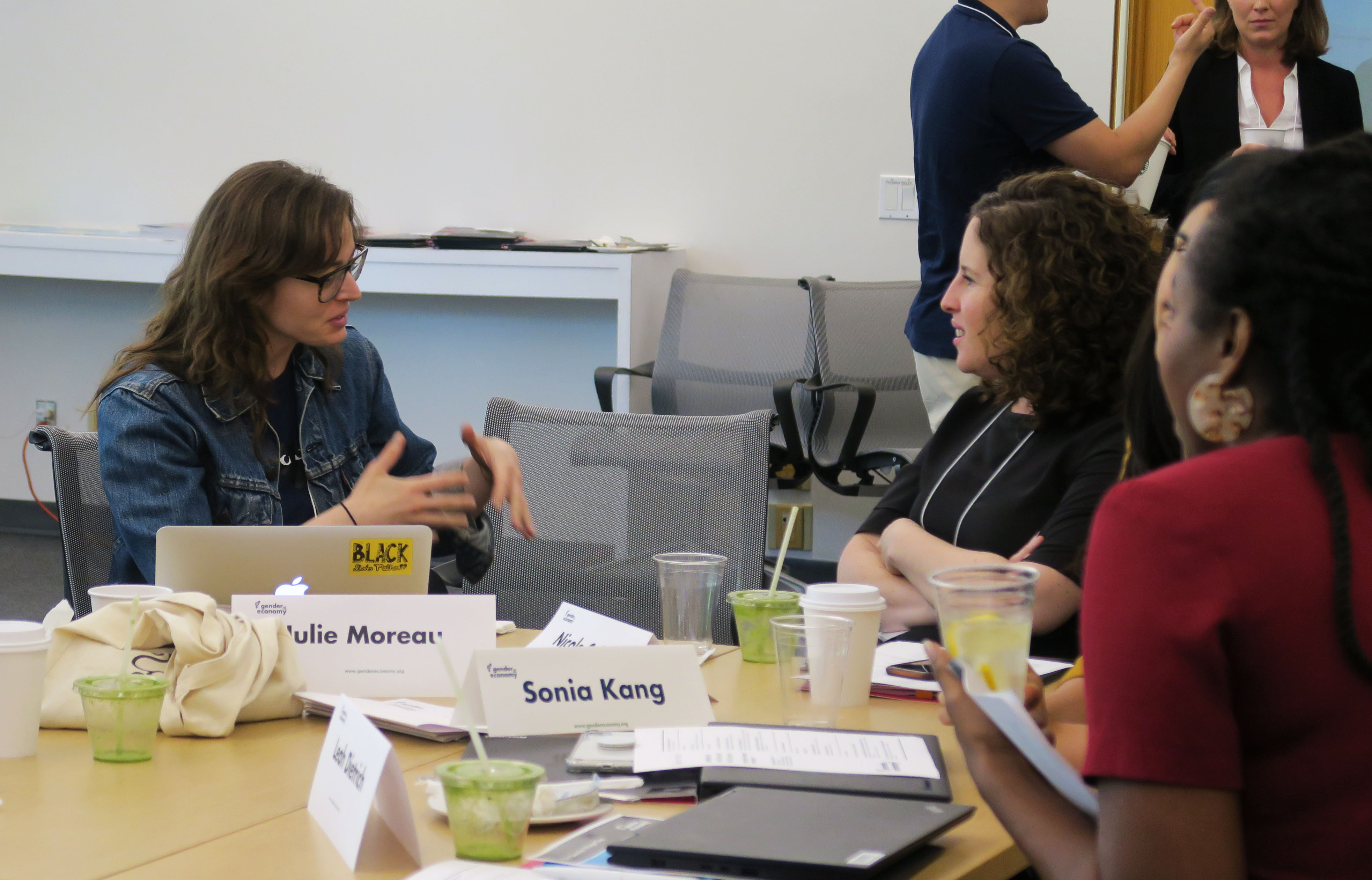
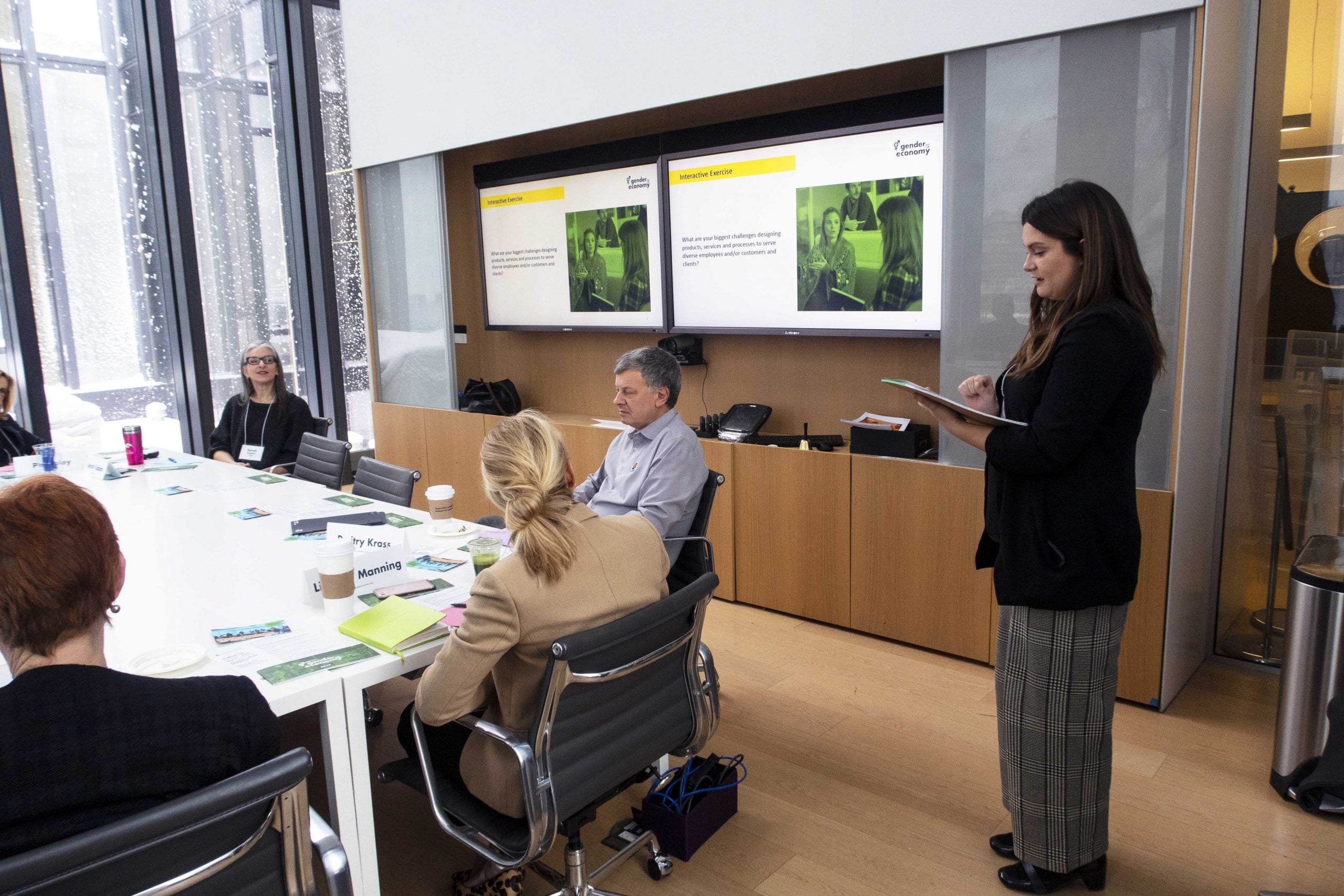
    Industry Workshop participants take part in a written activity
    Are you interested in supporting our research as an Industry Partner? Find out more here.

    [/fusion_text][fusion_separator style_type=”none” hide_on_mobile=”small-visibility,medium-visibility,large-visibility” class=”” id=”” sep_color=”” top_margin=”25″ bottom_margin=”25″ border_size=”” icon=”” icon_circle=”” icon_circle_color=”” width=”” alignment=”center” /][fusion_button link=”https://www.gendereconomy.org/past-events/” text_transform=”” title=”” target=”_blank” link_attributes=”” alignment=”” modal=”” hide_on_mobile=”small-visibility,medium-visibility,large-visibility” class=”” id=”” color=”custom” button_gradient_top_color=”#62bd19″ button_gradient_bottom_color=”#62bd19″ button_gradient_top_color_hover=”#00c2e2″ button_gradient_bottom_color_hover=”#00c2e2″ accent_color=”” accent_hover_color=”” type=”” bevel_color=”” border_width=”” size=”” stretch=”yes” icon=”” icon_position=”left” icon_divider=”no” animation_type=”” animation_direction=”left” animation_speed=”0.3″ animation_offset=”” border_radius=””]See more past events[/fusion_button][fusion_separator style_type=”none” hide_on_mobile=”small-visibility,medium-visibility,large-visibility” class=”” id=”” sep_color=”” top_margin=”20″ bottom_margin=”20″ border_size=”” icon=”” icon_circle=”” icon_circle_color=”” width=”” alignment=”center” /][fusion_title margin_top=”” margin_bottom=”” hide_on_mobile=”medium-visibility,large-visibility” class=”” id=”” size=”5″ content_align=”center” style_type=”default” sep_color=””]

    Or register below for these upcoming events

    [/fusion_title][fusion_recent_posts layout=”default” hover_type=”none” columns=”3″ number_posts=”3″ offset=”0″ pull_by=”category” cat_slug=”events” exclude_cats=”past” tag_slug=”” exclude_tags=”” thumbnail=”yes” title=”yes” meta=”no” meta_author=”no” meta_categories=”no” meta_date=”yes” meta_comments=”yes” meta_tags=”no” content_alignment=”” excerpt=”no” excerpt_length=”35″ strip_html=”yes” scrolling=”no” hide_on_mobile=”medium-visibility,large-visibility” class=”” id=”” animation_type=”” animation_direction=”left” animation_speed=”0.3″ animation_offset=”” /][/fusion_builder_column][/fusion_builder_row][/fusion_builder_container]

  • Do women in tech work experience a “glass escalator”?

    Do women in tech work experience a “glass escalator”?

    [fusion_builder_container admin_label=”” hundred_percent=”no” equal_height_columns=”no” menu_anchor=”” hide_on_mobile=”small-visibility,medium-visibility,large-visibility” class=”” id=”” background_color=”” background_image=”” background_position=”center center” background_repeat=”no-repeat” fade=”no” background_parallax=”none” enable_mobile=”no” parallax_speed=”0.3″ video_mp4=”” video_webm=”” video_ogv=”” video_url=”” video_aspect_ratio=”16:9″ video_loop=”yes” video_mute=”yes” video_preview_image=”” border_size=”” border_color=”” border_style=”solid” margin_top=”20″ margin_bottom=”” padding_top=”” padding_right=”” padding_bottom=”” padding_left=””][fusion_builder_row][fusion_builder_column type=”3_4″ layout=”3_4″ spacing=”” center_content=”no” hover_type=”none” link=”” min_height=”” hide_on_mobile=”small-visibility,medium-visibility,large-visibility” class=”” id=”” background_color=”” background_image=”” background_position=”left top” background_repeat=”no-repeat” border_size=”0″ border_color=”” border_style=”solid” border_position=”all” padding_top=”” padding_right=”” padding_bottom=”” padding_left=”” margin_top=”” margin_bottom=”” animation_type=”” animation_direction=”left” animation_speed=”0.3″ animation_offset=”” last=”false” first=”true”][fusion_text columns=”” column_min_width=”” column_spacing=”” rule_style=”default” rule_size=”” rule_color=”” hide_on_mobile=”small-visibility,medium-visibility,large-visibility” class=”” id=”” animation_type=”” animation_direction=”left” animation_speed=”0.3″ animation_offset=””]

    Summary

    “The glass escalator” is a metaphor typically used to describe how men in feminized workplaces rise through the ranks because of gender norms and gendered job expectations. For instance, men tend to be perceived as having stronger leadership qualities than women, and thus are fast-tracked into supervisor roles. This study used data from interviews with 32 women workers in the technology field to investigate whether the glass escalator applies to women in tech – a field notoriously dominated by men – and whether race has an impact. The study discovered that a better metaphor for white women in tech is a “glass step stool”: white women are encouraged to take on mid-level managerial positions, but continue to face barriers to achieving executive-level roles. Meanwhile, women of colour do not experience this step stool, and are forced to take deliberate steps, such as further education, to achieve advancement.

    Research

    The metaphor of the glass escalator suggests that men in women-dominated occupations tend to move into positions of authority because they are, more than women, perceived as possessing traits desirable for leadership roles. The author of this study questioned whether this metaphor applies to women working in tech work, a field dominated by men. Although women experience barriers to advancement at work, managerial roles in technology require strong interpersonal skills. Interpersonal skills are a feminine-associated trait, and research has found that women in engineering tend to be steered towards the social aspects of their work. In contrast, engineering is a technical role and is masculine-associated. Thus, women in tech work may experience a glass escalator effect, because gender norms suggest that they would be more capable managers than engineers. The study also investigated what impact race had on women’s experiences, as prior research on women in STEM has not often focused on race and gender together.

    The author conducted interviews with 32 women tech workers over the course of 18 months. Interviews focused on the women’s career paths, their experiences at work, and other career-related questions. Most worked for companies that produced computer hardware or software in tech hub cities in the United States, such as San Francisco. Thirteen participants were people of colour (six Asian and seven black or Latina). All participants except for two had at least a bachelor’s degree, eleven had a master’s, and seven had a PhD.

    Findings

    …women also decided to move into managerial positions to remove themselves from gendered hostility and poor work-family balance that they experienced in engineering culture.

    The author discovered that white women participants experienced not a glass escalator, but a glass step stool. That is, several white women began their careers in technical career paths such as software engineering, but supervisors solicited them to take on middle manager roles due to their strong “people skills”. The women also decided to move into managerial positions to remove themselves from gendered hostility and poor work-family balance that they experienced in engineering culture. However, the move was a small step up. Firstly, there was no clear next step to higher-level leadership, as women with technical training were not represented in “C-level” roles in their companies. Secondly, becoming a manager meant a trade-off: the women were no longer developing the skills that could have allowed them to move back to a technical position, particularly considering how fast technology and its associated skills change.

    In contrast to white women, women of colour had to specifically choose and work towards the jobs they wanted. Their supervisors did not identify them as having strong interpersonal skills nor encouraged them to move into management. Instead, women of colour were only identified for a position after they purposely received credentials or training for it. Moreover, some women of colour described feeling unwanted scrutiny and isolation at work, based on their race. In other words, only white women in the tech field were perceived as having managerial authority, and that authority was limited.

    Implications

    Moving women out of technical roles is not a solution for sexism in male-dominated fields—Although promoting women into mid-level managerial roles may seem like a solution for increasing gender diversity in leadership, this process does not transform masculine workplace cultures, and it does not improve representation of women in technical roles such as engineering. This is especially important in fields in which it is crucial to have diverse workers, such as artificial intelligence and machine learning. Rather than encouraging women to take on “social” roles that fit feminine norms, technology companies should facilitate inclusivity of women in all roles, including those that are highly masculinized.

    Rather than encouraging women to take on “social” roles that fit feminine norms, technology companies should facilitate inclusivity of women in all roles, including those that are highly masculinized.

    Stereotypically feminine norms often only apply to white women—This study demonstrates that jobs are not only gendered but also racialized: women of colour participants did not receive the same encouragement as white women to pursue managerial roles. This suggests that the feminine norm of having strong interpersonal skills only applied to white women. As tech companies aim to become more inclusive, it is important that they (1) recognize that the experiences of women of colour are fundamentally different from those of white women, and (2) centre rather than ignore these experiences.

    __________________________

    Research brief prepared by: CARMINA RAVANERA

    [/fusion_text][fusion_separator style_type=”none” hide_on_mobile=”small-visibility,medium-visibility,large-visibility” class=”” id=”” sep_color=”” top_margin=”20″ bottom_margin=”20″ border_size=”” icon=”” icon_circle=”” icon_circle_color=”” width=”” alignment=”center” /][fusion_button link=”https://www.gendereconomy.org/research-briefs/” text_transform=”” title=”” target=”_blank” link_attributes=”” alignment=”” modal=”” hide_on_mobile=”small-visibility,medium-visibility,large-visibility” class=”” id=”” color=”custom” button_gradient_top_color=”#62bd19″ button_gradient_bottom_color=”#62bd19″ button_gradient_top_color_hover=”#00c2e2″ button_gradient_bottom_color_hover=”#00c2e2″ accent_color=”” accent_hover_color=”” type=”” bevel_color=”” border_width=”” size=”” stretch=”yes” icon=”” icon_position=”left” icon_divider=”no” animation_type=”” animation_direction=”left” animation_speed=”0.3″ animation_offset=”” border_radius=””]See more research briefs[/fusion_button][fusion_separator style_type=”none” hide_on_mobile=”small-visibility,medium-visibility,large-visibility” class=”” id=”” sep_color=”” top_margin=”20″ bottom_margin=”20″ border_size=”” icon=”” icon_circle=”” icon_circle_color=”” width=”” alignment=”center” /][fusion_recent_posts layout=”default” hover_type=”none” columns=”3″ number_posts=”3″ offset=”0″ pull_by=”category” cat_slug=”research-briefs” exclude_cats=”” tag_slug=”” exclude_tags=”” thumbnail=”yes” title=”yes” meta=”no” meta_author=”no” meta_categories=”no” meta_date=”yes” meta_comments=”yes” meta_tags=”no” content_alignment=”” excerpt=”no” excerpt_length=”35″ strip_html=”yes” scrolling=”no” hide_on_mobile=”small-visibility,medium-visibility,large-visibility” class=”” id=”” animation_type=”” animation_direction=”left” animation_speed=”0.3″ animation_offset=”” /][/fusion_builder_column][fusion_builder_column type=”1_4″ layout=”1_4″ spacing=”” center_content=”no” hover_type=”none” link=”” min_height=”” hide_on_mobile=”small-visibility,medium-visibility,large-visibility” class=”” id=”” background_color=”” background_image=”” background_position=”left top” background_repeat=”no-repeat” border_size=”0″ border_color=”” border_style=”solid” border_position=”all” padding_top=”” padding_right=”” padding_bottom=”” padding_left=”” margin_top=”” margin_bottom=”” animation_type=”” animation_direction=”left” animation_speed=”0.3″ animation_offset=”” last=”true” first=”false”][fusion_title title_type=”text” rotation_effect=”bounceIn” display_time=”1200″ highlight_effect=”circle” loop_animation=”off” highlight_width=”9″ highlight_top_margin=”0″ before_text=”” rotation_text=”” highlight_text=”” after_text=”” hide_on_mobile=”small-visibility,medium-visibility,large-visibility” class=”briefsummary” id=”” content_align=”left” size=”3″ font_size=”” animated_font_size=”” line_height=”” letter_spacing=”” margin_top=”” margin_bottom=”” margin_top_mobile=”” margin_bottom_mobile=”” text_color=”” animated_text_color=”” highlight_color=”” style_type=”none” sep_color=””]

    Title

    Escalator or Step Stool? Gendered Labor and Token Processes in Tech Work

    Authors

    Sharla Alegria

    Source

    Academy of Management Journal

    Published

    2019

    DOI

    10.1177/0891243219835737

    Link

    https://journals.aom.org/doi/10.5465/amj.2016.1215

    Research brief prepared by

    Carmina Ravanera

    [/fusion_title][fusion_widget_area name=”avada-custom-sidebar-researchbriefsidebar” title_size=”” title_color=”” background_color=”” padding_top=”” padding_right=”” padding_bottom=”” padding_left=”” hide_on_mobile=”small-visibility,medium-visibility,large-visibility” class=”” id=”” /][/fusion_builder_column][/fusion_builder_row][/fusion_builder_container]
  • U of T Where You Are: Gender and the Economy – Lessons From COVID-19 for the New World of Work

    U of T Where You Are: Gender and the Economy – Lessons From COVID-19 for the New World of Work

    [fusion_builder_container hundred_percent=”no” equal_height_columns=”no” menu_anchor=”” hide_on_mobile=”small-visibility,medium-visibility,large-visibility” class=”” id=”” background_color=”” background_image=”” background_position=”center center” background_repeat=”no-repeat” fade=”no” background_parallax=”none” parallax_speed=”0.3″ video_mp4=”” video_webm=”” video_ogv=”” video_url=”” video_aspect_ratio=”16:9″ video_loop=”yes” video_mute=”yes” overlay_color=”” video_preview_image=”” border_color=”” border_style=”solid” padding_top=”” padding_bottom=”” padding_left=”” padding_right=”” type=”legacy”][fusion_builder_row][fusion_builder_column type=”1_1″ layout=”1_1″ background_position=”left top” background_color=”” border_color=”” border_style=”solid” border_position=”all” spacing=”yes” background_image=”” background_repeat=”no-repeat” padding_top=”” padding_right=”” padding_bottom=”” padding_left=”” margin_top=”0px” margin_bottom=”0px” class=”” id=”” animation_type=”” animation_speed=”0.3″ animation_direction=”left” hide_on_mobile=”small-visibility,medium-visibility,large-visibility” center_content=”no” last=”true” min_height=”” hover_type=”none” link=”” first=”true” border_sizes_top=”” border_sizes_bottom=”” border_sizes_left=”” border_sizes_right=””][fusion_text columns=”” column_min_width=”” column_spacing=”” rule_style=”default” rule_size=”” rule_color=”” hue=”” saturation=”” lightness=”” alpha=”” content_alignment_medium=”” content_alignment_small=”” content_alignment=”” hide_on_mobile=”small-visibility,medium-visibility,large-visibility” sticky_display=”normal,sticky” class=”” id=”” margin_top=”” margin_right=”” margin_bottom=”” margin_left=”” fusion_font_family_text_font=”” fusion_font_variant_text_font=”” font_size=”” line_height=”” letter_spacing=”” text_transform=”none” text_color=”” animation_type=”” animation_direction=”left” animation_speed=”0.3″ animation_offset=””]

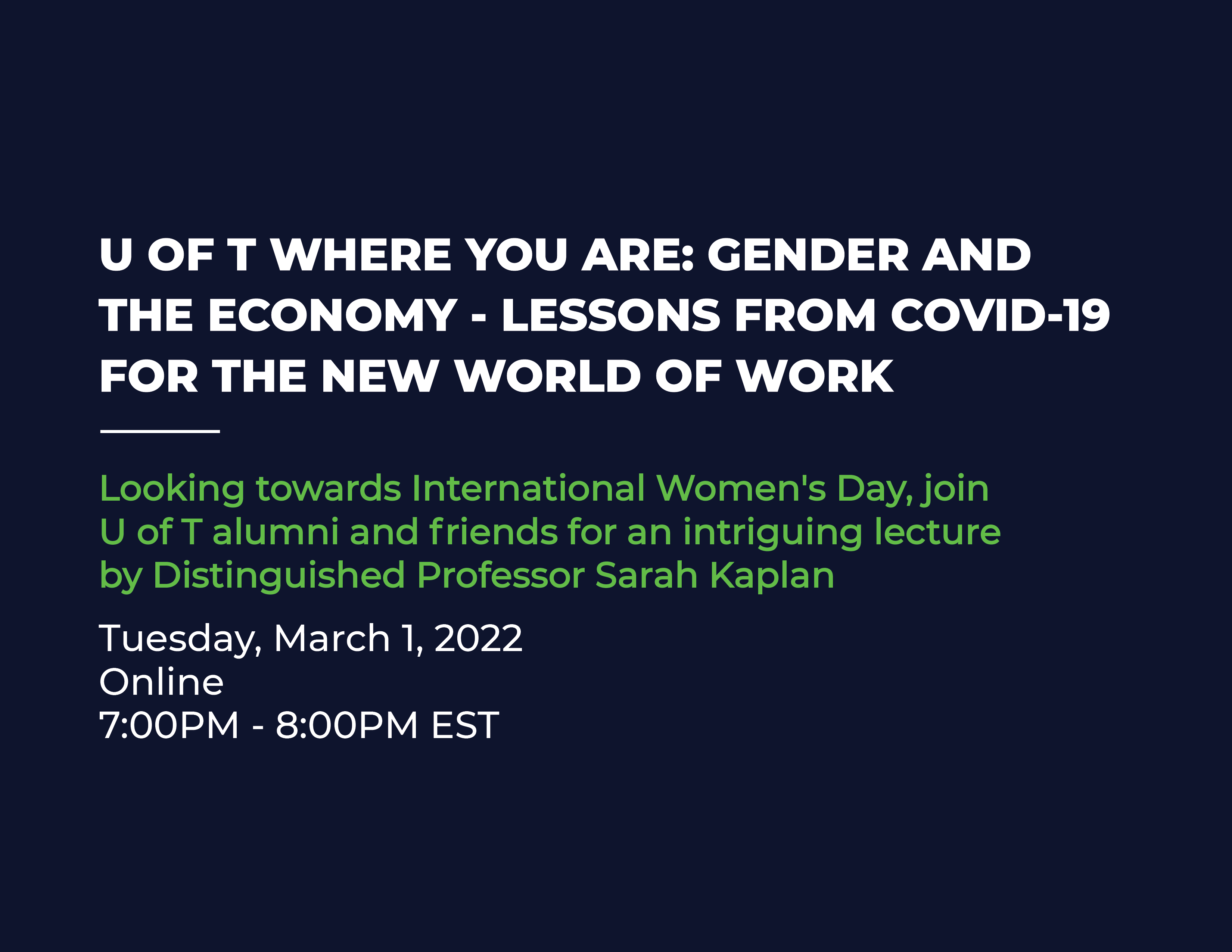
    Topic: U of T Where You Are: Gender and the economy – Lessons from COVID-19 for the new world of work

    Speaker: Sarah Kaplan

    Date & Time: March 1, 7-8PM EST

    Location: Online.

    Please register here for this event.

    Looking towards International Women’s Day, joint U of T alumni and friends for an intriguing lecture by Distinguished Professor Sarah Kaplan

    The COVID-19 pandemic has forced everyone to rethink work, careers and families. In this discussion, Professor Kaplan will explore the gendered impacts of the pandemic, how they relate to forces that existed before, and what this will mean for making progress on equity as we emerge into a new world of work. Building on research from the Institute for Gender and the Economy, she will discuss personal, social, organizational and policy implications.

    About the speaker

    Sarah Kaplan is the Distinguished Professor, Director of the Institute for Gender and the Economy (GATE), and Professor of Strategic Management, at the University of Toronto’s Rotman School of Management. She is a co-author of the bestselling business book, Creative Destruction. Her latest book—The 360° Corporation: From Stakeholder Trade-offs to Transformation—is based on her award-winning course at the Rotman School. Her current research focuses on applying an innovation lens to social challenges such as gender inequality. She was a strategic lead in developing the Feminist Economic Recovery Plan for Canada. In 2020, she launched a 5-course Specialization on Coursera: Gender Analytics: Gender Equity Through Inclusive Designwhich is aimed at building skills to do intersectional gender-based analysis for products, services and policies. She regularly advises corporations, governments and agencies on policies related to gender equality such as board diversity, care work, employment, pay equity, gender-based analysis and other topics. Formerly a professor at the University of Pennsylvania’s Wharton School (where she remains a Senior Fellow), and an innovation specialist for nearly a decade at McKinsey & Company, she earned her PhD at MIT’s Sloan School of Management. She has a BA with honors in Political Science from UCLA and an MA with distinction in International Relations and International Economics from Johns Hopkins University’s School for Advanced International Studies (SAIS)

    Please register here for this event.

    [/fusion_text][fusion_separator style_type=”none” hide_on_mobile=”small-visibility,medium-visibility,large-visibility” class=”” id=”” sep_color=”” top_margin=”20″ bottom_margin=”20″ border_size=”” icon=”” icon_circle=”” icon_circle_color=”” width=”” alignment=”center” /][fusion_button link=”https://www.gendereconomy.org/events/” text_transform=”” title=”” target=”_blank” link_attributes=”” alignment=”” modal=”” hide_on_mobile=”small-visibility,medium-visibility,large-visibility” class=”” id=”” color=”custom” button_gradient_top_color=”#62bd19″ button_gradient_bottom_color=”#62bd19″ button_gradient_top_color_hover=”#00c2e2″ button_gradient_bottom_color_hover=”#00c2e2″ accent_color=”” accent_hover_color=”” type=”” bevel_color=”” size=”” stretch=”yes” icon=”” icon_position=”left” icon_divider=”no” animation_type=”” animation_direction=”left” animation_speed=”0.3″ animation_offset=””]See more events[/fusion_button][/fusion_builder_column][/fusion_builder_row][/fusion_builder_container]

  • Why employees with families may be more absorbed at work

    Why employees with families may be more absorbed at work

    [fusion_builder_container admin_label=”” hundred_percent=”no” equal_height_columns=”no” menu_anchor=”” hide_on_mobile=”small-visibility,medium-visibility,large-visibility” class=”” id=”” background_color=”” background_image=”” background_position=”center center” background_repeat=”no-repeat” fade=”no” background_parallax=”none” enable_mobile=”no” parallax_speed=”0.3″ video_mp4=”” video_webm=”” video_ogv=”” video_url=”” video_aspect_ratio=”16:9″ video_loop=”yes” video_mute=”yes” video_preview_image=”” border_size=”” border_color=”” border_style=”solid” margin_top=”20″ margin_bottom=”” padding_top=”” padding_right=”” padding_bottom=”” padding_left=””][fusion_builder_row][fusion_builder_column type=”3_4″ layout=”3_4″ spacing=”” center_content=”no” hover_type=”none” link=”” min_height=”” hide_on_mobile=”small-visibility,medium-visibility,large-visibility” class=”” id=”” background_color=”” background_image=”” background_position=”left top” background_repeat=”no-repeat” border_size=”0″ border_color=”” border_style=”solid” border_position=”all” padding_top=”” padding_right=”” padding_bottom=”” padding_left=”” margin_top=”” margin_bottom=”” animation_type=”” animation_direction=”left” animation_speed=”0.3″ animation_offset=”” last=”no”][fusion_text columns=”” column_min_width=”” column_spacing=”” rule_style=”default” rule_size=”” rule_color=”” hide_on_mobile=”small-visibility,medium-visibility,large-visibility” class=”” id=”” animation_type=”” animation_direction=”left” animation_speed=”0.3″ animation_offset=””]

    Summary

    There is a common perception that employees with families are less committed to their work than single, childless employees. Single, childless employees tend to be perceived as “ideal workers” because it is assumed they do not have other obligations outside of work. However, this study found that single, childless workers in fact report lower absorption in their work than those with other family structures. The authors discovered that anticipating domestic activities after work, as opposed to leisure activities, can reinforce the “work mindset” and result in higher absorption at work. This is because domestic activities and work tasks are similarly goal-directed and obligatory. Since workers who have a spouse and / or children anticipate more domestic activities after work, their work absorption is higher than that of single, childless workers. This research suggests that employers need to be cautious when making assumptions about employees’ attitudes and dedication to work based on their family and personal lives.

    Anticipating domestic activities after work, as opposed to leisure activities, can reinforce the “work mindset” and result in higher absorption at work.

    Research

    The authors conducted two studies to measure the effect of family structure on employees’ absorption in their work. The first study was an analysis of a survey conducted with 469 alumni from an American university’s business school. The survey asked questions about respondents’ perceived levels of work absorption, such as how much they agreed with the statement “Nothing can distract me when I am working”. It also asked about their family structure, to see if there was a significant relationship between these two variables.

    The second study tested how employees’ anticipation of domestic or leisure activities after work affected their work absorption. Domestic activities include tasks such as cooking, cleaning, and taking care of children, while leisure activities include activities like going out with friends, playing sports, or watching movies. This study was a daily diary survey, where 97 employees of a university recorded their plans after work, and how absorbed they were in their work, for five consecutive days. A supplement to this study was conducted with 196 other working adults. It was also a daily diary survey, but in addition to recording their after-work activities and work absorption, respondents also identified whether they felt their after-work activities were goal-directed, obligatory, or an escape from their routine.

    Findings

    Results for the first study showed that single, childless employees reported lower work absorption than those with other family structures, even when controlling for other variables like gender, age, and job level.

    The second study examined why employees with different family structures have different work absorption. The authors analyzed daily diary survey results and discovered that anticipating domestic activities after work increased work absorption, while anticipating leisure activities after work decreased work absorption. While single, childless workers did not report anticipating a significantly different number of after-work activities than those with other family structures, they did anticipate fewer domestic activities. This resulted in their lower work absorption.

    In the supplement to the second study, the authors found that respondents tended to view domestic activities as more obligatory and goal-directed than leisure activities. Perceiving after-work activities as obligatory and goal-directed caused higher work absorption because it reinforced employees’ work-related mindset during the work day. On the other hand, due to a lack of association with goal direction and sense of obligation, anticipating after-work leisure activities decreased employees’ absorption at work.

    Childless employees reported lower work absorption than those with other family structures, even when controlling for other variables.

    Implications

    • Managers can mitigate bias against parents and caregivers in their evaluations of their commitment to work–Employers may think that parents or other caregivers are uncommitted or unfocused workers because they face obligations outside of work. Yet, this study shows that having domestic work to do later on in their day makes employees more absorbed in their work, and it is parents and spouses who are most likely to have these obligations. Managers should acknowledge this finding and mitigate bias against parents and caregivers in their evaluations of their commitment.
    • Managers can pay attention to the work-life needs of single, childless–Single, childless workers have a similar number of after-work activities as those in other family structures. Employers should not assume that single, childless workers do not have other obligations or that they are available to work extended hours: this puts an unnecessary burden on them. Further, organizations can support single, childless workers in pursuing goal-directed activities outside of work, like volunteering or professional development. This will increase employee work absorption while also benefitting workers’ careers and skills.

    [/fusion_text][fusion_separator style_type=”none” hide_on_mobile=”small-visibility,medium-visibility,large-visibility” class=”” id=”” sep_color=”” top_margin=”20″ bottom_margin=”20″ border_size=”” icon=”” icon_circle=”” icon_circle_color=”” width=”” alignment=”center” /][fusion_button link=”https://www.gendereconomy.org/research-briefs/” text_transform=”” title=”” target=”_blank” link_attributes=”” alignment=”” modal=”” hide_on_mobile=”small-visibility,medium-visibility,large-visibility” class=”” id=”” color=”custom” button_gradient_top_color=”#62bd19″ button_gradient_bottom_color=”#62bd19″ button_gradient_top_color_hover=”#00c2e2″ button_gradient_bottom_color_hover=”#00c2e2″ accent_color=”” accent_hover_color=”” type=”” bevel_color=”” border_width=”” size=”” stretch=”yes” icon=”” icon_position=”left” icon_divider=”no” animation_type=”” animation_direction=”left” animation_speed=”0.3″ animation_offset=”” border_radius=””]See more research briefs[/fusion_button][fusion_separator style_type=”none” hide_on_mobile=”small-visibility,medium-visibility,large-visibility” class=”” id=”” sep_color=”” top_margin=”20″ bottom_margin=”20″ border_size=”” icon=”” icon_circle=”” icon_circle_color=”” width=”” alignment=”center” /][fusion_recent_posts layout=”default” hover_type=”none” columns=”3″ number_posts=”3″ offset=”0″ pull_by=”category” cat_slug=”research-briefs” exclude_cats=”” tag_slug=”” exclude_tags=”” thumbnail=”yes” title=”yes” meta=”no” meta_author=”no” meta_categories=”no” meta_date=”yes” meta_comments=”yes” meta_tags=”no” content_alignment=”” excerpt=”no” excerpt_length=”35″ strip_html=”yes” scrolling=”no” hide_on_mobile=”small-visibility,medium-visibility,large-visibility” class=”” id=”” animation_type=”” animation_direction=”left” animation_speed=”0.3″ animation_offset=”” /][/fusion_builder_column][fusion_builder_column type=”1_4″ layout=”1_4″ spacing=”” center_content=”no” hover_type=”none” link=”” min_height=”” hide_on_mobile=”small-visibility,medium-visibility,large-visibility” class=”” id=”” background_color=”” background_image=”” background_position=”left top” background_repeat=”no-repeat” border_size=”0″ border_color=”” border_style=”solid” border_position=”all” padding_top=”” padding_right=”” padding_bottom=”” padding_left=”” margin_top=”” margin_bottom=”” animation_type=”” animation_direction=”left” animation_speed=”0.3″ animation_offset=”” last=”no”][fusion_title hide_on_mobile=”small-visibility,medium-visibility,large-visibility” class=”briefsummary” id=”” content_align=”left” size=”3″ font_size=”” line_height=”” letter_spacing=”” margin_top=”” margin_bottom=”” margin_top_mobile=”” margin_bottom_mobile=”” text_color=”” style_type=”none” sep_color=””]

    Title

    The Paradox of Family Structure and Plans After Work: Why Single Childless Employees May be the Least Absorbed

    Authors

    Tracy L. Dumas and Jill E. Perry-Smith

    Source

    Academy of Management Journal

    Published

    2018

    DOI

    10.5465/amj.2016.0086

    Link

    https://journals.aom.org/doi/10.5465/amj.2016.0086

    Research brief prepared by

    Carmina Ravanera

    [/fusion_title][fusion_widget_area name=”avada-custom-sidebar-researchbriefsidebar” title_size=”” title_color=”” background_color=”” padding_top=”” padding_right=”” padding_bottom=”” padding_left=”” hide_on_mobile=”small-visibility,medium-visibility,large-visibility” class=”” id=”” /][/fusion_builder_column][/fusion_builder_row][/fusion_builder_container]
  • Conversations with men engineers contribute to burnout for women engineers

    Conversations with men engineers contribute to burnout for women engineers

    [fusion_builder_container admin_label=”” hundred_percent=”no” equal_height_columns=”no” menu_anchor=”” hide_on_mobile=”small-visibility,medium-visibility,large-visibility” class=”” id=”” background_color=”” background_image=”” background_position=”center center” background_repeat=”no-repeat” fade=”no” background_parallax=”none” enable_mobile=”no” parallax_speed=”0.3″ video_mp4=”” video_webm=”” video_ogv=”” video_url=”” video_aspect_ratio=”16:9″ video_loop=”yes” video_mute=”yes” video_preview_image=”” border_size=”” border_color=”” border_style=”solid” margin_top=”20″ margin_bottom=”” padding_top=”” padding_right=”” padding_bottom=”” padding_left=””][fusion_builder_row][fusion_builder_column type=”3_4″ layout=”3_4″ spacing=”” center_content=”no” hover_type=”none” link=”” min_height=”” hide_on_mobile=”small-visibility,medium-visibility,large-visibility” class=”” id=”” background_color=”” background_image=”” background_position=”left top” background_repeat=”no-repeat” border_size=”0″ border_color=”” border_style=”solid” border_position=”all” padding_top=”” padding_right=”” padding_bottom=”” padding_left=”” margin_top=”” margin_bottom=”” animation_type=”” animation_direction=”left” animation_speed=”0.3″ animation_offset=”” last=”no”][fusion_text columns=”” column_min_width=”” column_spacing=”” rule_style=”default” rule_size=”” rule_color=”” hide_on_mobile=”small-visibility,medium-visibility,large-visibility” class=”” id=”” animation_type=”” animation_direction=”left” animation_speed=”0.3″ animation_offset=””]

    Summary

    Social identity threat occurs when individuals feel devalued based on their belonging to a social group. Through a daily diary study with 96 engineers, researchers found that women engineers regularly experience social identity threat at work through having negative conversations with men engineers (i.e., conversations that make women engineers feel incompetent or not accepted). In turn, women engineers experience mental exhaustion. The same result did not occur for men when they had negative conversations with women colleagues, nor did it occur between men or between women. Thus, workplaces should implement policy that fosters men to have positive interactions with women colleagues, creating safer spaces for them.

    Women engineers experience mental exhaustion due to social identity threat at work.

    Research

    According to the psychology literature, social identity threat occurs when individuals feel they are devalued or negatively stereotyped based on their social group. This study aimed to measure professional women’s experiences of social identity threat, as well as the outcomes for women. The authors hypothesized that women engineers experience social identity threat through conversations with men colleagues, specifically if the conversations make them feel incompetent or not accepted. They also predicted that this social identity threat leads to women’s psychological burnout and mental exhaustion.

    The authors conducted 10 daily diary surveys with 52 women and 44 men engineers over the course of two weeks. Each day, participants were asked to recall face-to-face conversations they had at work, identify the type of conversation, identify the gender of the conversation partner, and rate the positivity of their own reaction to the conversation (e.g. whether they felt respected and whether their competence was acknowledged). They also answered questions about whether they perceived social identity threat (e.g. “Today at work, I felt very aware of my gender”) and about their daily burnout (e.g. “Today, I felt emotionally drained at work”).

    Findings

    When women engineers had work conversations with men colleagues that made them feel a lack of belonging and feelings of incompetence (i.e., negative conversations), women experienced social identity threat. That is, they felt that they were being devalued based on their gender. The result did not occur for men when they had negative conversations with women, nor did it occur for negative conversations between women or between men. This latter result may be because conversations between people of the same gender, even negative ones, are unlikely to be interpreted as related to gender.

    The authors also discovered that experiencing social identity threat at work resulted in psychological burnout for women, but not for men. The authors suggest that even when professional women have succeeded academically, they still feel regular devaluation in the workplace. If speaking with men colleagues made women feel unaccepted and incompetent, women were more likely to experience mental exhaustion.

    If speaking with men colleagues made women feel unaccepted and incompetent, women were more likely to experience mental exhaustion.

    Implications

    • Managers, especially in professions dominated by men, should prioritize policy and training on positive work interactions–When women engineers have conversations with men engineers that leave them feeling incompetent and unaccepted, they experience psychological burnout. This may be a factor in women’s high attrition from STEM professions. Employers should prioritize policy on inclusive and positive workplace interactions in order to create safer spaces for women.
    • Even when women pursue education in STEM fields and find STEM jobs, workplace culture may push them out–Many people perceive that women are underrepresented in STEM simply because they do not choose STEM education. However, this study shows that women who are already in STEM have to navigate threats to their feelings of competence and acceptance on a daily basis. Workplace cultures need to adjust in order to retain women in professions dominated by men.

    [/fusion_text][fusion_separator style_type=”none” hide_on_mobile=”small-visibility,medium-visibility,large-visibility” class=”” id=”” sep_color=”” top_margin=”20″ bottom_margin=”20″ border_size=”” icon=”” icon_circle=”” icon_circle_color=”” width=”” alignment=”center” /][fusion_button link=”https://www.gendereconomy.org/research-briefs/” text_transform=”” title=”” target=”_blank” link_attributes=”” alignment=”” modal=”” hide_on_mobile=”small-visibility,medium-visibility,large-visibility” class=”” id=”” color=”custom” button_gradient_top_color=”#62bd19″ button_gradient_bottom_color=”#62bd19″ button_gradient_top_color_hover=”#00c2e2″ button_gradient_bottom_color_hover=”#00c2e2″ accent_color=”” accent_hover_color=”” type=”” bevel_color=”” border_width=”” size=”” stretch=”yes” icon=”” icon_position=”left” icon_divider=”no” animation_type=”” animation_direction=”left” animation_speed=”0.3″ animation_offset=”” border_radius=””]See more research briefs[/fusion_button][fusion_separator style_type=”none” hide_on_mobile=”small-visibility,medium-visibility,large-visibility” class=”” id=”” sep_color=”” top_margin=”20″ bottom_margin=”20″ border_size=”” icon=”” icon_circle=”” icon_circle_color=”” width=”” alignment=”center” /][fusion_recent_posts layout=”default” hover_type=”none” columns=”3″ number_posts=”3″ offset=”0″ pull_by=”category” cat_slug=”research-briefs” exclude_cats=”” tag_slug=”” exclude_tags=”” thumbnail=”yes” title=”yes” meta=”no” meta_author=”no” meta_categories=”no” meta_date=”yes” meta_comments=”yes” meta_tags=”no” content_alignment=”” excerpt=”no” excerpt_length=”35″ strip_html=”yes” scrolling=”no” hide_on_mobile=”small-visibility,medium-visibility,large-visibility” class=”” id=”” animation_type=”” animation_direction=”left” animation_speed=”0.3″ animation_offset=”” /][/fusion_builder_column][fusion_builder_column type=”1_4″ layout=”1_4″ spacing=”” center_content=”no” hover_type=”none” link=”” min_height=”” hide_on_mobile=”small-visibility,medium-visibility,large-visibility” class=”” id=”” background_color=”” background_image=”” background_position=”left top” background_repeat=”no-repeat” border_size=”0″ border_color=”” border_style=”solid” border_position=”all” padding_top=”” padding_right=”” padding_bottom=”” padding_left=”” margin_top=”” margin_bottom=”” animation_type=”” animation_direction=”left” animation_speed=”0.3″ animation_offset=”” last=”no”][fusion_title hide_on_mobile=”small-visibility,medium-visibility,large-visibility” class=”briefsummary” id=”” content_align=”left” size=”3″ font_size=”” line_height=”” letter_spacing=”” margin_top=”” margin_bottom=”” margin_top_mobile=”” margin_bottom_mobile=”” text_color=”” style_type=”none” sep_color=””]

    Title

    Engineering Exchanges: Daily Social Identity Threat Predicts Burnout Among Female Engineers

    Authors

    William M. Hall, Toni Schmader, and Elizabeth Croft

    Source

    Social Psychology and Personality Science

    Published

    2015

    DOI

    10.1177/1948550615572637

    Link

    https://journals.sagepub.com/doi/full/10.1177/1948550615572637

    Research brief prepared by

    Carmina Ravanera

    [/fusion_title][fusion_widget_area name=”avada-custom-sidebar-researchbriefsidebar” title_size=”” title_color=”” background_color=”” padding_top=”” padding_right=”” padding_bottom=”” padding_left=”” hide_on_mobile=”small-visibility,medium-visibility,large-visibility” class=”” id=”” /][/fusion_builder_column][/fusion_builder_row][/fusion_builder_container]
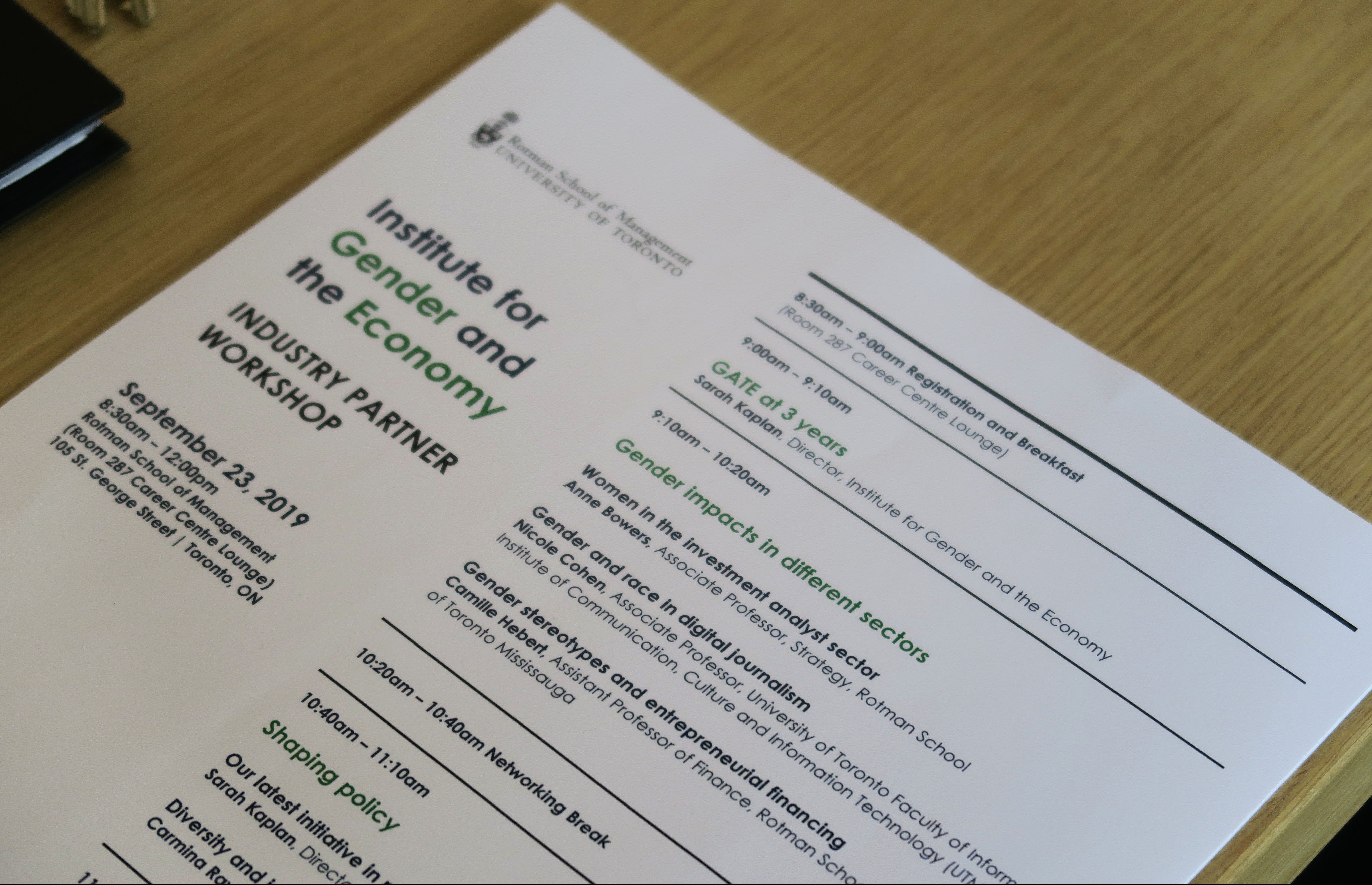
  • Industry Partner Workshop | September 2019

    Industry Partner Workshop | September 2019

    [fusion_builder_container hundred_percent=”no” equal_height_columns=”no” menu_anchor=”” hide_on_mobile=”small-visibility,medium-visibility,large-visibility” class=”” id=”” background_color=”” background_image=”” background_position=”center center” background_repeat=”no-repeat” fade=”no” background_parallax=”none” parallax_speed=”0.3″ video_mp4=”” video_webm=”” video_ogv=”” video_url=”” video_aspect_ratio=”16:9″ video_loop=”yes” video_mute=”yes” overlay_color=”” video_preview_image=”” border_size=”” border_color=”” border_style=”solid” padding_top=”” padding_bottom=”” padding_left=”” padding_right=””][fusion_builder_row][fusion_builder_column type=”1_1″ layout=”1_1″ background_position=”left top” background_color=”” border_size=”” border_color=”” border_style=”solid” border_position=”all” spacing=”yes” background_image=”” background_repeat=”no-repeat” padding_top=”” padding_right=”” padding_bottom=”” padding_left=”” margin_top=”0px” margin_bottom=”0px” class=”” id=”” animation_type=”” animation_speed=”0.3″ animation_direction=”left” hide_on_mobile=”small-visibility,medium-visibility,large-visibility” center_content=”no” last=”no” min_height=”” hover_type=”none” link=””][fusion_text columns=”” column_min_width=”” column_spacing=”” rule_style=”default” rule_size=”” rule_color=”” hide_on_mobile=”small-visibility,medium-visibility,large-visibility” class=”” id=””]

    Let’s change the conversation…

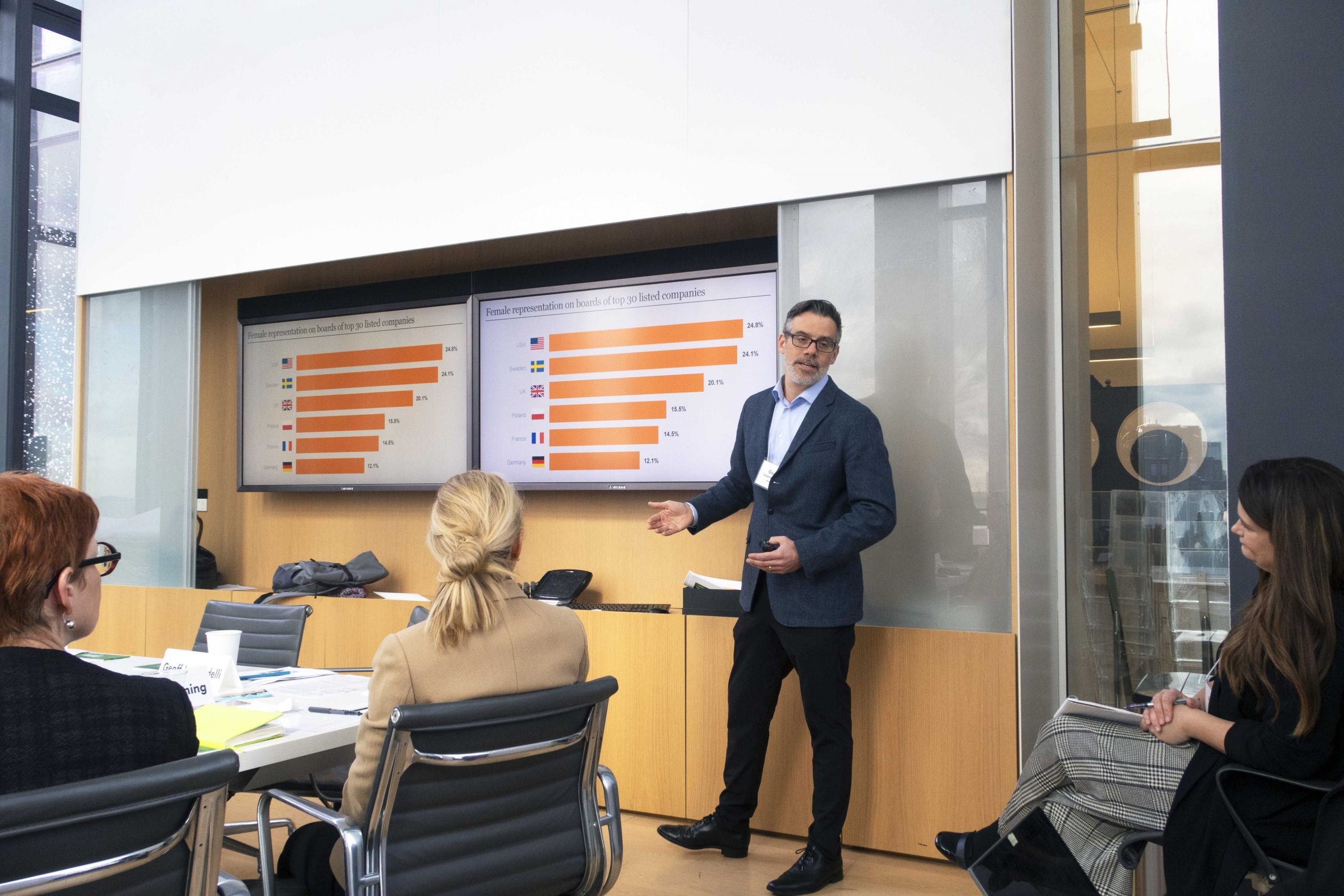
    A distinctive part of an industry partnership with GATE is to engage with university researchers on the cutting-edge topics of the day. Partners get a chance to learn about research in progress before it gets published and engage in dialogue with our researchers. In our fourth Industry Partner Workshop, researchers shared their latest insights on:

    • Women in the investment analyst sector
    • Gender and race in digital journalism
    • Gender stereotypes and entrepreneurial financing
    • Diversity and inclusion in small and medium enterprises

    In an exciting development, we also were able to share collaborative research on de-biasing job postings that we did jointly with one of our industry partners!

    Download key insights from the workshop, and a resource list, here.
    Are you interested in supporting our research as an Industry Partner? Find out more here.

    [/fusion_text][fusion_separator style_type=”none” hide_on_mobile=”small-visibility,medium-visibility,large-visibility” class=”” id=”” sep_color=”” top_margin=”25″ bottom_margin=”25″ border_size=”” icon=”” icon_circle=”” icon_circle_color=”” width=”” alignment=”center” /][fusion_button link=”https://www.gendereconomy.org/past-events/” text_transform=”” title=”” target=”_blank” link_attributes=”” alignment=”” modal=”” hide_on_mobile=”small-visibility,medium-visibility,large-visibility” class=”” id=”” color=”custom” button_gradient_top_color=”#62bd19″ button_gradient_bottom_color=”#62bd19″ button_gradient_top_color_hover=”#00c2e2″ button_gradient_bottom_color_hover=”#00c2e2″ accent_color=”” accent_hover_color=”” type=”” bevel_color=”” border_width=”” size=”” stretch=”yes” shape=”” icon=”” icon_position=”left” icon_divider=”no” animation_type=”” animation_direction=”left” animation_speed=”0.3″ animation_offset=””]See more past events[/fusion_button][fusion_separator style_type=”none” hide_on_mobile=”small-visibility,medium-visibility,large-visibility” class=”” id=”” sep_color=”” top_margin=”20″ bottom_margin=”20″ border_size=”” icon=”” icon_circle=”” icon_circle_color=”” width=”” alignment=”center” /][fusion_title margin_top=”” margin_bottom=”” hide_on_mobile=”medium-visibility,large-visibility” class=”” id=”” size=”5″ content_align=”center” style_type=”default” sep_color=””]

    Or register below for these upcoming events

    [/fusion_title][fusion_recent_posts layout=”default” hover_type=”none” columns=”3″ number_posts=”3″ offset=”0″ pull_by=”category” cat_slug=”events” exclude_cats=”past” tag_slug=”” exclude_tags=”” thumbnail=”yes” title=”yes” meta=”no” meta_author=”no” meta_categories=”no” meta_date=”yes” meta_comments=”yes” meta_tags=”no” content_alignment=”” excerpt=”no” excerpt_length=”35″ strip_html=”yes” scrolling=”no” hide_on_mobile=”medium-visibility,large-visibility” class=”” id=”” animation_type=”” animation_direction=”left” animation_speed=”0.3″ animation_offset=”” /][/fusion_builder_column][/fusion_builder_row][/fusion_builder_container]

  • How women are penalized at work for reporting sexual harassment

    How women are penalized at work for reporting sexual harassment

    [fusion_builder_container admin_label=”” hundred_percent=”no” equal_height_columns=”no” menu_anchor=”” hide_on_mobile=”small-visibility,medium-visibility,large-visibility” class=”” id=”” background_color=”” background_image=”” background_position=”center center” background_repeat=”no-repeat” fade=”no” background_parallax=”none” enable_mobile=”no” parallax_speed=”0.3″ video_mp4=”” video_webm=”” video_ogv=”” video_url=”” video_aspect_ratio=”16:9″ video_loop=”yes” video_mute=”yes” video_preview_image=”” border_color=”” border_style=”solid” margin_top=”20″ margin_bottom=”” padding_top=”” padding_right=”” padding_bottom=”” padding_left=”” type=”legacy”][fusion_builder_row][fusion_builder_column type=”3_4″ layout=”3_4″ spacing=”” center_content=”no” hover_type=”none” link=”” min_height=”” hide_on_mobile=”small-visibility,medium-visibility,large-visibility” class=”” id=”” background_color=”” background_image=”” background_position=”left top” background_repeat=”no-repeat” border_color=”” border_style=”solid” border_position=”all” padding_top=”” padding_right=”” padding_bottom=”” padding_left=”” margin_top=”” margin_bottom=”” animation_type=”” animation_direction=”left” animation_speed=”0.3″ animation_offset=”” last=”false” border_sizes_top=”0″ border_sizes_bottom=”0″ border_sizes_left=”0″ border_sizes_right=”0″ first=”true” spacing_right=””][fusion_text columns=”” column_min_width=”” column_spacing=”” rule_style=”default” rule_size=”” rule_color=”” hide_on_mobile=”small-visibility,medium-visibility,large-visibility” class=”” id=””]

    Summary

    Why does sexual harassment at work often go unreported? This experimental study demonstrates that women are penalized in terms of advancement opportunities when they self-report sexual harassment. Specifically, they are perceived as having insufficient social skills, morality, and warmth, which in turn affects their likelihood of promotion. However, if a coworker reports a woman’s sexual harassment, the woman’s advancement opportunities are not significantly affected. This finding suggests that bystander support means that victims don’t have to manage sexual harassment alone or jeopardize their professional advancement by reporting it. This study also found that bias against women who self-report sexual harassment reduced after the #MeToo movement started, which may suggest that activism can change gender biases and stereotyping.

    Bystander support means that victims don’t have to manage sexual harassment alone or jeopardize their professional advancement by reporting it.

    Research

    This study investigates what may deter women from reporting sexual harassment at work. Prior research has shown that there are common myths about women who report sexual harassment, including that women are fabricating their claims, that they have ulterior motives (e.g. to gain attention or money), that sexual attention is normal or flattering, and that it is the responsibility of the victim to stop harassment. These myths suggest that women who report sexual harassment are violating social norms. Therefore, the author of this study hypothesized that a woman who reports her sexual harassment at work will face normative discrimination: people would perceive her as having poor social and interpersonal qualities, which would then affect her advancement opportunities. On the other hand, having a coworker report the sexual harassment would not have the same effect, because the coworker would dispel the notion that the woman is lying or that the situation is not serious.

    This study consisted of survey experiments with 924 U.S. residents over the age of 18, recruited through Amazon Mechanical Turk. Participants were 50% men, 49.5% women, and 0.5% other genders. Five experiments took place in late 2017 and early 2018, unintentionally coinciding with the beginning of the #MeToo movement. The survey asked participants to imagine they were a manager considering the promotion of a fictional employee named Sarah Carter, and showed them a performance review. The review included one of the four randomly assigned conditions:

    • Sarah experienced nonsexual harassment and reported it herself
    • Sarah experienced nonsexual harassment and a coworker reported it
    • Sarah experienced sexual harassment and reported it herself
    • Sarah experienced sexual harassment and a coworker reported it

    Other than these conditions, the performance reviews were identical. This allowed the author to control for the effect of sexual harassment compared to other types of harassment, as well as the effect of a coworker reporting versus self-reporting. The survey then asked participants to rate their likelihood of promoting Sarah Carter, and to rate her on various traits like competence, morality, warmth, and social skills.

    Findings

    The employee who self-reported sexual harassment faced a significant penalty in terms of promotion opportunity: receiving the lowest likelihood of promotion. On the other hand, the employee whose coworker reported her sexual harassment did not receive a significant penalty. The gender of survey participants did not change this outcome: women were just as likely as men to penalize the employee who self-reported sexual harassment.

    The survey participants also viewed the self-reporting employee as significantly less moral, warm, and socially skilled than the employee whose coworker reported her sexual harassment, which mediated the penalty in promotion opportunity. In other words, participants perceived that the self-reporting employee was violating norms of how women should act, which in turn made them less likely to promote her. The author found that the employee’s perceived morality accounted for 40% of the effect on her promotion likelihood; her perceived warmth accounted for 83% of the effect; and her perceived social skills accounted for 90% of the effect. However, survey participants did not view the employee who self-reported sexual harassment as significantly less competent at her job.

    Participants perceived that the self-reporting employee was violating norms of how women should act, which in turn made them less likely to promote her.

    Notably, although participants exhibited bias against women who self-report sexual harassment at the beginning of the #MeToo movement (October, November, and December 2017), this bias declined over time: the study’s last experiments in January and February 2018 showed no bias. While it cannot be determined whether the #MeToo movement was the cause of the decline, this result may suggest that activism and awareness can affect perceptions of women who self-report sexual harassment.

    Implications

    • Employees should be encouraged to report harassment directed at their colleagues—This study suggests that women who experience sexual harassment face a double bind at work: if they self-report, they will be subject to bias that affects their advancement; if they do not, they have to experience their situation alone. However, if coworkers report women’s sexual harassment, women are not penalized. While this suggests that peer support can help women report without career repercussions, it does not change that women are penalized for speaking out on their own.
    • Organizations can increase awareness to transform bias against women who self-report sexual harassment—Although it is uncertain whether the rise of the #MeToo movement caused a reduction in bias over the five months of the study, it is possible that raised awareness and the media attention on the issue helped change people’s perceptions of women who self-report sexual harassment. This suggests that social activism and organizational awareness can have an important effect on gender bias and stereotyping.
    • Clearer guidelines and tools should be created for bystanders to report sexual harassment—Many employees are unsure of who they should report inappropriate behaviour to, how to do so, and what details should be included in the report. Therefore, organizations should develop effective reporting tools, such as anonymous tip lines, and introduce specific reporting guidelines that detail what information should be reported so that an investigation can be conducted.
    • Employee evaluations and promotions should be checked for bias against employees who self-report harassment—This study found that employees who self-report harassment often face significant penalties in terms of promotion opportunities due to the bias held against them by their fellow employees. In order to mitigate this penalty, those in charge of employee evaluations and promotions should be aware of this potential bias, and ensure any evaluations are based solely on job-related criteria like skill levels and achievements.

    [/fusion_text][fusion_separator style_type=”none” hide_on_mobile=”small-visibility,medium-visibility,large-visibility” class=”” id=”” sep_color=”” top_margin=”20″ bottom_margin=”20″ border_size=”” icon=”” icon_circle=”” icon_circle_color=”” width=”” alignment=”center” /][fusion_button link=”https://www.gendereconomy.org/research-briefs/” text_transform=”” title=”” target=”_blank” link_attributes=”” alignment=”” modal=”” hide_on_mobile=”small-visibility,medium-visibility,large-visibility” class=”” id=”” color=”custom” button_gradient_top_color=”#62bd19″ button_gradient_bottom_color=”#62bd19″ button_gradient_top_color_hover=”#00c2e2″ button_gradient_bottom_color_hover=”#00c2e2″ accent_color=”” accent_hover_color=”” type=”” bevel_color=”” size=”” stretch=”yes” icon=”” icon_position=”left” icon_divider=”no” animation_type=”” animation_direction=”left” animation_speed=”0.3″ animation_offset=””]See more research briefs[/fusion_button][fusion_separator style_type=”none” hide_on_mobile=”small-visibility,medium-visibility,large-visibility” class=”” id=”” sep_color=”” top_margin=”20″ bottom_margin=”20″ border_size=”” icon=”” icon_circle=”” icon_circle_color=”” width=”” alignment=”center” /][fusion_recent_posts layout=”default” hover_type=”none” columns=”3″ number_posts=”3″ offset=”0″ pull_by=”category” cat_slug=”research-briefs” exclude_cats=”” tag_slug=”” exclude_tags=”” thumbnail=”yes” title=”yes” meta=”no” meta_author=”no” meta_categories=”no” meta_date=”yes” meta_comments=”yes” meta_tags=”no” content_alignment=”” excerpt=”no” excerpt_length=”35″ strip_html=”yes” scrolling=”no” hide_on_mobile=”small-visibility,medium-visibility,large-visibility” class=”” id=”” animation_type=”” animation_direction=”left” animation_speed=”0.3″ animation_offset=”” /][/fusion_builder_column][fusion_builder_column type=”1_4″ layout=”1_4″ spacing=”” center_content=”no” hover_type=”none” link=”” min_height=”” hide_on_mobile=”small-visibility,medium-visibility,large-visibility” class=”” id=”” background_color=”” background_image=”” background_position=”left top” background_repeat=”no-repeat” border_color=”” border_style=”solid” border_position=”all” padding_top=”” padding_right=”” padding_bottom=”” padding_left=”” margin_top=”” margin_bottom=”” animation_type=”” animation_direction=”left” animation_speed=”0.3″ animation_offset=”” last=”true” border_sizes_top=”0″ border_sizes_bottom=”0″ border_sizes_left=”0″ border_sizes_right=”0″ first=”false”][fusion_title hide_on_mobile=”small-visibility,medium-visibility,large-visibility” class=”briefsummary” id=”” content_align=”left” size=”3″ font_size=”” line_height=”” letter_spacing=”” margin_top=”” margin_bottom=”” margin_top_mobile=”” margin_bottom_mobile=”” text_color=”” style_type=”none” sep_color=”” margin_top_small=”” margin_bottom_small=””]

    Title

    The Penalties for Self-Reporting Sexual Harassment

    Author

    Chloe Grace Hart

    Source

    Gender & Society

    Published

    2019

    DOI

    10.1177/0891243219842147

    Link

    https://journals.sagepub.com/doi/10.1177/0891243219842147

    Research brief prepared by

    Carmina Ravanera

    [/fusion_title][fusion_widget_area name=”avada-custom-sidebar-researchbriefsidebar” title_size=”” title_color=”” background_color=”” padding_top=”” padding_right=”” padding_bottom=”” padding_left=”” hide_on_mobile=”small-visibility,medium-visibility,large-visibility” class=”” id=”” /][/fusion_builder_column][/fusion_builder_row][/fusion_builder_container]