Tag: Careers+jobs

Research briefs, news, and event recaps related to careers and jobs.

  • Corinne Low on ‘What Data Tells Us About Women’s Lives’

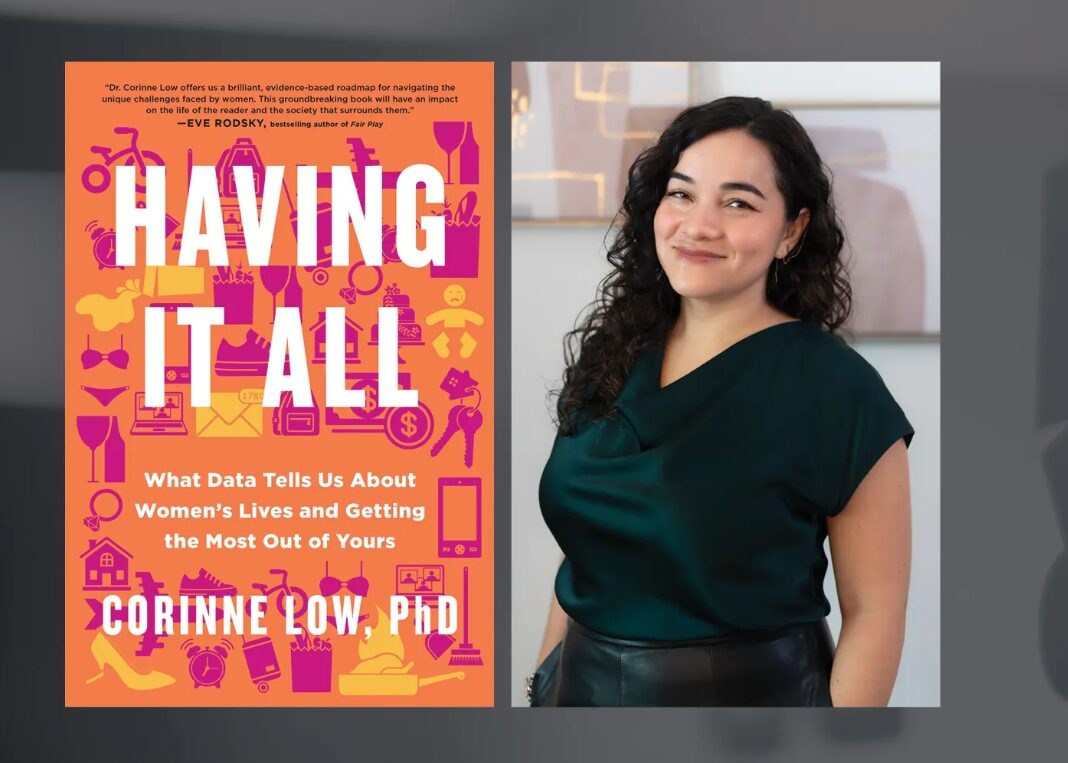
    Corinne Low on ‘What Data Tells Us About Women’s Lives’

    [fusion_builder_container type=”flex” hundred_percent=”no” equal_height_columns=”no” hide_on_mobile=”small-visibility,medium-visibility,large-visibility” background_position=”center center” background_repeat=”no-repeat” fade=”no” background_parallax=”none” parallax_speed=”0.3″ video_aspect_ratio=”16:9″ video_loop=”yes” video_mute=”yes” border_style=”solid”][fusion_builder_row][fusion_builder_column type=”1_1″ layout=”1_1″ background_position=”left top” border_style=”solid” border_position=”all” spacing=”yes” background_repeat=”no-repeat” margin_top=”0px” margin_bottom=”0px” animation_speed=”0.3″ animation_direction=”left” hide_on_mobile=”small-visibility,medium-visibility,large-visibility” center_content=”no” last=”true” hover_type=”none” min_height=”” link=”” background_blend_mode=”overlay” first=”true”][fusion_text]

    IN-PERSON AND VIRTUAL EVENT

    Date: December 2, 2025 at 5:30 PM – 6:30 PM EDT

    In-person location: Desautels Hall, Rotman School of Management, 105 St George Street, Toronto

    Co-presented by: Rotman Events

    Agenda:

    5:30 pm – Author discussion
    6:30 pm – Book signing, meet-and-greet and light refreshments

    Book Synopsis:

    You’re not imagining it: Women aren’t getting a good deal at home or at work. We have the evidence to prove it. This book gives you the power to change it.

    For women in America today, the promise of “having it all” is an ever-elusive carrot. Faced with unsustainable demands in every sphere, we are certainly doing it all—but at a steep cost. Research shows that biologically, culturally, and economically, we are on uneven playing ground, and one that drains us of our happiness. But that same data can empower us to make choices that will reclaim our time, our energy―and even our joy.

    In Having It All, Wharton professor and economist Dr. Corinne Low unpacks the hidden factors that influence women’s decision-making, and how the unintended consequences of these choices alter the course of our lives. From when and whether to get married and (or) have children to what type of career to pursue, whether to obtain an advanced degree to where to live—Dr. Low explores questions such as:

    • What if there is no optimal time to “have a family” but rather a slew of different considerations at different life stages?
    • What if we approached decisions around marriage and partnership as rigorously as we would an employment opportunity?
    • What if we valued our time in dollars and cents, and structured our lives around choices that give us the greatest return on our investments?

    Speaker

    Corinne Low

    Associate Professor of Business Economics and Public Policy, Wharton School, University of Pennsylvania

    Corinne Low is an Associate Professor of Business Economics and Public Policy at the Wharton School of the University of Pennsylvania. Her research focuses on the economics of gender and discrimination and has been published in top journals such as the American Economic Review, Quarterly Journal of Economics, and Journal of Political Economy. She was named one of Poets and Quants 40 MBA Professors under 40 in 2024. Her first book, Having It All, was published in September by Flatiron.

    Corinne and her work have also been featured by major popular media outlets, including Forbes, Vanity Fair, The LA Times, and NPR. Corinne is the co-creator of the Incentivized Resume Rating method for measuring hiring discrimination, and regularly speaks to and works with firms looking to improve their hiring and retention practices. She has spoken to and advised firms like Google, IFM Investors, Uber, Activision Blizzard, and Amazon Web Services, in addition to teaching in Wharton’s Executive Education programs. She has given talks to top academic institutions like Harvard University, Stanford University, and Oxford, as well as to organizations like the New York Federal Reserve, Brookings, and the US Department of Labor. She received her Ph.D. in Economics from Columbia University, her B.S. in Economics and Public Policy from Duke University, and formerly worked for McKinsey and Company. Outside of work, she is the co-founder and volunteer executive director for Open Hearts Initiative, a New York City based non-profit that aims to combat the homelessness crisis through pro-housing neighborhood organizing.

    Moderator

    Sonia Kang

    Professor, Organizational Behaviour and Human Resource Management, Department of Management, University of Toronto- Mississauga,

    Director, Insitute for Gender and the Economy (GATE),

    Canada Research Chair in Identity, Diversity, and Inclusion

    Sonia Kang is a Professor of Organizational Behaviour and Human Resource Management in the Department of Management at the University of Toronto Mississauga and director of the Insitute for Gender and the Economy (GATE). She holds a cross-appointment to the Organizational Behaviour and Human Resource Management area at Rotman. Her research explores the challenges and opportunities of diversity, including strategies for mitigating the far-reaching effects of stigma and harnessing the power of diversity for society and organizations alike. Sonia’s research has been published in journals including the Journal of Personality and Social Psychology, Psychological Science, Administrative Science Quarterly, and the Journal of Experimental Social Psychology, and has been featured in media outlets such as The Globe and Mail and The Atlantic.

    For more information on event logistics and registration, visit the Rotman Events website.

    [/fusion_text][/fusion_builder_column][/fusion_builder_row][/fusion_builder_container]

  • Who gets feedback, who gives it: Gendered patterns in workplace assessments

    Who gets feedback, who gives it: Gendered patterns in workplace assessments

    [fusion_builder_container hundred_percent=”no” equal_height_columns=”no” hide_on_mobile=”small-visibility,medium-visibility,large-visibility” background_position=”center center” background_repeat=”no-repeat” fade=”no” background_parallax=”none” enable_mobile=”no” parallax_speed=”0.3″ video_aspect_ratio=”16:9″ video_loop=”yes” video_mute=”yes” border_style=”solid” margin_top=”20″ type=”legacy”][fusion_builder_row][fusion_builder_column type=”3_4″ layout=”3_4″ center_content=”no” hover_type=”none” hide_on_mobile=”small-visibility,medium-visibility,large-visibility” background_position=”left top” background_repeat=”no-repeat” border_style=”solid” border_position=”all” animation_direction=”left” animation_speed=”0.3″ last=”false” first=”true” border_sizes_top=”0″ border_sizes_bottom=”0″ border_sizes_left=”0″ border_sizes_right=”0″ background_blend_mode=”overlay” min_height=”” link=””][fusion_text hide_on_mobile=”small-visibility,medium-visibility,large-visibility” sticky_display=”normal,sticky” text_transform=”none” animation_direction=”left” animation_speed=”0.3″ animation_delay=”0″]


    Highlights

    • Women are more likely to take on low-promotability tasks that are essential to organizations but often go unrecognized and unrewarded, such as providing detailed feedback.
    • In this study, women supervisors gave more thorough and helpful feedback, yet women supervisees were less likely to receive meaningful evaluations, regardless of their supervisor’s gender.
    • Addressing hidden inequalities in workplace assessments, both in who does the work and who benefits from it, can help create a more equitable workplace.

    Assessments are a ubiquitous part of organizational life. Across industries, performance evaluations play a central role in hiring, promotion, compensation, and dismissal decisions.

    Despite the prevalence and significance of assessments, we know surprisingly little about who performs the work of assessment, how they do it, and with what consequences. In response to this gap, Professor Laura Nelson and her colleagues set out to examine: Who provides feedback in organizations? Who does it well and equitably? And how might assessment practices reinforce or mitigate social inequalities?

    Using real-world behavioral data that includes both numerical ratings and written comments, the authors analyzed 33,456 in-the-moment evaluations of 359 resident physicians by 285 attending physicians in emergency medicine across eight accredited U.S. hospitals over a two-year period (2013–2015). The research team combined qualitative and quantitative methods with machine learning to examine the amount, context, and content of feedback. The analysis reveals important findings about how gender shapes the delivery and quality of workplace assessments and how feedback practices may reproduce or challenge inequality at work.

    Gendered patterns in high-quality, helpful assessments

    The data show that women attendings were more likely to offer motivating and constructive assessments: they not only provided more feedback, but their comments were more often helpful, task-specific, and reassuring. In contrast, men attendings’ assessments tended to be more minimalist. They were more likely to include a numeric evaluation with no written feedback or offer brief comments that are not particularly constructive to either the resident or the training program.

    …women attendings were more likely to offer motivating and constructive assessments: they not only provided more feedback, but their comments were more often helpful, task-specific, and reassuring.

    Despite women attendings being more likely to provide helpful feedback, both women and men attendings demonstrated a positive bias toward men residents. Specifically, men residents were more likely to receive helpful feedback or reassuring comments from both men and women attendings, while women residents were more likely to receive comments only in response to an error. This dynamic creates what the researchers termed “gender double jeopardy in low-promotability tasks,” where although more women in supervisory roles take the time to provide high-quality feedback, women subordinates do not fully benefit from their supervisors’ efforts.

     Encouraging high-quality feedback for all

    Professor Nelson emphasizes that solutions should not focus solely on changing women’s behavior or reducing their contributions. Instead of telling women to “just say no,” organizations should consider how to encourage men, and any others not providing high-quality feedback, to step up and fulfill this crucial role.

    As she explains: “The solution is often, ‘What should women do differently?’… but the takeaway from this is not, ‘How do we fix women? How do we change women?’ Rather, it’s, ‘How do we change the section of men who aren’t giving that good feedback to fulfill this very important role in these organizations? And what organizational structures can we put in place to even it out by bringing the men up to the level of women, rather than bringing women down to the level of men?’”

    “…the takeaway from this is not, ‘How do we fix women?’ … Rather, it’s, ‘How do we change the section of men who aren’t giving that good feedback to fulfill this very important role in these organizations?”

    From this perspective, the study highlights several key implications:

    • Shift away from “just say no” solutions
      Rather than focusing on advice that tells women to “just say no,” these findings underscore the importance of training everyone on how to give effective workplace assessments and avoid letting implicit biases influence evaluations.
    • Distribute assessment labor more evenly
      The data show a stark imbalance where a small number of attendings shoulder the majority of feedback labour: many men and women did not provide great feedback, and a few men and women provided an enormous amount of consistently high-quality feedback. To avoid gaps in support for early-career employees and students, organizations should consider strategies that encourage all supervisors to offer high-quality feedback. This could include offering simple guidelines (e.g., “Attending physicians typically write an average of three sentences referencing two concrete medical tasks in each comment.”)
    • Reward quality, not just quantity
      Incentives or recognition programs should value not only how much feedback someone gives but also the quality and effectiveness of that feedback.
    ______
    Research brief prepared by:

    Kuan Su

    [/fusion_text][fusion_separator style_type=”none” hide_on_mobile=”small-visibility,medium-visibility,large-visibility” top_margin=”20″ bottom_margin=”20″ alignment=”center” /][fusion_button link=”https://www.gendereconomy.org/research-briefs/” target=”_blank” hide_on_mobile=”small-visibility,medium-visibility,large-visibility” color=”custom” button_gradient_top_color=”#62bd19″ button_gradient_bottom_color=”#62bd19″ button_gradient_top_color_hover=”#00c2e2″ button_gradient_bottom_color_hover=”#00c2e2″ stretch=”yes” icon_position=”left” icon_divider=”no” animation_direction=”left” animation_speed=”0.3″]See more research briefs[/fusion_button][fusion_separator style_type=”none” hide_on_mobile=”small-visibility,medium-visibility,large-visibility” top_margin=”20″ bottom_margin=”20″ alignment=”center” /][fusion_recent_posts layout=”default” hover_type=”none” columns=”3″ number_posts=”3″ offset=”0″ pull_by=”category” cat_slug=”research-briefs” thumbnail=”yes” title=”yes” meta=”no” meta_author=”no” meta_categories=”no” meta_date=”yes” meta_comments=”yes” meta_tags=”no” excerpt=”no” excerpt_length=”35″ strip_html=”yes” scrolling=”no” hide_on_mobile=”small-visibility,medium-visibility,large-visibility” animation_direction=”left” animation_speed=”0.3″ /][/fusion_builder_column][fusion_builder_column type=”1_4″ layout=”1_4″ center_content=”no” hover_type=”none” hide_on_mobile=”small-visibility,medium-visibility,large-visibility” background_position=”left top” background_repeat=”no-repeat” border_style=”solid” border_position=”all” animation_direction=”left” animation_speed=”0.3″ last=”true” first=”false” border_sizes_top=”0″ border_sizes_bottom=”0″ border_sizes_left=”0″ border_sizes_right=”0″ background_blend_mode=”overlay” min_height=”” link=””][fusion_title title_type=”text” rotation_effect=”bounceIn” display_time=”1200″ highlight_effect=”circle” loop_animation=”off” highlight_width=”9″ highlight_top_margin=”0″ title_link=”off” link_target=”_self” hide_on_mobile=”small-visibility,medium-visibility,large-visibility” sticky_display=”normal,sticky” class=”briefsummary” content_align=”left” size=”3″ text_shadow=”no” text_shadow_blur=”0″ text_stroke=”no” text_stroke_size=”1″ text_overflow=”none” gradient_font=”no” gradient_start_position=”0″ gradient_end_position=”100″ gradient_type=”linear” radial_direction=”center center” linear_angle=”180″ style_type=”none” animation_direction=”left” animation_speed=”0.3″ animation_delay=”0″]

    Title

    Taking the Time: The Implications of Workplace Assessment for Organizational Gender Inequality

    Author

    Laura K. Nelson, Alexandra Brewer, Anna S. Mueller, Daniel M. O’Connor, Arjun Dayal, and Vineet M. Arora

    Source

    American Sociological Review

    Published

    2023

    Link

    https://journals.sagepub.com/doi/10.1177/00031224231184264

    Research brief prepared by

    Kuan Su

    [/fusion_title][fusion_widget_area name=”avada-custom-sidebar-researchbriefsidebar” hide_on_mobile=”small-visibility,medium-visibility,large-visibility” /][/fusion_builder_column][/fusion_builder_row][/fusion_builder_container]

  • Re-thinking the advice to women to “lean in” and always negotiate

    Re-thinking the advice to women to “lean in” and always negotiate

    [fusion_builder_container hundred_percent=”no” equal_height_columns=”no” hide_on_mobile=”small-visibility,medium-visibility,large-visibility” background_position=”center center” background_repeat=”no-repeat” fade=”no” background_parallax=”none” enable_mobile=”no” parallax_speed=”0.3″ video_aspect_ratio=”16:9″ video_loop=”yes” video_mute=”yes” border_style=”solid” margin_top=”20″ type=”legacy”][fusion_builder_row][fusion_builder_column type=”3_4″ layout=”3_4″ center_content=”no” hover_type=”none” hide_on_mobile=”small-visibility,medium-visibility,large-visibility” background_position=”left top” background_repeat=”no-repeat” border_style=”solid” border_position=”all” animation_direction=”left” animation_speed=”0.3″ last=”false” first=”true” border_sizes_top=”0″ border_sizes_bottom=”0″ border_sizes_left=”0″ border_sizes_right=”0″ background_blend_mode=”overlay” min_height=”” link=””][fusion_text hide_on_mobile=”small-visibility,medium-visibility,large-visibility” sticky_display=”normal,sticky” text_transform=”none” animation_direction=”left” animation_speed=”0.3″ animation_delay=”0″]


    Highlights

    • Women are skilled at choosing when to negotiate and succeed in gaining more 74% of the time when they decide to negotiate.
    • Forcing women to negotiate in all situations leads to worse outcomes, with financial losses tripling compared to when they have a choice.
    • Both men and women benefit from deciding when to negotiate, but societal pressure disproportionately pushes women to negotiate more often, even when it may not be beneficial.

    With the recent passing of Lilly Ledbetter, the legendary advocate for gender-wage equality, it is timely to revisit our assumptions about how to close the gender wage gap. Many believe that women should negotiate more often—the “lean in” movement, for example, advises women to ask for more during salary negotiations. But is negotiating more always the best approach for women?

    Women know when to negotiate

    A study by Christine Exley, Muriel Niederle, and Lise Vesterlund found that women are skilled at recognizing when negotiating will benefit them. The researchers conducted a series of controlled experiments where participants could either choose to negotiate or were forced to negotiate, which allowed them to observe decision-making processes and outcomes. When given a choice, women enter negotiations that lead to positive financial outcomes. In fact, the study found that when women choose to negotiate, they end up with a better deal 74% of the time. This means that women are good at selecting opportunities where negotiation pays off, and they generally avoid situations that are likely to lead to losses.

    However, when women are forced to negotiate in all situations, the outcomes are notably worse. As Christine Exley explains, “Negotiations can lead to better outcomes, but unnecessary ones are costly. They can also leave women feeling pressured to negotiate while worrying about overdoing it.”

    The data backs this up: losses triple when women are required to negotiate in unfavorable circumstances. Indeed, more negotiations do not necessarily lead to better results—sometimes, they do the opposite. Forcing women to negotiate in every scenario strips them of their ability to exercise sound judgment about when negotiations will work in their favor.

    When women choose to negotiate, they end up with a better deal 74% of the time.

    How do men compare?

    The findings further suggest that men and women are equally capable of recognizing when a negotiation is worth entering. Like women, men also experience more financial losses when they are pushed to negotiate in all situations.

    Importantly, the study found no evidence that men are inherently better at negotiating or at identifying good opportunities for negotiation compared to women. Both genders benefit when they have the freedom to decide when to negotiate, and both experience increased risks when they are forced to negotiate without considering the context.

    Still, there is greater pressure on women to negotiate than on men

    Despite evidence that women know when to enter win-worthy negotiations, society tends to put more pressure on them than on men to negotiate. A follow-up experiment revealed a stronger expectation among people that women should not be allowed to avoid negotiations—even when it might not be the best choice for them—while men were given more flexibility. This shows a tendency to push women into actions that aren’t necessarily in their best interest, a phenomenon that the researchers call the paternalistic demand.

    This pressure to negotiate puts women in a double bind: If they follow their own judgment and avoid negotiations in unfavorable situations, they are criticized for not being assertive enough. But when they are pushed into negotiating in all situations and things go badly, they can end up losing money and even damaging their reputation at work.

    Where do we go next?

    These findings offer several actionable insights for organizational leaders and HR managers:

    1. Avoid blanket advice for women to negotiate more: The data show that women are already skilled at knowing when to enter negotiations. Encouraging all employees to negotiate in all situations, regardless of potential outcomes, can lead to financial losses and heightened stress, particularly for women.
    2. Support a choice-driven approach: Rather than pushing for more frequent negotiations, organizations should focus on creating a work environment where employees feel empowered to choose when negotiation is appropriate. Transparency in salary ranges, clear criteria for promotions, and open channels for discussing growth can enable employees to make informed choices about negotiation.
    3. Challenge gendered expectations around negotiation. Leaders should recognize that women face unique pressures to negotiate more often due to societal biases. It’s important to challenge stereotypes and avoid creating additional pressures on women to negotiate more when it may not be in their best interest. Removing the pressure to “lean in” at every opportunity can help reduce unnecessary stress and lead to better outcomes.

    The notion that women should “lean in” and negotiate more frequently overlooks important nuances in negotiation dynamics that women are apparently already aware of. Instead of uniformly pushing women to always negotiate, organizations should create fair and supportive structures where all employees can freely choose to negotiate when it makes sense for them.

    As for employees themselves who feel pressured to negotiate despite their instincts suggesting otherwise, Exley offers a reassuring reminder: “While learning negotiation tactics is valuable, both women and men should know that the idea to ‘always negotiate’ is misguided. The situation matters, and your preferences matter too.”

    “…the idea to ‘always negotiate’ is misguided. The situation matters, and your preferences matter too,”

    ______
    Research brief prepared by:

    Alice Choe

    [/fusion_text][fusion_separator style_type=”none” hide_on_mobile=”small-visibility,medium-visibility,large-visibility” top_margin=”20″ bottom_margin=”20″ alignment=”center” /][fusion_button link=”https://www.gendereconomy.org/research-briefs/” target=”_blank” hide_on_mobile=”small-visibility,medium-visibility,large-visibility” color=”custom” button_gradient_top_color=”#62bd19″ button_gradient_bottom_color=”#62bd19″ button_gradient_top_color_hover=”#00c2e2″ button_gradient_bottom_color_hover=”#00c2e2″ stretch=”yes” icon_position=”left” icon_divider=”no” animation_direction=”left” animation_speed=”0.3″]See more research briefs[/fusion_button][fusion_separator style_type=”none” hide_on_mobile=”small-visibility,medium-visibility,large-visibility” top_margin=”20″ bottom_margin=”20″ alignment=”center” /][fusion_recent_posts layout=”default” hover_type=”none” columns=”3″ number_posts=”3″ offset=”0″ pull_by=”category” cat_slug=”research-briefs” thumbnail=”yes” title=”yes” meta=”no” meta_author=”no” meta_categories=”no” meta_date=”yes” meta_comments=”yes” meta_tags=”no” excerpt=”no” excerpt_length=”35″ strip_html=”yes” scrolling=”no” hide_on_mobile=”small-visibility,medium-visibility,large-visibility” animation_direction=”left” animation_speed=”0.3″ /][/fusion_builder_column][fusion_builder_column type=”1_4″ layout=”1_4″ center_content=”no” hover_type=”none” hide_on_mobile=”small-visibility,medium-visibility,large-visibility” background_position=”left top” background_repeat=”no-repeat” border_style=”solid” border_position=”all” animation_direction=”left” animation_speed=”0.3″ last=”true” first=”false” border_sizes_top=”0″ border_sizes_bottom=”0″ border_sizes_left=”0″ border_sizes_right=”0″ background_blend_mode=”overlay” min_height=”” link=””][fusion_title title_type=”text” rotation_effect=”bounceIn” display_time=”1200″ highlight_effect=”circle” loop_animation=”off” highlight_width=”9″ highlight_top_margin=”0″ title_link=”off” link_target=”_self” hide_on_mobile=”small-visibility,medium-visibility,large-visibility” sticky_display=”normal,sticky” class=”briefsummary” content_align=”left” size=”3″ text_shadow=”no” text_shadow_blur=”0″ text_stroke=”no” text_stroke_size=”1″ text_overflow=”none” gradient_font=”no” gradient_start_position=”0″ gradient_end_position=”100″ gradient_type=”linear” radial_direction=”center center” linear_angle=”180″ style_type=”none” animation_direction=”left” animation_speed=”0.3″ animation_delay=”0″]

    Title

    Knowing When to Ask: The Cost of Leaning In

    Author

    Christine Exley, Muriel Niederle, and Lise Vesterlund

    Source

    Journal of Political Economy

    Published

    2020

    Link

    https://doi.org/10.1086/704616

    Research brief prepared by

    Alice Choe

    [/fusion_title][fusion_widget_area name=”avada-custom-sidebar-researchbriefsidebar” hide_on_mobile=”small-visibility,medium-visibility,large-visibility” /][/fusion_builder_column][/fusion_builder_row][/fusion_builder_container]

  • Freshco: Redefining the Blue-Collar Sector

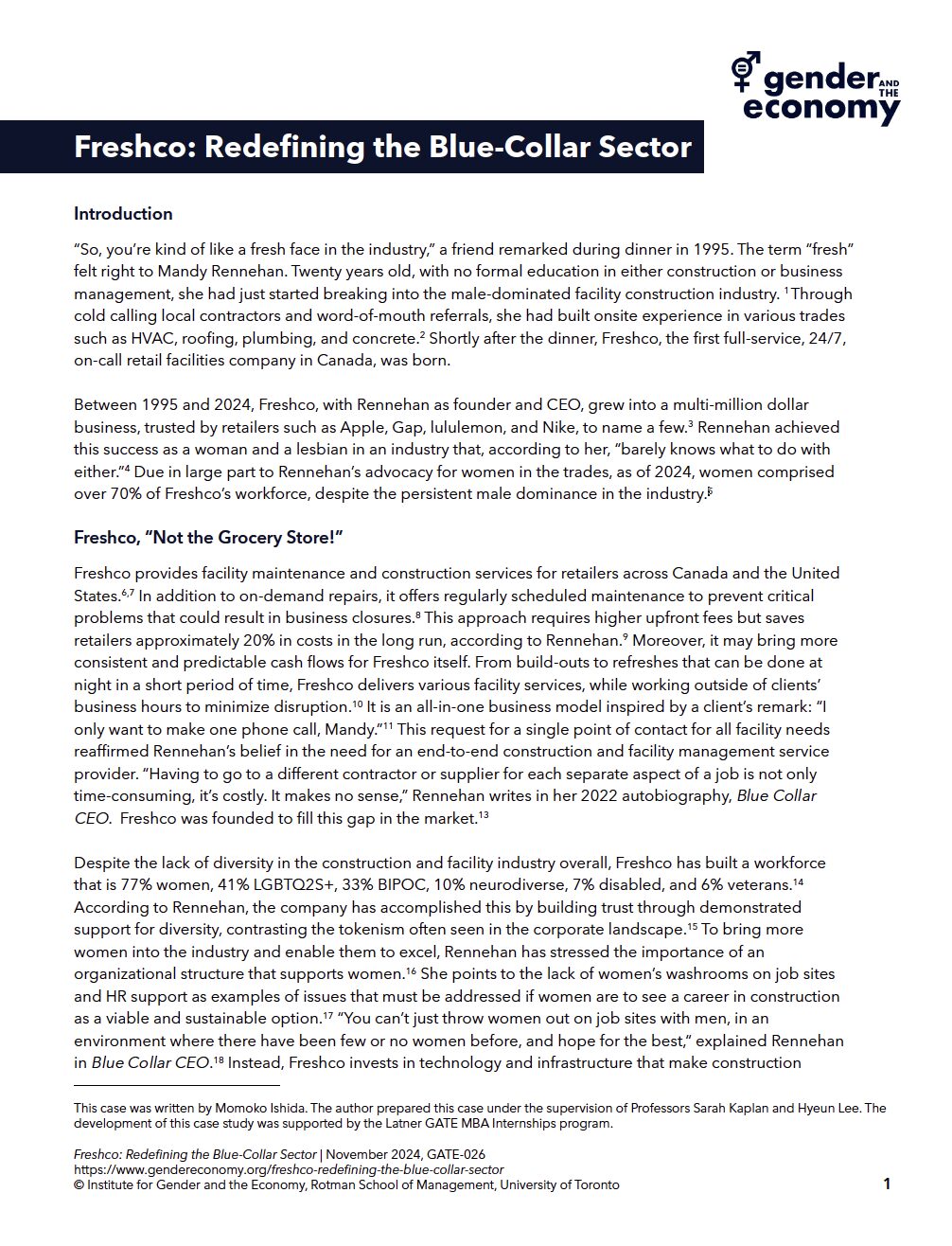
    Freshco: Redefining the Blue-Collar Sector


    Introduction

     “So, you’re kind of like a fresh face in the industry,” a friend remarked during dinner in 1995. The term “fresh” felt right to Mandy Rennehan. Twenty years old, with no formal education in either construction or business management, she had just started breaking into the male-dominated facility construction industry. Through cold calling local contractors and word-of-mouth referrals, she had built onsite experience in various trades such as HVAC, roofing, plumbing, and concrete. Shortly after the dinner, Freshco, the first full-service, 24/7, on-call retail facilities company in Canada, was born.

    Between 1995 and 2024, Freshco, with Rennehan as founder and CEO, grew into a multi-million dollar business, trusted by retailers such as Apple, Gap, lululemon, and Nike, to name a few. Rennehan achieved this success as a woman and a lesbian in an industry that, according to her, “barely knows what to do with either.” Due in large part to Rennehan’s advocacy for women in the trades, as of 2024, women comprised over 70% of Freshco’s workforce, despite the persistent male dominance in the industry.

    TO VIEW AND DOWNLOAD THE FULL CASE STUDY, FOLLOW THESE INSTRUCTIONS.

     This case was written by Momoko Ishida. The author prepared this case under the supervision of Professors Sarah Kaplan and Hyeun Lee.

    The development of this case study was supported by the Latner GATE MBA Internships program.