Tag: Gender analysis+budgeting

Research briefs, news, and event recaps related to gender analysis and budgeting.

  • Sarah Kaplan appears before Standing Senate Committee on Social Affairs, Science and Technology

    Sarah Kaplan appears before Standing Senate Committee on Social Affairs, Science and Technology

    On September 28, 2022, Sarah Kaplan was invited to speak before the Standing Senate Committee on Social Affairs, Science and Technology regarding the role of gender-based analysis plus in the policy process.

    You can watch her full testimony, or read her opening remarks here or down below. Read the report, The Role of Gender-based Analysis Plus in the Policy Process.

    Testimony before Standing Senate Committee on Social Affairs, Science and Technology

    Good afternoon.

    It is an honor to appear before this Committee to comment on the role of gender-based analysis plus in the policy process.

    I am a Professor and Director of the Institute for Gender and the Economy at the University of Toronto’s Rotman School of Management. In this role, I promote the use of rigorous academic research to inform policy and practice. To prepare for this testimony, I reviewed the scholarly literature as well as government audits and reports on GBA+.

    I would like to start by emphasizing that the introduction of GBA+ into government policy analysis has been an essential step forward in assuring that policies, regulations and programs are advancing greater equity in Canadian society which has been further reinforced by the Canadian Gender Budgeting Act and the Gender Results Framework introduced in the 2018 Budget. Canadians can be proud that intersectional gender-based analysis is recognized by the Canadian government as a key competency in support of the development of effective programs and policies.

    The promise of GBA+ is that it can not only measure and evaluate policy impacts but also inform policy priorities, shape policy and program design, and guide implementation. Yet, despite considered attention to GBA+, there continue to be opportunities for improvement as it has yet to achieve its promise.

    My review of the literature and audits suggests that although GBA+ is supposed to be used across all government departments and agencies, it is inconsistently applied (with 40% of departments not having a formal GBA+ policy), and often used only late in policy design and evaluation. Only 39% of departments perform it at the critical problem definition stage more than 60% of the time. By only applying GBA+ late in the process, policy makers miss out on opportunities to use intersectional gender-based insights to identify policy priorities and shape policy design. Instead, GBA+ tends to be used to identify impacts after the priorities and policies are established and then to suggest some incremental modifications around the margins that could mitigate gendered, racial or other impacts. Thus, the true potential of GBA+ is missed.

    Why might this be?

    First, the staff charged with GBA+ may not have the skills or the time to use GBA+ in the most appropriate ways, and there is a lack of oversight and engagement by senior staff. While the government and the Canadian College have augmented training, tools and guidance since 2015, the capacity of departments to do GBA+ has still remained a challenge. Much of the training is focused on the technical and administrative processes for GBA+ such as how to fill out the appropriate forms for budget submissions but not on how to engage in GBA+ for policy prioritization and design. At the Institute for Gender and the Economy, we conducted a stakeholder analysis associated with the development of our own Gender Analytics training program and found that many people within the government did not have the knowledge about how to undertake GBA+.

    Second, some of the challenge in assuring effective GBA+ is in the lack of quantified data. The collection of disaggregated data on diverse groups has been slow. However, getting better quantitative data will not automatically lead to better policy. Scholars who have studied GBA+ have pointed out that the current implementation of GBA+ does not include a process for a critical reading of policy or a consideration of how problems are defined. A focus only on numbers may divert attention from consultations with and support of feminist, community, Indigenous and social justice organizations who have originated—and are keepers of—GBA+ knowledge. It risks turning GBA+ into a seemingly “neutral” and bureaucratic methodology without recognizing the ways that power is embedded in the process.

    Third, intersectionality is not yet effectively applied. The “plus” focuses on adding race or income or disability or Indigeneity to gender rather than considering them simultaneously to understand the ways policy impacts (either negative or positive) can be amplified or dampened because of these intersections. Further, gender is often treated as a binary without recognizing the diversity of gender in nonbinary, Two-Spirit, intersex and transgender peoples.

    So, what could be done to improve? Some recommendations that come from this overview include:

    First, reframing GBA+ as central to policy and program planning rather than an add on requirement and monitoring departments and agencies in their appropriate use of GBA+, including making sure the “plus” of intersectionality is foregrounded.

    Second, building capacity in GBA+ including at the most senior levels, not just in service of administrative procedures for completing budget submissions but in how to use GBA+ to set priorities, question assumptions, design policies and programs, and monitor impact.

    Third, engaging more deeply with—and financially supporting—grassroots and academic organizations that hold GBA+ knowledge, involving them in both data collection and the co- design of policies and programs.

    Finally, investing in better collection of intersectional data through Statistics Canada and other mechanisms, while at the same time recognizing that quantified data is not the only important input to a good GBA+ analysis.

    In conclusion, GBA+ holds great promise, but it will be least effective if it is only used as a policy evaluation tool. Its true power will come when the insights generated lead to innovative policies that can overcome many of the impasses faced by efforts to achieve greater equity in society to date.

    Thank you very much. Merci beaucoup.

  • Gender-based analysis as a turnaround strategy at McCarthy Uniforms

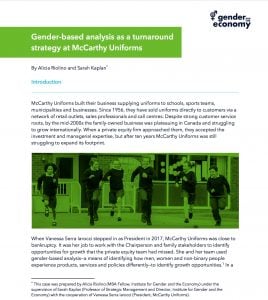
    Gender-based analysis as a turnaround strategy at McCarthy Uniforms

    [fusion_builder_container hundred_percent=”no” equal_height_columns=”no” menu_anchor=”” hide_on_mobile=”small-visibility,medium-visibility,large-visibility” class=”” id=”” background_color=”” background_image=”” background_position=”center center” background_repeat=”no-repeat” fade=”no” background_parallax=”none” parallax_speed=”0.3″ video_mp4=”” video_webm=”” video_ogv=”” video_url=”” video_aspect_ratio=”16:9″ video_loop=”yes” video_mute=”yes” overlay_color=”” video_preview_image=”” border_size=”” border_color=”” border_style=”solid” padding_top=”” padding_bottom=”” padding_left=”” padding_right=””][fusion_builder_row][fusion_builder_column type=”1_1″ layout=”1_1″ background_position=”left top” background_color=”” border_size=”” border_color=”” border_style=”solid” border_position=”all” spacing=”yes” background_image=”” background_repeat=”no-repeat” padding_top=”” padding_right=”” padding_bottom=”” padding_left=”” margin_top=”0px” margin_bottom=”0px” class=”” id=”” animation_type=”” animation_speed=”0.3″ animation_direction=”left” hide_on_mobile=”small-visibility,medium-visibility,large-visibility” center_content=”no” last=”no” min_height=”” hover_type=”none” link=””][fusion_text columns=”” column_min_width=”” column_spacing=”” rule_style=”default” rule_size=”” rule_color=”” hide_on_mobile=”small-visibility,medium-visibility,large-visibility” class=”” id=””]

    Overview

    Written by Alicia Riolino and Sarah Kaplan, Institute for Gender and the Economy

    McCarthy Uniforms is a uniform supplier to schools, sports teams, municipalities, and businesses headquartered in Canada. This case study focuses specifically on how the current President, Vanessa Serra Iarocci, and her team used gender-based analysis to identify growth opportunities in order to save McCarthy Uniforms from bankruptcy between 2017 and 2019.

    This case would be useful for those interested in or teaching courses in:
    • Gender-based analysis
    • Strategic management
    • Leadership
    • Change management

    Introduction

    McCarthy Uniforms built their business supplying uniforms to schools, sports teams, municipalities and businesses. Since 1956, they have sold uniforms directly to customers via a network of retail outlets, sales professionals and call centres. Despite strong customer service roots, by the mid-2000s the family-owned business was plateauing in Canada and struggling to grow internationally. When a private equity firm approached them, they accepted the investment and managerial expertise, but after ten years McCarthy Uniforms was still struggling to expand its footprint.

    When Vanessa Serra Iarocci stepped in as President in 2017, McCarthy Uniforms was close to bankruptcy. It was her job to work with the Chairperson and family stakeholders to identify opportunities for growth that the private equity team had missed. She and her team used gender-based analysis—a means of identifying how men, women and non-binary people experience products, services and policies differently—to identify growth opportunities. In a short time, they spotted opportunities to innovate on their service delivery and product offering, as well as to market McCarthy Uniforms’ existing gender-friendly practices.

    Since 2017, the solutions identified through gender-based analysis have supported double-digit revenue growth at McCarthy Uniforms by identifying opportunities for innovation within a mature industry and finding ways to grow without compromising service, quality or sustainability.

    To view and download the full case study, follow these instructions.

    [/fusion_text][/fusion_builder_column][/fusion_builder_row][/fusion_builder_container]

  • Sarah Kaplan appears before the Senate Standing Committee on National Finance

    Sarah Kaplan appears before the Senate Standing Committee on National Finance

    Sarah Kaplan was invited to speak before the Senate Standing Committee on National Finance regarding Bill C-86 on December 05, 2018.

    Bill C-86 is the second Budget Implementation Act for Budget 2018 and includes several measures to increase women’s participation in the workforce (e.g. the Employment Insurance Parental Sharing Benefit), assure pay equity in federally regulated workplaces, and promote gender budgeting. Bill C-86 also establishes the Department for Women and Gender Equality (WAGE), previously known as Status of Women Canada.

    You can download the full testimony here, as well as read it below. If you’d like to watch the meeting in full, including Sarah Kaplan’s testimony, click here.


    Testimony before Senate Standing Committee on National Finance regarding Bill C-86

    Good evening.

    It is an honor to appear before this Committee to comment on Bill C-86, as it relates to the creation of the Department for Women and Gender Equality.

    I am a Professor and Director of the Institute for Gender and the Economy at the University of Toronto. In this role, I promote the use of rigorous academic research to inform policy and practice, with a specific goal of supporting innovative new solutions to achieving gender equality.

    There are a number of reasons that the creation of this Department will yield progress on equality in Canadian society.

    First, it announces and anchors equality as a central value for Canadians. Its name signals its focus on women and also people of diverse genders, including two-spirit, gender nonbinary and trans people. It further signals attention to men and masculinities. As we have learned from recent efforts to improve parental leave policies, it is vital to pay attention to facilitating new norms of masculinity that can transform caregiving and paid work for men, women, and people of diverse genders.

    Relatedly, I would also like to call to your attention the importance of the section under “powers and duties” which includes understanding “the intersection of sex and gender with other identity factors that include race, national and ethnic origin, Indigenous origin or identify, age, sexual orientation, socio-economic conditions, place of residence and disability.” That the department would have this mandate to put intersectionality front and centre is essential for the pursuit of equality because we know that most barriers to full participation in all spheres of peoples’ lives come precisely at these points of intersection.

    Second, appropriately funded and resourced, the department can serve as a centre of excellence for capabilities in gender analysis and policy-making. While some form of gender analysis has been mandated since 1995 at the Federal level, we still lack essential capabilities for conducting and using these analyses — and this is at the Federal, Provincial and local levels of government as well as in the corporate and non-profit spheres. Gender analysis at its best should be used for three interrelated sets of activities: (1) qualitative and quantitative need finding, (2) policy design and implementation, and (3) policy evaluation. To date, most of the efforts have been placed on the third step: we formulate a policy and then see what the gender effects might be, perhaps implementing remedial steps to try to fix any adverse impacts. And, I worry that even this third step may not be conducted at a sufficient level of depth, with the right level of research and analysis, especially including the intersections I mentioned above.

    Take for example, the Innovation Superclusters Initiative which, in its own program guide, admitted that it will be investing in industries that “attract more skilled workers who are men compared to women.” It indicated that, to address this problem, applicants must “articulate how they will endeavor to increase female representation concerning both employment and leadership.” However, if we were to have started with a gender analysis, we might have designed a supercluster initiative that had inclusive innovation at its base rather than as an additional consideration. We don’t even know what kinds of models we might be able to invent if we used gender analysis for innovative policy design rather than for remediation.

    Thus, using gender analysis from the outset might have the potential to change and improve policy design. For example, in infrastructure investment, we know that investments in local-stop public transportation differentially benefit women and children while investments in highways differentially benefit men who tend to drive and commute longer distances. Or, a true analysis of the impacts of maternity leave would have shown that extension of such leaves to 18 months is a poor substitute for more accessible childcare and can do serious damage to women’s attachment to the labour force. Such information should shape choices about how policies, budgets and taxes are decided.

    The Department has the opportunity to develop gender analysis capabilities and support other departments and agencies in meeting their mandate to do true gender budgeting. This will strengthen the national capacity to advance gender equality in all of its intersections. But, capability development takes time. It requires sustained investment and an accumulation of data, research and experience over years. It requires support for an ecosystem of government bodies, grassroots organizations and business. Creating a department assures that this accumulation process cannot be interrupted or set back—as it has been in the past—without the significant public debate that comes with the legislative process.

    Third, again with adequate funding and resources, the Department can also be a source of policy innovation based on the gender analysis it will conduct and support. Gender analysis, as I mentioned before, will be least effective it is only used as a policy evaluation tool. Its true power will come when the insights generated lead to innovative policies that overcome many of the impasses faced by efforts to achieve gender equality to date. For example, today we worry that not enough women enter into entrepreneurship, so we layer on special pools of funds to the Business Development Bank for female entrepreneurs. But, what if we used research and analysis to develop new, inclusive models for promoting entrepreneurship that might help the BDC reinvent entirely how it works? We cannot know without the careful work of a Department dedicated to making the most of research and analysis on current inequalities and also on key mechanisms for overcoming them.

    In conclusion, on a personal note, and speaking as an immigrant to Canada, I can say that Canada today has the opportunity to be a global beacon of light when it comes to gender equality. The creation of a Department of Women and Gender Equality can be a powerful symbol of Canada’s commitment to these issues and a source of innovation and insight for Canada and the world as we continue to work towards equality.

    I am at your disposal to answer any questions.

    Thank you very much. Merci beaucoup.


    Did you like this? Sign up for our monthly newsletter here for more research and insights.
  • Doing gender analysis: A case study of Root Capital’s Women in Agriculture Initiative

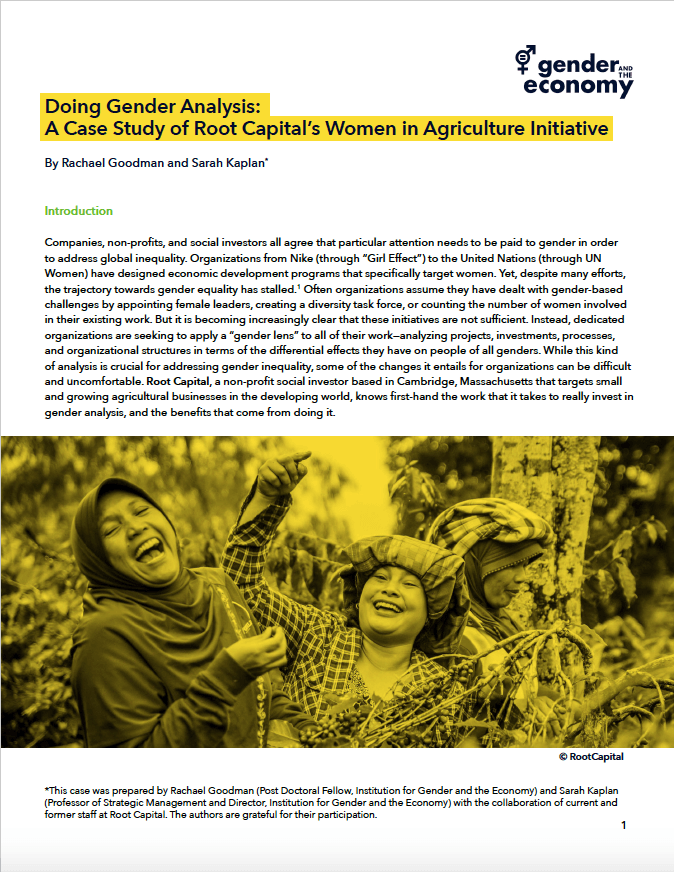
    Doing gender analysis: A case study of Root Capital’s Women in Agriculture Initiative

    Overview

    Written by Rachael Goodman and Sarah Kaplan, Institute for Gender and the Economy

    Root Capital is a social enterprise that invests in agricultural businesses in developing economies to bring them into the formal economy and develop their capabilities. This case study focuses specifically on Root Capital’s Women in Agriculture Initiative in order to examine how a gender analysis of their activities improved their impact. It provides clear examples of gender analysis at work, how it is done and the organizational implications of doing it.

    This case would be useful for those interested in or teaching courses in:
    • Gender analysis in the business context
    • Social enterprise
    • Economic development
    • Agricultural economics
    • Social impact
    • Women’s empowerment

    Introduction

    Companies, non-profits, and social investors all agree that particular attention needs to be paid to gender in order to address global inequality. Organizations from Nike (through “Girl Effect”) to the United Nations (through UN Women) have designed economic development programs that specifically target women. Yet, despite many efforts, the trajectory towards gender equality has stalled. Often organizations assume they have dealt with gender-based challenges by appointing female leaders, creating a diversity task force, or counting the number of women involved in their existing work. But it is becoming increasingly clear that these initiatives are not sufficient. Instead, dedicated organizations are seeking to apply a “gender lens” to all of their work—analyzing projects, investments, processes, and organizational structures in terms of the differential effects they have on people of all genders. While this kind of analysis is crucial for addressing gender inequality, some of the changes it entails for organizations can be difficult and uncomfortable. Root Capital, a non-profit social investor based in Cambridge, Massachusetts that targets small and growing agricultural businesses in the developing world, knows first-hand the work that it takes to really invest in gender analysis, and the benefits that come from doing it.


    To view and download the full case study, follow these instructions.
  • The Brief: How can gender budgeting promote equality?

    The Brief: How can gender budgeting promote equality?

    In Canada, the current federal government has put forth for the first time a “gender equality budget.” But, what is gender budgeting? It is a way for governments and non-governmental organizations to promote gender equality using administrative and fiscal policy by assessing the differing needs people of different genders, designing policies to remedy them and subsequently testing to see if the policies had their intended impacts.

    Gender budgeting should not just be about equally distributing government spending to men and women.

    To implement policy changes, gender budgeting analysis takes into account a range of identity factors such as age, education, language, ethnic backgrounds, geography, culture and income. By placing an emphasis on these intersectional factors, gender budgeting can create and inform better decision making that can improve conditions for women as well as other marginalized peoples.

    This explainer is based on a workshop on gender budgeting hosted by the Institute for Gender and the Economy (GATE) in 2016.

    View the full research brief here.

    Did you like this video? Follow us on Twitter, LinkedIn, and Youtube for more, and sign up for our monthly newsletter.
  • GATE hosts pre-budget consultation on gender impacts with Minister Morneau

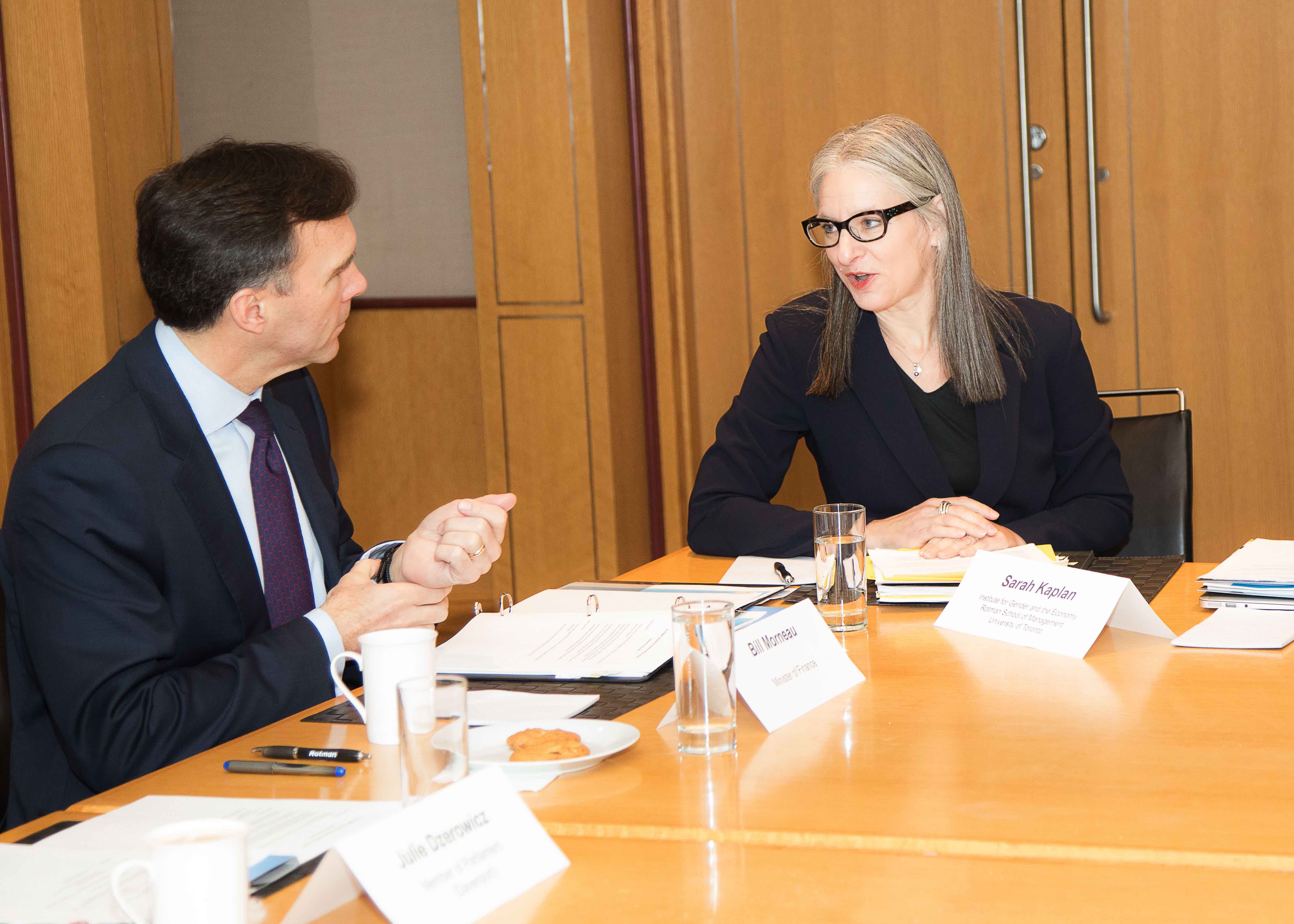
    GATE hosts pre-budget consultation on gender impacts with Minister Morneau

    On November 23, 2017, Professor Sarah Kaplan, Director of GATE, hosted a pre-budget consultation on gender impacts with Finance Bill Minister Morneau. We were joined by Julie Dzerowicz, MP from Davenport, and Chair of the Woman’s Caucus sub-committee looking at how to increase women’s participation in the workforce, as well as a group of more than 20 gender experts from academia and NGO’s. We had a lively discussion covering parental leave, women’s entrepreneurship, representation of women in top decision making positions, housing, pensions, support for women’s organizations, healthcare, moving beyond the gender binary, and recognition the many intersections between gender, race, ethnicity, class, age, and ability.


    Other attendees included:

    • Kate Bezanson, ‎Chair and Associate Professor, Department of Sociology, Brock University
    • Clément Chartier, President, Métis National Council
    • Susan Christoffersen, Professor and Vice-Dean, Undergraduate and Specialized Programs, Rotman School of Management, University of Toronto
    • Grace-Edward Galabuzi, Associate Professor, Department of Politics and Public Administration, Ryerson University
    • Helen Kennedy, Executive Director, Egale Canada Human Rights Trust
    • Janet Kranz, Co-Lead, Women’s Economic Council Collective and member of the Canadian CED Network’s People-Centred Economy Group
    • Kate McInturff, Senior Researcher, Canadian Centre for Policy Alternatives
    • Jessica Mustachi, Ontario Coordinator, Campaign 2000, Family Service Toronto
    • Lisa Philipps, Interim Vice-President Academic & Provost and Professor, Osgoode Hall Law School, York University
    • Aldeli Albán Reyna, Senior Advocacy and Public Policy Coordinator, YWCA Canada
    • Laurel Rothman, Interim Coordinator, Public Policy and Government Relations, Ontario Coalition for Better Child Care
    • Maya Roy, CEO, YWCA Canada
    • Diana Sarosi, Manager of Policy, Oxfam Canada
  • Gender budgeting: A tool for achieving equality

    Gender budgeting: A tool for achieving equality

    [fusion_builder_container admin_label=”” hundred_percent=”no” equal_height_columns=”no” menu_anchor=”” hide_on_mobile=”small-visibility,medium-visibility,large-visibility” class=”” id=”” background_color=”” background_image=”” background_position=”center center” background_repeat=”no-repeat” fade=”no” background_parallax=”none” enable_mobile=”no” parallax_speed=”0.3″ video_mp4=”” video_webm=”” video_ogv=”” video_url=”” video_aspect_ratio=”16:9″ video_loop=”yes” video_mute=”yes” video_preview_image=”” border_size=”” border_color=”” border_style=”solid” margin_top=”20″ margin_bottom=”” padding_top=”” padding_right=”” padding_bottom=”” padding_left=””][fusion_builder_row][fusion_builder_column type=”3_4″ layout=”3_4″ spacing=”” center_content=”no” hover_type=”none” link=”” min_height=”” hide_on_mobile=”small-visibility,medium-visibility,large-visibility” class=”” id=”” background_color=”” background_image=”” background_position=”left top” background_repeat=”no-repeat” border_size=”0″ border_color=”” border_style=”solid” border_position=”all” padding_top=”” padding_right=”” padding_bottom=”” padding_left=”” margin_top=”” margin_bottom=”” animation_type=”” animation_direction=”left” animation_speed=”0.3″ animation_offset=”” last=”no”][fusion_text columns=”” column_min_width=”” column_spacing=”” rule_style=”default” rule_size=”” rule_color=”” class=”” id=””]

    Download the infographic.  View the video explainer.

    In a context of widening social and economic inequalities, governments can use budgets as tools to achieve social justice objectives concurrently with economic objectives. “Gender budgeting” is one such approach and was the topic of an April 2017 discussion and debate at a workshop co-hosted by the Gender Budget Lab @ York and the Rotman School of Management’s Institute for Gender and the Economy at the University of Toronto. The event featured keynote speakers Diane Elson, Emeritus Professor, University of Essex and Former Chair of the UK Women’s Budget Group and Janet Stotsky, an economist with the International Monetary Fund. Other participating scholars and professionals included: Isabella Bakker, Barbara Cameron, Lisa Phillips, and Brenda Spotton Visano from the Gender Budget Lab @ York, Kerry Rittich from the University of Toronto Faculty of Law, Diana Sarosi of Oxfam Canada, Armine Yalnizyan of CBC Radio Business, and Sarah Kaplan, founder of the Institute for Gender and Economy. The points below summarize the main themes and takeaways from our discussions.

    What is gender budgeting?

    Gender budgeting is a way for governments and non-governmental organizations to promote gender equality using administrative and fiscal policy.

    It involves understanding the differences in a budget’s impact on men and women and subsequently creating policies to remedy inequalities. For example, an analysis by the UK Women’s Budget Group showed that the cumulative impact of changes in taxes and benefits led to decreased income for women at all levels of wealth and only created benefits for men in the top 10 percent, and that this effect was compounded when considering race as well as gender. Some people might object to this analysis, saying that it is not about any kind of intentional discrimination and that “it just happens to work out that way” or “it is just because of demographics.” However, gender budgeting aims at uncovering the often-unintended outcomes that increase inequality in society. For example, in Canada’s recent budget, analysis suggests that the new caregiver credit will actually benefit men overall more than women because a beneficiary has to have a market income in order to gain the tax credit.

    The aim of gender budgeting is to build a process at national and subnational levels that produce gender-sensitive budgets. An example of the gender budgeting process would be to analyze the ways in which cutting funding for child care services may disproportionately impact women who tend to provide more unpaid labour at home and may reduce productivity (if women are forced to abandon paid work if childcare is not funded).

    Why does gender budgeting create value?

    By applying a gender lens to budgets, governments can understand the different needs of their constituents and plan, execute and monitor expenditures and revenues more effectively.

    This method of policy intervention helps governments raise and allocate public money toward those in need, focusing on the plights of marginalized communities. Gender budgeting is not necessarily a “zero sum game.” Applying a gender lens to budgets is often positively correlated to economic outcomes. In Austria, for example, gender budgeting resulted in a reform that increased workforce participation and productivity: the income tax was amended to reduce effective taxation on secondary earners, encouraging greater female labor force participation.

    How does gender budgeting work?

    There are two major levers governments can pull in gender budgeting – tax measures (such as tax-advantaged savings plans) and direct expenditures (such as welfare, childcare, old age support). Both should be analyzed through a gender lens. There are no “rules” with regard to the best way to implement gender budgeting, but best practices include:

    • A gender needs assessment, including views and opinions from stakeholders and civil society representatives, of the extent to which government policies and programs meet gender equality needs, with a view to identifying priorities for policy action in the budgetary context.
    • An ex-ante assessment of individual budget measures or their impact on gender equality, in advance of their inclusion in the budget. The annual budget is accompanied with an official assessment, conducted by the central budget authority (or under its authority) of the budget’s overall impact in promoting gender equality, including a gender- disaggregated analysis of specific policy measures (both revenue- and expenditure-related).
    • Requirements prescribing that a minimum proportion of budget-related performance objectives and budgeted resources be allocated towards gender-responsive policies.
    • An ex-post impact assessment of individual budget measures of the extent to which gender equality is effectively promoted and/or attained through the policies set out in the annual budget. Ideally, this would come in the form of a gender audit of the budget conducted by an authority different from the central budget authority.

    What makes gender budgeting work well?

    • Gender budgeting must start with a needs assessment. Effective gender budgeting recognizes differences in women and men’s circumstances. For example, if more women live in poverty than men, then they should receive more welfare benefits. Or, if tax rebates are offered for childcare, the benefit might not reach the people who need this childcare support the most – women who are too poor to pay much in taxes and need childcare to increase their incomes.
    • Budgets should reframe spending on human capital as an “investment.” Government accounting lists spending on infrastructure as a capital investment but spending on human development (e.g., childcare) as an expenditure. Alternative gender-based budgets recognize that spending on human capital is also an investment. For example, in developed countries such as England, investment in free universal childcare (40 hours per week, for 48 weeks a year, to all pre-school children from the age of 6 months) could cut the gender pay gap by 3 percentage points and the employment gap by 5 percentage points.
    • Budget and tax cuts should be analyzed as much as expenditures. Cuts to public services impact women more severely than men because they earn less, live in greater poverty and rely in higher numbers on welfare benefits. This is often referred to as the “triple whammy” impact of cuts to social services: women are the primary users and deliverers of public services and most likely to pick up the slack when services are cut. Women are more likely to replace losses in public benefits with unpaid work, constraining women’s ability to participate in the labor force.  In the case of childcare, multiple factors must be assessed before governments propose solutions to budget cuts. For example, the benefits of tax rebates offered for childcare do not extend to women who are in low tax brackets. Consequently, if women cannot send their children to daycare, they cannot go out to work and earn a large enough income for tax exemptions. Also, tax cuts for fuel consumption may disproportionately benefit men because of the pattern of car ownership (they own larger vehicles and drive them more often).

    Why might gender budgeting not work well?

    • Gender budgeting should not just be about equally distributing government spending to men and women. To implement policy changes, gender budgeting analysis takes into account a range of identity factors such as age, education, language, ethnic backgrounds, geography, culture and income. By placing an emphasis on these intersectional factors, gender budgeting can create and inform better decision making that can improve conditions for women as well as other marginalized peoples. Equal distribution of resources would not address the differential needs of the different populations.
    • Gender budgeting should not simply list the areas of expenditure associated with “women’s issues.” While gender budgeting does call attention to issues such as childcare which has been framed historically as “women’s issues,” it also focuses on all of the ways that government budget and fiscal policy can have differential effects on women and men. For example, investment in infrastructure has a primary job creation benefit for men who dominate the construction trades. Another example can be taken from Canada’s labour market in 2005. If newcomers and women in Canada had been granted the same opportunities as men, personal income would have been $168 billion higher, an additional 1.6 million women would have been employed, and the GDP would have increased by 21%. Failure to create gender-sensitive budgets results in economic loss. Though many government policies are seemingly fair or well-intentioned, the consequences of not reviewing policies through a gender lens can generate inequalities and disadvantages.

    If governments do use gender budgeting, how can they avoid the pitfalls?

    • The Ministry of Finance (or equivalent) needs to lead gender budgeting. If the people who hold the purse strings and allocate the resources are not applying a gender lens to budgets, then the impact will be low. Gender budgeting cannot be relegated to the Ministry for the Status of Women or equivalent department. Ministries or departments of government must identify objectives consistent with gender-related development goals, adopt policies consistent with these goals, and fund programs to achieve them. It is also necessary to set measurable targets and track results.
    • Look to successful programs for inspiration. Many of the practices of developing countries – e.g., Rwanda – could be role models for developed economies. In Rwanda, the Ministry of Finance led the creation of gender budgeting pilots in four gender-sensitive ministries: education, health, agriculture, and infrastructure. Working within this framework, Rwanda improved on key education and health indicators at a faster rate than other African countries. One area of improvement was in land registration, which focused on providing an equal basis for women and men to make use of property for economic and other purposes. Indicators were set to measure progress, and a gender monitoring office evaluated outcomes and held ministries and other government entities accountable. Although not directly causal, the positive outcomes of persistent government involvement in Rwanda are indicative of how gender budgeting analysis in combination with fiscal policies can be used to achieve goals. While the specific issue of land ownership may not be relevant to all countries, we learn from Rwanda that a gender analysis of the budgets can highlight key bottlenecks and support policy changes.

    What can non-governmental organizations do to encourage governments to adopt gender budgeting?

    In the absence of adequate government efforts in gender budgeting, non-governmental and non-profit organizations can play a critical role in producing statistics, research, and assessments to provide policy leaders and government officials with the knowledge of how to further gender equality goals. One prominent example of a gender budgeting organization is the UK Women’s Budget Group. Started in 1989, this not-for-profit network includes academics, policy researchers, trade unionists, and activists, funded by donations, grants, and commissions, working in both paid and voluntary positions. The group’s analysis shed light on gender issues through an on-going dialogue with HM Treasury and more recently, as austerity measures were introduced in the Conservative government, with MPs. The group provides alternative plans that seek to address issues of inequality in absence of adequate government support of gender budgeting. However, while non-profit organizations such as the UK Women’s Budget Group can assist societies in promoting gender equality, more sustainable solutions require direct government involvement in gender budgeting processes.

    Conclusion

    While it is a start, it is not enough for a government to conduct gender impact assessments of budgets.

    Good assessments need to recognize that discrimination doesn’t have to be overt but may happen indirectly based on the unintended consequences of budgets.

    Gender budgeting draws our attention to the current gendered structures in our society that lead women to perform more unpaid work than men and to make economic sacrifices to manage childcare. Gender budgeting also encourages a process of engagement with politicians and civil society groups to ensure policies meet the needs of marginalized communities.The key insight from the workshop is that budgeting – through taxes and expenditures – can be an important tool for achieving greater social equality. Gender budgeting is the process by which these goals can be accomplished.

    [/fusion_text][fusion_separator style_type=”none” hide_on_mobile=”small-visibility,medium-visibility,large-visibility” class=”” id=”” sep_color=”” top_margin=”20″ bottom_margin=”20″ border_size=”” icon=”” icon_circle=”” icon_circle_color=”” width=”” alignment=”center” /][fusion_button link=”https://www.gendereconomy.org/research-briefs/” text_transform=”” title=”” target=”_blank” link_attributes=”” alignment=”” modal=”” hide_on_mobile=”small-visibility,medium-visibility,large-visibility” class=”” id=”” color=”custom” button_gradient_top_color=”#62bd19″ button_gradient_bottom_color=”#62bd19″ button_gradient_top_color_hover=”#00c2e2″ button_gradient_bottom_color_hover=”#00c2e2″ accent_color=”” accent_hover_color=”” type=”” bevel_color=”” border_width=”” size=”” stretch=”yes” shape=”” icon=”” icon_position=”left” icon_divider=”no” animation_type=”” animation_direction=”left” animation_speed=”0.3″ animation_offset=””]See more research briefs[/fusion_button][fusion_separator style_type=”none” hide_on_mobile=”small-visibility,medium-visibility,large-visibility” class=”” id=”” sep_color=”” top_margin=”20″ bottom_margin=”20″ border_size=”” icon=”” icon_circle=”” icon_circle_color=”” width=”” alignment=”center” /][fusion_recent_posts layout=”default” hover_type=”none” columns=”3″ number_posts=”3″ offset=”0″ pull_by=”category” cat_slug=”research-briefs” exclude_cats=”” tag_slug=”” exclude_tags=”” thumbnail=”yes” title=”yes” meta=”no” meta_author=”no” meta_categories=”no” meta_date=”yes” meta_comments=”yes” meta_tags=”no” content_alignment=”” excerpt=”no” excerpt_length=”35″ strip_html=”yes” scrolling=”no” hide_on_mobile=”small-visibility,medium-visibility,large-visibility” class=”” id=”” animation_type=”” animation_direction=”left” animation_speed=”0.3″ animation_offset=”” /][/fusion_builder_column][fusion_builder_column type=”1_4″ layout=”1_4″ spacing=”” center_content=”no” hover_type=”none” link=”” min_height=”” hide_on_mobile=”small-visibility,medium-visibility,large-visibility” class=”” id=”” background_color=”” background_image=”” background_position=”left top” background_repeat=”no-repeat” border_size=”0″ border_color=”” border_style=”solid” border_position=”all” padding_top=”” padding_right=”” padding_bottom=”” padding_left=”” margin_top=”” margin_bottom=”” animation_type=”” animation_direction=”left” animation_speed=”0.3″ animation_offset=”” last=”no”][fusion_title hide_on_mobile=”small-visibility,medium-visibility,large-visibility” class=”briefsummary” id=”” content_align=”left” size=”3″ font_size=”” line_height=”” letter_spacing=”” margin_top=”” margin_bottom=”” text_color=”” style_type=”none” sep_color=””]

    Research brief prepared by

    Zainab Coovadia and Sarah Kaplan

    Published

    October 20, 2017

    [/fusion_title][fusion_widget_area name=”avada-custom-sidebar-researchbriefsidebar” title_size=”” title_color=”” background_color=”” padding_top=”” padding_right=”” padding_bottom=”” padding_left=”” hide_on_mobile=”small-visibility,medium-visibility,large-visibility” class=”” id=”” /][/fusion_builder_column][/fusion_builder_row][/fusion_builder_container]

  • Budgeting for Equality: Lessons from the UK and beyond

    Budgeting for Equality: Lessons from the UK and beyond

    [fusion_builder_container hundred_percent=”no” equal_height_columns=”no” menu_anchor=”” hide_on_mobile=”small-visibility,medium-visibility,large-visibility” class=”” id=”” background_color=”” background_image=”” background_position=”center center” background_repeat=”no-repeat” fade=”no” background_parallax=”none” parallax_speed=”0.3″ video_mp4=”” video_webm=”” video_ogv=”” video_url=”” video_aspect_ratio=”16:9″ video_loop=”yes” video_mute=”yes” overlay_color=”” video_preview_image=”” border_color=”” border_style=”solid” padding_top=”” padding_bottom=”” padding_left=”” padding_right=”” type=”legacy”][fusion_builder_row][fusion_builder_column type=”1_1″ layout=”1_1″ background_position=”left top” background_color=”” border_color=”” border_style=”solid” border_position=”all” spacing=”yes” background_image=”” background_repeat=”no-repeat” padding_top=”” padding_right=”” padding_bottom=”” padding_left=”” margin_top=”0px” margin_bottom=”0px” class=”” id=”” animation_type=”” animation_speed=”0.3″ animation_direction=”left” hide_on_mobile=”small-visibility,medium-visibility,large-visibility” center_content=”no” last=”true” min_height=”” hover_type=”none” link=”” border_sizes_top=”” border_sizes_bottom=”” border_sizes_left=”” border_sizes_right=”” first=”true”][fusion_text columns=”” column_min_width=”” column_spacing=”” rule_style=”” rule_size=”” rule_color=”” hue=”” saturation=”” lightness=”” alpha=”” content_alignment_medium=”” content_alignment_small=”” content_alignment=”” hide_on_mobile=”small-visibility,medium-visibility,large-visibility” sticky_display=”normal,sticky” class=”” id=”” margin_top=”” margin_right=”” margin_bottom=”” margin_left=”” fusion_font_family_text_font=”” fusion_font_variant_text_font=”” font_size=”” line_height=”” letter_spacing=”” text_transform=”” text_color=”” animation_type=”” animation_direction=”left” animation_color=”” animation_speed=”0.3″ animation_delay=”0″ animation_offset=”” logics=””]On April 4, 2017, we had a day-long research round table on gender budgeting which included a public keynote speech from Diane Elson, Emeritus Professor in the Department of Sociology, University of Essex and former Chair of the UK Women’s Budget Group.

    For lessons learned from the gender budgeting research roundtable, see our research brief and infographic here.

    For a short recap of Dr. Elson’s talk, see the video below.

    About the talk

    In a context of widening inequalities, it is more than ever important that the alignment of government budgets and social justice should be improved.  Gender budgeting seeks to secure this through a focus on how budgets impact on gender equality and the well-being of women, in particular women who also experience other inequalities, such as those related to class, ethnicity, age, disability and sexual orientation.  Professor Elson’s talk drew on UK experience with gender budgeting, focusing on the different and changing roles of government and civil society; the implications of equalities law; and research conducted by the UK Women’s Budget Group on the distributional impact of budget measures. She highlighted lessons learned that may have relevance to Canada.

    About the speaker

    Professor Elson is an internationally known researcher on gender, economic rights and social rights, and government budgets. She is one of the founding thought leaders for gender-responsive budgeting – the analysis and development of government budgets from a gender equality perspective, and has given presentations on this to government officials and parliamentarians in numerous countries, including South Africa, India, Brazil, Chile and Morocco. From 2009 to 2016, she served as chair of the UK Women’s Budget Group, which brings together feminist economists, researchers, policy experts and activists to work towards a gender-equal society in which women’s financial independence gives them greater autonomy at work, home, and in civil society.  Professor Elson is a member of the UN Committee for Development Policy and consultant to UN Women. She has served as Vice-President of the International Association for Feminist Economic and on the advisory committee of the IMF project on gender budgeting. She is Emeritus Professor in the Department of Sociology at Essex, Research Associate at the Center for Women’s Global Leadership, Rutgers University and has held visiting appointments at several schools including Carleton University, Ottawa.  In 2016 she was awarded the Leontief Prize for Advancing the Frontiers of Economic Thought.

    Sponsors

    The event will be co-sponsored by the York Research Chair on Global Governance, Gender and Human Rights; The Gender Budget Lab @ York; and The Institute for Gender and the Economy at Rotman.[/fusion_text][fusion_separator style_type=”none” hide_on_mobile=”small-visibility,medium-visibility,large-visibility” class=”” id=”” sep_color=”” top_margin=”50″ bottom_margin=”50″ border_size=”” icon=”” icon_circle=”” icon_circle_color=”” width=”” alignment=”center” /][fusion_button link=”https://www.gendereconomy.org/events/” text_transform=”” title=”” target=”_blank” link_attributes=”” alignment=”” modal=”” hide_on_mobile=”small-visibility,medium-visibility,large-visibility” class=”” id=”” color=”custom” button_gradient_top_color=”#62bd19″ button_gradient_bottom_color=”#62bd19″ button_gradient_top_color_hover=”#00c2e2″ button_gradient_bottom_color_hover=”#00c2e2″ accent_color=”” accent_hover_color=”” type=”” bevel_color=”” size=”” stretch=”yes” icon=”” icon_position=”left” icon_divider=”no” animation_type=”” animation_direction=”left” animation_speed=”0.3″ animation_offset=””]See more past events[/fusion_button][fusion_separator style_type=”none” hide_on_mobile=”small-visibility,medium-visibility,large-visibility” class=”” id=”” sep_color=”” top_margin=”20″ bottom_margin=”20″ border_size=”” icon=”” icon_circle=”” icon_circle_color=”” width=”” alignment=”center” /][fusion_title margin_top=”” margin_bottom=”” hide_on_mobile=”medium-visibility,large-visibility” class=”” id=”” size=”5″ content_align=”center” style_type=”default” sep_color=””]

    Or register below for these upcoming events

    [/fusion_title][fusion_recent_posts layout=”default” hover_type=”none” columns=”3″ number_posts=”3″ offset=”0″ pull_by=”category” cat_slug=”events” exclude_cats=”past” tag_slug=”” exclude_tags=”” thumbnail=”yes” title=”yes” meta=”no” meta_author=”no” meta_categories=”no” meta_date=”yes” meta_comments=”yes” meta_tags=”no” content_alignment=”” excerpt=”no” excerpt_length=”35″ strip_html=”yes” scrolling=”no” hide_on_mobile=”medium-visibility,large-visibility” class=”” id=”” animation_type=”” animation_direction=”left” animation_speed=”0.3″ animation_offset=”” /][/fusion_builder_column][/fusion_builder_row][/fusion_builder_container]