

Tag: MBA

Research briefs, news, and event recaps related to MBA programs.

  • Fostering inclusion: Women in Capital Markets Design Sprint

    Fostering inclusion: Women in Capital Markets Design Sprint

    [fusion_builder_container hundred_percent=”no” equal_height_columns=”no” menu_anchor=”” hide_on_mobile=”small-visibility,medium-visibility,large-visibility” class=”” id=”” background_color=”” background_image=”” background_position=”center center” background_repeat=”no-repeat” fade=”no” background_parallax=”none” parallax_speed=”0.3″ video_mp4=”” video_webm=”” video_ogv=”” video_url=”” video_aspect_ratio=”16:9″ video_loop=”yes” video_mute=”yes” overlay_color=”” video_preview_image=”” border_color=”” border_style=”solid” padding_top=”” padding_bottom=”” padding_left=”” padding_right=”” type=”legacy”][fusion_builder_row][fusion_builder_column type=”1_1″ layout=”1_1″ background_position=”left top” background_color=”” border_color=”” border_style=”solid” border_position=”all” spacing=”yes” background_image=”” background_repeat=”no-repeat” padding_top=”” padding_right=”” padding_bottom=”” padding_left=”” margin_top=”0px” margin_bottom=”0px” class=”” id=”” animation_type=”” animation_speed=”0.3″ animation_direction=”left” hide_on_mobile=”small-visibility,medium-visibility,large-visibility” center_content=”no” last=”true” min_height=”” hover_type=”none” link=”” border_sizes_top=”” border_sizes_bottom=”” border_sizes_left=”” border_sizes_right=”” first=”true”][fusion_text columns=”” column_min_width=”” column_spacing=”” rule_style=”” rule_size=”” rule_color=”” hue=”” saturation=”” lightness=”” alpha=”” content_alignment_medium=”” content_alignment_small=”” content_alignment=”” hide_on_mobile=”small-visibility,medium-visibility,large-visibility” sticky_display=”normal,sticky” class=”” id=”” margin_top=”” margin_right=”” margin_bottom=”” margin_left=”” fusion_font_family_text_font=”” fusion_font_variant_text_font=”” font_size=”” line_height=”” letter_spacing=”” text_transform=”” text_color=”” animation_type=”” animation_direction=”left” animation_color=”” animation_speed=”0.3″ animation_delay=”0″ animation_offset=”” logics=””]

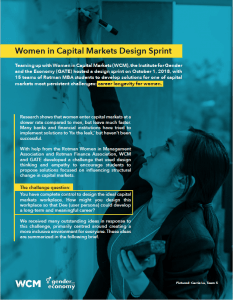
    Teaming up with Women in Capital Markets (WCM), the Institute for Gender and the Economy (GATE) hosted a design sprint on October 1, 2018, with 15 teams of Rotman MBA students to develop solutions for one of capital markets most persistent challenges: career longevity for women.

    Rotman MBA students

    Research shows that women enter capital markets at a slower rate compared to men, but leave much faster. Many banks and financial institutions have tried to implement solutions to ‘fix the leak,’ but haven’t been successful.

    With help from the Rotman Women in Management Association and Rotman Finance Association, WCM and GATE developed a challenge that used design thinking and empathy to encourage students to propose solutions focused on influencing structural change in capital markets.

    The challenge question:

    You have complete control to design the ideal capital markets workplace. How might you design this workplace so that Dee (user persona) could develop a long-term and meaningful career?

    We received many outstanding ideas in response to this challenge, primarily centred around creating a more inclusive environment for everyone.

    Rotman MBA students (2)

    The Finalists 

    Four teams were nominated for the finals; Team 3, Team 6, Team 9, and Team 14. Their ideas ranged from introducing roles within capital markets to signal the importance of diversity and inclusion, to an application that distributed work equitably among team members to create improved flexibility and performance measurement. The four finalists’ ideas are listed below:

    Workload Delegation Tool–A software that distributes new work based on bandwidth, priority, and capability. This will ensure that one team member isn’t overwhelmed by the work on their plate, and every employee’s work is visible, accounted for, and recognized. (The winning idea by Team 6!)

    Dialogue Committee–A group responsible for creating opportunities for open discussion among teams, managers, and organizational leaders. By having conversations between groups, we can move towards progress.

    Stretch Project for Associates–A capstone project for early-career Associates that showcases both their soft and hard skills. Projects provide an opportunity for meaningful and actionable feedback early, and can create a platform for improvement and insight.

    VP Gender Risk Management–A new role that focuses on increasing diversity within capital markets as a risk deterrent. This position’s mandate would be to engage with diverse teams in order to improve return on investment, and promote inclusion in the workplace.

    The winning team comprised of Franklin Gumeyi, Jack Shi, Yurisleidy Zoreda Vazquez, and Asli Zayim. For their prize, they will spend an hour on the trading floor with Derek Flood, RBC’s Head of Canadian Equities.

    In addition to our finalists, 11 other teams pitched their ideas. These teams identified four areas of opportunity in the capital markets industry, and indicated that if these areas are targeted, and current challenges are remedied, capital markets can foster a more inclusive culture. This will not only elongate the careers of women, but also attract and retain a more diverse workforce.

    Thank you to all of the participants, coaches, and judges for being a part of this great event!

    To see all of the recommendations and ideas, view or download this short brief.
    [/fusion_text][fusion_separator style_type=”none” hide_on_mobile=”small-visibility,medium-visibility,large-visibility” class=”” id=”” sep_color=”” top_margin=”15″ bottom_margin=”15″ border_size=”” icon=”” icon_circle=”” icon_circle_color=”” width=”” alignment=”center” /][fusion_button link=”https://www.gendereconomy.org/events/” text_transform=”” title=”” target=”_blank” link_attributes=”” alignment=”” modal=”” hide_on_mobile=”small-visibility,medium-visibility,large-visibility” class=”” id=”” color=”custom” button_gradient_top_color=”#62bd19″ button_gradient_bottom_color=”#62bd19″ button_gradient_top_color_hover=”#00c2e2″ button_gradient_bottom_color_hover=”#00c2e2″ accent_color=”” accent_hover_color=”” type=”” bevel_color=”” size=”” stretch=”yes” icon=”” icon_position=”left” icon_divider=”no” animation_type=”” animation_direction=”left” animation_speed=”0.3″ animation_offset=””]See more past events[/fusion_button][fusion_separator style_type=”none” hide_on_mobile=”small-visibility,medium-visibility,large-visibility” class=”” id=”” sep_color=”” top_margin=”20″ bottom_margin=”20″ border_size=”” icon=”” icon_circle=”” icon_circle_color=”” width=”” alignment=”center” /][fusion_title margin_top=”” margin_bottom=”” hide_on_mobile=”medium-visibility,large-visibility” class=”” id=”” size=”5″ content_align=”center” style_type=”default” sep_color=””]

    Or register below for these upcoming events

    [/fusion_title][fusion_recent_posts layout=”default” hover_type=”none” columns=”3″ number_posts=”3″ offset=”0″ pull_by=”category” cat_slug=”events” exclude_cats=”past” tag_slug=”” exclude_tags=”” thumbnail=”yes” title=”yes” meta=”no” meta_author=”no” meta_categories=”no” meta_date=”yes” meta_comments=”yes” meta_tags=”no” content_alignment=”” excerpt=”no” excerpt_length=”35″ strip_html=”yes” scrolling=”no” hide_on_mobile=”medium-visibility,large-visibility” class=”” id=”” animation_type=”” animation_direction=”left” animation_speed=”0.3″ animation_offset=”” /][/fusion_builder_column][/fusion_builder_row][/fusion_builder_container]


  • Examining gender variation in MBA career paths

    Examining gender variation in MBA career paths

    [fusion_builder_container admin_label=”” hundred_percent=”no” equal_height_columns=”no” menu_anchor=”” hide_on_mobile=”small-visibility,medium-visibility,large-visibility” class=”” id=”” background_color=”” background_image=”” background_position=”center center” background_repeat=”no-repeat” fade=”no” background_parallax=”none” enable_mobile=”no” parallax_speed=”0.3″ video_mp4=”” video_webm=”” video_ogv=”” video_url=”” video_aspect_ratio=”16:9″ video_loop=”yes” video_mute=”yes” video_preview_image=”” border_size=”” border_color=”” border_style=”solid” margin_top=”20″ margin_bottom=”” padding_top=”” padding_right=”” padding_bottom=”” padding_left=””][fusion_builder_row][fusion_builder_column type=”3_4″ layout=”3_4″ spacing=”” center_content=”no” hover_type=”none” link=”” min_height=”” hide_on_mobile=”small-visibility,medium-visibility,large-visibility” class=”” id=”” background_color=”” background_image=”” background_position=”left top” background_repeat=”no-repeat” border_size=”0″ border_color=”” border_style=”solid” border_position=”all” padding_top=”” padding_right=”” padding_bottom=”” padding_left=”” dimension_margin=”” animation_type=”” animation_direction=”left” animation_speed=”0.3″ animation_offset=”” last=”no”][fusion_text columns=”” column_min_width=”” column_spacing=”” rule_style=”default” rule_size=”” rule_color=”” class=”” id=””]

    Summary

    This paper analyzes the career choices and trajectories of MBA graduates, and whether these vary by gender. Interviews with men and women twelve years after graduating with an MBA reveal that careers followed one of three pathways: (1) lockstep employment, in which graduates remain in the same job; (2) transitory employment, in which graduates transition between three or more jobs; and (3) career exit. Men and women followed the lockstep career path in similar numbers, however, their experiences with transitory employment and career exit differ. Through the transitory career pathway, men more often experienced an accelerated career and continued salary growth. By contrast, women following this career path more often experienced stalled careers, which included decreases in their most recent salary, or the inability to move up via promotion or pay. Women more frequently exited the workforce than men.

    Research

    While women’s MBA graduation rates have increased significantly in the past 40 years, research demonstrates that female MBA holders lag behind their male counterparts with regard to pay and promotion. The authors of this study conducted 73 life history interviews with MBA graduates twelve years after graduation, in order to examine the factors contributing to diverging pathways of men and women who have similar starting points.

    28 women and 45 men were interviewed about their college and early work trajectories; experiences with the MBA; work/family balance; life after the MBA; current work experiences; and future expectations.

    The data revealed three distinct career pathways for MBA alumni: (1) lockstep careers, (2) transitory careers, and (3) exiting careers.

    • Lockstep careers – The majority of men and women experiencing this type of career path worked for a large employer, received multiple promotions, and remained with the same organization. Twenty-six percent of MBA men and 32 percent of MBA women were represented in this category. Both men and women following this trajectory indicated that promotions were relatively seamless and attainable in their work organizations. Also of importance was the workplace flexibility they were afforded, both through informal arrangements made with superiors, and through formal policies, such as parental leave, that were available.
    • Transitory careers – The majority of MBA graduates fell into the transitory career pathway category, with 70 percent of men and 50 percent of women have worked for between four and six employers within a ten-year period. Transitory workers more often reported obstacles to promotion that motivated them to seek out new employment opportunities. They also reported receiving little support from bosses for workplace flexibility. Subsequently, 25 percent of women and 15 percent of men in this group reported switching jobs to achieve better work/life balance. Notably, on this path, men fared better than women when moving to new organizations. Sixty-six percent of men in this group reported having accelerated careers, where they enjoyed continuous opportunities for promotion and salary increases as they transitioned between jobs. By contrast, the majority of women in this group (57 percent) reported having stalled careers, where opportunities for advancement between jobs was stagnant, and they did not experience salary raises as they moved between jobs.
    • Exiting careers – The exit career path represented the smallest number of MBA graduates. Eighteen percent of women and four percent of men reported leaving their careers altogether. Both women and men following the exit trajectory reported feeling sidelined in their career prior to exit. They reported leaving both due to work constraints, such as being laid off or generally unhappy in their previous position, as well as due to family obligations, such as needing to provide childcare or support elderly parents. The MBAs in this category did not anticipate returning to work, nor where they looking for job opportunities.

    This study points to the significance of the transitory career pathway for a majority of MBA graduates, and how this trajectory differs for men and women.

    When people have short work histories, gender may serve as a biased indicator of quality that employers use to assess female candidates.

    In particular, women in their twenties and thirties may be stereotyped as less committed owing to their status (or would-be status) as mothers, and subsequently offered fewer vertical opportunities for advancement. This finding is important for career specializations beyond the MBA, given that tenure at any one company is increasingly shorter for a wide swath of the working population.

    Implications

    • Promotions – When there are clear steps to promotion that are accessible to people at the start of their careers, women may advance more easily. Management and HR personnel can ensure that requirements for promotion are clearly explained to entry-level workers.
    • Retention – Employee retention also increases when employers provide a range of workplace flexibility options. Managers and HR personnel can encourage the use of both informal arrangements made on an individual basis, and formal policies that are widely implemented for both men and women.
    • Resume reviews – Women may be particularly discriminated against for having short job tenures when they apply to a new job opening. Hiring personnel may consider adopting “blind” resume reviews to mitigate bias that women and mothers experience when attempting to switch jobs.

    [/fusion_text][fusion_separator style_type=”none” hide_on_mobile=”small-visibility,medium-visibility,large-visibility” class=”” id=”” sep_color=”” top_margin=”20″ bottom_margin=”20″ border_size=”” icon=”” icon_circle=”” icon_circle_color=”” width=”” alignment=”center” /][fusion_button link=”https://www.gendereconomy.org/research-briefs/” text_transform=”” title=”” target=”_blank” link_attributes=”” alignment=”” modal=”” hide_on_mobile=”small-visibility,medium-visibility,large-visibility” class=”” id=”” color=”custom” button_gradient_top_color=”#62bd19″ button_gradient_bottom_color=”#62bd19″ button_gradient_top_color_hover=”#00c2e2″ button_gradient_bottom_color_hover=”#00c2e2″ accent_color=”” accent_hover_color=”” type=”” bevel_color=”” border_width=”” size=”” stretch=”yes” shape=”” icon=”” icon_position=”left” icon_divider=”no” animation_type=”” animation_direction=”left” animation_speed=”0.3″ animation_offset=””]See more research briefs[/fusion_button][fusion_separator style_type=”none” hide_on_mobile=”small-visibility,medium-visibility,large-visibility” class=”” id=”” sep_color=”” top_margin=”20″ bottom_margin=”20″ border_size=”” icon=”” icon_circle=”” icon_circle_color=”” width=”” alignment=”center” /][fusion_recent_posts layout=”default” hover_type=”none” columns=”3″ number_posts=”3″ offset=”0″ pull_by=”category” cat_slug=”research-briefs” exclude_cats=”” tag_slug=”” exclude_tags=”” thumbnail=”yes” title=”yes” meta=”no” meta_author=”no” meta_categories=”no” meta_date=”yes” meta_comments=”yes” meta_tags=”no” content_alignment=”” excerpt=”no” excerpt_length=”35″ strip_html=”yes” scrolling=”no” hide_on_mobile=”small-visibility,medium-visibility,large-visibility” class=”” id=”” animation_type=”” animation_direction=”left” animation_speed=”0.3″ animation_offset=”” /][/fusion_builder_column][fusion_builder_column type=”1_4″ layout=”1_4″ spacing=”” center_content=”no” hover_type=”none” link=”” min_height=”” hide_on_mobile=”small-visibility,medium-visibility,large-visibility” class=”” id=”” background_color=”” background_image=”” background_position=”left top” background_repeat=”no-repeat” border_size=”0″ border_color=”” border_style=”solid” border_position=”all” padding_top=”” padding_right=”” padding_bottom=”” padding_left=”” dimension_margin=”” animation_type=”” animation_direction=”left” animation_speed=”0.3″ animation_offset=”” last=”no”][fusion_title margin_top=”” margin_bottom=”” hide_on_mobile=”small-visibility,medium-visibility,large-visibility” class=”briefsummary” id=”” size=”3″ content_align=”left” style_type=”none” sep_color=””]

    Title

    Gender and the MBA: Differences in Career Trajectories, Institutional Support, and Outcomes

    Authors

    Sarah E. Patterson; Sarah Damaske; Christen Sheroff

    Institutions

    The Pennsylvania State University

    Source

    Gender & Society

    Published

    April 2017

    Link

    http://journals.sagepub.com/doi/abs/10.1177/0891243217703630

    Research brief prepared by

    Kim de Laat[/fusion_title][fusion_widget_area name=”avada-custom-sidebar-researchbriefsidebar” title_size=”” title_color=”” background_color=”” padding_top=”” padding_right=”” padding_bottom=”” padding_left=”” hide_on_mobile=”small-visibility,medium-visibility,large-visibility” class=”” id=”” /][/fusion_builder_column][/fusion_builder_row][/fusion_builder_container]

  • Financial Times Business School Newsletter

    The Financial Times Business School Newsletter points to Sarah Kaplan’s Rotman Management Magazine on gender equality as an innovation challenge.

  • Your ambition is showing

    Your ambition is showing

    [fusion_builder_container admin_label=”” hundred_percent=”no” equal_height_columns=”no” menu_anchor=”” hide_on_mobile=”small-visibility,medium-visibility,large-visibility” class=”” id=”” background_color=”” background_image=”” background_position=”center center” background_repeat=”no-repeat” fade=”no” background_parallax=”none” enable_mobile=”no” parallax_speed=”0.3″ video_mp4=”” video_webm=”” video_ogv=”” video_url=”” video_aspect_ratio=”16:9″ video_loop=”yes” video_mute=”yes” video_preview_image=”” border_size=”” border_color=”” border_style=”solid” margin_top=”20″ margin_bottom=”” padding_top=”” padding_right=”” padding_bottom=”” padding_left=””][fusion_builder_row][fusion_builder_column type=”3_4″ layout=”3_4″ spacing=”” center_content=”no” hover_type=”none” link=”” min_height=”” hide_on_mobile=”small-visibility,medium-visibility,large-visibility” class=”” id=”” background_color=”” background_image=”” background_position=”left top” background_repeat=”no-repeat” border_size=”0″ border_color=”” border_style=”solid” border_position=”all” padding_top=”” padding_right=”” padding_bottom=”” padding_left=”” dimension_margin=”” animation_type=”” animation_direction=”left” animation_speed=”0.3″ animation_offset=”” last=”no”][fusion_text columns=”” column_min_width=”” column_spacing=”” rule_style=”default” rule_size=”” rule_color=”” class=”” id=””]

    Summary

    Research shows that men avoid female partners who are more ambitious or more highly educated than they are. This puts single women in a position where their professional behavior (including speaking up in meetings and working late) may influence how “desirable” they are perceived to be by potential male partners. This paper explores the ways in which single women avoid sending “negative” signals to the marriage market.

    Research

    Single people seeking a partner are most likely to meet that partner within their professional network. However, research shows that heterosexual men prefer partners who are less professionally ambitious than they are which sets up an interesting tension within the workplace marriage market.

    Heterosexual men prefer partners who are less professionally ambitious than they are, which sets up tension within the workplace marriage market.

    This paper explores whether single heterosexual women alter their behavior in the workplace to avoid sending “undesirable” signals about their professional ambition to their single coworkers. To test this, the authors conducted studies at an elite MBA program where many students are seeking long-term partners, and where students’ behavior is relevant for the labor market.

    To start, first-year MBA students took a survey asking them to think back over their prior two years of work experience and whether they ever avoided certain actions they thought would help their careers because they were concerned it would make them “look too ambitious, assertive, or pushy.” There were significant differences in the answers between women and men, and also between single and married/partnered women. For example, 64% of single women had avoided asking for a raise or promotion for that reason compared to 39% of married/partnered women, and only 27% of men. 73% of single women said they had avoided at least one career-enhancing action for fear of appearing too ambitious.

    73% of single women said they had avoided at least one career-enhancing action for fear of appearing too ambitious.

    This behavior apparently continued in business school, as unmarried female MBA students had lower class participation marks on average than their married female peers (with no apparent difference on other marks for exams or homework).

    To isolate single women’s behavior in different contexts, the authors conducted two field experiments in partnership with the career office at the MBA program. In order to test whether women made different choices depending on whether or not their actions would be observed publicly by their classmates, the students in a career class were given a questionnaire about their job performance. Some students were told that their specific answers would be discussed in the career class, while others were told that the answers would be shared anonymously. There was no difference between single and non-single women’s answers when the students were told their answers would be anonymous. However, when students were told their answers would be shared publicly, single women reported lower willingness to travel for work, a desire to work fewer hours per week, and even said they aspired to a lower salary than their non-single female peers. Men and non-single women’s answers did not vary depending on whether their answers would be shared or anonymous.

    Next, the authors tested whether single women’s reported preferences changed when they believed their answers would be seen by single men in particular. In another career class, the students were placed into small groups with either all men, all women, or a mix of both. The students were asked to make choices between three pairs of hypothetical jobs and told they would discuss their answers in the small groups. When in all-female groups, 68% of women reported that they would prefer a job with a higher salary that required more hours of work per week over a job that paid less and required fewer hours. However, when in groups with male peers, single women were 26% less likely to make that same choice. Additionally, in groups with more single men, single women were less likely to choose a more career-focused option.

    Implications

    • Corporations – We see this discrepancy between true and admitted ambition in large part because we still operate in a society that expects men to achieve more than women. For single, heterosexual women to feel more comfortable being honest about their ambition, society’s expectations about her ambition must shift. Corporate policies around family leave that create equal opportunities for men and women to participate in family life may eventually contribute to changes in expectations about the roles that men and women play at work and at home, ultimately making a woman’s ambition, less of an “undesirable” trait in the marriage market.
    • Universities – How and when single, heterosexual women are asked about career preferences could influence their answers. Care should be taken when using this kind of information to place students on certain career tracks as it may not reflect their true desires.
    • Individuals – Most women are likely not aware that they are self-censoring their ambitions in this way. Increased awareness of the subconscious pressure to conform to marriage market “desirability” standards may cause them to be more forthright with their preferences.

    [/fusion_text][fusion_separator style_type=”none” hide_on_mobile=”small-visibility,medium-visibility,large-visibility” class=”” id=”” sep_color=”” top_margin=”20″ bottom_margin=”20″ border_size=”” icon=”” icon_circle=”” icon_circle_color=”” width=”” alignment=”center” /][fusion_button link=”https://www.gendereconomy.org/research-briefs/” text_transform=”” title=”” target=”_blank” link_attributes=”” alignment=”” modal=”” hide_on_mobile=”small-visibility,medium-visibility,large-visibility” class=”” id=”” color=”custom” button_gradient_top_color=”#62bd19″ button_gradient_bottom_color=”#62bd19″ button_gradient_top_color_hover=”#00c2e2″ button_gradient_bottom_color_hover=”#00c2e2″ accent_color=”” accent_hover_color=”” type=”” bevel_color=”” border_width=”” size=”” stretch=”yes” shape=”” icon=”” icon_position=”left” icon_divider=”no” animation_type=”” animation_direction=”left” animation_speed=”0.3″ animation_offset=””]See more research briefs[/fusion_button][fusion_separator style_type=”none” hide_on_mobile=”small-visibility,medium-visibility,large-visibility” class=”” id=”” sep_color=”” top_margin=”20″ bottom_margin=”20″ border_size=”” icon=”” icon_circle=”” icon_circle_color=”” width=”” alignment=”center” /][fusion_recent_posts layout=”default” hover_type=”none” columns=”3″ number_posts=”3″ offset=”0″ pull_by=”category” cat_slug=”research-briefs” exclude_cats=”” tag_slug=”” exclude_tags=”” thumbnail=”yes” title=”yes” meta=”no” meta_author=”no” meta_categories=”no” meta_date=”yes” meta_comments=”yes” meta_tags=”no” content_alignment=”” excerpt=”no” excerpt_length=”35″ strip_html=”yes” scrolling=”no” hide_on_mobile=”small-visibility,medium-visibility,large-visibility” class=”” id=”” animation_type=”” animation_direction=”left” animation_speed=”0.3″ animation_offset=”” /][/fusion_builder_column][fusion_builder_column type=”1_4″ layout=”1_4″ spacing=”” center_content=”no” hover_type=”none” link=”” min_height=”” hide_on_mobile=”small-visibility,medium-visibility,large-visibility” class=”” id=”” background_color=”” background_image=”” background_position=”left top” background_repeat=”no-repeat” border_size=”0″ border_color=”” border_style=”solid” border_position=”all” padding_top=”” padding_right=”” padding_bottom=”” padding_left=”” dimension_margin=”” animation_type=”” animation_direction=”left” animation_speed=”0.3″ animation_offset=”” last=”no”][fusion_title margin_top=”” margin_bottom=”” hide_on_mobile=”small-visibility,medium-visibility,large-visibility” class=”briefsummary” id=”” size=”3″ content_align=”left” style_type=”none” sep_color=””]

    Title

    “Acting Wife”: The Impacts of Gender Norms and Women’s Relationship Status on Career Ambitions in the United States

    Authors

    Leonardo Bursztyn, Thomas
    Fujiwara, Amanda Pallais

    Institutions

    University of Chicago,
    Princeton University,
    Harvard University

    Source

    American Economic Review

    Published

    January 2017

    Link

    10.3386/w23043

    Research brief prepared by

    Celeste Jalbert[/fusion_title][fusion_widget_area name=”avada-custom-sidebar-researchbriefsidebar” title_size=”” title_color=”” background_color=”” padding_top=”” padding_right=”” padding_bottom=”” padding_left=”” hide_on_mobile=”small-visibility,medium-visibility,large-visibility” class=”” id=”” /][/fusion_builder_column][/fusion_builder_row][/fusion_builder_container]

  • Press Release on Rotman’s student engagement in GATE

    Students at the University of Toronto’s Rotman School of Management Are Changing the Conversation on Gender Equality

  • Design Thinking and Gender Equality

    Design Thinking and Gender Equality

    Our Executive in Residence, Vanessa Iarocci talks about our new course on Designing for Equality and the work of GATE on “What She Said” with Christine Bentley & Kate Wheeler

  • Rotman’s Women in Management Association (WIMA)

    Rotman’s Women in Management Association (WIMA)

    WIMA (Women in Management Association) promotes women in all aspects of business and management, encouraging and fostering the growth, development and advancement of women in the business community. Leveraging its strong, and diverse, network of students, alumnae and industry representatives, WIMA helps members develop the skills necessary to achieve their goals and confidently take on challenges in the work place.

    To see our work in action, check out the Women in Capital Markets design sprint here.
  • WiMen

    WiMen

    WiMen is a network of men who are committed to understanding and increasing diversity and gender inclusion in the Rotman community and in the workplace. WiMen espouses 3 core pillars: building knowledge about unconscious bias and gender differences, becoming empowered to become better leaders, and championing a unified force to improve gender equity.

    To see our work in action, check out the design of everyday men design sprint here.