
Author: Salwa Iqbal

  • A Year in Review: A Look Back at 2024

    A Year in Review: A Look Back at 2024

    [fusion_builder_container hundred_percent=”no” equal_height_columns=”no” menu_anchor=”” hide_on_mobile=”small-visibility,medium-visibility,large-visibility” class=”” id=”” background_color=”” background_image=”” background_position=”center center” background_repeat=”no-repeat” fade=”no” background_parallax=”none” parallax_speed=”0.3″ video_mp4=”” video_webm=”” video_ogv=”” video_url=”” video_aspect_ratio=”16:9″ video_loop=”yes” video_mute=”yes” overlay_color=”” video_preview_image=”” border_color=”” border_style=”solid” padding_top=”” padding_bottom=”” padding_left=”” padding_right=”” type=”legacy” admin_toggled=”no”][fusion_builder_row][fusion_builder_column type=”1_1″ layout=”1_1″ background_position=”left top” background_color=”” border_color=”” border_style=”solid” border_position=”all” spacing=”yes” background_image=”” background_repeat=”no-repeat” padding_top=”” padding_right=”” padding_bottom=”” padding_left=”” margin_top=”0px” margin_bottom=”0px” class=”” id=”” animation_type=”” animation_speed=”0.3″ animation_direction=”left” hide_on_mobile=”small-visibility,medium-visibility,large-visibility” center_content=”no” last=”true” min_height=”” hover_type=”none” link=”” border_sizes_top=”” border_sizes_bottom=”” border_sizes_left=”” border_sizes_right=”” first=”true”][fusion_text columns=”” column_min_width=”” column_spacing=”” rule_style=”” rule_size=”” rule_color=”” hue=”” saturation=”” lightness=”” alpha=”” content_alignment_medium=”” content_alignment_small=”” content_alignment=”” hide_on_mobile=”small-visibility,medium-visibility,large-visibility” sticky_display=”normal,sticky” class=”” id=”” margin_top=”” margin_right=”” margin_bottom=”” margin_left=”” fusion_font_family_text_font=”” fusion_font_variant_text_font=”” font_size=”” line_height=”” letter_spacing=”” text_transform=”none” text_color=”” animation_type=”” animation_direction=”left” animation_speed=”0.3″ animation_offset=””]


    As we look back on our ninth year and begin our tenth, we reflect on nearly a decade of pushing boundaries, challenging assumptions, and equipping changemakers with knowledge and tools to build a more inclusive economy. From students and researchers to policymakers and industry leaders, our community is at the forefront of understanding and addressing how gender and its intersections shape economic experiences.

    We invite you to explore our past year through this interactive report!

    [/fusion_text][fusion_separator style_type=”none” hide_on_mobile=”small-visibility,medium-visibility,large-visibility” class=”” id=”” sep_color=”” top_margin=”25″ bottom_margin=”25″ border_size=”” icon=”” icon_circle=”” icon_circle_color=”” width=”” alignment=”center” /][fusion_button link=”” text_transform=”uppercase” title=”” target=”_self” link_attributes=”” alignment=”center” modal=”” hide_on_mobile=”small-visibility,medium-visibility,large-visibility” class=”” id=”” color=”custom” button_gradient_top_color=”#62bd19″ button_gradient_bottom_color=”#62bd19″ button_gradient_top_color_hover=”#62bd19″ button_gradient_bottom_color_hover=”” accent_color=”” accent_hover_color=”” type=”” bevel_color=”” border_color=”” border_hover_color=”” size=”” stretch=”default” icon=”” icon_position=”left” icon_divider=”no” animation_type=”” animation_direction=”left” animation_speed=”0.3″ animation_offset=””]See more annual reports[/fusion_button][fusion_section_separator divider_type=”triangle” divider_position=”center” divider_candy=”bottom” icon=”” icon_color=”” bordersize=”” bordercolor=”#62bd19″ backgroundcolor=”#62bd19″ hide_on_mobile=”small-visibility,medium-visibility,large-visibility” class=”” id=”” /][fusion_separator style_type=”none” hide_on_mobile=”small-visibility,medium-visibility,large-visibility” class=”” id=”” sep_color=”” top_margin=”25″ bottom_margin=”25″ border_size=”” icon=”” icon_circle=”” icon_circle_color=”” width=”” alignment=”center” /][fusion_recent_posts layout=”default” picture_size=”fixed” hover_type=”none” columns=”3″ number_posts=”-1″ post_status=”” offset=”0″ pull_by=”category” cat_slug=”annual-reports” exclude_cats=”” tag_slug=”” exclude_tags=”” thumbnail=”yes” title=”yes” meta=”yes” meta_author=”no” meta_categories=”no” meta_date=”yes” meta_comments=”yes” meta_tags=”no” content_alignment=”” excerpt=”no” excerpt_length=”35″ strip_html=”yes” scrolling=”no” hide_on_mobile=”small-visibility,medium-visibility,large-visibility” class=”” id=”” animation_type=”” animation_direction=”left” animation_speed=”0.3″ animation_offset=”” /][/fusion_builder_column][/fusion_builder_row][/fusion_builder_container]
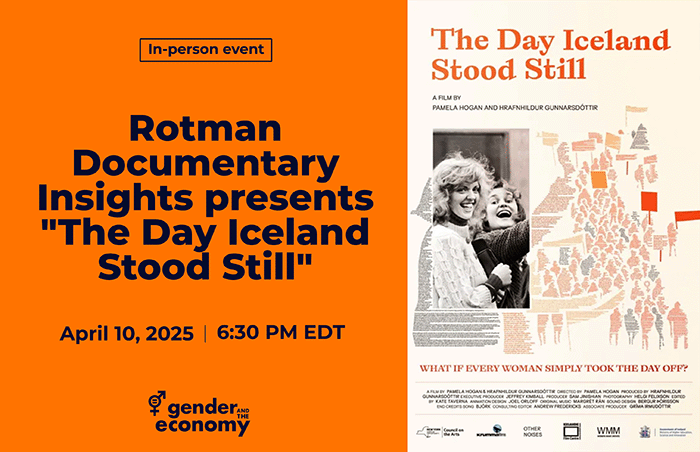
  • Rotman Documentary Insights presents “The Day Iceland Stood Still”

    Rotman Documentary Insights presents “The Day Iceland Stood Still”


    Topic: Rotman Documentary Insights presents “The Day Iceland Stood Still”

    Date: April 10, 6:30 PM – 8:15 PM EDT

    Synopsis:

    On the morning of October 24, 1975, 90 percent of Iceland’s women walked off their jobs and out of their homes. Fed up with the gaping inequity between the value of women’s labour and women’s wages, female employees, wives and mothers just stopped—stopped working, cooking, cleaning and looking after their children—together on that fall morning. The country came to an abrupt standstill, but a revolution had begun. Fascinating archives and inspiring animation accompany new interviews with the women and activists who were there that day. Nearly 50 years later, director Pamela Hogan and producer Hrafnhildur Gunnarsdóttir reconstruct the dramatic 12 hours that reimagined what was possible for women in Iceland—and, in fact, the world. Relive the moment—or cheer along for the first time—as these gender-equity sheroes share what it was like to throw one of the most effective and dramatic protest wrenches into the patriarchal machine.

    REGISTRATION LINK

    Speaker:

    Pamela Hogan, Director & Producer

    Hrafnhildur Gunnarsdóttir, Producer

    Moderator:

    Maja Djikic, Associate Professor, Director, Self-Development Laboratory, Rotman School of Management

    About our Speaker:

    An Emmy-winning filmmaker, journalist, and media executive, over her career, Pamela Hogan has often focused on under-reported stories about ordinary women who do the extraordinary. Her film Looks Like Laury Sounds Like Laury was named one of “The Best TV Shows of 2015” by The New York Times. She co-created, and executive produced the PBS series Women, War & Peace, directing the award-winning episode I Came to Testify, which highlighted the experiences of Bosnian women during wartime. The series reached 12 million viewers and won several awards, including the Overseas Press Club’s Murrow Award, a Television Academy Honor, and the ABA’s Silver Gavel. Hogan also served as executive producer for PBS’s Wide Angle, creating the Emmy-winning documentary Ladies First and the Time for School series. She has received a National Council for Research on Women award and teaches at Columbia University’s Graduate School of Journalism.

    Acclaimed Icelandic filmmaker Hrafnhildur Gunnarsdóttir has produced several films on the Icelandic women’s movement, including Women in Red Stockings and The Kitchen Sink Revolution, the latter of which won the Edda Award. She directed Her Age, a series of 52 shorts celebrating Icelandic women’s history, and her latest project, the 5-part series People Like That, chronicles the 40-year struggle for gay rights in Iceland. Her film The Vasulka Effect, about video art pioneers Woody and Steina Vasulka, received multiple awards, including Best Portrait at the International Festival of Films in Canada. In 2024, Iceland’s President honoured her with the Falcon award—the “Knight’s Cross”—in recognition of her work raising awareness in the field of equality.

    Event Logistics:

    This event is available to attend in-person only.

    Rotman Events is committed to accessibility for all people. If you have any access needs or if there are any ways we can support your full participation in this session, please email Mandi Gosling [events@rotman.utoronto.ca] no later than 2 weeks in advance of the event and we will be glad to work with you to make the appropriate arrangements.

    General Admission: In-Person Ticket Details

    The event will be hosted at Innis Town Hall (2 Sussex Ave. Toronto, ON M5S 1J5). Your registration fee includes a seat in the theatre for the film screening and moderated Q&A.

    Cancellation & Refund Policy

    • Refunds will only be issued for cancellations received in writing NO LATER than 24 hours prior to the event. Please email events@rotman.utoronto.ca for processing.
    • In-person registrants who do not pick up their book at the event will have 5 business days to request postal delivery by emailing us at events@rotman.utoronto.ca. All unclaimed books will be returned to the publisher after that time.

    Questions: events@rotman.utoronto.ca, Mandi Gosling

  • Mirza: Inclusive Innovation in Childcare

    Mirza: Inclusive Innovation in Childcare


     Introduction

    Affordable and accessible childcare is one of the most important barriers to achieving gender equality. Many people are forced to stay home, work reduced hours, or take on jobs with lower pay in order to accommodate childcare needs in a system that does not provide good options.

    Enter Mirza to help contribute to a solution. Named after Maryam Mirzakhani, the first woman to win the Fields Medal in mathematics, Mirza is a fintech company that has developed a Software-as-a-Service (SaaS) platform to help employers and workers navigate government and state-level childcare support programs in the United States. Mirza was founded by Mel Faxon and Siran Cao, who observed how their family and friends experienced systemic childcare shortages and the motherhood penalty. With the goal of making access to childcare benefits simple and easy, Mirza offers a platform that connects private sector players with funds from the public sector. Integrated with employers’ HR systems, the platform allows employees to discover, in just a few clicks, which subsidies and supports they are eligible for.

    To maximize impact, Mirza focuses on employers with a high proportion of frontline workers at the lower end of the income distribution, such as call centers. By working closely with hourly and low-wage workers, Mirza has developed a deep understanding of their needs—not just resource constraints but also literacy barriers—and has customized solutions to address them. Mirza plans to leverage the lessons learned from improving accessibility in government-funded childcare to expand into other care economies, such as elder care and school lunch programs. This case shares the story of how Mirza was founded, the challenges they faced, the pivots they made to find the right business model, and some of their early successes.

    TO VIEW AND DOWNLOAD THE FULL CASE STUDY, FOLLOW THESE INSTRUCTIONS.

    This case was written by Hyeun Lee and Sarah Kaplan. We are grateful for the participation of Mel Faxon and Siran Cao.

  • Asked to be a sponsor or mentor? 5 tips for a lasting impact

    Asked to be a sponsor or mentor? 5 tips for a lasting impact

    [fusion_builder_container type=”flex” hundred_percent=”no” equal_height_columns=”no” menu_anchor=”” hide_on_mobile=”small-visibility,medium-visibility,large-visibility” class=”” id=”” background_color=”” background_image=”” background_position=”center center” background_repeat=”no-repeat” fade=”no” background_parallax=”none” parallax_speed=”0.3″ video_mp4=”” video_webm=”” video_ogv=”” video_url=”” video_aspect_ratio=”16:9″ video_loop=”yes” video_mute=”yes” overlay_color=”” video_preview_image=”” border_color=”” border_style=”solid” padding_top=”” padding_bottom=”” padding_left=”” padding_right=””][fusion_builder_row][fusion_builder_column type=”1_1″ layout=”1_1″ background_position=”left top” background_color=”” border_color=”” border_style=”solid” border_position=”all” spacing=”yes” background_image=”” background_repeat=”no-repeat” padding_top=”” padding_right=”” padding_bottom=”” padding_left=”” margin_top=”0px” margin_bottom=”0px” class=”” id=”” animation_type=”” animation_speed=”0.3″ animation_direction=”left” hide_on_mobile=”small-visibility,medium-visibility,large-visibility” center_content=”no” last=”true” min_height=”” hover_type=”none” link=”” border_sizes_top=”” border_sizes_bottom=”” border_sizes_left=”” border_sizes_right=”” first=”true”][fusion_text columns=”” column_min_width=”” column_spacing=”” rule_style=”” rule_size=”” rule_color=”” hue=”” saturation=”” lightness=”” alpha=”” content_alignment_medium=”” content_alignment_small=”” content_alignment=”” hide_on_mobile=”small-visibility,medium-visibility,large-visibility” sticky_display=”normal,sticky” class=”” id=”” margin_top=”” margin_right=”” margin_bottom=”” margin_left=”” fusion_font_family_text_font=”” fusion_font_variant_text_font=”” font_size=”” line_height=”” letter_spacing=”” text_transform=”none” text_color=”” animation_type=”” animation_direction=”left” animation_color=”” animation_speed=”0.3″ animation_delay=”0″ animation_offset=”” logics=””]

    Title: Asked to be a sponsor or mentor? 5 tips for a lasting impact

    Author: Sonia Kang

    You’ve risen through the ranks and proven yourself, and now other employees are turning to you for guidance. How can you set yourself up for success as you step into the role of a mentor or sponsor? It turns out, the secret is in the details. Sonia Kang, a professor of organizational behaviour and human resource management at the University of Toronto Mississauga with a cross-appointment to the Rotman School of Management, is an expert on workplace dynamics. Here is her take on five ways managers and leaders can become better mentors or sponsors.

    Read the full article here

    [/fusion_text][/fusion_builder_column][/fusion_builder_row][/fusion_builder_container]

  • Gender Lens Investing: The 2X Global Approach to Systemic Change

    Gender Lens Investing: The 2X Global Approach to Systemic Change


     Introduction

     2X Global (the Platform) is a global membership network for investors, capital providers, and intermediaries working in public and private markets, across both developed and emerging economies, to mobilize capital for gender finance. Its goal is to create an inclusive and equitable financial system that values all people and the planet, an outcome that Alyanna Carrion, program manager with 2X Global, calls a “win-win” for both women and capital providers. 2X Global aims to achieve these goals by emphasizing accountability through measurable outcomes and providing guidance on effective practices, ultimately helping investors navigate power dynamics and achieve tangible social impact returns through their financial decisions. 

    TO VIEW AND DOWNLOAD THE FULL CASE STUDY, FOLLOW THESE INSTRUCTIONS.

     This case was written by Tanmay Padhye. The author prepared this case under the supervision of Professors Sonia Kang and Hyeun Lee. 

    The development of this case study was supported by the Latner GATE MBA Internships program.