Author: Salwa Iqbal

  • Layered Lives: Gender Identities in Focus

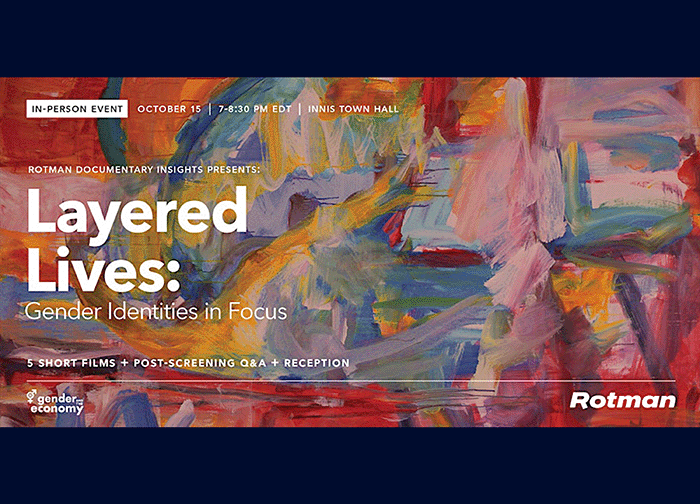
    Layered Lives: Gender Identities in Focus


    Date: Oct. 15, 2024

    Event Synopsis:

    Join us for Layered Lives: Gender Identities in Focus, a powerful screening of short films that brings to life the complex intersections of gender with other key aspects of identity, such as culture, race, disability, and indigeneity. These films provide an opportunity to move beyond theoretical discussions and to connect with the lived experiences of individuals navigating these overlapping identities.

    In a series of new, original shorts that range in style (including dramatic narrative, animated, documentary and experimental shorts), local Canadian filmmakers consider personal stories that highlight the nuances often overlooked in professional and academic spaces. How do these identities impact how people navigate our economy, community and society at large? The screening will be followed by a dynamic conversation with the filmmakers, where we’ll explore the questions and themes raised by their work. This event is not just a showcase of artistic expression but a call to deepen our understanding of how gender intersects with other forms of identity in ways that shape lives, opportunities, and challenges.

    After the screening, we invite you to join us for a reception celebrating these films and the 100th public event hosted by the Institute for Gender and the Economy (GATE).

    REGISTRATION LINK

    Featured films include:

    Generations of Home by Chelsea Nyomi

    Leveled by Sara Rangooni

    Meteor by Atefeh Khademolreza

    Miss Campbell: Inuk Teacher by Heather Campbell

    Superhero Inc. by Elizabeth Whitmere and Christine Bélanger

    Speakers:

    Christine Bélanger, Co-Director, Superhero Inc.

    Heather Campbell, Director, Miss Campbell: Inuk Teacher

    Chelsea Nyomi, Director, Generations of Home

    Sara Rangooni, Director, Leveled

    Moderator:

    Dr. Sonia Kang, Canada Research Chair in Identity, Diversity, and Inclusion; Professor of Organizational Behavior and Human Resource Management, UofT; Academic Director, Institute for Gender and the Economy (GATE), Rotman School of Management

    Event Logistics:

    This event is available to attend IN-PERSON only.

    Rotman Events is committed to accessibility for all people. If you have any access needs or if there are any ways we can support your full participation in this session, please email Mandi Gosling [events@rotman.utoronto.ca] no later than 2 weeks in advance of the event and we will be glad to work with you to make the appropriate arrangements.

    After the screening, please join us for a reception celebrating these films and the 100th public event hosted by the Institute for Gender and the Economy.

    General Admission: In-Person Ticket Details

    • The event will be hosted at Innis Town Hall (2 Sussex Ave. Toronto, ON M5S 1J5). Your registration fee includes attendance at the screening and reception.

    Cancellation/Refund Policy

    • Refunds will only be issued for cancellations received in writing NO LATER than 24 hours prior to the event. Please email events@rotman.utoronto.ca for processing.

    Questions: events@rotman.utoronto.ca, Mandi Gosling
  • How Comply-or-Explain Disclosure Regulation Can Improve Corporate Governance and Gender Equality

    [fusion_builder_container type=”flex” hundred_percent=”no” equal_height_columns=”no” menu_anchor=”” hide_on_mobile=”small-visibility,medium-visibility,large-visibility” class=”” id=”” background_color=”” background_image=”” background_position=”center center” background_repeat=”no-repeat” fade=”no” background_parallax=”none” parallax_speed=”0.3″ video_mp4=”” video_webm=”” video_ogv=”” video_url=”” video_aspect_ratio=”16:9″ video_loop=”yes” video_mute=”yes” overlay_color=”” video_preview_image=”” border_color=”” border_style=”solid” padding_top=”” padding_bottom=”” padding_left=”” padding_right=””][fusion_builder_row][fusion_builder_column type=”1_1″ layout=”1_1″ background_position=”left top” background_color=”” border_color=”” border_style=”solid” border_position=”all” spacing=”yes” background_image=”” background_repeat=”no-repeat” padding_top=”” padding_right=”” padding_bottom=”” padding_left=”” margin_top=”0px” margin_bottom=”0px” class=”” id=”” animation_type=”” animation_speed=”0.3″ animation_direction=”left” hide_on_mobile=”small-visibility,medium-visibility,large-visibility” center_content=”no” last=”true” min_height=”” hover_type=”none” link=”” border_sizes_top=”” border_sizes_bottom=”” border_sizes_left=”” border_sizes_right=”” first=”true”][fusion_text columns=”” column_min_width=”” column_spacing=”” rule_style=”” rule_size=”” rule_color=”” hue=”” saturation=”” lightness=”” alpha=”” content_alignment_medium=”” content_alignment_small=”” content_alignment=”” hide_on_mobile=”small-visibility,medium-visibility,large-visibility” sticky_display=”normal,sticky” class=”” id=”” margin_top=”” margin_right=”” margin_bottom=”” margin_left=”” fusion_font_family_text_font=”” fusion_font_variant_text_font=”” font_size=”” line_height=”” letter_spacing=”” text_transform=”none” text_color=”” animation_type=”” animation_direction=”left” animation_color=”” animation_speed=”0.3″ animation_delay=”0″ animation_offset=”” logics=””]

    Title: How Comply-or-Explain Disclosure Regulation Can Improve Corporate Governance and Gender Equality

    Author: Aaron A. Dhir, Sarah Kaplan and Maria Arabella Robles

    In 2020, the Nasdaq stock market filed a proposal with the U.S. Securities and Exchange Commission seeking permission to adopt a board diversity-related disclosure requirement for its listed companies. In 2021, the SEC approved the proposal, making Nasdaq the most significant stock exchange to date to mandate listing rules that reflect the intention of diversifying corporate boardrooms, wrote Prof.SarahKaplan and colleagues in an article from The CLS Blue Sky Blog. The post is based on a research article  “Corporate Governance and Gender Equality: A Study of Comply-or-Explain Disclosure Regulation,” published in the Seattle University Law Review. Nasdaq’s support for diversity is not the first attempt to address homogeneous boards in the U.S. In 2009, the SEC adopted a rule requiring publicly traded firms to report whether they consider diversity in identifying director nominees. More recently, California mandated diversity quotas. Between these two approaches – the light touch of the SEC’s “pure disclosure” and the heavy hand of California’s quota – Nasdaq’s new listing rule reflects a principles-based philosophy that is implemented through a “comply-or-explain” formulation. It requires listed companies to state whether they adhere to a particular standard of behavior (“comply”) and, if not, they must provide reasons for their lack of compliance (“explain”).

    Read the full article here

    [/fusion_text][/fusion_builder_column][/fusion_builder_row][/fusion_builder_container]

  • Ottawa needs to act on a proposal for a guaranteed basic income for P.E.I.

    Ottawa needs to act on a proposal for a guaranteed basic income for P.E.I.

    [fusion_builder_container type=”flex” hundred_percent=”no” equal_height_columns=”no” menu_anchor=”” hide_on_mobile=”small-visibility,medium-visibility,large-visibility” class=”” id=”” background_color=”” background_image=”” background_position=”center center” background_repeat=”no-repeat” fade=”no” background_parallax=”none” parallax_speed=”0.3″ video_mp4=”” video_webm=”” video_ogv=”” video_url=”” video_aspect_ratio=”16:9″ video_loop=”yes” video_mute=”yes” overlay_color=”” video_preview_image=”” border_color=”” border_style=”solid” padding_top=”” padding_bottom=”” padding_left=”” padding_right=””][fusion_builder_row][fusion_builder_column type=”1_1″ layout=”1_1″ background_position=”left top” background_color=”” border_color=”” border_style=”solid” border_position=”all” spacing=”yes” background_image=”” background_repeat=”no-repeat” padding_top=”” padding_right=”” padding_bottom=”” padding_left=”” margin_top=”0px” margin_bottom=”0px” class=”” id=”” animation_type=”” animation_speed=”0.3″ animation_direction=”left” hide_on_mobile=”small-visibility,medium-visibility,large-visibility” center_content=”no” last=”true” min_height=”” hover_type=”none” link=”” border_sizes_top=”” border_sizes_bottom=”” border_sizes_left=”” border_sizes_right=”” first=”true”][fusion_text columns=”” column_min_width=”” column_spacing=”” rule_style=”” rule_size=”” rule_color=”” hue=”” saturation=”” lightness=”” alpha=”” content_alignment_medium=”” content_alignment_small=”” content_alignment=”” hide_on_mobile=”small-visibility,medium-visibility,large-visibility” sticky_display=”normal,sticky” class=”” id=”” margin_top=”” margin_right=”” margin_bottom=”” margin_left=”” fusion_font_family_text_font=”” fusion_font_variant_text_font=”” font_size=”” line_height=”” letter_spacing=”” text_transform=”none” text_color=”” animation_type=”” animation_direction=”left” animation_color=”” animation_speed=”0.3″ animation_delay=”0″ animation_offset=”” logics=””]

    Title: Ottawa needs to act on a proposal for a guaranteed basic income for P.E.I.

    Author:Robin Boadway, Kourtney Koebel

    The highly touted GBI plan could be a model for other provinces, but it will take full cooperation between federal and provincial governments.

    Canada has made little progress in reducing poverty over the past 50 years. In 2019, the relative income poverty rate among the working-age population was 11.4 per cent, up slightly from 10.3 per cent in 1976, wrote Kourtney Koebel, a post-doctoral researcher with GATE and Prof. Robin Boadway of Queen’s University in a column from Policy Options on August 28. This is despite the fact that Canada: (a) spends substantially more on aggregate social expenditure as a percentage of GDP today (18.8 per cent) than it did in the 1980s (13 per cent) and (b) has radically reduced poverty among seniors and children thanks to generous, unconditional income support programs for those groups.

    Read the full article here

    [/fusion_text][/fusion_builder_column][/fusion_builder_row][/fusion_builder_container]

  • Adasina: Reimagining Finance for Social Justice

    Adasina: Reimagining Finance for Social Justice


    Introduction

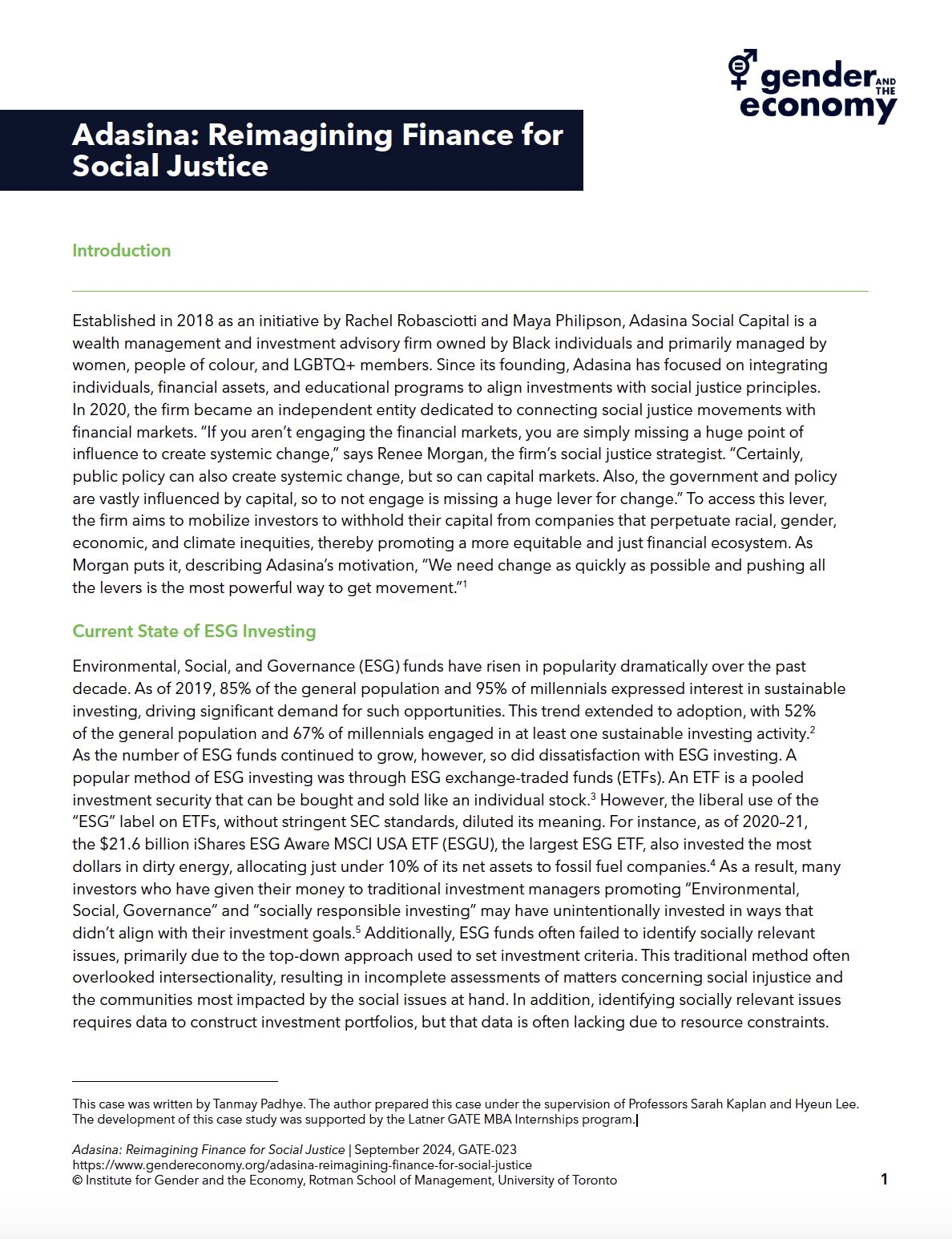
    Established in 2018 as an initiative by Rachel Robasciotti and Maya Philipson, Adasina Social Capital is a wealth management and investment advisory firm owned by Black individuals and primarily managed by women, people of colour, and LGBTQ+ members. Since its founding, Adasina has focused on integrating individuals, financial assets, and educational programs to align investments with social justice principles. In 2020, the firm became an independent entity dedicated to connecting social justice movements with financial markets. “If you aren’t engaging the financial markets, you are simply missing a huge point of influence to create systemic change,” says Renee Morgan, the firm’s social justice strategist. “Certainly, public policy can also create systemic change, but so can capital markets. Also, the government and policy are vastly influenced by capital, so to not engage is missing a huge lever for change.” To access this lever, the firm aims to mobilize investors to withhold their capital from companies that perpetuate racial, gender, economic, and climate inequities, thereby promoting a more equitable and just financial ecosystem. As Morgan puts it, describing Adasina’s motivation, “We need change as quickly as possible and pushing all the levers is the most powerful way to get movement.”

    TO VIEW AND DOWNLOAD THE FULL CASE STUDY, FOLLOW THESE INSTRUCTIONS.

     This case was written by Tanmay Padhye. The author prepared this case under the supervision of Professors Sarah Kaplan and Hyeun Lee. 

    The development of this case study was supported by the Latner GATE MBA Internships program. 


  • Toyota x UBC: Closing the Safety Gap for Pregnant Women in Automotive Design

    Toyota x UBC: Closing the Safety Gap for Pregnant Women in Automotive Design


    Introduction

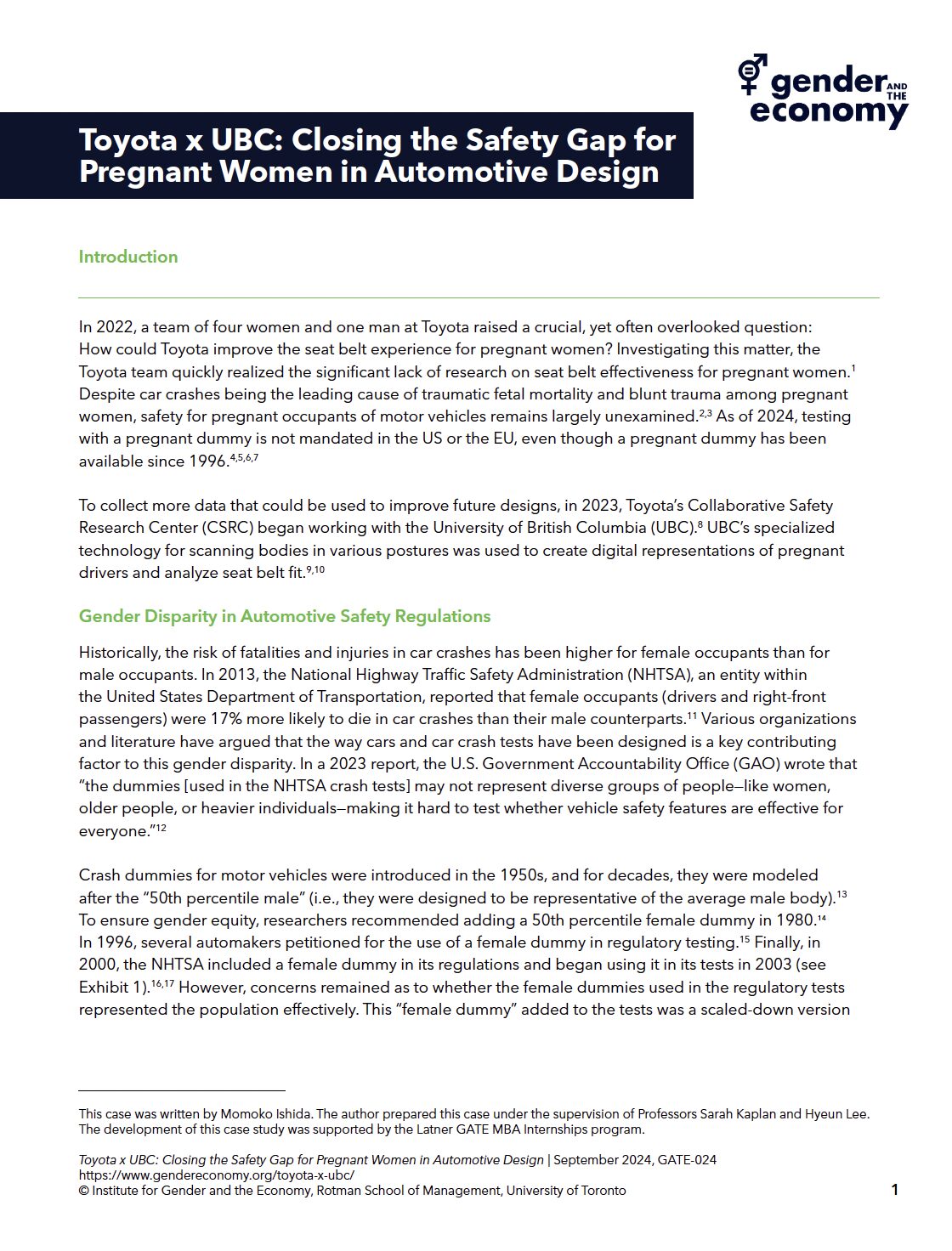
    In 2022, a team of four women and one man at Toyota raised a crucial, yet often overlooked question: How could Toyota improve the seat belt experience for pregnant women? Investigating this matter, the Toyota team quickly realized the significant lack of research on seat belt effectiveness for pregnant women. Despite car crashes being the leading cause of traumatic fetal mortality and blunt trauma among pregnant women, safety for pregnant occupants of motor vehicles remains largely unexamined. As of 2024, testing with a pregnant dummy is not mandated in the US or the EU, even though a pregnant dummy has been available since 1996.

    To collect more data that could be used to improve future designs, in 2023, Toyota’s Collaborative Safety Research Center (CSRC) began working with the University of British Columbia (UBC). UBC’s specialized technology for scanning bodies in various postures was used to create digital representations of pregnant drivers and analyze seat belt fit.

    TO VIEW AND DOWNLOAD THE FULL CASE STUDY, FOLLOW THESE INSTRUCTIONS.

     This case was written by Momoko Ishida. The author prepared this case under the supervision of Professors Sarah Kaplan and Hyeun Lee.

    The development of this case study was supported by the Latner GATE MBA Internships program. 

  • Coralus: A Collective Economy for Perpetual Investment in Women and Non-binary Ventures

    Coralus: A Collective Economy for Perpetual Investment in Women and Non-binary Ventures


    Introduction 

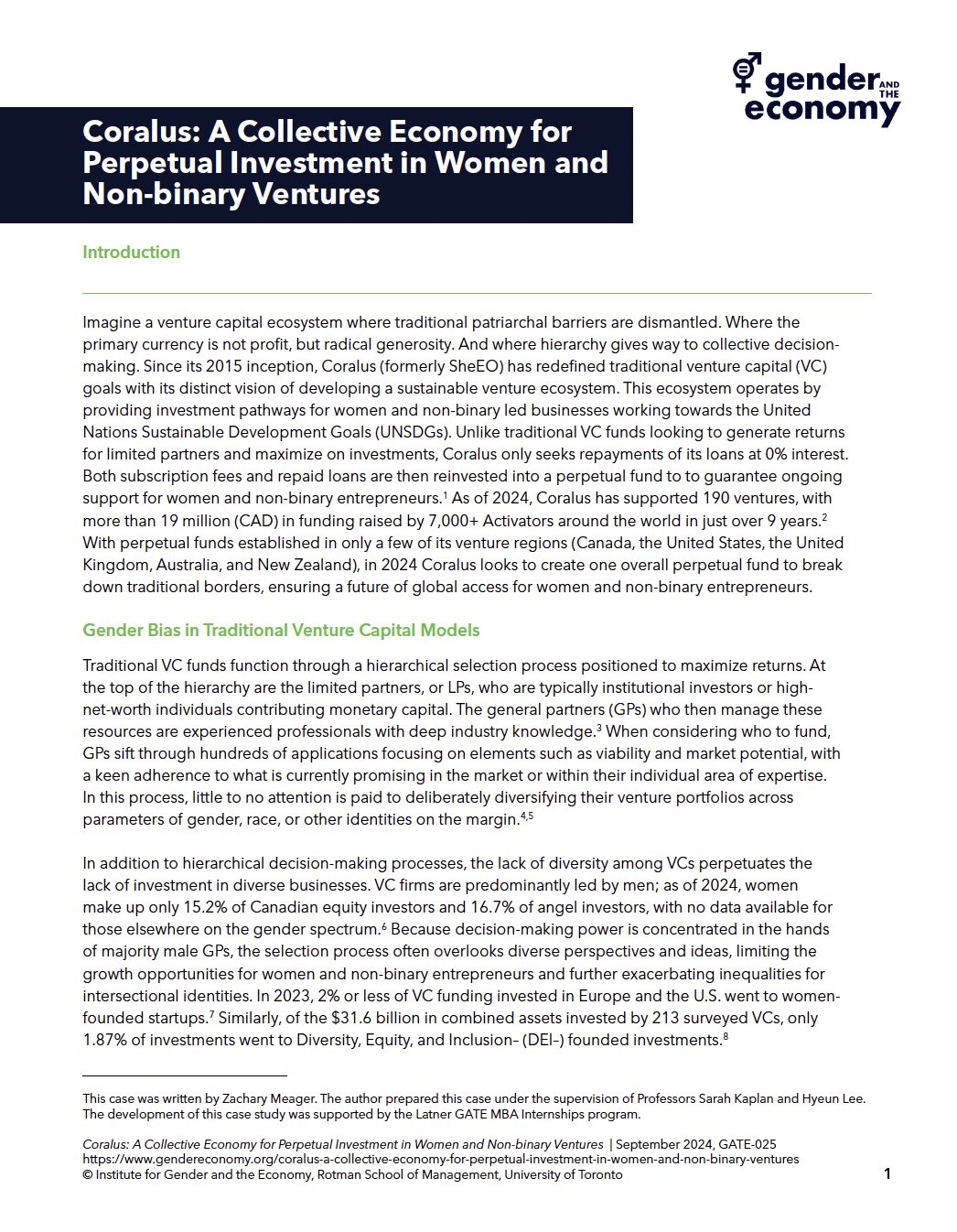
    Imagine a venture capital ecosystem where traditional patriarchal barriers are dismantled. Where the primary currency is not profit, but radical generosity. And where hierarchy gives way to collective decision-making. Since its 2015 inception, Coralus (formerly SheEO) has redefined traditional venture capital (VC) goals with its distinct vision of developing a sustainable venture ecosystem. This ecosystem operates by providing investment pathways for women and non-binary led businesses working towards the United Nations Sustainable Development Goals (UNSDGs). Unlike traditional VC funds looking to generate returns for limited partners and maximize on investments, Coralus only seeks repayments of its loans at 0% interest. Both subscription fees and repaid loans are then reinvested into a perpetual fund to to guarantee ongoing support for women and non-binary entrepreneurs.1 As of 2024, Coralus has supported 190 ventures, with more than 19 million (CAD) in funding raised by 7,000+ Activators around the world in just over 9 years.2 With perpetual funds established in only a few of its venture regions (Canada, the United States, the United Kingdom, Australia, and New Zealand), in 2024 Coralus looks to create one overall perpetual fund to break down traditional borders, ensuring a future of global access for women and non-binary entrepreneurs.

    TO VIEW AND DOWNLOAD THE FULL CASE STUDY, FOLLOW THESE INSTRUCTIONS.

     This case was written by Zachary Meager. The author prepared this case under the supervision of Professors Sarah Kaplan and Hyeun Lee. 

    The development of this case study was supported by the Latner GATE MBA Internships program. 

  • Voices of Trust: Businesses’ Role in Reconciliation

    Voices of Trust: Businesses’ Role in Reconciliation

    [fusion_builder_container hundred_percent=”no” hundred_percent_height=”no” hundred_percent_height_scroll=”no” hundred_percent_height_center_content=”yes” equal_height_columns=”no” menu_anchor=”” hide_on_mobile=”small-visibility,medium-visibility,large-visibility” status=”published” publish_date=”” class=”” id=”” border_color=”” border_style=”solid” margin_top=”” margin_bottom=”” padding_top=”” padding_right=”” padding_bottom=”2px” padding_left=”” gradient_start_color=”” gradient_end_color=”” gradient_start_position=”0″ gradient_end_position=”100″ gradient_type=”linear” radial_direction=”center center” linear_angle=”180″ background_color=”” background_image=”” background_position=”center center” background_repeat=”no-repeat” fade=”no” background_parallax=”none” enable_mobile=”no” parallax_speed=”0.3″ background_blend_mode=”none” video_mp4=”” video_webm=”” video_ogv=”” video_url=”” video_aspect_ratio=”16:9″ video_loop=”yes” video_mute=”yes” video_preview_image=”” filter_hue=”0″ filter_saturation=”100″ filter_brightness=”100″ filter_contrast=”100″ filter_invert=”0″ filter_sepia=”0″ filter_opacity=”100″ filter_blur=”0″ filter_hue_hover=”0″ filter_saturation_hover=”100″ filter_brightness_hover=”100″ filter_contrast_hover=”100″ filter_invert_hover=”0″ filter_sepia_hover=”0″ filter_opacity_hover=”100″ filter_blur_hover=”0″ type=”legacy”][fusion_builder_row][fusion_builder_column type=”1_1″ layout=”1_1″ spacing=”” center_content=”no” link=”” target=”_self” min_height=”” hide_on_mobile=”small-visibility,medium-visibility,large-visibility” class=”” id=”” hover_type=”none” border_color=”” border_style=”solid” border_position=”all” border_radius=”” box_shadow=”no” dimension_box_shadow=”” box_shadow_blur=”0″ box_shadow_spread=”0″ box_shadow_color=”” box_shadow_style=”” padding_top=”” padding_right=”” padding_bottom=”” padding_left=”” margin_top=”” margin_bottom=”” background_type=”single” gradient_start_color=”” gradient_end_color=”” gradient_start_position=”0″ gradient_end_position=”100″ gradient_type=”linear” radial_direction=”center center” linear_angle=”180″ background_color=”” background_image=”” background_image_id=”” background_position=”left top” background_repeat=”no-repeat” background_blend_mode=”none” animation_type=”” animation_direction=”left” animation_speed=”0.3″ animation_offset=”” filter_type=”regular” filter_hue=”0″ filter_saturation=”100″ filter_brightness=”100″ filter_contrast=”100″ filter_invert=”0″ filter_sepia=”0″ filter_opacity=”100″ filter_blur=”0″ filter_hue_hover=”0″ filter_saturation_hover=”100″ filter_brightness_hover=”100″ filter_contrast_hover=”100″ filter_invert_hover=”0″ filter_sepia_hover=”0″ filter_opacity_hover=”100″ filter_blur_hover=”0″ last=”true” first=”true” border_sizes_top=”0″ border_sizes_bottom=”0″ border_sizes_left=”0″ border_sizes_right=”0″][fusion_text columns=”” column_min_width=”” column_spacing=”” rule_style=”” rule_size=”” rule_color=”” hue=”” saturation=”” lightness=”” alpha=”” content_alignment_medium=”” content_alignment_small=”” content_alignment=”” hide_on_mobile=”small-visibility,medium-visibility,large-visibility” sticky_display=”normal,sticky” class=”” id=”” margin_top=”” margin_right=”” margin_bottom=”” margin_left=”” fusion_font_family_text_font=”” fusion_font_variant_text_font=”” font_size=”” line_height=”” letter_spacing=”” text_transform=”” text_color=”” animation_type=”” animation_direction=”left” animation_color=”” animation_speed=”0.3″ animation_delay=”0″ animation_offset=”” logics=””]

    Event Synopsis:

    Building on its 25-year experience studying public trust in institutions through the Trust Barometer global survey, Edelman Canada has developed a new study that focuses on trust among Indigenous communities across the country.

    Guided by the Truth and Reconciliation Commission’s Call to Action 92 upon the corporate sector to, among other things, provide education on the history and realities of Indigenous peoples, Edelman has conducted a trust survey specifically with Indigenous respondents.

    The event will kick off with a presentation of the study’s findings by Megan Spoore, National Lead of Corporate Affairs, and Sam Lessard, Vice President of Corporate Affairs, and will be followed by a panel discussion moderated by Sara Wolfe, Co-founder of Equity Cubed and Executive-in-Residence at Rotman School of Management. Panelists will delve into the role of businesses in advancing reconciliation and explore the trust dynamics between Indigenous communities and corporate institutions.

    REGISTRATION LINK

    Panelists Include:

    Keith Henry, President and Chief Executive Officer, Indigenous Tourism Association of Canada

    Angela Mark, Director, Research, Canadian Council for Aboriginal Business

    Mélanie Valcin, President and CEO, United for Literacy/Littératie Ensemble

    About our moderator:

    Sara Wolfe is a citizen of Brunswick House First Nation in Treaty 9. She is the External Director for Wilson College for Leadership and Civic Studies at McMaster University, an Executive-in-Residence at the Rotman School of Management, and co-founder of Equity Cubed. Sara is an accomplished executive leader who works at the intersection of health, education, social finance and corporate governance. Her 27 years of clinical and research practice as a community-based nurse and midwife give her a deep understanding of Indigenous culture and communities. She holds an Executive MBA from the Rotman School of Management at the University of Toronto, the ICD.D designation, and is a Senior Fellow at Massey College.

    Event Logistics:

    This event is available to attend in-person or virtually via livestream.

    Rotman Events is committed to accessibility for all people. If you have any access needs or if there are any ways we can support your full participation in this session, please email Mandi Gosling [events@rotman.utoronto.ca] no later than 2 weeks in advance of the event and we will be glad to work with you to make the appropriate arrangements.

    General Admission: In-Person Ticket Details

    • The event will be hosted in Desautels Hall at the Rotman School of Management (105 Saint George Street, Toronto, ON M5S 3E6).General Admission: Livestream
    • Rotman Events will email registrants a link to the livestream. Your registration includes access to the livestream and video replay for 30 days.

    Questions: events@rotman.utoronto.ca, Mandi Gosling