
Faculty Research Fellow Sonia Kang talks about her research on resumé whitening and the unintended consequences of diversity statements on CBC’s Metro Morning
Tag: Diversity+inclusion
Research briefs, news, and event recaps related to diversity and inclusion.
-

The challenges of gender diversity can affect whether firms “survive and thrive”
[fusion_builder_container hundred_percent=”no” equal_height_columns=”no” menu_anchor=”” hide_on_mobile=”small-visibility,medium-visibility,large-visibility” class=”” id=”” background_color=”” background_image=”” background_position=”center center” background_repeat=”no-repeat” fade=”no” background_parallax=”none” parallax_speed=”0.3″ video_mp4=”” video_webm=”” video_ogv=”” video_url=”” video_aspect_ratio=”16:9″ video_loop=”yes” video_mute=”yes” overlay_color=”” video_preview_image=”” border_color=”” border_style=”solid” padding_top=”” padding_bottom=”” padding_left=”” padding_right=”” type=”legacy”][fusion_builder_row][fusion_builder_column type=”1_1″ layout=”1_1″ background_position=”left top” background_color=”” border_color=”” border_style=”solid” border_position=”all” spacing=”yes” background_image=”” background_repeat=”no-repeat” padding_top=”” padding_right=”” padding_bottom=”” padding_left=”” margin_top=”0px” margin_bottom=”0px” class=”” id=”” animation_type=”” animation_speed=”0.3″ animation_direction=”left” hide_on_mobile=”small-visibility,medium-visibility,large-visibility” center_content=”no” last=”true” min_height=”” hover_type=”none” link=”” border_sizes_top=”” border_sizes_bottom=”” border_sizes_left=”” border_sizes_right=”” first=”true”][fusion_text columns=”” column_min_width=”” column_spacing=”” rule_style=”” rule_size=”” rule_color=”” hue=”” saturation=”” lightness=”” alpha=”” content_alignment_medium=”” content_alignment_small=”” content_alignment=”” hide_on_mobile=”small-visibility,medium-visibility,large-visibility” sticky_display=”normal,sticky” class=”” id=”” margin_top=”” margin_right=”” margin_bottom=”” margin_left=”” fusion_font_family_text_font=”” fusion_font_variant_text_font=”” font_size=”” line_height=”” letter_spacing=”” text_transform=”” text_color=”” animation_type=”” animation_direction=”left” animation_color=”” animation_speed=”0.3″ animation_delay=”0″ animation_offset=”” logics=””]In one of four short talks on how to “Survive and Thrive,” Sarah Kaplan talks about the challenges of achieving gender diversity.
The Rotman School strategy area launched its new book: Survive and Thrive: Winning Against Strategic Threats to Your Business. In one of the 4 short talks launching the book, GATE director, Sarah Kaplan, spoke about the challenges of achieving gender diversity in your business on November 7, 2017.
In it, she talks about how lack of attention to diversity issues can lead to important challenges to businesses including lawsuits, reputational damage and struggles in the war for talent. She highlights four actions individuals and organizations can do to invest in equality: sponsoring (not just mentoring); enrolling and engaging to build support in the organization; increasing transparency of information on recruiting, pay and promotions; and monitoring people and holding them accountable.
The full chapter is available here.
About “Survive and Thrive”
From Volkswagen to BP, from Blackberry to Bombardier, from United Airlines to Equifax, businesses — large and small — face threats to their survival. These worries keep corporate leaders awake and night. Is there anything businesses can do about it?
This question and more is answered in the new book, Survive and Thrive: Winning Against Strategic Threats to Your Business, featuring a collection of insights by strategy professors at the University of Toronto’s Rotman School of Management. The book takes readers through some of the most vexing threats to business today, threats that put the very existence of organizations into question. From disruptive innovation, to social media disasters, to mistaken technical investments, to gender discrimination, to misunderstood competition, companies need to be able to anticipate crises and prepare to deal with them head on. Reading this book, readers will get warnings about four mistakes that companies commonly make – blindness to interactions between systems, getting locked in to existing ways of doing business, falling victim to cognitive biases, and derailment by short-termism.
The good news is that mistakes can be managed. Using structured anticipation, companies can prepare, reorganise and challenge themselves to embrace rather than shirk from risk.
Executives will find principles and practices for anticipating potential threats and creating responses that permit their businesses to not only survive but thrive.
Editor Joshua S. Gans is a professor of strategic management and holds the Jeffrey S. Skoll Chair of Technical Innovation and Entrepreneurship at the Rotman School. He is also chief economist of the School’s Creative Destruction Lab. He wrote The Disruption Dilemma, Information Wants to be Shared, and several other books.
Editor Sarah Kaplan, Director of the Institute for Gender and the Economy at the Rotman School, is also Distinguished Professor of Gender and the Economy and a professor of strategic management. She co-wrote the business bestseller Creative Destruction.
“The mantra for the book is that leaders need to be alert and not panicked. While there are always threats that can take out a business, alongside those threats are manageable actions that can be deployed to either pre-empt or confront them,” say Profs. Gans and Kaplan.
In addition to Profs. Gans and Kaplan, contributors to the book include Rotman Professors Ajay Agrawal, Anne Bowers, Kevin Bryan, Alberto Galasso, Anita McGahan, Will Mitchell, A. Rebecca Reuber, Michael Ryall, and András Tilcsik.
Further information is available online at www.surviveandthrivebook.net or on major online booksellers.
[/fusion_text][fusion_separator style_type=”none” hide_on_mobile=”small-visibility,medium-visibility,large-visibility” class=”” id=”” sep_color=”” top_margin=”50″ bottom_margin=”50″ border_size=”” icon=”” icon_circle=”” icon_circle_color=”” width=”” alignment=”center” /][fusion_button link=”https://www.gendereconomy.org/events/” text_transform=”” title=”” target=”_blank” link_attributes=”” alignment=”” modal=”” hide_on_mobile=”small-visibility,medium-visibility,large-visibility” class=”” id=”” color=”custom” button_gradient_top_color=”#62bd19″ button_gradient_bottom_color=”#62bd19″ button_gradient_top_color_hover=”#00c2e2″ button_gradient_bottom_color_hover=”#00c2e2″ accent_color=”” accent_hover_color=”” type=”” bevel_color=”” size=”” stretch=”yes” icon=”” icon_position=”left” icon_divider=”no” animation_type=”” animation_direction=”left” animation_speed=”0.3″ animation_offset=””]See more past events[/fusion_button][fusion_separator style_type=”none” hide_on_mobile=”small-visibility,medium-visibility,large-visibility” class=”” id=”” sep_color=”” top_margin=”20″ bottom_margin=”20″ border_size=”” icon=”” icon_circle=”” icon_circle_color=”” width=”” alignment=”center” /][fusion_title margin_top=”” margin_bottom=”” hide_on_mobile=”medium-visibility,large-visibility” class=”” id=”” size=”5″ content_align=”center” style_type=”default” sep_color=””]
Or register below for these upcoming events
[/fusion_title][fusion_recent_posts layout=”default” hover_type=”none” columns=”3″ number_posts=”3″ offset=”0″ pull_by=”category” cat_slug=”events” exclude_cats=”past” tag_slug=”” exclude_tags=”” thumbnail=”yes” title=”yes” meta=”no” meta_author=”no” meta_categories=”no” meta_date=”yes” meta_comments=”yes” meta_tags=”no” content_alignment=”” excerpt=”no” excerpt_length=”35″ strip_html=”yes” scrolling=”no” hide_on_mobile=”medium-visibility,large-visibility” class=”” id=”” animation_type=”” animation_direction=”left” animation_speed=”0.3″ animation_offset=”” /][/fusion_builder_column][/fusion_builder_row][/fusion_builder_container]
-

Gender diversity increases corporate board effectiveness
[fusion_builder_container admin_label=”” hundred_percent=”no” equal_height_columns=”no” menu_anchor=”” hide_on_mobile=”small-visibility,medium-visibility,large-visibility” class=”” id=”” background_color=”” background_image=”” background_position=”center center” background_repeat=”no-repeat” fade=”no” background_parallax=”none” enable_mobile=”no” parallax_speed=”0.3″ video_mp4=”” video_webm=”” video_ogv=”” video_url=”” video_aspect_ratio=”16:9″ video_loop=”yes” video_mute=”yes” video_preview_image=”” border_size=”” border_color=”” border_style=”solid” margin_top=”20″ margin_bottom=”” padding_top=”” padding_right=”” padding_bottom=”” padding_left=””][fusion_builder_row][fusion_builder_column type=”3_4″ layout=”3_4″ spacing=”” center_content=”no” hover_type=”none” link=”” min_height=”” hide_on_mobile=”small-visibility,medium-visibility,large-visibility” class=”” id=”” background_color=”” background_image=”” background_position=”left top” background_repeat=”no-repeat” border_size=”0″ border_color=”” border_style=”solid” border_position=”all” padding_top=”” padding_right=”” padding_bottom=”” padding_left=”” dimension_margin=”” animation_type=”” animation_direction=”left” animation_speed=”0.3″ animation_offset=”” last=”no”][fusion_text columns=”” column_min_width=”” column_spacing=”” rule_style=”default” rule_size=”” rule_color=”” class=”” id=””]
Summary
While the number of women on S&P 1500 boards continues to increase steadily, women remain significantly underrepresented and, as of 2013, not represented at all on 25% of the boards. Many countries outside the US have addressed this inequality by implementing regulations (e.g. quotas, public disclosure), citing evidence that more diverse boards increase firm value. However, the research on this link is mixed. This study isolates the ways in which gender diversity might improve firm value through additional expertise in a particular field or function. The findings show that boards are more effective when they are made up of people with diverse contributions and that women are more likely than men to bring new and unique skills to the board.
Research
Building on research that links better advice from a firm’s board with increased firm value, this paper asks: Do women increase a board’s effectiveness, and thus its value, and what is it about their contributions that cause this? Research supports that variation in functional experience contributes to a board’s diversity and produces better quality decisions and more creative, innovative insights. This paper set out to determine whether women are more likely to contribute to the functional diversity on a board–thereby enhancing board effectiveness and increasing firm value.
Variation in functional experience contributes to a board’s diversity and produces better quality decisions, as well as more more creative, innovative insights.
Given that women are more significantly underrepresented on smaller boards, this study focused on firms in the S&P SmallCap 60 Index and their disclosure of the functional types represented on their board. The researchers first looked at the newly appointed female board directors and found that women were more likely than men to contribute additional, new, and more distinct types of expertise. Thus, when women join boards, they contribute more than men to the diversity of functional experience present on the board
Women were more likely than men to contribute additional, new, and more distinct types of expertise.
The study found that not only do women, on average, possess more types of functional expertise, they are also more likely to bring expertise in the areas of risk management, human resources, sustainability, corporate governance, regulatory/legal/compliance, and political/government. They also noted that of the most underrepresented board skills overall, four of the five (human resources, risk management, sustainability, political/government, and R&D) were more likely to be possessed by women than men.
These findings demonstrate that increasing female representation on boards will increase board diversity given their new and unique skill contribution. Thus increasing the effectiveness of the board and, in turn, increase firm value.
Implications
- Expand recruitment – Women are more likely to bring important and underrepresented skills to corporate boards and steps should be taken to increase their presence. When boards expand their search to increase gender diversity, they will acquire greater functional diversity in key areas which will, in turn, increase the effectiveness of the board.
- Transparent policies – Policies that require or encourage public disclosure of board composition or set quotas may help increase the diversity on boards.
- Shift what “good” looks like – Men disproportionately bring experience in finance and operations (“line jobs” that men historically hold) but not human resources, governance, risk management, etc. (“staff jobs” that women have historically taken). Because we have prioritized certain (predominantly male) functions on boards, women who have historically been relegated to certain undervalued functions continue to be underrepresented.
[/fusion_text][fusion_separator style_type=”none” hide_on_mobile=”small-visibility,medium-visibility,large-visibility” class=”” id=”” sep_color=”” top_margin=”20″ bottom_margin=”20″ border_size=”” icon=”” icon_circle=”” icon_circle_color=”” width=”” alignment=”center” /][fusion_button link=”https://www.gendereconomy.org/research-briefs/” text_transform=”” title=”” target=”_blank” link_attributes=”” alignment=”” modal=”” hide_on_mobile=”small-visibility,medium-visibility,large-visibility” class=”” id=”” color=”custom” button_gradient_top_color=”#62bd19″ button_gradient_bottom_color=”#62bd19″ button_gradient_top_color_hover=”#00c2e2″ button_gradient_bottom_color_hover=”#00c2e2″ accent_color=”” accent_hover_color=”” type=”” bevel_color=”” border_width=”” size=”” stretch=”yes” shape=”” icon=”” icon_position=”left” icon_divider=”no” animation_type=”” animation_direction=”left” animation_speed=”0.3″ animation_offset=””]See more research briefs[/fusion_button][fusion_separator style_type=”none” hide_on_mobile=”small-visibility,medium-visibility,large-visibility” class=”” id=”” sep_color=”” top_margin=”20″ bottom_margin=”20″ border_size=”” icon=”” icon_circle=”” icon_circle_color=”” width=”” alignment=”center” /][fusion_recent_posts layout=”default” hover_type=”none” columns=”3″ number_posts=”3″ offset=”0″ pull_by=”category” cat_slug=”research-briefs” exclude_cats=”” tag_slug=”” exclude_tags=”” thumbnail=”yes” title=”yes” meta=”no” meta_author=”no” meta_categories=”no” meta_date=”yes” meta_comments=”yes” meta_tags=”no” content_alignment=”” excerpt=”no” excerpt_length=”35″ strip_html=”yes” scrolling=”no” hide_on_mobile=”small-visibility,medium-visibility,large-visibility” class=”” id=”” animation_type=”” animation_direction=”left” animation_speed=”0.3″ animation_offset=”” /][/fusion_builder_column][fusion_builder_column type=”1_4″ layout=”1_4″ spacing=”” center_content=”no” hover_type=”none” link=”” min_height=”” hide_on_mobile=”small-visibility,medium-visibility,large-visibility” class=”” id=”” background_color=”” background_image=”” background_position=”left top” background_repeat=”no-repeat” border_size=”0″ border_color=”” border_style=”solid” border_position=”all” padding_top=”” padding_right=”” padding_bottom=”” padding_left=”” dimension_margin=”” animation_type=”” animation_direction=”left” animation_speed=”0.3″ animation_offset=”” last=”no”][fusion_title margin_top=”” margin_bottom=”” hide_on_mobile=”small-visibility,medium-visibility,large-visibility” class=”briefsummary” id=”” size=”3″ content_align=”left” style_type=”none” sep_color=””]
Title
Gender Diversity on Corporate Boards: Do Women Contribute Unique Skills?”
Authors
Daehyun Kim, Laura T. Starks
Institutions
University of Toronto,
University of Texas at AustinSource
American Economic Review
Published
May 2016
Link
https://www.aeaweb.org/
articles?id=10.1257/
aer.p20161032Research brief prepared by
Celeste Jalbert
[/fusion_title][fusion_widget_area name=”avada-custom-sidebar-researchbriefsidebar” title_size=”” title_color=”” background_color=”” padding_top=”” padding_right=”” padding_bottom=”” padding_left=”” hide_on_mobile=”small-visibility,medium-visibility,large-visibility” class=”” id=”” /][/fusion_builder_column][/fusion_builder_row][/fusion_builder_container]
-

GATE-funded researcher receives Canada Research Chair in Strategy, Organizations, and Society
András Tilcsik, associate professor of strategic management, received a Tier 2 Canada Research Chair.
-

The debate about quotas
[fusion_builder_container admin_label=”” hundred_percent=”no” equal_height_columns=”no” menu_anchor=”” hide_on_mobile=”small-visibility,medium-visibility,large-visibility” class=”” id=”” background_color=”” background_image=”” background_position=”center center” background_repeat=”no-repeat” fade=”no” background_parallax=”none” enable_mobile=”no” parallax_speed=”0.3″ video_mp4=”” video_webm=”” video_ogv=”” video_url=”” video_aspect_ratio=”16:9″ video_loop=”yes” video_mute=”yes” video_preview_image=”” border_size=”” border_color=”” border_style=”solid” margin_top=”20″ margin_bottom=”” padding_top=”” padding_right=”” padding_bottom=”” padding_left=””][fusion_builder_row][fusion_builder_column type=”3_4″ layout=”3_4″ spacing=”” center_content=”no” hover_type=”none” link=”” min_height=”” hide_on_mobile=”small-visibility,medium-visibility,large-visibility” class=”” id=”” background_color=”” background_image=”” background_position=”left top” background_repeat=”no-repeat” border_size=”0″ border_color=”” border_style=”solid” border_position=”all” padding_top=”” padding_right=”” padding_bottom=”” padding_left=”” margin_top=”” margin_bottom=”” animation_type=”” animation_direction=”left” animation_speed=”0.3″ animation_offset=”” last=”no”][fusion_text columns=”” column_min_width=”” column_spacing=”” rule_style=”default” rule_size=”” rule_color=”” hide_on_mobile=”small-visibility,medium-visibility,large-visibility” class=”” id=””]
Download the infographic. View the video explainer.
The gender equality challenge
Policy makers and organizations have been working toward achieving gender diversity for many decades, but progress has been slow and is perhaps even stagnating. Only 5% of the 500 CEOs on the 2016 Fortune 500 list are women, a mere 27 out of 500. Men are two to three times more likely to hold senior management positions, a figure that has stagnated for almost 30 years despite widespread efforts to remedy this imbalance. Employers still lean toward hiring men over women who have similar qualifications, and the gender wage gap persists in numerous occupations. In Canada, despite implementation of a “comply or explain” disclosure regime to facilitate gender diversity on boards of directors, 45% of companies still have no women on their boards.1 Notwithstanding extensive research on the topic and widespread diversity initiatives, gender representation remains a persistent problem in corporate leadership and in the workforce.
Only 5% of the 500 CEOs on the 2016 Fortune 500 list are women, a mere 27 out of 500.
Many have believed that it would be enough to develop “gender blind” or “gender neutral” management practices. The argument has been, if employers introduce structures and systems that focus on the objective merit of employees and job candidates, they should be able to overcome discrimination based on implicit or explicit biases. Yet, these systems seem not to have helped organizations make enough progress. Even some gender aware policies, such as requirements to fill candidate pools with underrepresented minorities without setting hard quotas, have failed to solve the key problem of female representation. At the rate we are going in North America, achieving 30% female representation on boards of directors, for example, would require at least 30 years.
Achieving 30% female representation on boards of directors would require at least 30 years.
Because of this sluggish progress toward gender equality, organizations and policy makers are increasingly considering the possibility of implementing quotas, particularly at the level of board directors, to achieve gender parity. Quotas, it is argued, would jump start the process of achieving equal representation. Yet, the idea of imposing quotas on employers – even only at the level of the board of directors – has been met with resistance. As a result, quotas have remained shrouded in controversy about their expected benefits and potential pitfalls.
Recently, leading scholars gathered to debate this question during the Gender and the Economy Research Roundtable held at the Rotman School of Management at the University of Toronto. In the format of an Oxford-style debate, Professors Tiziana Casciaro (University of Toronto, Rotman School), Aaron Dhir (Osgoode Hall Law School, York University), Lisa Leslie (NYU Stern School) and Nico Lacetera (University of Toronto, Institute for Management and Innovation; National Bureau of Economic Research) presented their research-based arguments for and against quotas as an important and useful tool for achieving gender equality in the workforce. The points below are a summary of the main arguments made in the debate.
Why quotas might not work
Research suggests that there might be a number of reasons for being concerned about the effect of quotas.
- Illegal or perceived as unjust. In some jurisdictions, quotas may violate legislation. In the United States, for example, constitutional law would likely present insurmountable obstacles to the promulgation of a quota-based regime. Even where quotas are legal, people may interpret quotas as a violation of perceptions of justice at the individual level, even if they are creating more fairness in terms of gender distribution at the societal level.2 From a psychological perspective, any gain for one group (in this case, women) is often perceived as a loss for another group (in this case, men), leading men potentially to perceive quotas as unfair.3
- Potential stigma. One risk is that those women who are included in boards due to the imposition of quotas might be stigmatized. There is a possibility that they will be seen as less qualified and only on the board because of the quotas. This may hurt their ability to contribute to board discussions and undermine their effectiveness. This is particularly true if women are added to boards at token levels. Evidence suggests that a single woman on a board will likely be marginalized or delegitimized.4
When a woman is the only female member on a board, she will likely be marginalized or delegitimized
- Reduced employee engagement. Perceptions of unfairness can trigger unintended negative consequences. Employers who impose quotas may become less attractive to male job applicants. Quotas may also lead to low engagement and negative job attitudes among male employees. Furthermore, this perception of unfairness may cause men to become less supportive of diversity policies than they were prior to implementing quotas.
- Reduced support for diversity initiatives. Research has long established that people can be motivated by intrinsic (personal) or extrinsic (externally provided) rewards. Quotas act as an extrinsic motivator because they are a rule imposed externally that forces managers to behave in a certain way. Psychological research has consistently shown that when someone else forces or rewards people for doing something, they become less motivated about the task: they attribute their motivation to coercion. In the case of quotas, even if employees personally believe in working toward gender diversity, imposed quotas can make them believe that they only care about diversity because the company wants them to, not because they do personally. Indeed, research suggests that external prompts, such as mandatory diversity training or grievance systems, are associated with negative impacts on the representation of women.5
Psychological research has consistently shown that when someone else forces or rewards people for doing something, they become less motivated about the task
- No trickle down. Much of the conversation about quotas has focused on assuring that more women are represented on corporate boards of directors. This has the effect of democratizing access to opportunities in an important area of leadership. However, there is evidence that such quotas fail to lead to broader organizational impacts. For example, the quotas implemented in Norway did result in women holding 40% of board seats, but the positive effects in the boardrooms did not trickle down to lower levels in companies. A study showed that the benefits were strictly limited to the board level, and underrepresentation and wage disparities persisted at all other levels.6 For those who have argued that greater proportions of women on boards are correlated with performance, little evidence was found in Norway to support this claim.7 8 9
- Failure to address underlying discrimination. Evidence from Norway suggests that quotas may not change anything about the deeper-rooted problem. For example, many Norwegian companies delisted from the stock exchange at the time quotas were imposed (though some of this may have been due to a contemporaneous modification in rules that changed the requirement that financial firms had to be public). In the early days of the quota implementation, a small group of women called the “golden skirts” came to hold several board positions at different organizations. Quotas merely require a certain number of women to be present in a workplace, and this imposed number can distort the real purposes for promoting gender parity and diversity.
Why quotas could work
Yet, other evidence suggests that concerns about the negative impacts of quotas may be overblown.
- Fears not realized. In interviews of board members in the US and Europe, it appeared that there is hostility toward quotas in countries that don’t have them and enthusiasm for quotas in countries that do have them.10 In other words, only those who were unfamiliar with quotas thought they were a bad thing. Indeed, when examining the lived experiences of board members in Norway, there was a strong narrative of change.11 While directors in the Norwegian companies had initially strongly opposed quotas, once quotas were imposed by the government, the directors eventually changed their minds. According to these directors, their fears were unfounded, and, after a period of transition, they felt that the increased representation of women on boards actually improved overall governance and decision making. One analogy that some have made is to that of banning smoking in restaurants and bars. These policies – initially vehemently opposed by business establishments as risking financial losses – now are widely accepted and favourably viewed as a public good by almost everyone.
There is hostility toward quotas in countries that don’t have them and enthusiasm for quotas in countries that do have them
- No pipeline problem. An initial question about imposing quotas is always: where will we find the women? A survey of more than 1,000 board members found that men attributed the existing imbalance to a lack of women in the candidate pools, whereas women explained it as a function of established closed male networks and biases. While in Norway, there was an initial “golden skirt” effect where a few women held many seats, after a few years this problem resolved itself and now there are many different women represented on the country’s boards of directors. The imposition of quotas led boards to search more creatively and expansively for board members – beyond their Rolodexes – and this dramatically increased the candidate pool.
- No stigma. Evidence from the Norwegian experience suggests that few female board members who had been beneficiaries of the quotas reported feeling stigmatized or isolated. This was in part because with a 40% quota, women achieved a critical mass on every board. At 40% representation, a group is no longer marginalized. Simply having enough women is a means for countering the potential negative stigma, while adding only one or two women leads to tokenization and delegitimization.
With a 40% quota, women achieved a critical mass on every board
- Substantial Positive effects. Research suggests that insisting on a critical mass of women on boards can lead to several benefits in terms of board governance, including more robust deliberation, disruption of groupthink, more effective risk management, higher quality monitoring of management, and more systematic work.12 Indeed, because searches for women board members often lead to candidates who may not fit the typical profile, women end up bringing more diverse experience in a wider variety of functional areas than men – often adding skills in the areas of HR, government relations, and marketing that might have been lacking.13 The new women board members introduced new viewpoints not previously considered.
The new women board members introduced new viewpoints not previously considered.
- A useful shock to the system. As ample research has established, gender biases are built into many organizational systems and human decision making processes. Psychological research shows that we are susceptible to unconscious biases and stereotypes. Additionally, research tells us that we form networks with others who are socially similar to ourselves. As a whole, these unconscious processes are deeply embedded in individuals and organizational systems, and it is unrealistic to expect that these will disappear without an abrupt external shock. Under the Canadian “comply or explain” approach to board diversity, the primary explanation offered by companies who do not adopt gender targets is that they recruit “based on merit.”14 However, research shows that supposedly meritocratic systems are as susceptible to these biases as other systems (and perhaps even more).15 Thus, quotas provide a stringent and structured framework to overcome these unconscious biases such that there is less room for unintended discrimination to emerge.
Next steps
We can glean advice from this debate about what mistakes and pitfalls to avoid when enforcing quotas – or more broadly, affirmative action programs – and what some alternatives to this form of action may be.
If you do impose quotas, how can you avoid the pitfalls?
The debated suggested that quotas can be very effective and even well-received if implemented with care. Some actions include:
- Change the narrative. There is evidence that how affirmative action plans are framed matters. In particular, when decision makers justify an affirmative action (quota) plan because of the need to remedy past discrimination or the desire to increase diversity, they reduce negative reactions to the policy. Alternatively, just saying that a certain group is underrepresented increases negative reactions.16
- Establish a critical mass. A quota of 20% women is unlikely to perpetuate any positive change and will instead incur negative reactions. As shown in interviews with female directors in Norway, marginalization becomes difficult when 40% of the workforce are women. This is a potential difficulty with the “comply or explain” approach. It may lead boards to make incremental progress, adding one woman at a time. Where there is low representation, then the risks of stigmatization and tokenism increase.
As shown in interviews with female directors in Norway, marginalization becomes difficult when 40% of the board members are women.
- Expand your search. To avoid the problem of having the same small group of women getting appointed to various different boards or positions – termed “golden skirts” in Norway – employers should be actively seeking and reaching out to women so they have a large qualified pool from which they can extract large numbers of qualified women.
- Expand your definition of the ideal candidate. There are competent and qualified women out there, but companies must look beyond their typical circle of recruitment and reach out. Research has shown that people have prototypes about the ideal worker, or the ideal leader, which is typically male. Recruiters need to expand their idea of an ideal candidate beyond the male prototype and create a large pool of qualified female candidates.
- Provide support to facilitate quota implementation. Simply imposing a quota is not enough, and there should be support in the form of policies to facilitate quotas. For example, parental leave policies and work re-entry programs for both men and women should be in place to avoid potential pitfalls and help smooth out the process.
- Expect some discomfort. Moving to quotas may not be a smooth process. Even in Norway, where there is general satisfaction with quotas now, there was a period of transition. Organizational change is never easy, but it is the price to pay for the benefits.
If you don’t use quotas, how can you make enough progress?17 18
The debate suggested some tools for making change without using quotas. These include:
- Engage in targeted recruiting. Reach out and find women to apply for jobs and offer them resources for training, but do not impose a required number of women to be hired. Research shows that the larger number of women in your candidate pool, the higher the chance you will hire a woman. Recent research has shown that when you have just one woman in the finalist candidate pool, there is statistically no chance that she will be hired.19
The larger number of women in your candidate pool, the higher the chance you will hire a woman
- Provide voluntary opportunities for diversity training. Voluntary diversity training for managers are programs where they can voluntarily sign up for training sessions that teach them the benefits of diversity and how to reduce unconscious bias. These programs, when voluntary, have been shown through research to increase diversity efforts and beliefs, and increase the number of women and minorities hired.
- Appoint diversity managers. Designating specific roles dedicated to creating and sustaining diversity at the workplace will signal that the organization is committed to diversity and will create more awareness about diversity issues. Research has also shown that appointing diversity managers increases social accountability, or the desire to look more fair-minded for other managers, and increases the hiring rate of women and other minorities.
- Create corporate diversity task forces. Effective task forces include department heads and other line executives as well as members of underrepresented groups. Task forces can analyze information on diversity for the whole company, for business units, and for departments to figure out what needs attention and then develop action plans for change. These task forces also help promote social accountability of the organization as a whole.
- Hold people accountable. One form of accountability is through transparency, as research shows that people monitor their own biases when they expect that others will see what decisions they make. A second form of accountability is through external monitoring, in which achieving diversity targets is part of a person’s compensation and reward system.
People monitor their own biases when they expect that others will see what decisions they make.
The debate helps bring research-based evidence to change the conversation about quotas.
Suggested reading list for more information
Dhir, Aaron A. Challenging boardroom homogeneity: Corporate law, governance, and diversity. Cambridge University Press, 2015.
Dhir, Aaron A. “What Norway Can Teach the U.S. About Getting More Women Into Boardrooms.” The Atlantic. Atlantic Media Company, 4 May 2015.
Dobbin, Frank, and Alexandra Kalev. “Why Diversity Programs Fail.” Harvard Business Review. Harvard Business Publishing, Aug. 2016.
Johnson, Stefanie K., David R. Hekman, and Elsa T. Chan. “If There’s Only One Woman in Your Candidate Pool, There’s Statistically No Chance She’ll Be Hired.” Harvard Business Review. Harvard Business Publishing, 26 Apr. 2016.
Kaplan, Sarah (2015). “Meritocracy: From Myth to Reality.” Rotman Magazine (Spring: 48-53)
Wiersema, Margarethe, and Marie Louise Mors. “What Board Directors Really Think of Gender Quotas.” Harvard Business Review. Harvard Business Press, 14 Nov. 2016.
References cited in summary
1 CSA Multilateral Staff Notice 58-308 Staff Review of Women on Boards and in Executive Officer Positions – Compliance with NI 58-101 Disclosure of Corporate Governance Practices, September 28, 2016
2 Lowery, B. S., Unzueta, M. M., Knowles, E. D., & Goff, P. A. (2006). Concern for the in-group and opposition to affirmative action. Journal of Personality and Social Psychology, 90, 961-974.
3 Shteynberg, G., Leslie, L. M., Knight, A. P., & Mayer, D. M. (2011). But affirmative action hurts us! Race-related beliefs shape perceptions of White disadvantage and policy unfairness. Organizational Behavior and Human Decision Processes, 115, 1-12.
4 Leslie, L. M., Mayer, D. M., & Kravitz, D. A. (2014). The stigma of affirmative action: A stereotyping-based theory and meta-analytic test of the consequences for performance. Academy of Management Journal, 57, 964-989.
5 Dobbin, F., Schrage, D., & Kalev, A. (2015). Rage against the Iron Cage: The Varied Effects of Bureaucratic Personnel Reforms on Diversity. American Sociological Review.
6 Bertrand, M., Black, S. E., Jensen, S., & Lleras-Muney, A. (2014). Breaking the glass ceiling? The effect of board quotas on female labor market outcomes in Norway (No. w20256). National Bureau of Economic Research.
7 Adams, R. B., & Ferreira, D. (2009). Women in the boardroom and their impact on governance and performance. Journal of Financial Economics, 94, 291-309.
8 Ahern, K. R., & Dittmar, A. K. (2012). The changing of the boards: The impact on firm valuation of mandated female board representation. Quarterly Journal of Economics, 127, 137-197.
9 Matsa, D. A., & Miller, A. R. (2013). A female style in corporate leadership? Evidence from quotas. American Economic Journal: Applied Economics, 5, 136-69.
10 Wiersema, Margarethe, and Marie Louise Mors. “What Board Directors Really Think of Gender Quotas.” Harvard Business Review. Harvard Business Press, 14 Nov. 2016.
11 Dhir, Aaron A. Challenging boardroom homogeneity: Corporate law, governance, and diversity. Cambridge University Press, 2015.
12 Dhir, Aaron A. Challenging boardroom homogeneity: Corporate law, governance, and diversity. Cambridge University Press, 2015.
13 Kim, Daehyun & Laura Starks, Gender Diversity on Corporate Boards: Do Women Contribute Unique Skills? American Economic Review: Papers & Proceedings, 106(5): 267-27
14 CSA Multilateral Staff Notice 58-308 Staff Review of Women on Boards and in Executive Officer Positions – Compliance with NI 58-101 Disclosure of Corporate Governance Practices, September 28, 2016, p. 6.
15 Kaplan, Sarah (2015). Meritocracy: From Myth to Reality. Rotman Magazine (Spring: 48-53)
16 Harrison, D. A., Kravitz, D. A., Mayer, D. M., Leslie, L. M., & Lev-Arey, D. (2006). Understanding attitudes toward affirmative action programs in employment: Summary and meta-analysis of 35 years of research. Journal of Applied Psychology, 91, 1013-1036.
17 Dobbin, Frank, and Alexandra Kalev. “Why Diversity Programs Fail.” Harvard Business Review. Harvard Business Publishing, Aug. 2016.
8 Dobbin, F., Schrage, D., & Kalev, A. (2015). Rage against the Iron Cage: The Varied Effects of Bureaucratic Personnel Reforms on Diversity. American Sociological Review.
19 Johnson, Stefanie K., David R. Hekman, and Elsa T. Chan. “If There’s Only One Woman in Your Candidate Pool, There’s Statistically No Chance She’ll Be Hired.” Harvard Business Review. Harvard Business Publishing, 26 Apr. 2016.[/fusion_text][fusion_separator style_type=”none” hide_on_mobile=”small-visibility,medium-visibility,large-visibility” class=”” id=”” sep_color=”” top_margin=”20″ bottom_margin=”20″ border_size=”” icon=”” icon_circle=”” icon_circle_color=”” width=”” alignment=”center” /][fusion_button link=”https://www.gendereconomy.org/category/research-overviews/” text_transform=”” title=”” target=”_blank” link_attributes=”” alignment=”” modal=”” hide_on_mobile=”small-visibility,medium-visibility,large-visibility” class=”” id=”” color=”custom” button_gradient_top_color=”#62bd19″ button_gradient_bottom_color=”#62bd19″ button_gradient_top_color_hover=”#00c2e2″ button_gradient_bottom_color_hover=”#00c2e2″ accent_color=”” accent_hover_color=”” type=”” bevel_color=”” border_width=”” size=”” stretch=”yes” shape=”” icon=”” icon_position=”left” icon_divider=”no” animation_type=”” animation_direction=”left” animation_speed=”0.3″ animation_offset=””]See more research overviews[/fusion_button][fusion_separator style_type=”none” hide_on_mobile=”small-visibility,medium-visibility,large-visibility” class=”” id=”” sep_color=”” top_margin=”20″ bottom_margin=”20″ border_size=”” icon=”” icon_circle=”” icon_circle_color=”” width=”” alignment=”center” /][fusion_recent_posts layout=”default” picture_size=”fixed” hover_type=”none” columns=”3″ number_posts=”3″ offset=”0″ pull_by=”category” cat_slug=”research-overviews” exclude_cats=”” tag_slug=”” exclude_tags=”” thumbnail=”yes” title=”yes” meta=”no” meta_author=”no” meta_categories=”no” meta_date=”yes” meta_comments=”yes” meta_tags=”no” content_alignment=”” excerpt=”no” excerpt_length=”35″ strip_html=”yes” scrolling=”no” hide_on_mobile=”small-visibility,medium-visibility,large-visibility” class=”” id=”” animation_type=”” animation_direction=”left” animation_speed=”0.3″ animation_offset=”” /][/fusion_builder_column][fusion_builder_column type=”1_4″ layout=”1_4″ spacing=”” center_content=”no” hover_type=”none” link=”” min_height=”” hide_on_mobile=”small-visibility,medium-visibility,large-visibility” class=”” id=”” background_color=”” background_image=”” background_position=”left top” background_repeat=”no-repeat” border_size=”0″ border_color=”” border_style=”solid” border_position=”all” padding_top=”” padding_right=”” padding_bottom=”” padding_left=”” margin_top=”” margin_bottom=”” animation_type=”” animation_direction=”left” animation_speed=”0.3″ animation_offset=”” last=”no”][fusion_title hide_on_mobile=”small-visibility,medium-visibility,large-visibility” class=”briefsummary” id=”” content_align=”left” size=”3″ font_size=”” line_height=”” letter_spacing=”” margin_top=”” margin_bottom=”” text_color=”” style_type=”none” sep_color=””]
Research brief prepared by
Joyce He and Sarah Kaplan
Published
October 26, 2017
[/fusion_title][fusion_widget_area name=”avada-custom-sidebar-researchbriefsidebar” title_size=”” title_color=”” background_color=”” padding_top=”” padding_right=”” padding_bottom=”” padding_left=”” hide_on_mobile=”small-visibility,medium-visibility,large-visibility” class=”” id=”” /][/fusion_builder_column][/fusion_builder_row][/fusion_builder_container]
-

Why Progress is Slow on Gender Parity
As part of our Rotman Short Talks series, hear from Professor Sarah Kaplan about why progress towards gender equality is slow. In it, she focuses on the risks of backlash and the discomfort associated with diversity. She argues that the myth of meritocracy is getting in the way of progress. And, she highlights that getting comfortable with discomfort is the only way to move forward.
Sarah Kaplan is Professor of Strategic Management at the Rotman School. She is author of the New York Times business bestseller, Creative Destruction, challenging the notion of sustainable competitive advantage and the myth of excellence, and the recently released Survive and Thrive: Winning Against Strategic Threats to Your Business. The research shows that long-established companies, instead of maintaining excellence, almost always under-perform the market over time. Ironically, the very culture and meticulously maintained systems that fuel the good times cause companies to stall out. Her work has focused on generating insights that can help companies avoid this cultural lock-in and innovate at the pace and scale of the market.
Her current research continues this exploration of how organizations participate in and respond to the emergence of new fields and technologies. Her studies examine the biotechnology, fiber optics, financial services, nanotechnology and most recently, the field emerging at the nexus of gender and finance. Her interest in gender lens investing is in understanding how whole new ecosystems can be built. She recently authored “Gender Equality as an Innovation Challenge” in the Rotman Magazine (2017), “The Risky Rhetoric of Female Risk Aversion” in the Stanford Social Innovation Review (2016), “Meritocracy: From Myth to Reality” in the Rotman Magazine (2015), “The Rise of Gender Capitalism,” in the Stanford Social Innovation Review (2014).
Formerly a professor at the Wharton School, University of Pennsylvania (where she remains a Senior Fellow), and a consultant and innovation specialist for nearly a decade at McKinsey & Company in New York, she completed her doctoral research at the Sloan School of Management at the Massachusetts Institute of Technology (MIT).
-
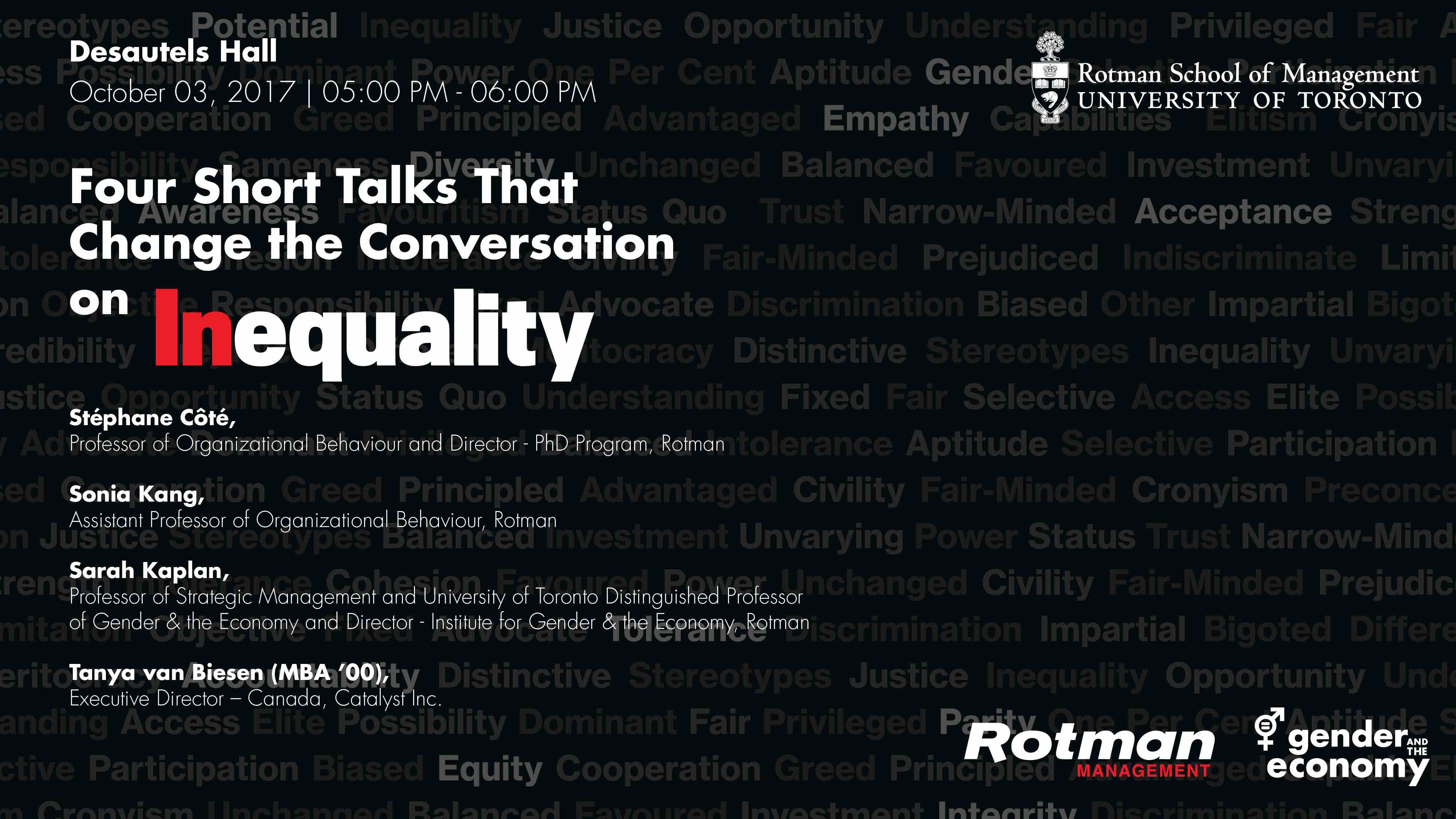
Four Short Talks: Changing the conversation on inequality
[fusion_builder_container hundred_percent=”no” equal_height_columns=”no” menu_anchor=”” hide_on_mobile=”small-visibility,medium-visibility,large-visibility” class=”” id=”” background_color=”” background_image=”” background_position=”center center” background_repeat=”no-repeat” fade=”no” background_parallax=”none” parallax_speed=”0.3″ video_mp4=”” video_webm=”” video_ogv=”” video_url=”” video_aspect_ratio=”16:9″ video_loop=”yes” video_mute=”yes” overlay_color=”” video_preview_image=”” border_color=”” border_style=”solid” padding_top=”” padding_bottom=”” padding_left=”” padding_right=”” type=”legacy”][fusion_builder_row][fusion_builder_column type=”1_1″ layout=”1_1″ background_position=”left top” background_color=”” border_color=”” border_style=”solid” border_position=”all” spacing=”yes” background_image=”” background_repeat=”no-repeat” padding_top=”” padding_right=”” padding_bottom=”” padding_left=”” margin_top=”0px” margin_bottom=”0px” class=”” id=”” animation_type=”” animation_speed=”0.3″ animation_direction=”left” hide_on_mobile=”small-visibility,medium-visibility,large-visibility” center_content=”no” last=”true” min_height=”” hover_type=”none” link=”” border_sizes_top=”” border_sizes_bottom=”” border_sizes_left=”” border_sizes_right=”” first=”true”][fusion_text columns=”” column_min_width=”” column_spacing=”” rule_style=”” rule_size=”” rule_color=”” hue=”” saturation=”” lightness=”” alpha=”” content_alignment_medium=”” content_alignment_small=”” content_alignment=”” hide_on_mobile=”small-visibility,medium-visibility,large-visibility” sticky_display=”normal,sticky” class=”” id=”” margin_top=”” margin_right=”” margin_bottom=”” margin_left=”” fusion_font_family_text_font=”” fusion_font_variant_text_font=”” font_size=”” line_height=”” letter_spacing=”” text_transform=”” text_color=”” animation_type=”” animation_direction=”left” animation_color=”” animation_speed=”0.3″ animation_delay=”0″ animation_offset=”” logics=””]On October 03, 2017, we featured four short “TED” style talks on inequality to launch the publication of Rotman Magazine’s special issue on Inequality.
Speakers:
Sonia Kang, Assistant Professor of Organizational Behaviour, Rotman
Tanya van Biesen (MBA ’00), Executive Director – Canada, Catalyst Inc.
Stéphane Côté, Professor of Organizational Behaviour and Director – PhD Program, Rotman
Sarah Kaplan, Professor of Strategic Management; University of Toronto Distinguished Professor of Gender & the Economy; and Director – Institute for Gender & the Economy, Rotman[/fusion_text][fusion_separator style_type=”none” hide_on_mobile=”small-visibility,medium-visibility,large-visibility” class=”” id=”” sep_color=”” top_margin=”50″ bottom_margin=”50″ border_size=”” icon=”” icon_circle=”” icon_circle_color=”” width=”” alignment=”center” /][fusion_button link=”https://www.gendereconomy.org/events/” text_transform=”” title=”” target=”_blank” link_attributes=”” alignment=”” modal=”” hide_on_mobile=”small-visibility,medium-visibility,large-visibility” class=”” id=”” color=”custom” button_gradient_top_color=”#62bd19″ button_gradient_bottom_color=”#62bd19″ button_gradient_top_color_hover=”#00c2e2″ button_gradient_bottom_color_hover=”#00c2e2″ accent_color=”” accent_hover_color=”” type=”” bevel_color=”” size=”” stretch=”yes” icon=”” icon_position=”left” icon_divider=”no” animation_type=”” animation_direction=”left” animation_speed=”0.3″ animation_offset=””]See more past events[/fusion_button][fusion_separator style_type=”none” hide_on_mobile=”small-visibility,medium-visibility,large-visibility” class=”” id=”” sep_color=”” top_margin=”20″ bottom_margin=”20″ border_size=”” icon=”” icon_circle=”” icon_circle_color=”” width=”” alignment=”center” /][fusion_title margin_top=”” margin_bottom=”” hide_on_mobile=”medium-visibility,large-visibility” class=”” id=”” size=”5″ content_align=”center” style_type=”default” sep_color=””]
Or register below for these upcoming events
[/fusion_title][fusion_recent_posts layout=”default” hover_type=”none” columns=”3″ number_posts=”3″ offset=”0″ pull_by=”category” cat_slug=”events” exclude_cats=”past” tag_slug=”” exclude_tags=”” thumbnail=”yes” title=”yes” meta=”no” meta_author=”no” meta_categories=”no” meta_date=”yes” meta_comments=”yes” meta_tags=”no” content_alignment=”” excerpt=”no” excerpt_length=”35″ strip_html=”yes” scrolling=”no” hide_on_mobile=”medium-visibility,large-visibility” class=”” id=”” animation_type=”” animation_direction=”left” animation_speed=”0.3″ animation_offset=”” /][/fusion_builder_column][/fusion_builder_row][/fusion_builder_container]
-

Strategies for a revolution in careers for women
Financial Times
Many businesses are opting to write mission statements that affirm their support for diversity and to put their staff through “implicit bias training”, which highlights how people make racist and sexist assumptions about others. Both steps are well-intentioned but can be counter-productive if not backed by deeper changes, warns Sarah Kaplan.
-

How to be an Ally: Lending privilege
[fusion_builder_container hundred_percent=”no” equal_height_columns=”no” menu_anchor=”” hide_on_mobile=”small-visibility,medium-visibility,large-visibility” class=”” id=”” background_color=”” background_image=”” background_position=”center center” background_repeat=”no-repeat” fade=”no” background_parallax=”none” parallax_speed=”0.3″ video_mp4=”” video_webm=”” video_ogv=”” video_url=”” video_aspect_ratio=”16:9″ video_loop=”yes” video_mute=”yes” overlay_color=”” video_preview_image=”” border_color=”” border_style=”solid” padding_top=”” padding_bottom=”” padding_left=”” padding_right=”” type=”legacy”][fusion_builder_row][fusion_builder_column type=”1_1″ layout=”1_1″ background_position=”left top” background_color=”” border_color=”” border_style=”solid” border_position=”all” spacing=”yes” background_image=”” background_repeat=”no-repeat” padding_top=”” padding_right=”” padding_bottom=”” padding_left=”” margin_top=”0px” margin_bottom=”0px” class=”” id=”” animation_type=”” animation_speed=”0.3″ animation_direction=”left” hide_on_mobile=”small-visibility,medium-visibility,large-visibility” center_content=”no” last=”true” min_height=”” hover_type=”none” link=”” border_sizes_top=”” border_sizes_bottom=”” border_sizes_left=”” border_sizes_right=”” first=”true”][fusion_text columns=”” column_min_width=”” column_spacing=”” rule_style=”” rule_size=”” rule_color=”” hue=”” saturation=”” lightness=”” alpha=”” content_alignment_medium=”” content_alignment_small=”” content_alignment=”” hide_on_mobile=”small-visibility,medium-visibility,large-visibility” sticky_display=”normal,sticky” class=”” id=”” margin_top=”” margin_right=”” margin_bottom=”” margin_left=”” fusion_font_family_text_font=”” fusion_font_variant_text_font=”” font_size=”” line_height=”” letter_spacing=”” text_transform=”” text_color=”” animation_type=”” animation_direction=”left” animation_color=”” animation_speed=”0.3″ animation_delay=”0″ animation_offset=”” logics=””]
Diversity and inclusion have become hot topics in technology, but you may not know how you can make a difference.
On September 25, 2017, Anjuan Simmons shared his insights about what any of us can do to be an ally.
About the talk
Diversity and inclusion have become hot topics in workplaces but you may not know how you can make a difference. This talk will help you understand that–no matter your background–you have privilege and can lend it to marginalized groups in the workplace.
About the Speaker
Anjuan Simmons is a technologist with a successful track record of delivering technology solutions from the user interface to the database. He is an energetic and informative speaker who presents at conferences, seminars, schools, and community centers around the world on topics including diversity, inclusion, Agile software development, and leadership. Anjuan has an undergraduate degree in electrical engineering from the University of Texas at Austin and an MBA from Texas A&M University.[/fusion_text][fusion_separator style_type=”none” hide_on_mobile=”small-visibility,medium-visibility,large-visibility” class=”” id=”” sep_color=”” top_margin=”50″ bottom_margin=”50″ border_size=”” icon=”” icon_circle=”” icon_circle_color=”” width=”” alignment=”center” /][fusion_button link=”https://www.gendereconomy.org/events/” text_transform=”” title=”” target=”_blank” link_attributes=”” alignment=”” modal=”” hide_on_mobile=”small-visibility,medium-visibility,large-visibility” class=”” id=”” color=”custom” button_gradient_top_color=”#62bd19″ button_gradient_bottom_color=”#62bd19″ button_gradient_top_color_hover=”#00c2e2″ button_gradient_bottom_color_hover=”#00c2e2″ accent_color=”” accent_hover_color=”” type=”” bevel_color=”” size=”” stretch=”yes” icon=”” icon_position=”left” icon_divider=”no” animation_type=”” animation_direction=”left” animation_speed=”0.3″ animation_offset=””]See more past events[/fusion_button][fusion_separator style_type=”none” hide_on_mobile=”small-visibility,medium-visibility,large-visibility” class=”” id=”” sep_color=”” top_margin=”20″ bottom_margin=”20″ border_size=”” icon=”” icon_circle=”” icon_circle_color=”” width=”” alignment=”center” /][fusion_title margin_top=”” margin_bottom=”” hide_on_mobile=”medium-visibility,large-visibility” class=”” id=”” size=”5″ content_align=”center” style_type=”default” sep_color=””]
Or register below for these upcoming events
[/fusion_title][fusion_recent_posts layout=”default” hover_type=”none” columns=”3″ number_posts=”3″ offset=”0″ pull_by=”category” cat_slug=”events” exclude_cats=”past” tag_slug=”” exclude_tags=”” thumbnail=”yes” title=”yes” meta=”no” meta_author=”no” meta_categories=”no” meta_date=”yes” meta_comments=”yes” meta_tags=”no” content_alignment=”” excerpt=”no” excerpt_length=”35″ strip_html=”yes” scrolling=”no” hide_on_mobile=”medium-visibility,large-visibility” class=”” id=”” animation_type=”” animation_direction=”left” animation_speed=”0.3″ animation_offset=”” /][/fusion_builder_column][/fusion_builder_row][/fusion_builder_container]
