Tag: Diversity+inclusion

Research briefs, news, and event recaps related to diversity and inclusion.

  • The diversity paradox: More women at the top doesn’t mean more equity at the bottom

    The diversity paradox: More women at the top doesn’t mean more equity at the bottom

    [fusion_builder_container hundred_percent=”no” equal_height_columns=”no” hide_on_mobile=”small-visibility,medium-visibility,large-visibility” background_position=”center center” background_repeat=”no-repeat” fade=”no” background_parallax=”none” enable_mobile=”no” parallax_speed=”0.3″ video_aspect_ratio=”16:9″ video_loop=”yes” video_mute=”yes” border_style=”solid” margin_top=”20″ type=”legacy”][fusion_builder_row][fusion_builder_column type=”3_4″ layout=”3_4″ center_content=”no” hover_type=”none” hide_on_mobile=”small-visibility,medium-visibility,large-visibility” background_position=”left top” background_repeat=”no-repeat” border_style=”solid” border_position=”all” animation_direction=”left” animation_speed=”0.3″ last=”false” first=”true” border_sizes_top=”0″ border_sizes_bottom=”0″ border_sizes_left=”0″ border_sizes_right=”0″ background_blend_mode=”overlay” min_height=”” link=””][fusion_text hide_on_mobile=”small-visibility,medium-visibility,large-visibility” sticky_display=”normal,sticky” text_transform=”none” animation_direction=”left” animation_speed=”0.3″ animation_delay=”0″]


    Highlights

    • Increasing women’s representation in senior management can boost a firm’s external reputation. However, firms that view themselves as diversity leaders often reduce internal efforts to support junior women.
    • This reduced focus on inclusive practices can lead to fewer job offers for early-career women.
    • Representation alone does not guarantee equity—especially if women lack power in decision-making roles. Empowering women through roles on hiring and diversity committees helps sustain equitable progress.

    Organizations across industries are under pressure to increase the number of women in leadership roles. But what happens after a company meets this expectation? New research by Priyanka Dwivedi and Lionel Paolella reveals an unintended consequence: in men-dominated industries, firms that appear to be leaders in senior-level gender diversity compared to their peers often stop investing in internal diversity practices. As a result, they end up offering fewer jobs to junior women.

    The diversity paradox

    The study explores what the authors call a “diversity paradox:” the perception of success at the top level can reduce the urgency to act elsewhere in the organization. When firms have more senior women than the industry average, leaders often believe they’ve done enough to address gender equity. This perception of progress leads to a drop in attention and resources devoted to diversity efforts lower down the hierarchy. In practice, this means that hiring managers may stop prioritizing gender-diverse applicant pools or fail to adopt inclusive hiring practices, reducing opportunities for early-career women.

    When firms have more senior women than the industry average, leaders often believe they’ve done enough to address gender equity. This perception of progress leads to a drop in attention and resources devoted to diversity efforts lower down the hierarchy.

    Using panel data from the largest U.S. corporate law firms between 2007 and 2015, the researchers find that firms with a higher-than-average share of women in senior management extend fewer job offers to junior women. This effect is explained by a reduction in internal diversity practices, such as targeted recruitment, mentoring, or diversity training. However, when women have substantial representation on diversity and hiring committees, these negative effects are significantly reduced.

    The problem isn’t simply that senior women aren’t doing enough. In many of these firms, senior women remain in the minority and may lack the authority, time, or organizational support to drive firm-wide change. Unless these women are given formal roles on decision-making committees, their ability to influence hiring and diversity practices is constrained. Meanwhile, men leaders may overestimate progress and redirect attention to other priorities.

    Representation is only part of the equation

    This research offers a critical insight for companies striving to improve gender diversity: representation at the top is only part of the equation. True progress requires continuous engagement with internal practices that support women at all levels. Firms that appear ahead of the curve may still fall short in fostering inclusive practices at lower levels. Leaders must resist the temptation to “check the box” and instead commit to ongoing action.

    Companies can establish accountability structures that formally include women in decision-making around hiring and diversity. Having women on these committees empowers them to advocate for equity in ways that are recognized and rewarded. Additionally, firms can invest in programs that go beyond surface-level diversity—such as inclusive mentoring, targeted outreach to women candidates, and internal assessments that identify where systems may still disadvantage women.

    Leaders must resist the temptation to “check the box” and instead commit to ongoing action.

    Managers across the organization can also be reminded that progress in one area does not mean the work is done. Equity efforts should be seen as part of a long-term commitment to fairness, culture change, and sustained inclusion, requiring attention, resources, and leadership buy-in at all levels.

    ______
    Research brief prepared by:

    Grusha Agarwal

    [/fusion_text][fusion_separator style_type=”none” hide_on_mobile=”small-visibility,medium-visibility,large-visibility” top_margin=”20″ bottom_margin=”20″ alignment=”center” /][fusion_button link=”https://www.gendereconomy.org/research-briefs/” target=”_blank” hide_on_mobile=”small-visibility,medium-visibility,large-visibility” color=”custom” button_gradient_top_color=”#62bd19″ button_gradient_bottom_color=”#62bd19″ button_gradient_top_color_hover=”#00c2e2″ button_gradient_bottom_color_hover=”#00c2e2″ stretch=”yes” icon_position=”left” icon_divider=”no” animation_direction=”left” animation_speed=”0.3″]See more research briefs[/fusion_button][fusion_separator style_type=”none” hide_on_mobile=”small-visibility,medium-visibility,large-visibility” top_margin=”20″ bottom_margin=”20″ alignment=”center” /][fusion_recent_posts layout=”default” hover_type=”none” columns=”3″ number_posts=”3″ offset=”0″ pull_by=”category” cat_slug=”research-briefs” thumbnail=”yes” title=”yes” meta=”no” meta_author=”no” meta_categories=”no” meta_date=”yes” meta_comments=”yes” meta_tags=”no” excerpt=”no” excerpt_length=”35″ strip_html=”yes” scrolling=”no” hide_on_mobile=”small-visibility,medium-visibility,large-visibility” animation_direction=”left” animation_speed=”0.3″ /][/fusion_builder_column][fusion_builder_column type=”1_4″ layout=”1_4″ center_content=”no” hover_type=”none” hide_on_mobile=”small-visibility,medium-visibility,large-visibility” background_position=”left top” background_repeat=”no-repeat” border_style=”solid” border_position=”all” animation_direction=”left” animation_speed=”0.3″ last=”true” first=”false” border_sizes_top=”0″ border_sizes_bottom=”0″ border_sizes_left=”0″ border_sizes_right=”0″ background_blend_mode=”overlay” min_height=”” link=””][fusion_title title_type=”text” rotation_effect=”bounceIn” display_time=”1200″ highlight_effect=”circle” loop_animation=”off” highlight_width=”9″ highlight_top_margin=”0″ title_link=”off” link_target=”_self” hide_on_mobile=”small-visibility,medium-visibility,large-visibility” sticky_display=”normal,sticky” class=”briefsummary” content_align=”left” size=”3″ text_shadow=”no” text_shadow_blur=”0″ text_stroke=”no” text_stroke_size=”1″ text_overflow=”none” gradient_font=”no” gradient_start_position=”0″ gradient_end_position=”100″ gradient_type=”linear” radial_direction=”center center” linear_angle=”180″ style_type=”none” animation_direction=”left” animation_speed=”0.3″ animation_delay=”0″]

    Title

    Tick Off the Gender Diversity Box: Examining the Cross-Level Effects of Women’s Representation in Senior Management

    Author

    Priyanka Dwivedi and Lionel Paolella

    Source

    Academy of Management Journal

    Published

    2024

    Link

    https://doi.org/10.5465/amj.2021.0506

    Research brief prepared by

    Grusha Agarwal

    [/fusion_title][fusion_widget_area name=”avada-custom-sidebar-researchbriefsidebar” hide_on_mobile=”small-visibility,medium-visibility,large-visibility” /][/fusion_builder_column][/fusion_builder_row][/fusion_builder_container]
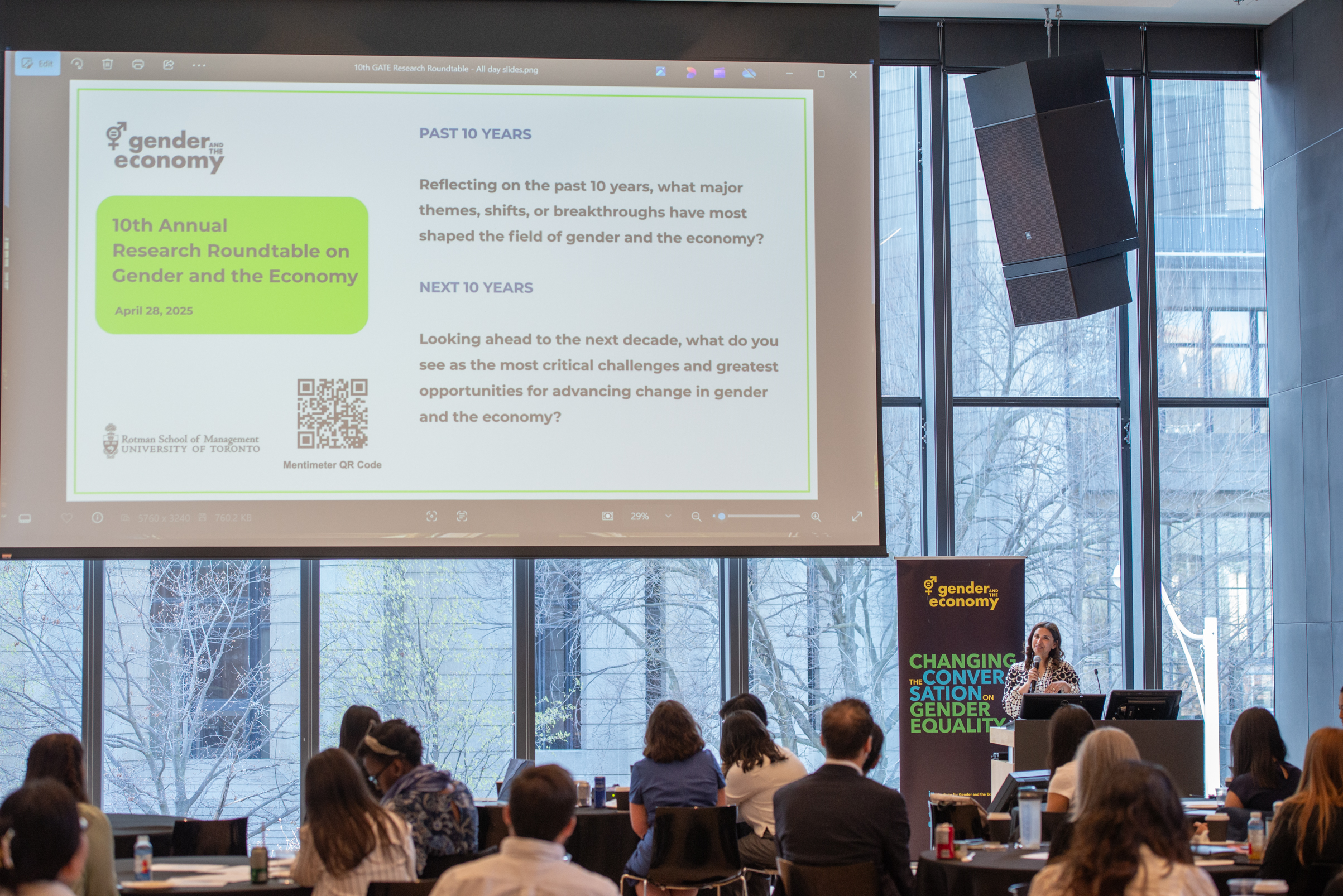
  • 10th Annual Research Roundtable | May 2025

    10th Annual Research Roundtable | May 2025


    GATE’s 10th annual research roundtable brought together a multidisciplinary group of emerging and established from across the University of Toronto—each funded through GATE research grants. Attendees shared bold new research, received valuable feedback, and built meaningful connections.

    So, what did we learn?

    We summarized the 10 research snapshots from our funded research on gender and the economy:

    The Effects of an Additional Year without Childcare (Carmen Quezada, Economic Analysis and Policy):

    Using a longitudinal dataset from Chile , this study shows how delaying school entry by one year can boost academic outcomes for children—but at a cost to mothers. Mothers face reduced workforce participation and income, take on the bulk of added childcare responsibilities, and sometimes take on more flexible, but precarious, informal work.

    • Takeaway: Even well-intended policies can deepen gender inequities without systemic childcare support.

    Socio-Economic Pathways of Japanese Women and Non-Binary Migrants in Canada (Izumi Sakamoto, Social Work):

    Study participants revealed key push and pull factors for migration to Canada, with gender-based discrimination and rigid norms pushing women to leave Japan, and better career opportunities, educational access, and LGBTQ+ inclusion pulling them to Canada. Although many migrants found more freedom and institutional support in Canada, they also faced racism, disillusionment, and underemployment.

    • Takeaway: Migration experiences are shaped by the intersections of gender, race, imperial legacies, and false promises of inclusion.

     Institutional Drift, Property Rights, and Economic Development (Rob Gillezeau, Economic Analysis and Policy):

    How have historical treaties shaped economic outcomes for Indigenous nations in Canada? Communities that signed treaties earn $7,000 less on average than those that did not, largely due to lower employment income. This  suggests that privatizing reserve land may worsen inequality, whereas landback initiatives and stronger treaty enforcement could help close the gap.

    • Takeaway: Historical institutions continue to shape economic inequities—and policy choices today can deepen or disrupt that legacy.

    Racial Dynamics and Citations in Economics (Marlene Koffi, Economics):

    This study examines racial disparities in the diffusion of ideas, focusing on how race shapes citation patterns. The findings reveal a consistent citation penalty for non-white authors: papers by non-white economists are cited about 5% less on average, with the gap widening to nearly 10% in top journals.

    • Takeaway: Race continues to shape the flow of ideas in economics, with implications for equity, innovation, and knowledge production.

     Circle Teachings as Methodological Guides (Jordyn Hrenyk, GATE Postdoctoral Fellow)

    Drawing from their own experiences as Indigenous scholars working with non-Indigenous collaborators, , the researchers introduce the Sharing Circle as a methodological guide for how to work together.  Circle protocols include: opening the circle in a good way, inviting everyone to participate when and how they want, using a talking stick to create a predictable communication rhythm, and closing the circle only when the Circle Keeper feels the work is done.  Together, these practices support reflexive theorizing and story work.

    • Takeaway: Sharing Circles offer a non-hierarchical and relational approach to research grounded in Indigenous ways of knowing.

    Non-Black Consumer Perceptions of Black Atypicality for  Cosmetic Products (Tosen Nwadei, OBHRM)

    This study examines whether the race of a model who appears on an advertisement for a cosmetic product affects consumers’ assumptions about the product’s intended users. Model race significantly influenced perceptions—but only for more racialized product categories (e.g., shampoo). The results suggest that the perceived racialization of a product significantly shapes whether it is perceived to be “for everyone”.

    • Takeaway: Efforts to increase representation in advertising may be perceived as atypical or exclusionary when consumers racialize the product itself.

    How “Genius” Framing in Creative Job Ads can Decrease the Gender Diversity of Applicant Pools (Grusha Agarwal, OBHRM)  

    This multi-method study examines how language in job ads influences applicant interest and perceptions. While “genius” framing is common in job ads for creative jobs, “explorer” language attracts more applicants—especially those high in openness—and appeals equally to men and women. It also reduces perceptions of masculine workplace culture and signals a more inclusive environment.

    • Takeaway: Job ad language affects both who applies and how inclusive an organization is perceived to be.

    People (Mistakenly) Highlight Disadvantages over Advantages in DEI Communication (Minwen Yang, Marketing)

    This research explores how individuals present themselves in high-stakes contexts like job applications. Across five studies, people were more likely to emphasize disadvantages than advantages in their DEI statements.

    • Takeaway: Applicants often misjudge what DEI messaging is most effective—highlighting advantage may yield better outcomes than emphasizing disadvantage.

    The Impact of Sexual Misconduct on Scientific Production and Gender Diversity (Manuela Collis, Strategy)

    This study explores the broader organizational consequences of sexual misconduct within university departments, focusing on three key outcomes: scientific productivity, collaboration patterns, and gender diversity. Preliminary findings and theorizing suggest that incidents of sexual misconduct reduce women’s sense of belonging and contribute to declines in their scholarly output.

    • Takeaway: Sexual misconduct may have ripple effects that extend beyond individual cases, undermining departmental culture, productivity, and equity in academia.

    Gender, Feedback, and Persistence Following Rejection (Laura Doering, Strategy)

    This study examines how gender and feedback interact to shape persistence following grant rejection—a key concern in addressing gender disparities in academia.  The findings show that after narrowly missing a funding threshold (“near misses”), men and women are equally likely to reapply. However, when the rejection is more severe (“wide misses”), women are significantly less likely to reapply compared to their male counterparts.

    • Takeaway: Gender gaps in persistence may stem not only from rejection itself, but also from the nature and severity of feedback received.

    Download our infographic for 10 TAKEAWAYS from GATE’s 10th Annual Research Roundtable -PDF -12May2025

    [fusion_imageframe image_id=”13934|fusion-1200″ aspect_ratio=”” custom_aspect_ratio=”100″ aspect_ratio_position=”” skip_lazy_load=”” lightbox=”no” gallery_id=”” lightbox_image=”” lightbox_image_id=”” alt=”” link=”https://www.gendereconomy.org/wp-content/uploads/2025/05/10-TAKEAWAYS-from-GATEs-10th-Annual-Research-Roundtable-PNG-12May2025.png” linktarget=”_self” hide_on_mobile=”small-visibility,medium-visibility,large-visibility” sticky_display=”normal,sticky” class=”” id=”” max_width=”” sticky_max_width=”” align_medium=”none” align_small=”none” align=”none” mask=”” custom_mask=”” mask_size=”” mask_custom_size=”” mask_position=”” mask_custom_position=”” mask_repeat=”” style_type=”” blur=”” stylecolor=”” hue=”” saturation=”” lightness=”” alpha=”” hover_type=”none” magnify_full_img=”” magnify_duration=”120″ scroll_height=”100″ scroll_speed=”1″ margin_top_medium=”” margin_right_medium=”” margin_bottom_medium=”” margin_left_medium=”” margin_top_small=”” margin_right_small=”” margin_bottom_small=”” margin_left_small=”” margin_top=”” margin_right=”” margin_bottom=”” margin_left=”” bordersize=”” bordercolor=”” borderradius=”” z_index=”” caption_style=”off” caption_align_medium=”none” caption_align_small=”none” caption_align=”none” caption_title=”” caption_text=”” caption_title_tag=”2″ fusion_font_family_caption_title_font=”” fusion_font_variant_caption_title_font=”” caption_title_size=”” caption_title_line_height=”” caption_title_letter_spacing=”” caption_title_transform=”” caption_title_color=”” caption_background_color=”” fusion_font_family_caption_text_font=”” fusion_font_variant_caption_text_font=”” caption_text_size=”” caption_text_line_height=”” caption_text_letter_spacing=”” caption_text_transform=”” caption_text_color=”” caption_border_color=”” caption_overlay_color=”” caption_margin_top=”” caption_margin_right=”” caption_margin_bottom=”” caption_margin_left=”” animation_type=”” animation_direction=”left” animation_color=”” animation_speed=”0.3″ animation_delay=”0″ animation_offset=”” filter_hue=”0″ filter_saturation=”100″ filter_brightness=”100″ filter_contrast=”100″ filter_invert=”0″ filter_sepia=”0″ filter_opacity=”100″ filter_blur=”0″ filter_hue_hover=”0″ filter_saturation_hover=”100″ filter_brightness_hover=”100″ filter_contrast_hover=”100″ filter_invert_hover=”0″ filter_sepia_hover=”0″ filter_opacity_hover=”100″ filter_blur_hover=”0″]https://www.gendereconomy.org/wp-content/uploads/2025/05/10-TAKEAWAYS-from-GATEs-10th-Annual-Research-Roundtable-PNG-12May2025-1200×1200.png[/fusion_imageframe]

    [fusion_imageframe image_id=”13942|fusion-800″ aspect_ratio=”” custom_aspect_ratio=”100″ aspect_ratio_position=”” skip_lazy_load=”” lightbox=”no” gallery_id=”” lightbox_image=”” lightbox_image_id=”” alt=”” link=”” linktarget=”_self” hide_on_mobile=”small-visibility,medium-visibility,large-visibility” sticky_display=”normal,sticky” class=”” id=”” max_width=”” sticky_max_width=”” align_medium=”none” align_small=”none” align=”none” mask=”” custom_mask=”” mask_size=”” mask_custom_size=”” mask_position=”” mask_custom_position=”” mask_repeat=”” style_type=”” blur=”” stylecolor=”” hue=”” saturation=”” lightness=”” alpha=”” hover_type=”none” magnify_full_img=”” magnify_duration=”120″ scroll_height=”100″ scroll_speed=”1″ margin_top_medium=”” margin_right_medium=”” margin_bottom_medium=”” margin_left_medium=”” margin_top_small=”” margin_right_small=”” margin_bottom_small=”” margin_left_small=”” margin_top=”” margin_right=”” margin_bottom=”” margin_left=”” bordersize=”” bordercolor=”” borderradius=”” z_index=”” caption_style=”off” caption_align_medium=”none” caption_align_small=”none” caption_align=”none” caption_title=”” caption_text=”” caption_title_tag=”2″ fusion_font_family_caption_title_font=”” fusion_font_variant_caption_title_font=”” caption_title_size=”” caption_title_line_height=”” caption_title_letter_spacing=”” caption_title_transform=”” caption_title_color=”” caption_background_color=”” fusion_font_family_caption_text_font=”” fusion_font_variant_caption_text_font=”” caption_text_size=”” caption_text_line_height=”” caption_text_letter_spacing=”” caption_text_transform=”” caption_text_color=”” caption_border_color=”” caption_overlay_color=”” caption_margin_top=”” caption_margin_right=”” caption_margin_bottom=”” caption_margin_left=”” animation_type=”” animation_direction=”left” animation_color=”” animation_speed=”0.3″ animation_delay=”0″ animation_offset=”” filter_hue=”0″ filter_saturation=”100″ filter_brightness=”100″ filter_contrast=”100″ filter_invert=”0″ filter_sepia=”0″ filter_opacity=”100″ filter_blur=”0″ filter_hue_hover=”0″ filter_saturation_hover=”100″ filter_brightness_hover=”100″ filter_contrast_hover=”100″ filter_invert_hover=”0″ filter_sepia_hover=”0″ filter_opacity_hover=”100″ filter_blur_hover=”0″]https://www.gendereconomy.org/wp-content/uploads/2025/05/SQ7_3651-800×532.jpg[/fusion_imageframe]

    [fusion_gallery order_by=”desc” limit=”” pagination_type=”” load_more_btn_text=”” layout=”” picture_size=”” aspect_ratio=”” custom_aspect_ratio=”100″ aspect_ratio_position=”” gallery_masonry_grid_ratio=”” gallery_masonry_width_double=”” lightbox=”yes” lightbox_content=”” lightbox_id=”” margin_top=”” margin_right=”” margin_bottom=”” margin_left=”” hide_on_mobile=”small-visibility,medium-visibility,large-visibility” class=”” id=”” columns_medium=”0″ columns_small=”0″ columns=”3″ column_spacing=”” hover_type=”” bordersize=”” bordercolor=”” hue=”” saturation=”” lightness=”” alpha=”” border_radius=”” load_more_btn_span=”no” button_alignment=”center” load_more_btn_hover_color=”” load_more_btn_color=”” load_more_btn_hover_bg_color=”” load_more_btn_bg_color=”” caption_style=”off” caption_title_tag=”2″ fusion_font_family_caption_title_font=”” fusion_font_variant_caption_title_font=”” caption_title_size=”” caption_title_line_height=”” caption_title_letter_spacing=”” caption_title_transform=”” caption_title_color=”” caption_background_color=”” fusion_font_family_caption_text_font=”” fusion_font_variant_caption_text_font=”” caption_text_size=”” caption_text_line_height=”” caption_text_letter_spacing=”” caption_text_transform=”” caption_text_color=”” caption_border_color=”” caption_overlay_color=”” caption_align_medium=”none” caption_align_small=”none” caption_align=”none” caption_margin_top=”” caption_margin_right=”” caption_margin_bottom=”” caption_margin_left=”” parent_dynamic_content=””][fusion_gallery_image image=”https://www.gendereconomy.org/wp-content/uploads/2025/05/SQ5_6841-1.jpg” image_id=”13952″ aspect_ratio_position=”” masonry_image_position=”” image_title=”” image_caption=”” link=”” linktarget=”_self” /][fusion_gallery_image image=”https://www.gendereconomy.org/wp-content/uploads/2025/05/SQ5_6793.jpg” image_id=”13939″ aspect_ratio_position=”” masonry_image_position=”” image_title=”” image_caption=”” link=”” linktarget=”_self” /][fusion_gallery_image image=”https://www.gendereconomy.org/wp-content/uploads/2025/05/SQ5_6730.jpg” image_id=”13937″ aspect_ratio_position=”” masonry_image_position=”” image_title=”” image_caption=”” link=”” linktarget=”_self” /][fusion_gallery_image image=”https://www.gendereconomy.org/wp-content/uploads/2025/05/SQ7_3701.jpg” image_id=”13943″ aspect_ratio_position=”” masonry_image_position=”” image_title=”” image_caption=”” link=”” linktarget=”_self” /][fusion_gallery_image image=”https://www.gendereconomy.org/wp-content/uploads/2025/05/IMG_8880-scaled.jpg” image_id=”13950″ aspect_ratio_position=”” masonry_image_position=”” image_title=”” image_caption=”” link=”” linktarget=”_self” /][fusion_gallery_image image=”https://www.gendereconomy.org/wp-content/uploads/2025/05/IMG_8900-scaled.jpg” image_id=”13947″ aspect_ratio_position=”” masonry_image_position=”” image_title=”” image_caption=”” link=”” linktarget=”_self” /][fusion_gallery_image image=”https://www.gendereconomy.org/wp-content/uploads/2025/05/IMG_8887-scaled.jpg” image_id=”13949″ aspect_ratio_position=”” masonry_image_position=”” image_title=”” image_caption=”” link=”” linktarget=”_self” /][fusion_gallery_image image=”https://www.gendereconomy.org/wp-content/uploads/2025/05/IMG_8941-scaled.jpg” image_id=”13948″ aspect_ratio_position=”” masonry_image_position=”” image_title=”” image_caption=”” link=”” linktarget=”_self” /][fusion_gallery_image image=”https://www.gendereconomy.org/wp-content/uploads/2025/05/IMG_8969-scaled.jpg” image_id=”13945″ aspect_ratio_position=”” masonry_image_position=”” image_title=”” image_caption=”” link=”” linktarget=”_self” /][fusion_gallery_image image=”https://www.gendereconomy.org/wp-content/uploads/2025/05/IMG_8898-scaled.jpg” image_id=”13946″ aspect_ratio_position=”” masonry_image_position=”” image_title=”” image_caption=”” link=”” linktarget=”_self” /][fusion_gallery_image image=”https://www.gendereconomy.org/wp-content/uploads/2025/05/IMG_8957-scaled.jpg” image_id=”13944″ aspect_ratio_position=”” masonry_image_position=”” image_title=”” image_caption=”” link=”” linktarget=”_self” /][/fusion_gallery]

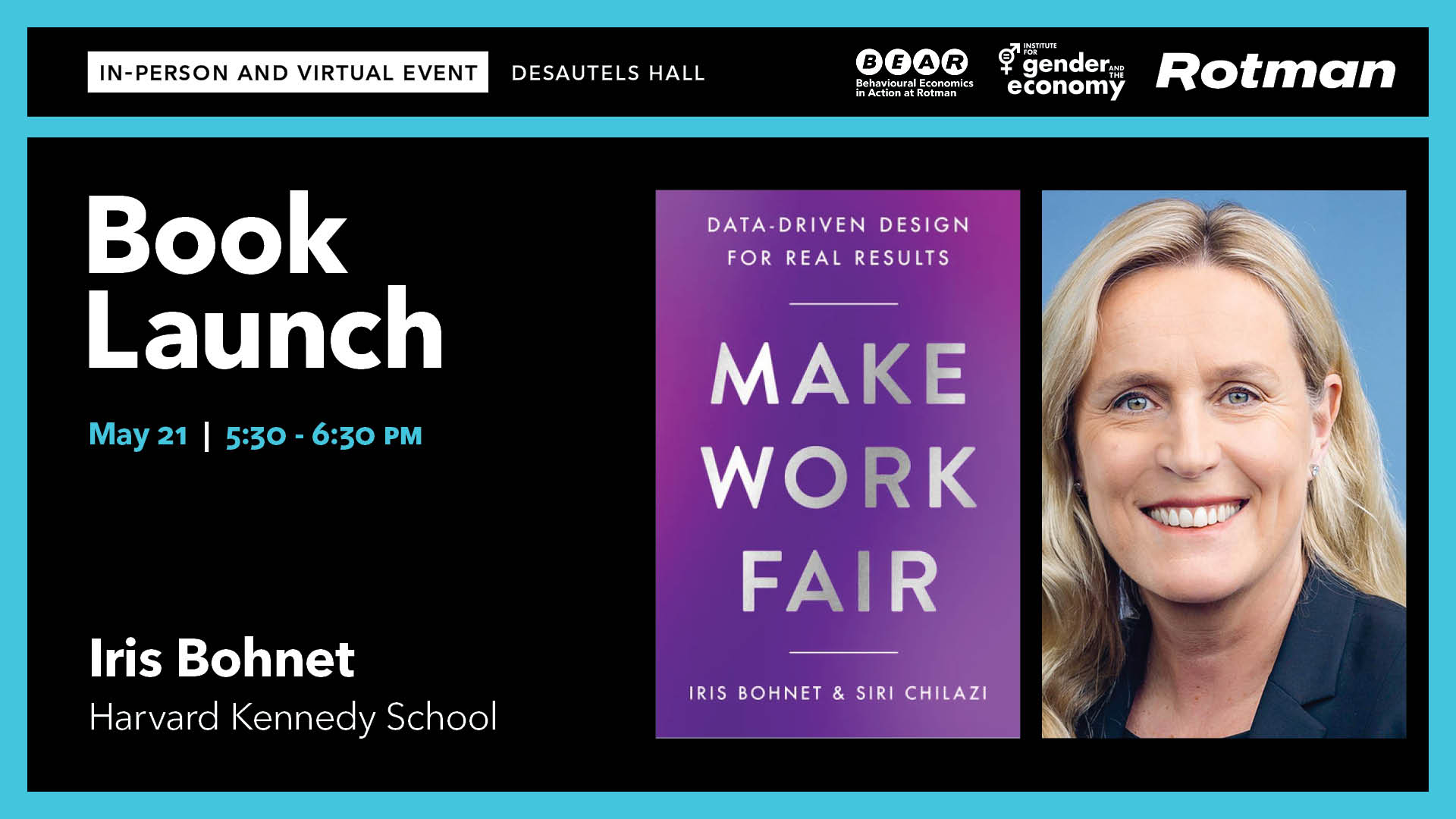
  • Iris Bohnet on ‘Make Work Fair: Data-Driven Design for Real Results’

    Iris Bohnet on ‘Make Work Fair: Data-Driven Design for Real Results’


    Event Information

    Date: May 21 2025, 5:30 PM – 6:30 PM EDT

    Format: Hybrid

    In-person location: Desautels Hall, Rotman School of Management, 105 St. George, Toronto

    REGISTRATION LINK

    Synopsis:

    To make organizations more fair, many well-meaning individuals and companies invest their time and resources in diversity, equity, and inclusion (DEI) initiatives. But because inequity is built into the structures, processes, and environments of our workplaces, adding these programs has been ineffective and often becomes a burden passed off to the individuals they are meant to help.

    In Make Work Fair, behavioral scientist and author of What Works Iris Bohnet and gender expert Siri Chilazi offer data-backed, actionable solutions that build fairness into the very fabric of the workplace. Their methods—tested at many organizations, and grounded in data proven to work in the real world—help us make fairer, and simply better, decisions. Using their three-part framework, employees at all levels can embed fairness into their everyday practices.

    Speaker:

    Iris Bohnet, Albert Pratt Professor of Business and Government: Co-director, Women and Public Policy Program, Harvard Kennedy School

    Rhia Catapano, Assistant Professor, Marketing, Rotman School of Management

    About our Speaker:

    Iris Bohnet is the Albert Pratt Professor of Business and Government and the co-director of the Women and Public Policy Program at Harvard Kennedy School. She is a behavioral economist, combining insights from economics and psychology to improve decision-making in organizations and society, often with a gender or cross-cultural perspective. Her most recent research examines behavioral design to embed equity at work. She is the author of the award-winning book What Works: Gender Equality by Design and co-author of the new book Make Work Fair.Bohnet advises governments and companies around the world, including serving as Special Advisor on the Gender Equality Acceleration Plan to the UN Secretary-General/Deputy Secretary-General and as a member of the Gender Equality Advisory Council of the G7. She was named one of the Most Influential Academics in Government and one of the most Influential People in Gender Policy by apolitical. Professor Bohnet served as academic dean of Harvard Kennedy School for six years and as the faculty chair of the executive program “Global Leadership and Public Policy for the 21st Century” for the World Economic Forum’s Young Global Leaders for more than ten years. She presently serves as the faculty director of the social sciences at Harvard Radcliffe Institute and on a number of boards and advisory boards.

    Rhia Catapano is an Assistant Professor of Marketing at Rotman at the University of Toronto. Her research explores how consumer psychology can be leveraged to benefit society. In one stream, she examines how people can be shifted away from entrenched views, and factors that affect receptiveness to the opposition. In another research stream, she explores the role of meaning in consumer satisfaction and decision-making. Her research has been published in leading journals including Journal of Personality and Social Psychology, Psychological Science, and Journal of Consumer Psychology.

    Event Logistics:

    Rotman Events is committed to accessibility for all people. If you have any access needs or if there are any ways we can support your full participation in this session, please email Rotman Events at events@rotman.utoronto.ca no later than 2 weeks in advance of the event and we will be glad to work with you to make the appropriate arrangements.

    Cancellation & Refund Policy

    • Refunds will only be issued for cancellations received in writing NO LATER than 24 hours prior to the event. Please email events@rotman.utoronto.ca for processing.

    For more details about event logistics, please visit Rotman Events website.

  • How can we move beyond DEI backlash?

    How can we move beyond DEI backlash?

    [fusion_builder_container hundred_percent=”no” equal_height_columns=”no” hide_on_mobile=”small-visibility,medium-visibility,large-visibility” background_position=”center center” background_repeat=”no-repeat” fade=”no” background_parallax=”none” enable_mobile=”no” parallax_speed=”0.3″ video_aspect_ratio=”16:9″ video_loop=”yes” video_mute=”yes” border_style=”solid” margin_top=”20″ type=”legacy”][fusion_builder_row][fusion_builder_column type=”3_4″ layout=”3_4″ center_content=”no” hover_type=”none” hide_on_mobile=”small-visibility,medium-visibility,large-visibility” background_position=”left top” background_repeat=”no-repeat” border_style=”solid” border_position=”all” animation_direction=”left” animation_speed=”0.3″ last=”false” first=”true” border_sizes_top=”0″ border_sizes_bottom=”0″ border_sizes_left=”0″ border_sizes_right=”0″ background_blend_mode=”overlay” min_height=”” link=””][fusion_text hide_on_mobile=”small-visibility,medium-visibility,large-visibility” sticky_display=”normal,sticky” text_transform=”none” animation_direction=”left” animation_speed=”0.3″ animation_delay=”0″]


    Highlights

    • Employees from dominant groups may feel threatened by diversity, equity, and inclusion initiatives, but this threat can lead to transformational learning, growth, and allyship, rather than backlash.
    • Learning and growth are more likely to happen in organizations that value difference and promote diversity.
    • Encouraging dialogue across different perspectives in a safe environment can also facilitate those in dominant groups towards allyship.

    U.S. President Donald Trump’s recent executive order banning diversity, equity, and inclusion (DEI) programs in all federal departments is a stark example of backlash towards initiatives for fairness for historically marginalized groups.

    Research has suggested that dominant groups—those with disproportionate access to resources and power in society, such as white men—feel threatened by DEI because it calls into question values held about their identity, and causes them to believe they will lose resources, power, or opportunities, even if this is not the case. This is called social identity threat.

    For example, the #MeToo movement has made some men feel their identities as men are being tarnished and that they may be unfairly accused. Such feelings of threat can and have led to backlash.

    But recent research by Professors Camellia Bryan and Brent J. Lyons suggests that this threat can actually be an opportunity for growth and allyship in workplaces—if the conditions in an organization are right.

    Transformational learning from threat

    Previous research has suggested that when dominant groups face threats to their identities, they become unwilling to be allies to those in marginalized groups. This research offers a new model that shows how such threats can lead to transformational learning and eventually, allyship.

    The authors propose that when employees in dominant groups feel threatened by DEI or other initiatives for marginalized groups, these feelings of disorientation may in fact help them open up to reflection and introspection. They may begin to assess their existing beliefs and interpretations about marginalized groups, seek out new information that challenges their beliefs (such as books and media), and then update their beliefs. These actions can, in turn, result in meaningful support and allyship.

    …when employees in dominant groups feel threatened by DEI or other initiatives for marginalized groups, these feelings of disorientation may in fact help them open up to reflection and introspection.

    A safe and open organizational climate

    However, such transformational learning may require an organization that encourages growth and change. Organizations that have a culture that promotes diversity, and sees diversity as enhancing learning and performance, can help employees to critically reflect on their identities and beliefs because they are more likely to see differences as respected and valued.

    Dialogue from different perspectives can also facilitate learning for employees from dominant groups. Engaging with colleagues who offer alternative viewpoints in a psychologically safe environment can allow employees to challenge their harmful assumptions and figure out how to support marginalized groups in a way that is not performative. It can also allow them to receive feedback as they change their behaviours.

    As such, the authors suggest that diversity training for employees help them confront bias in a way that encourages rather than shuts down dialogue. Training on how to approach difficult conversations, and on how to critically reflect on one’s interpretations and beliefs, may be more helpful than training that simply introduces information without space for dialogue.

    Training on how to approach difficult conversations, and on how to critically reflect on one’s interpretations and beliefs, may be more helpful than training that simply introduces information without space for dialogue.

    Change will not happen overnight. Members of dominant groups may be more amenable to growth when faced with identity threat if they already value equality and are relatively open to understanding inequality, compared to those who tend to justify inequality and hierarchy.

    However, in an encouraging and safe environment, employees may progress from a surface-level understanding and reflection of inequality to a deeper understanding, and begin to be more critical of beliefs that are harmful to those facing marginalization.

    While some companies and governments are cutting their DEI programs, the organizations that acknowledge backlash and embrace the opportunity for their employees to grow and learn will create more inclusive and engaged workplaces.

    ______
    Research brief prepared by:

    Carmina Ravanera

    [/fusion_text][fusion_separator style_type=”none” hide_on_mobile=”small-visibility,medium-visibility,large-visibility” top_margin=”20″ bottom_margin=”20″ alignment=”center” /][fusion_button link=”https://www.gendereconomy.org/research-briefs/” target=”_blank” hide_on_mobile=”small-visibility,medium-visibility,large-visibility” color=”custom” button_gradient_top_color=”#62bd19″ button_gradient_bottom_color=”#62bd19″ button_gradient_top_color_hover=”#00c2e2″ button_gradient_bottom_color_hover=”#00c2e2″ stretch=”yes” icon_position=”left” icon_divider=”no” animation_direction=”left” animation_speed=”0.3″]See more research briefs[/fusion_button][fusion_separator style_type=”none” hide_on_mobile=”small-visibility,medium-visibility,large-visibility” top_margin=”20″ bottom_margin=”20″ alignment=”center” /][fusion_recent_posts layout=”default” hover_type=”none” columns=”3″ number_posts=”3″ offset=”0″ pull_by=”category” cat_slug=”research-briefs” thumbnail=”yes” title=”yes” meta=”no” meta_author=”no” meta_categories=”no” meta_date=”yes” meta_comments=”yes” meta_tags=”no” excerpt=”no” excerpt_length=”35″ strip_html=”yes” scrolling=”no” hide_on_mobile=”small-visibility,medium-visibility,large-visibility” animation_direction=”left” animation_speed=”0.3″ /][/fusion_builder_column][fusion_builder_column type=”1_4″ layout=”1_4″ center_content=”no” hover_type=”none” hide_on_mobile=”small-visibility,medium-visibility,large-visibility” background_position=”left top” background_repeat=”no-repeat” border_style=”solid” border_position=”all” animation_direction=”left” animation_speed=”0.3″ last=”true” first=”false” border_sizes_top=”0″ border_sizes_bottom=”0″ border_sizes_left=”0″ border_sizes_right=”0″ background_blend_mode=”overlay” min_height=”” link=””][fusion_title title_type=”text” rotation_effect=”bounceIn” display_time=”1200″ highlight_effect=”circle” loop_animation=”off” highlight_width=”9″ highlight_top_margin=”0″ title_link=”off” link_target=”_self” hide_on_mobile=”small-visibility,medium-visibility,large-visibility” sticky_display=”normal,sticky” class=”briefsummary” content_align=”left” size=”3″ text_shadow=”no” text_shadow_blur=”0″ text_stroke=”no” text_stroke_size=”1″ text_overflow=”none” gradient_font=”no” gradient_start_position=”0″ gradient_end_position=”100″ gradient_type=”linear” radial_direction=”center center” linear_angle=”180″ style_type=”none” animation_direction=”left” animation_speed=”0.3″ animation_delay=”0″]

    Title

    Beyond Backlash: Advancing Dominant-Group Employees’ Learning, Allyship, and Growth Through Social Identity Threat

    Author

    Camellia Bryan and Brent J. Lyons

    Source

    Academy of Management Review

    Published

    2024

    Link

    https://journals.aom.org/doi/epub/10.5465/amr.2021.0521

    Research brief prepared by

    Carmina Ravanera

    [/fusion_title][fusion_widget_area name=”avada-custom-sidebar-researchbriefsidebar” hide_on_mobile=”small-visibility,medium-visibility,large-visibility” /][/fusion_builder_column][/fusion_builder_row][/fusion_builder_container]

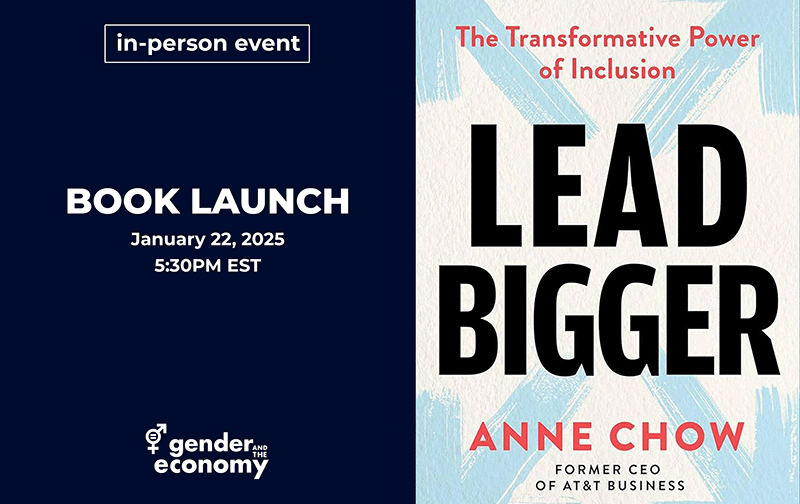
  • Anne Chow on ‘Lead Bigger: The Transformative Power of Inclusion’

    Anne Chow on ‘Lead Bigger: The Transformative Power of Inclusion’


    Topic: Lead Bigger: The Transformative Power of Inclusion (Simon & Schuster, September 2024)

    Date: January 22, 2025, 5:30PM EST

    Synopsis:

    Drawing from over three decades of experience, former CEO of AT&T Business Anne Chow shares how to lead bigger by leveraging inclusion beyond DEI, to elevate your work, workforce, and workplace.For generations, when we’ve needed to innovate and grow, we’ve been told to “think bigger”—it’s now time to Lead Bigger.

    In a world that’s become more interconnected yet polarized, inclusion has been overly politicized and narrowly defined to issues of gender and race. As a result, we need a new approach to inclusive leadership that goes beyond DEI, harnessing its power for innovation and growth. In Lead Bigger, Anne Chow reframes inclusion as the required leadership competency of expanding our perspectives for greater performance in our work, workforce, and workplace.

    As former CEO of AT&T Business, she was the first woman of color to hold the position of CEO in the company’s over one hundred and forty year history. Chow draws from her expertise in transforming organizations to teach you how to create a dynamic environment that engages everyone you and your company interact with—as well as those you wish to be connected to—while adapting to the ever-changing world. This book equips you with the necessary tools to expand your inclusive leadership skills, including prompts, tactics, and enriching insights from leadership visionaries General Stanley McChrystal, Arianna Huffington, and Adam Grant.

    Chow illuminates a seismic shift in the business world, in which a more humanistic approach is required as technology upends work as we know it. If you’re committed to advancing work that matters, engaging a dynamic workforce, and fostering an agile workplace, you’re ready to Lead Bigger.

    REGISTRATION LINK

    Speaker:

    Anne Chow, Former CEO, AT&T Business

    In Conversation with: Nouman Ashraf, Associate Professor, Teaching Stream, Organizational Behaviour and Human Resource Management

    About our Speaker:

    As the former CEO of AT&T Business, Anne Chow was the first woman and first woman of color to hold the position of CEO at AT&T in 2019, overseeing more than 35,000 employees who collectively served 3 million business customers worldwide during her time there. She is currently the Lead Director on the board of Franklin Covey, serves on the board of 3M and CSX, and teaches at Northwestern University’s Kellogg School of Management. You can listen to Anne on Harvard Business Review’s Race at Work, WFAA and MSNBC.

    Nouman Ashraf is Assistant Professor, Teaching Stream within the Organizational Behavior and Human Resources Management area at the Rotman School of Management. He possesses a broad range of professional, academic and research interests, with a specialized focus on enabling innovative and inclusive practices within organization life. For the last decade and a half, he has held progressively senior roles at the University of Toronto. He is a recognized thought leader in governance, and has taught thousands of directors in the national Rotman program on Not for Profit Governance in partnership with the Institute for Corporate Directors since its inception in 2007.

    An award winning faculty member, Nouman teaches Emancipatory Leadership within the Executive MBA as well as the OMNIUM Global Executive MBA Program, Leading Social Innovation within the 2 and 3 Year MBA programs, and Leading across Differences within the Rotman Commerce Program. He is the Academic Director of various custom leadership programs in partnership with Rotman Executive Program clients. His previous consulting clients include Telus, Cliffs Natural Resources, Bayer, the Canadian Broadcasting Corporation, the Ontario Trillium Foundation, United Way Toronto, and numerous post-secondary and healthcare institutions. At Lunch time, he can be found at Massey College within the University of Toronto, where he mentors exceptional post-graduate students in his capacity as Senior Fellow.

    Event Logistics:

    This event is available to attend in-person only.

    Rotman Events is committed to accessibility for all people. If you have any access needs or if there are any ways we can support your full participation in this session, please email [events@rotman.utoronto.ca] no later than 2 weeks in advance of the event and we will be glad to work with you to make the appropriate arrangements.

    General Admission: In-Person Ticket Details

    The event will be hosted in Desautels Hall at the Rotman School of Management (105 Saint George Street, Toronto, ON M5S 3E6).

    Cancellation & Refund Policy

    • Refunds will only be issued for cancellations received in writing NO LATER than 24 hours prior to the event. Please email events@rotman.utoronto.ca for processing.
    • In-person registrants who do not pick up their book at the event will have 5 business days to request postal delivery by emailing us at events@rotman.utoronto.ca. All unclaimed books will be returned to the publisher after that time.

    Questions: events@rotman.utoronto.ca, Megan Murphy

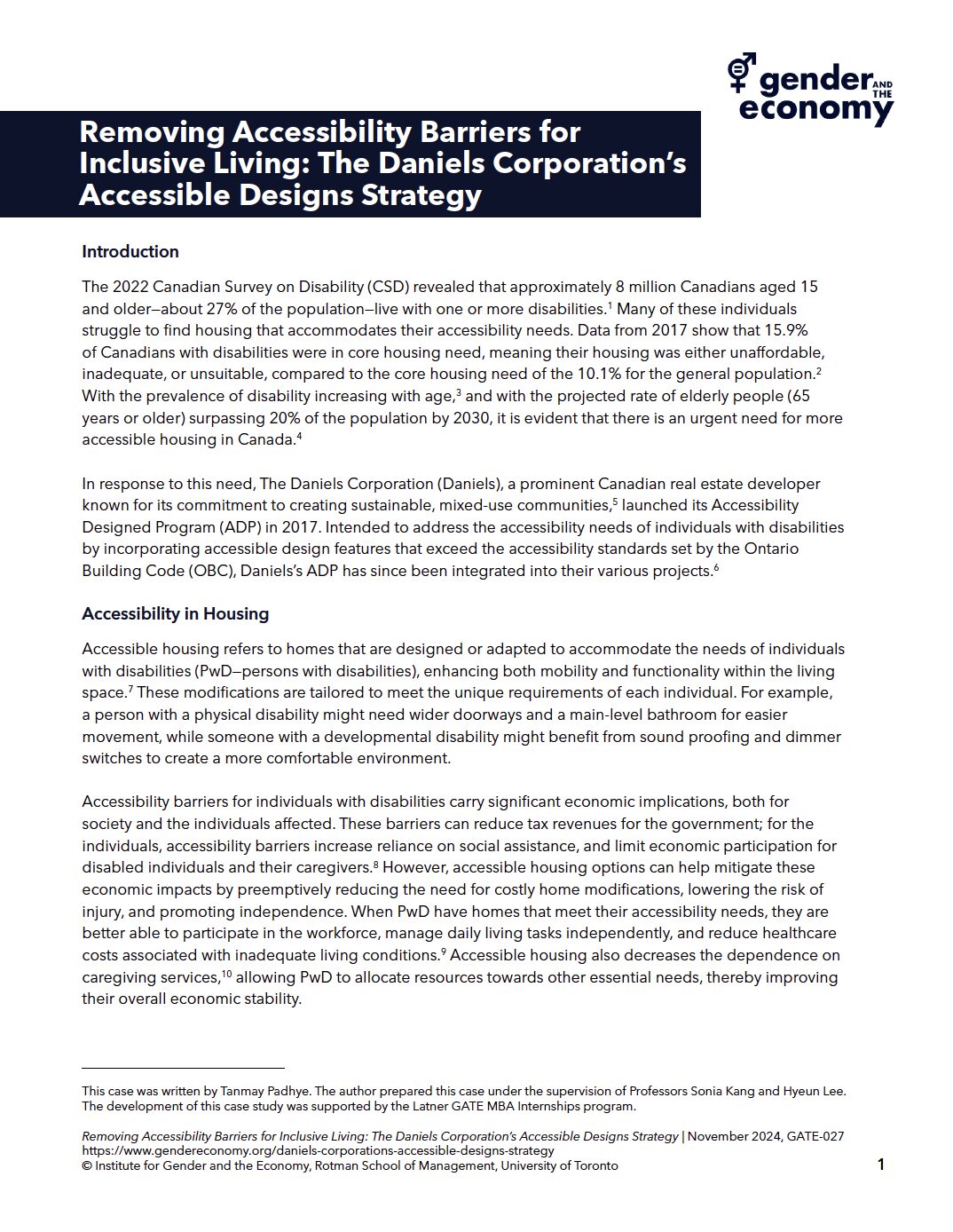
  • Removing Accessibility Barriers for Inclusive Living: The Daniels Corporation’s Accessible Designs Strategy

    Removing Accessibility Barriers for Inclusive Living: The Daniels Corporation’s Accessible Designs Strategy


     Introduction

    The 2022 Canadian Survey on Disability (CSD) revealed that approximately 8 million Canadians aged 15 and older—about 27% of the population—live with one or more disabilities. Many of these individuals struggle to find housing that accommodates their accessibility needs. Data from 2017 show that 15.9% of Canadians with disabilities were in core housing need, meaning their housing was either unaffordable, inadequate, or unsuitable, compared to the core housing need of the 10.1% for the general population. With the prevalence of disability increasing with age, and with the projected rate of elderly people (65 years or older) surpassing 20% of the population by 2030, it is evident that there is an urgent need for more accessible housing in Canada.

    In response to this need, The Daniels Corporation (Daniels), a prominent Canadian real estate developer known for its commitment to creating sustainable, mixed-use communities, launched its Accessibility Designed Program (ADP) in 2017. Intended to address the accessibility needs of individuals with disabilities by incorporating accessible design features that exceed the accessibility standards set by the Ontario Building Code (OBC), Daniels’s ADP has since been integrated into their various projects.

    TO VIEW AND DOWNLOAD THE FULL CASE STUDY, FOLLOW THESE INSTRUCTIONS.

     This case was written by Tanmay Padhye. The author prepared this case under the supervision of Professors Sonia Kang and Hyeun Lee.

    The development of this case study was supported by the Latner GATE MBA Internships program. 


  • Pigment Paradox: A podcast on colourism in India and beyond

    Pigment Paradox: A podcast on colourism in India and beyond


    About the series: BMO GATE MBA Fellow Nishtha Taneja tackles the tough topic of colourism in the workplace and beyond. Lighter skin tones often receive preferential treatment, while darker skin tones face discrimination. This bias exists across various racial and ethnic communities and influences important areas such as employment, housing, and social interactions.

    Episode 1 — Unfiltered: Women Speak Out on Colorism’s Impact from Playground to Boardroom

    Episode 1 show notes

    Episode 2 — Uncovering Bias: HR Dilemmas and DEI Solutions

    Episode 2 show notes

    Episode 3 — Beyond Skin Deep: Women’s Mental Health & Colorism

    Episode 3 show notes

    Episode 4 — Color beyond Borders: The Global Impact of Corporate Colorism

    Episode 4 show notes

    *Disclaimer: The opinions expressed in this series do not necessarily reflect the views of the Institute for Gender and the Economy or the University of Toronto.

    LISTEN TO OTHER GATE PODCAST SERIES ON THE GATE AUDIO CHANNEL ON APPLE PODCASTS OR THE GATE AUDIO PLAYLIST ON SPOTIFY

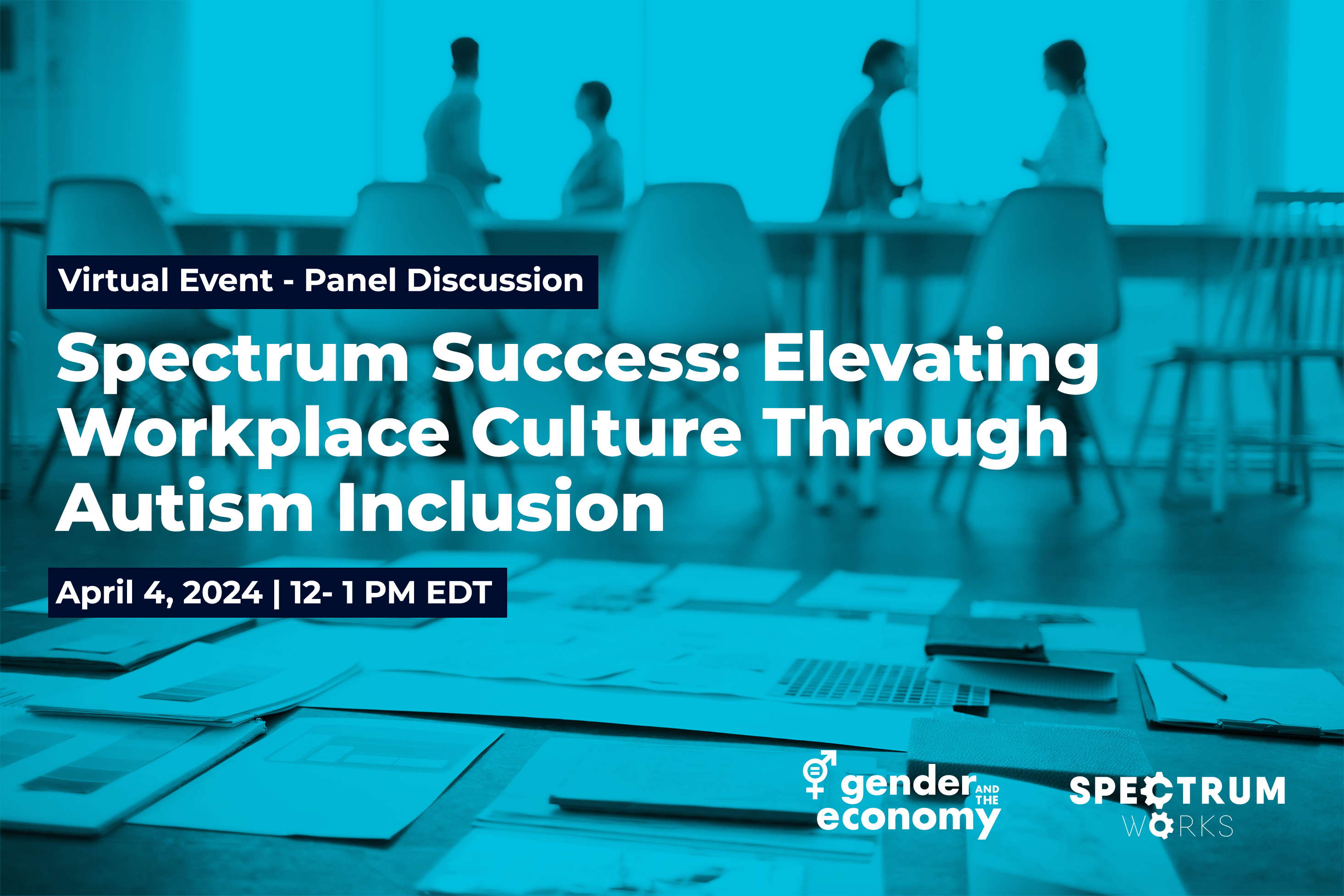
  • Spectrum Success: Elevating Workplace Culture Through Autism Inclusion

    Spectrum Success: Elevating Workplace Culture Through Autism Inclusion

    [fusion_builder_container hundred_percent=”no” equal_height_columns=”no” hide_on_mobile=”small-visibility,medium-visibility,large-visibility” background_position=”center center” background_repeat=”no-repeat” fade=”no” background_parallax=”none” parallax_speed=”0.3″ video_aspect_ratio=”16:9″ video_loop=”yes” video_mute=”yes” border_style=”solid” type=”legacy”][fusion_builder_row][fusion_builder_column type=”1_1″ layout=”1_1″ background_position=”left top” border_style=”solid” border_position=”all” spacing=”yes” background_repeat=”no-repeat” margin_top=”0px” margin_bottom=”0px” animation_speed=”0.3″ animation_direction=”left” hide_on_mobile=”small-visibility,medium-visibility,large-visibility” center_content=”no” last=”true” hover_type=”none” first=”true” min_height=”” link=”” background_blend_mode=”overlay”][fusion_text columns=”” column_min_width=”” column_spacing=”” rule_style=”” rule_size=”” rule_color=”” hue=”” saturation=”” lightness=”” alpha=”” content_alignment_medium=”” content_alignment_small=”” content_alignment=”” hide_on_mobile=”small-visibility,medium-visibility,large-visibility” sticky_display=”normal,sticky” class=”” id=”” margin_top=”” margin_right=”” margin_bottom=”” margin_left=”” fusion_font_family_text_font=”” fusion_font_variant_text_font=”” font_size=”” line_height=”” letter_spacing=”” text_transform=”none” text_color=”” animation_type=”” animation_direction=”left” animation_color=”” animation_speed=”0.3″ animation_delay=”0″ animation_offset=”” logics=””]

    Topic: Spectrum Success: Elevating Workplace Culture Through Autism Inclusion

    Speakers:

    The Honourable Mike Lake, Member of Parliament

    Nadira Badri, Verification Officer, CIBC

    Heather Linka, Neurodiversity Employment Consultant

    Carole Mendonca, National Leader, Deloitte Accessibility

    Maja Djikic, Associate Professor & Executive Director, Self Development Lab, Rotman School of Management (moderator)

    Synopsis:

    GATE hosted an insightful panel discussion in partnership with Spectrum Works (powered by Substance Cares) for Autism Acceptance Month. The panel discussed key topics around the successful integration of autism into workplace diversity. Panelists shared meaningful policies and programs that corporations and government can use to engage the autistic community. They also discussed strategies to bridge hiring gaps, enhance workplace culture, and support divergent thinking.

    Featuring insightful speakers and experts with firsthand experience in navigating employment with autism, the panel aimed to empower professionals to become champions of autism in the workplace.

    View the full event recording to learn the key takeaways from the event.

    [/fusion_text][fusion_separator style_type=”none” hide_on_mobile=”small-visibility,medium-visibility,large-visibility” top_margin=”20″ bottom_margin=”20″ alignment=”center” /][fusion_button link=”https://www.gendereconomy.org/events/” target=”_blank” hide_on_mobile=”small-visibility,medium-visibility,large-visibility” color=”custom” button_gradient_top_color=”#62bd19″ button_gradient_bottom_color=”#62bd19″ button_gradient_top_color_hover=”#00c2e2″ button_gradient_bottom_color_hover=”#00c2e2″ stretch=”yes” icon_position=”left” icon_divider=”no” animation_direction=”left” animation_speed=”0.3″]See more events[/fusion_button][/fusion_builder_column][/fusion_builder_row][/fusion_builder_container]