Tag: Feminism

Research briefs, news, and event recaps related to feminism.

  • Maja Djikic on ‘The Possible Self: A Leader’s Guide to Personal Development’

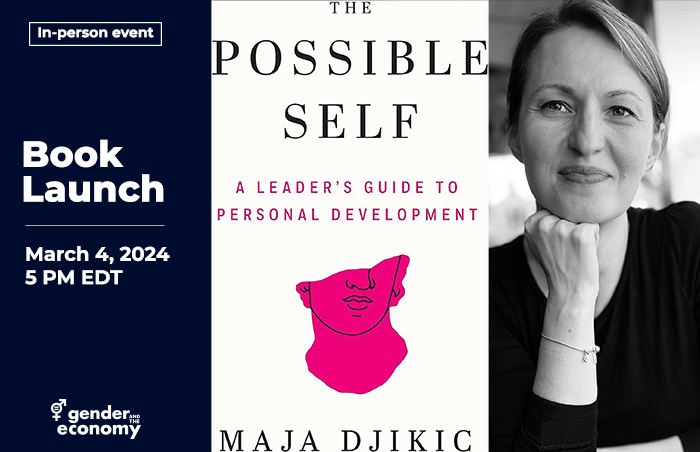
    Maja Djikic on ‘The Possible Self: A Leader’s Guide to Personal Development’

    [fusion_builder_container hundred_percent=”no” equal_height_columns=”no” hide_on_mobile=”small-visibility,medium-visibility,large-visibility” background_position=”center center” background_repeat=”no-repeat” fade=”no” background_parallax=”none” parallax_speed=”0.3″ video_aspect_ratio=”16:9″ video_loop=”yes” video_mute=”yes” border_style=”solid” type=”legacy”][fusion_builder_row][fusion_builder_column type=”1_1″ layout=”1_1″ background_position=”left top” border_style=”solid” border_position=”all” spacing=”yes” background_repeat=”no-repeat” margin_top=”0px” margin_bottom=”0px” animation_speed=”0.3″ animation_direction=”left” hide_on_mobile=”small-visibility,medium-visibility,large-visibility” center_content=”no” last=”true” hover_type=”none” first=”true” min_height=”” link=”” background_blend_mode=”overlay”][fusion_text columns=”” column_min_width=”” column_spacing=”” rule_style=”” rule_size=”” rule_color=”” hue=”” saturation=”” lightness=”” alpha=”” content_alignment_medium=”” content_alignment_small=”” content_alignment=”” hide_on_mobile=”small-visibility,medium-visibility,large-visibility” sticky_display=”normal,sticky” class=”” id=”” margin_top=”” margin_right=”” margin_bottom=”” margin_left=”” fusion_font_family_text_font=”” fusion_font_variant_text_font=”” font_size=”” line_height=”” letter_spacing=”” text_transform=”none” text_color=”” animation_type=”” animation_direction=”left” animation_color=”” animation_speed=”0.3″ animation_delay=”0″ animation_offset=”” logics=””]

    Topic: Maja Djikic on ‘The Possible Self: A Leader’s Guide to Personal Development’

    Dean Susan Christoffersen of the Rotman School of Management hosted a discussion with Maja Djikic, Associate Professor of Organizational Behavior and Human Resource Management, Director of the Self-Development Laboratory and Faculty Teaching Fellow at GATE. At the event, they highlighted the insights from Maja’s new book, ‘The Possible Self: A Leader’s Guide to Personal Development’ with over 700 event attendees.

    Maja shared with us that in order to discover purpose and achieve real, lasting change, we need to move beyond narrowly targeted ideas and strategies like changing our mindset or slightly altering our behaviour, and instead go deeper and focus on our innate desires and achieve true healing.

    Maja explored how sustained change can only happen when all five parts of ourselves move in the same direction and at the same time. She introduced a transformational system called the Wheel of Change—a simple, five-segment plan that corresponds with the five key parts of ourselves: Desires, Actions, Emotions, Thoughts, and Body.

    Maja also discussed external factors in our lives, such as discrimination, stereotyping, and bias, and how they can hinder our ability to heal and move forward, especially affecting those in marginalized communities. She emphasized the importance of healing, highlighting its role in fostering growth and positive change within our communities.

    “There’s this dichotomy that ‘we need to change the world, not the person’, but we can help ourselves heal so we can interact with the world in a way that benefits us.”

    – Maja Djikic


    [/fusion_text][fusion_separator style_type=”none” hide_on_mobile=”small-visibility,medium-visibility,large-visibility” top_margin=”20″ bottom_margin=”20″ alignment=”center” /][fusion_button link=”https://www.gendereconomy.org/events/” target=”_blank” hide_on_mobile=”small-visibility,medium-visibility,large-visibility” color=”custom” button_gradient_top_color=”#62bd19″ button_gradient_bottom_color=”#62bd19″ button_gradient_top_color_hover=”#00c2e2″ button_gradient_bottom_color_hover=”#00c2e2″ stretch=”yes” icon_position=”left” icon_divider=”no” animation_direction=”left” animation_speed=”0.3″]See more events[/fusion_button][/fusion_builder_column][/fusion_builder_row][/fusion_builder_container]
  • Dr. Jen Gunter on ‘The Science, Medicine, and Mythology of Menstruation’

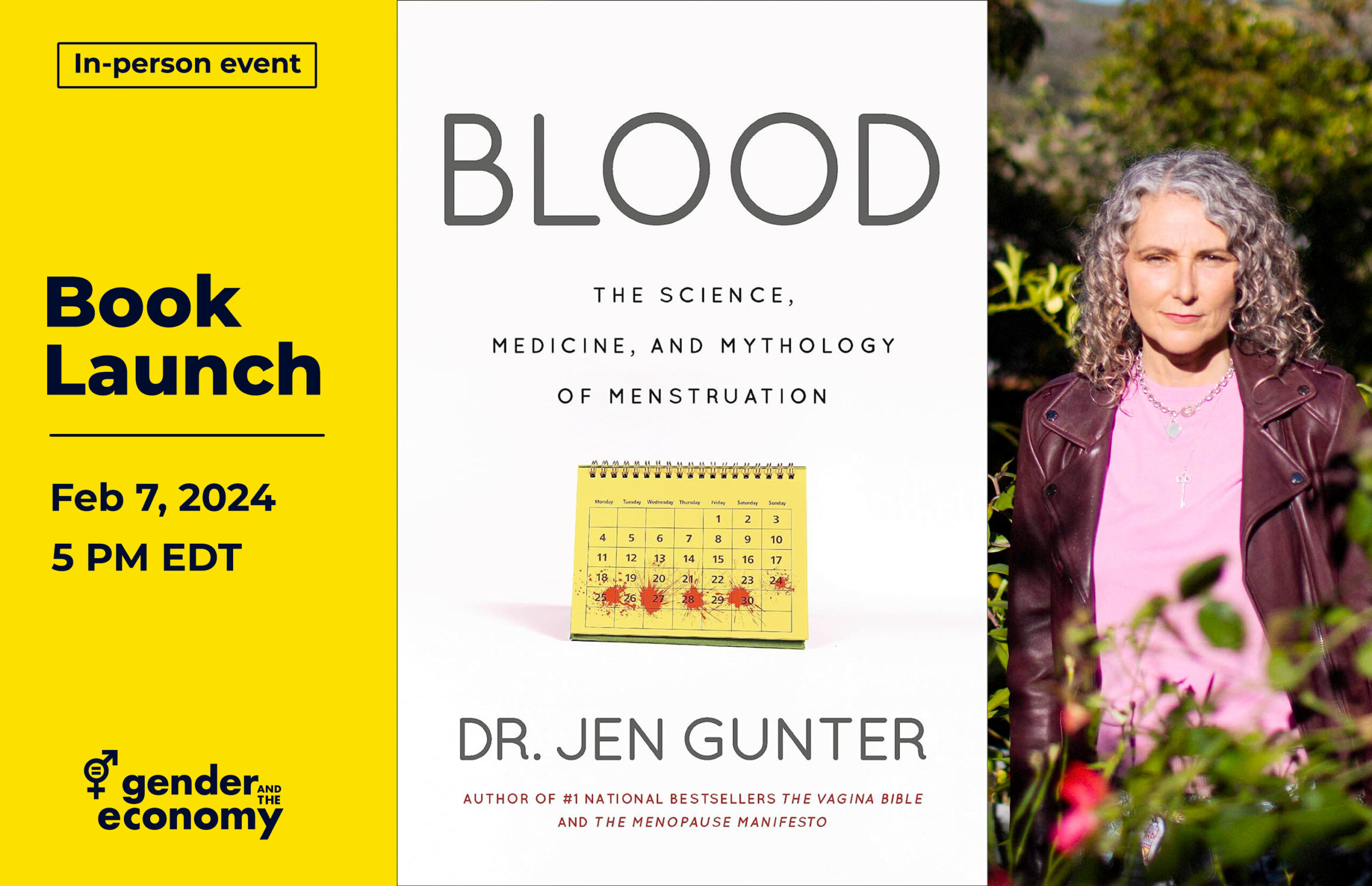
    Dr. Jen Gunter on ‘The Science, Medicine, and Mythology of Menstruation’

    [fusion_builder_container hundred_percent=”no” equal_height_columns=”no” hide_on_mobile=”small-visibility,medium-visibility,large-visibility” background_position=”center center” background_repeat=”no-repeat” fade=”no” background_parallax=”none” parallax_speed=”0.3″ video_aspect_ratio=”16:9″ video_loop=”yes” video_mute=”yes” border_style=”solid” type=”legacy”][fusion_builder_row][fusion_builder_column type=”1_1″ layout=”1_1″ background_position=”left top” border_style=”solid” border_position=”all” spacing=”yes” background_repeat=”no-repeat” margin_top=”0px” margin_bottom=”0px” animation_speed=”0.3″ animation_direction=”left” hide_on_mobile=”small-visibility,medium-visibility,large-visibility” center_content=”no” last=”true” hover_type=”none” first=”true” min_height=”” link=”” background_blend_mode=”overlay”][fusion_text columns=”” column_min_width=”” column_spacing=”” rule_style=”” rule_size=”” rule_color=”” hue=”” saturation=”” lightness=”” alpha=”” content_alignment_medium=”” content_alignment_small=”” content_alignment=”” hide_on_mobile=”small-visibility,medium-visibility,large-visibility” sticky_display=”normal,sticky” class=”” id=”” margin_top=”” margin_right=”” margin_bottom=”” margin_left=”” fusion_font_family_text_font=”” fusion_font_variant_text_font=”” font_size=”” line_height=”” letter_spacing=”” text_transform=”none” text_color=”” animation_type=”” animation_direction=”left” animation_color=”” animation_speed=”0.3″ animation_delay=”0″ animation_offset=”” logics=””]

    Topic: Dr. Jen Gunter on ‘The Science, Medicine, and Mythology of Menstruation’

    Dr. Jen Gunter returned to the Rotman School of Management to discuss her latest book, Blood: The Science, Medicine, and Mythology of Menstruation (Random House Canada Jan. 23 2024) with GATE’s Founding Director, Dr. Sarah Kaplan. (She visited us in 2019 to discuss her book, The Vagina Bible and in 2021 to discuss her book Menopause Manifesto).

    Most women can expect to have hundreds of periods in a lifetime. Yet few are given the tools to understand the science of their own cycle, how it changes over their lifetime, and how it connects to their overall health. Together, Dr. Gunter and Dr. Kaplan had an animated discussion about the historical and social myths about menstruation and the impact that misinformation and stigmatization have had on women’s health, economic empowerment, and the society.

    Dr. Gunter also highlights the connections between menstruation and the health risks associated with pregnancy, birth control and abortion, encouraging the audience to think about abortion in a different light. She emphasized that when access to abortion is restricted, the maternal mortality rate goes up, and women face higher rates of poverty and economic uncertainty.

    “It’s really important that the concept of abortion is introduced early as if it’s no big deal – because it is no big deal. It should be free and available to everybody. The ability to choose your reproductive path should be a human right.”

    – Jen Gunter

    We will turn the recording of this event into a special episode of our signature myth-busting podcast, BUSTED Season 3, which is on Apple Podcast and Spotify. Stay tuned!

    Watch Dr. Jen Gunter speak about why she included abortion in a book about periods

    [/fusion_text][fusion_separator style_type=”none” hide_on_mobile=”small-visibility,medium-visibility,large-visibility” top_margin=”20″ bottom_margin=”20″ alignment=”center” /][fusion_button link=”https://www.gendereconomy.org/events/” target=”_blank” hide_on_mobile=”small-visibility,medium-visibility,large-visibility” color=”custom” button_gradient_top_color=”#62bd19″ button_gradient_bottom_color=”#62bd19″ button_gradient_top_color_hover=”#00c2e2″ button_gradient_bottom_color_hover=”#00c2e2″ stretch=”yes” icon_position=”left” icon_divider=”no” animation_direction=”left” animation_speed=”0.3″]See more events[/fusion_button][/fusion_builder_column][/fusion_builder_row][/fusion_builder_container]

  • MEDA: Breaking the cycle of poverty by investing in entrepreneurs

    MEDA: Breaking the cycle of poverty by investing in entrepreneurs


    Overview 

    MEDA, an international economic development organization, has consistently made efforts to prioritize shared voices, taking local contexts into account to create programs that promote equity and benefit the Global South. By involving local expertise, MEDA has worked to rectify inequitable systems, cater to the needs of the local stakeholders, and deliver effective programs.

    Course Topics: 

    • Gender-based analysis
    • Economic development
    • Entrepreneurship
    • Agri-food businesses

     Introduction 

    MEDA—is an international economic development organization that combats poverty by creating community-based business solutions . The organization celebrated 70 years in 2023, and it has worked in over 70 countries. MEDA incorporates a market systems approach that addresses the root causes of underdeveloped markets, especially the things that prevent people in poverty and marginalized groups, such as youth and women, from participating in and benefiting from market growth.

    Early on, MEDA recognized the potential of leveraging the agri-food market system to create opportunities to help marginalized communities out of poverty. In developing countries in particular, agricultural development is a powerful tool to end extreme poverty. MEDA has been at the forefront of providing ongoing support for producing, processing, and marketing of food crops, livestock, poultry, and aquaculture. MEDA’s approach acknowledges that every aspect of the business system can be influenced by cultural, political, and social forces and their approach focuses on the impacts of addressing social norms, power relations, and systemic inequalities. MEDA also strives to expand choices and opportunities for the participants in these systems, working with them to create culturally appropriate strategies to spur systems change in the agri-food market.

    To view and download the full case study, follow these instructions.

    This case was written by Vania Sembiring. The author prepared this case under the supervision of Professors Sarah Kaplan and Hyeun Lee.

  • Reina: Breaking the Concrete Ceiling in Housing Development

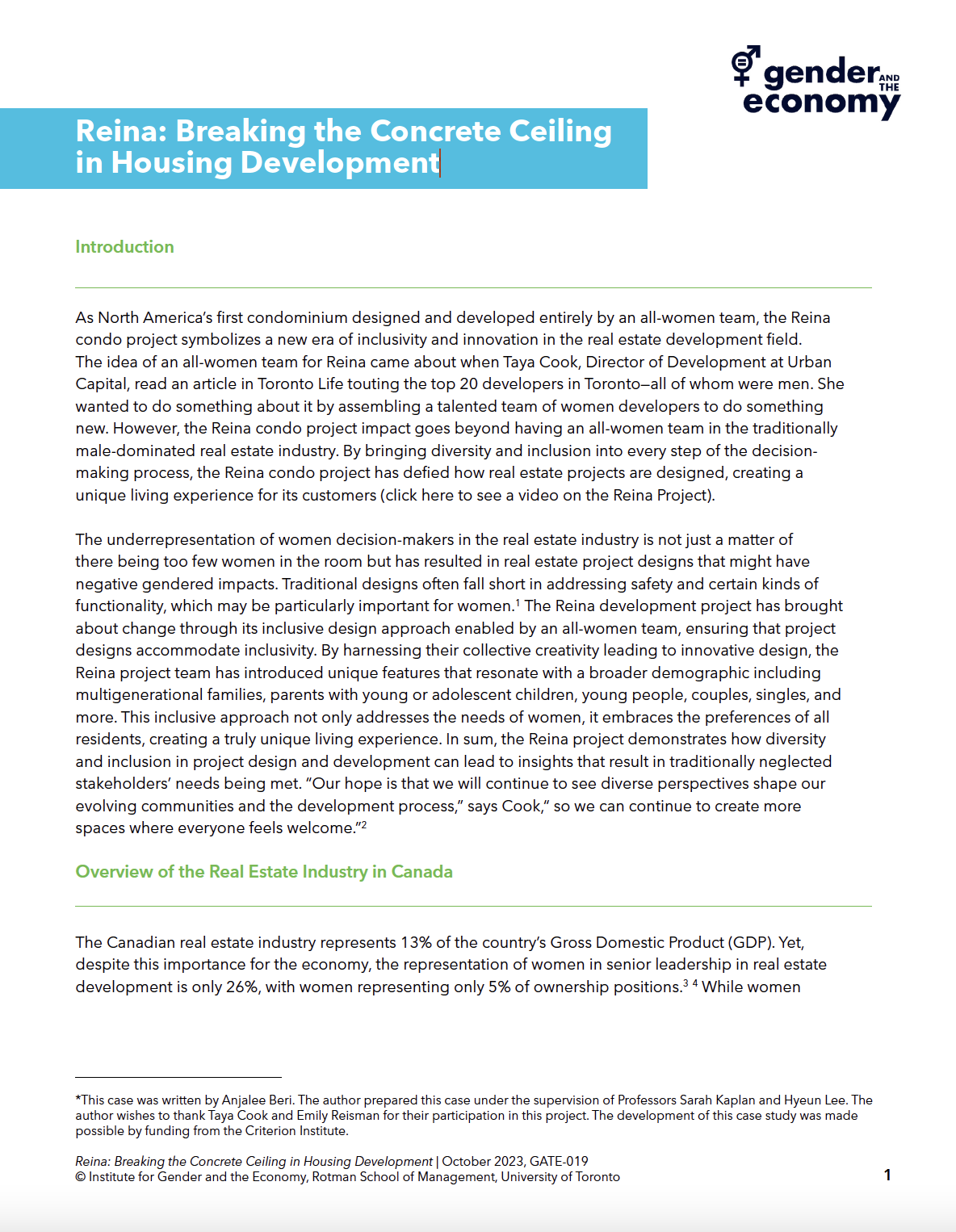
    Reina: Breaking the Concrete Ceiling in Housing Development


    Overview 

    The underrepresentation of women decision-makers in the real estate industry has resulted in real estate project designs that may have negative gendered impacts or may not serve all communities well. By bringing diversity and inclusion into every step of the decision-making process, the Reina condo project has reinvented how real estate projects are designed, creating a unique living experience for its customers. 

    Course Topics: 

    • Real estate 
    • Business design 
    • Diversity and inclusion 
    • Gender analysis 
    • Leadership 

     Introduction 

    As North America’s first condominium designed and developed entirely by an all-women team, Reina signifies a new era of inclusivity and innovation in the real estate development field. The concept of an all-women team for the Reina project came about when Taya Cook, Director of Development at Urban Capital, read an article in Toronto Life touting the top 20 developers in Toronto—all of whom were men. She wanted to do something about it by assembling a talented team of women developers, planners and designers to do something new.  

    The Reina condo project has brought about change through its inclusive design approach enabled by its all-women team, ensuring that the project design accommodates inclusivity. By incorporating lessons and insights from community engagement, the Reina project team has introduced unique features that resonate with a broader demographic including multigenerational families, parents with young or adolescent children, young people, couples, singles, and more. This inclusive approach not only addresses the needs of women, it embraces the preferences of all residents, creating a truly unique living experience. In sum, the Reina project demonstrates how diversity and inclusion in project design and development can lead to insights that result in traditionally neglected stakeholders’ needs being met.  

    To view and download the full case study, follow these instructions.

    This case was written by Anjalee Beri. The author prepared this case under the supervision of Professors Sarah Kaplan and Hyeun Lee.  

  • Knix Period Underwear: Navigating Growth in a Market Neglected by Venture Capital

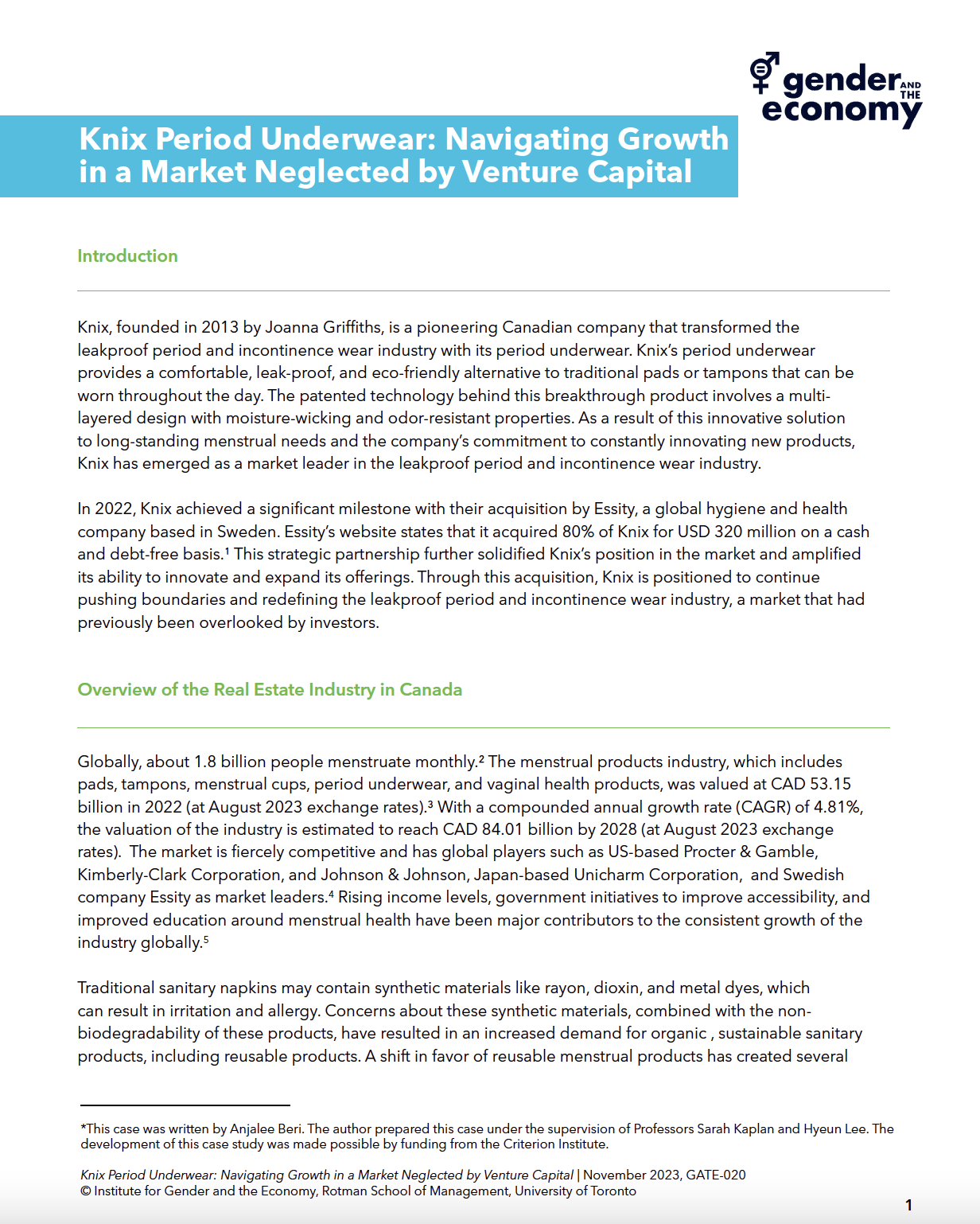
    Knix Period Underwear: Navigating Growth in a Market Neglected by Venture Capital


    Overview 

    This case study examines how Knix has been able to redefine the menstrual products industry and establish leadership in leakproof period and incontinence wear. Knix’s success urges us to examine how the shift towards a more inclusive, adaptive business model and the innovation of products that truly resonate with the customer base can build new market opportunities.  

    Course Topics: 

    • Gender-based analysis 
    • Entrepreneurship 
    • Product innovation 
    • Venture finance 

    Introduction 

    Knix, founded in 2013 by Joanna Griffiths, is a pioneering Canadian company that transformed the leakproof period and incontinence wear industry with its period underwear. Knix’s period underwear provides a comfortable, leak-proof, and eco-friendly alternative to traditional pads or tampons that can be worn throughout the day. The patented technology behind this breakthrough product involves a multi-layered design with moisture-wicking and odor-resistant properties. As a result of this innovative solution to long-standing menstrual needs and the company’s commitment to constantly innovating new products, Knix has emerged as a market leader in the leakproof period and incontinence wear industry.  

    In 2022, Knix achieved a significant milestone with their acquisition by Essity, a global hygiene and health company based in Sweden. for USD 320 million (for 80% ownership).  This strategic partnership further solidified Knix’s position in the market and amplified its ability to innovate and expand its offerings while also demonstrating the economic value of paying attention to markets that have been neglected by large consumer companies.  

    To view and download the full case study, follow these instructions.

    This case was written by Anjalee Beri. The author prepared this case under the supervision of Professors Sarah Kaplan and Hyeun Lee.  

  • Janine Rogan on ‘The Pink Tax’

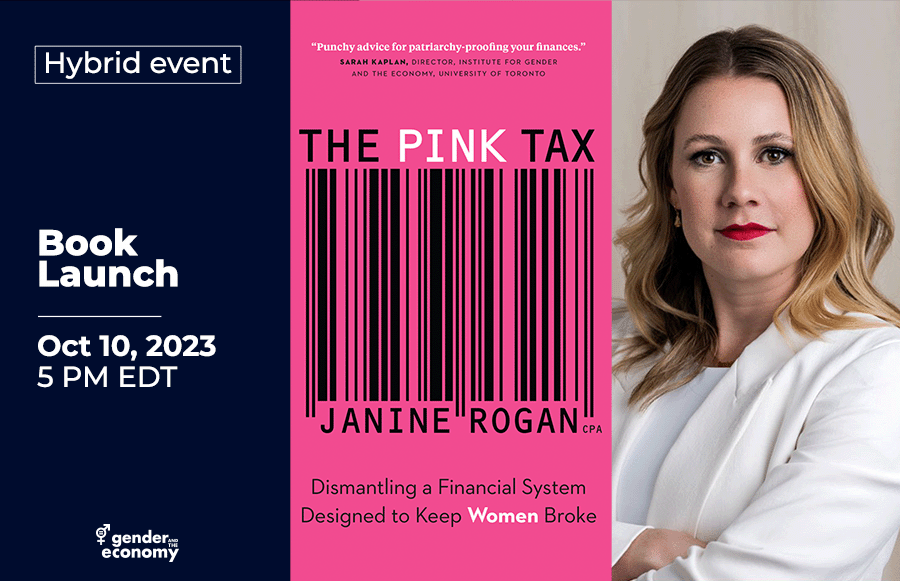
    Janine Rogan on ‘The Pink Tax’

    [fusion_builder_container hundred_percent=”no” equal_height_columns=”no” hide_on_mobile=”small-visibility,medium-visibility,large-visibility” background_position=”center center” background_repeat=”no-repeat” fade=”no” background_parallax=”none” parallax_speed=”0.3″ video_aspect_ratio=”16:9″ video_loop=”yes” video_mute=”yes” border_style=”solid” type=”legacy”][fusion_builder_row][fusion_builder_column type=”1_1″ layout=”1_1″ background_position=”left top” border_style=”solid” border_position=”all” spacing=”yes” background_repeat=”no-repeat” margin_top=”0px” margin_bottom=”0px” animation_speed=”0.3″ animation_direction=”left” hide_on_mobile=”small-visibility,medium-visibility,large-visibility” center_content=”no” last=”true” hover_type=”none” first=”true” min_height=”” link=”” background_blend_mode=”overlay”][fusion_text columns=”” column_min_width=”” column_spacing=”” rule_style=”” rule_size=”” rule_color=”” hue=”” saturation=”” lightness=”” alpha=”” content_alignment_medium=”” content_alignment_small=”” content_alignment=”” hide_on_mobile=”small-visibility,medium-visibility,large-visibility” sticky_display=”normal,sticky” class=”” id=”” margin_top=”” margin_right=”” margin_bottom=”” margin_left=”” fusion_font_family_text_font=”” fusion_font_variant_text_font=”” font_size=”” line_height=”” letter_spacing=”” text_transform=”none” text_color=”” animation_type=”” animation_direction=”left” animation_color=”” animation_speed=”0.3″ animation_delay=”0″ animation_offset=”” logics=””]

    Topic: The Pink Tax: Dismantling a Financial System Designed to Keep Women Broke (Page Two Press, May 4 2023)

    GATE Founding Director Sarah Kaplan and Janine Rogan, founder and CEO of The Wealth Building Academy Inc. and an award-winning CPA, discussed Rogan’s new book The Pink Tax: Dismantling a Financial System Designed to Keep Women Broke (Page Two Press, May 4, 2023). Together, they busted tired myths about the gender wealth gap.

    Janine spoke about how the pink tax extends far beyond the costs of pink or feminine branded productsit is built into our financial systems and the very fabric of our society, allowing it to continue perpetuating the wage gap. As a result, women and other marginalized people have less to save, less to invest and, ultimately, accumulate less wealth over a lifetime.

    Janine shared some approaches that could help reach economic equality by smashing the pink tax, breaking down bias, and dismantling a financial system built by men, for men.

    “We have to be mindful of what interest rates we are allowing. Because if someone has low income who may not have the ability to build their credit scores or (are) new to the country, what interest rate do they get? They are getting the highest one. And that’s so wealth destroying.”

    – Janine Rogan  

    Watch Janine Rogan discuss how the pink tax affects marginalized communities

    [/fusion_text][fusion_separator style_type=”none” hide_on_mobile=”small-visibility,medium-visibility,large-visibility” top_margin=”20″ bottom_margin=”20″ alignment=”center” /][fusion_button link=”https://www.gendereconomy.org/events/” target=”_blank” hide_on_mobile=”small-visibility,medium-visibility,large-visibility” color=”custom” button_gradient_top_color=”#62bd19″ button_gradient_bottom_color=”#62bd19″ button_gradient_top_color_hover=”#00c2e2″ button_gradient_bottom_color_hover=”#00c2e2″ stretch=”yes” icon_position=”left” icon_divider=”no” animation_direction=”left” animation_speed=”0.3″]See more events[/fusion_button][/fusion_builder_column][/fusion_builder_row][/fusion_builder_container]
     

  • Gender Analytics: Possibilities conference

    [fusion_builder_container hundred_percent=”no” equal_height_columns=”no” hide_on_mobile=”small-visibility,medium-visibility,large-visibility” background_position=”center center” background_repeat=”no-repeat” fade=”no” background_parallax=”none” parallax_speed=”0.3″ video_aspect_ratio=”16:9″ video_loop=”yes” video_mute=”yes” border_style=”solid” type=”legacy”][fusion_builder_row][fusion_builder_column type=”1_1″ layout=”1_1″ background_position=”left top” border_style=”solid” border_position=”all” spacing=”yes” background_repeat=”no-repeat” margin_top=”0px” margin_bottom=”0px” animation_speed=”0.3″ animation_direction=”left” hide_on_mobile=”small-visibility,medium-visibility,large-visibility” center_content=”no” last=”true” hover_type=”none” first=”true” min_height=”” link=”” background_blend_mode=”overlay”][fusion_text columns=”” column_min_width=”” column_spacing=”” rule_style=”” rule_size=”” rule_color=”” hue=”” saturation=”” lightness=”” alpha=”” content_alignment_medium=”” content_alignment_small=”” content_alignment=”” hide_on_mobile=”small-visibility,medium-visibility,large-visibility” sticky_display=”normal,sticky” class=”” id=”” margin_top=”” margin_right=”” margin_bottom=”” margin_left=”” fusion_font_family_text_font=”” fusion_font_variant_text_font=”” font_size=”” line_height=”” letter_spacing=”” text_transform=”none” text_color=”” animation_type=”” animation_direction=”left” animation_speed=”0.3″ animation_offset=””]

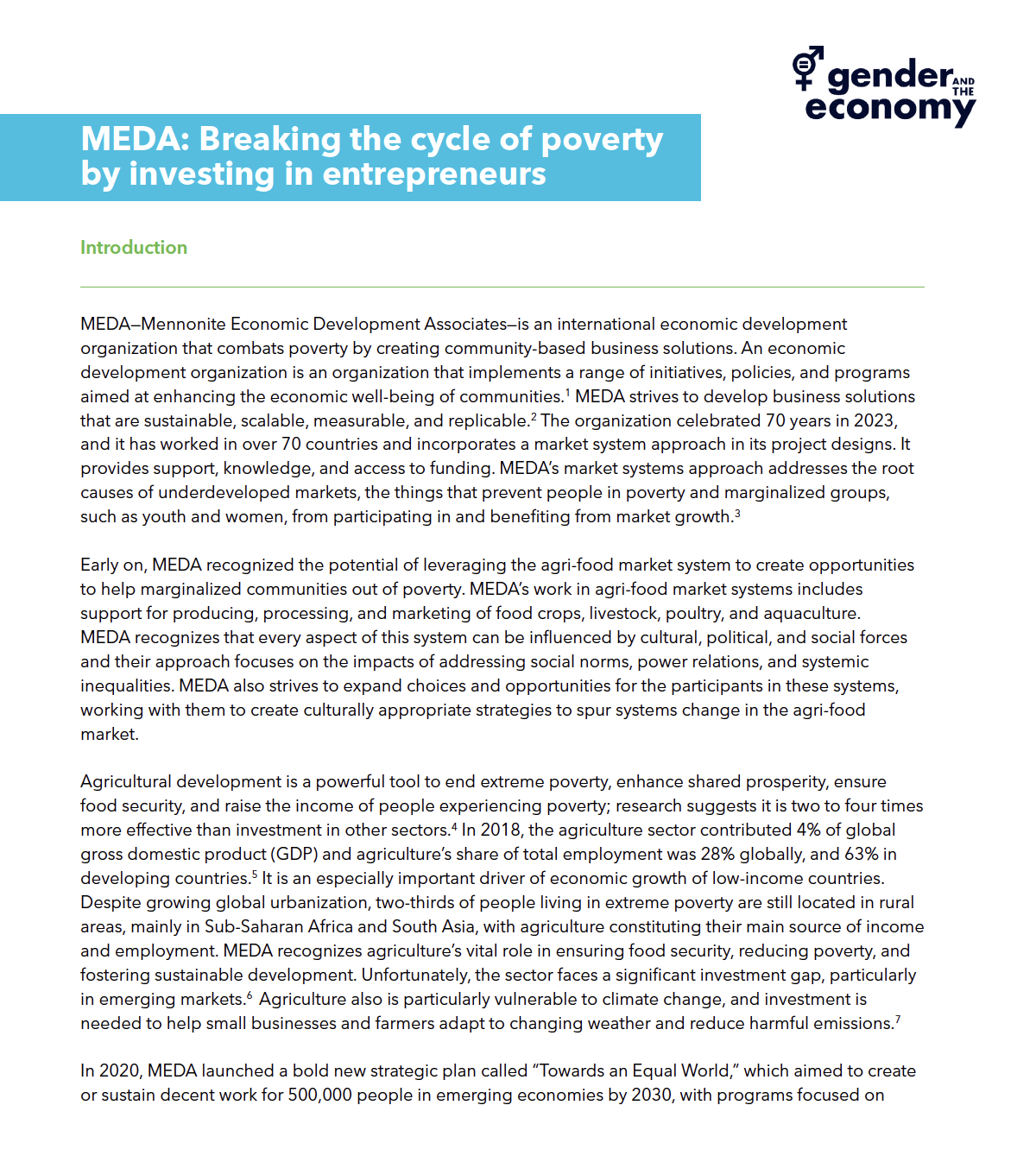
    Topic: Gender Analytics: Possibilities conference 

    Date: April 27-28, 2023

    Location: University of Toronto / Livestream 

    Co-hosted by: Institute for Gender and the Economy (GATE), TD Management and Data Analytics Lab (TD MDAL) 

    View our speakers list

    PLEASE REGISTER HERE FOR THIS EVENT.

    Using inclusive analytics to generate innovative products, services, and policies

    The hybrid in-person and online conference will take place on April 27, 2023.This is an excellent opportunity for leaders and innovators from academia, the private sector, government, and non-profits to come together to share how to create innovative products, services, and policies using inclusive analytics. We have already announced 15 speakers with more to come! Check out the full program and get your tickets here. We look forward to seeing you at the GA:P conference in 2023!

    Gender Analytics creates possibilities for high-impact innovation based on rich analytics, inclusive design and transformational leadership. While most people pigeon-hole gender equality as a question of diversity and inclusion inside organizations, thinking about inclusion as shaping how we design products, services, and policies creates an expansive space for innovation and impact.

    The Institute for Gender and the Economy (GATE) and the TD Management and Data Analytics Lab (TD MDAL)–two leading research centers at the University of Toronto’s Rotman School of Management–are co-hosting the first Gender Analytics: Possibilities (GA:P) conference. This is an opportunity for leaders and innovators from academia, the private sector, government, and non-profits to come together to share learnings and capitalize on insights from intersectional gender-based analyses.

    Through engaging panel discussions, small-group workshops, and an online exhibition, you will learn how inclusive analytics can generate new products, services and policies and make real progress on inclusion and gender equality.

    [/fusion_text][fusion_separator style_type=”none” hide_on_mobile=”small-visibility,medium-visibility,large-visibility” top_margin=”20″ bottom_margin=”20″ alignment=”center” /][fusion_button link=”https://www.gendereconomy.org/events/” target=”_blank” hide_on_mobile=”small-visibility,medium-visibility,large-visibility” color=”custom” button_gradient_top_color=”#62bd19″ button_gradient_bottom_color=”#62bd19″ button_gradient_top_color_hover=”#00c2e2″ button_gradient_bottom_color_hover=”#00c2e2″ stretch=”yes” icon_position=”left” icon_divider=”no” animation_direction=”left” animation_speed=”0.3″]See more events[/fusion_button][/fusion_builder_column][/fusion_builder_row][/fusion_builder_container]

  • We CAN Break Free: What it Takes to Challenge Gender-Based Violence

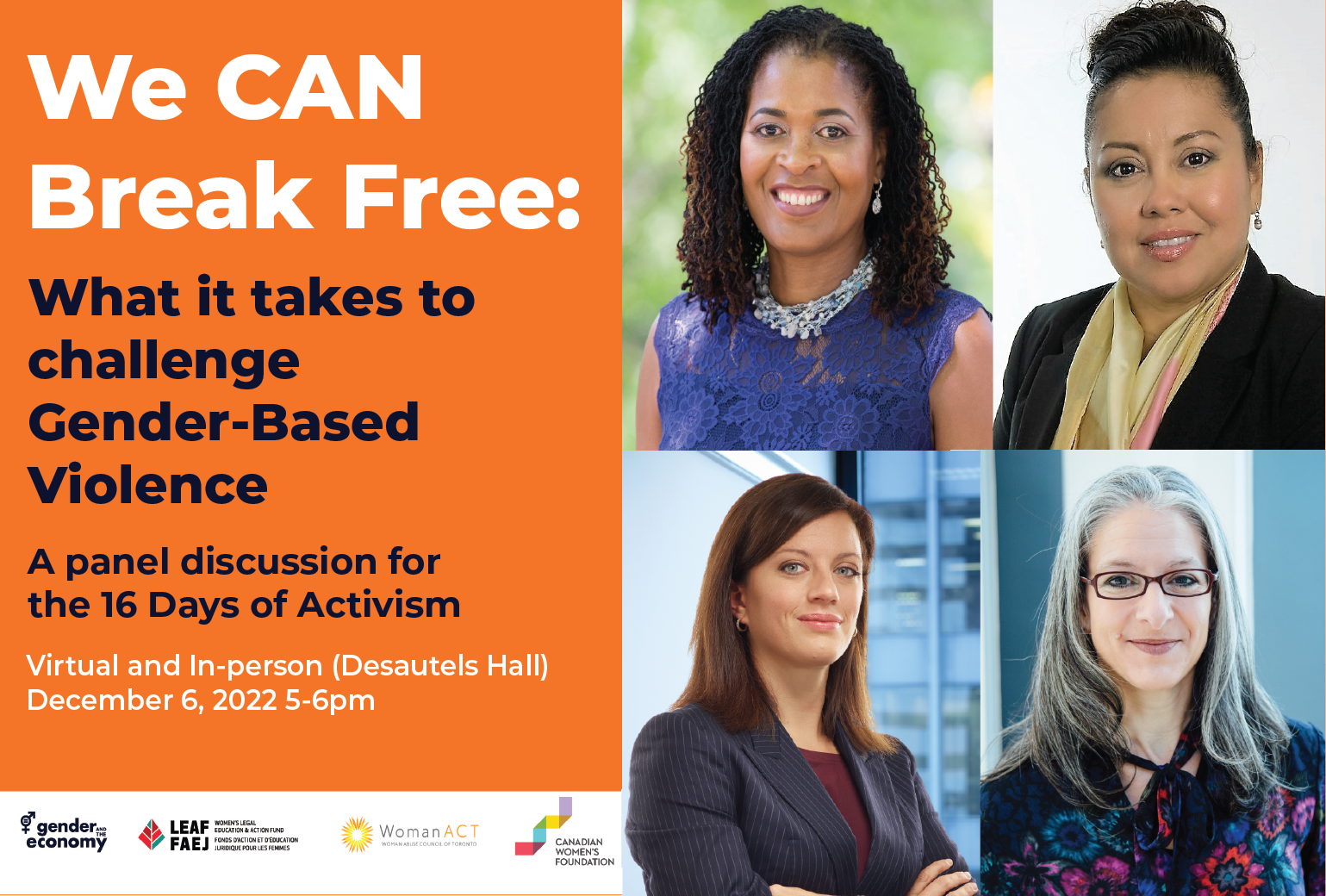
    We CAN Break Free: What it Takes to Challenge Gender-Based Violence

    [fusion_builder_container hundred_percent=”no” equal_height_columns=”no” hide_on_mobile=”small-visibility,medium-visibility,large-visibility” background_position=”center center” background_repeat=”no-repeat” fade=”no” background_parallax=”none” parallax_speed=”0.3″ video_aspect_ratio=”16:9″ video_loop=”yes” video_mute=”yes” border_style=”solid” type=”legacy”][fusion_builder_row][fusion_builder_column type=”1_1″ layout=”1_1″ background_position=”left top” border_style=”solid” border_position=”all” spacing=”yes” background_repeat=”no-repeat” margin_top=”0px” margin_bottom=”0px” animation_speed=”0.3″ animation_direction=”left” hide_on_mobile=”small-visibility,medium-visibility,large-visibility” center_content=”no” last=”true” hover_type=”none” first=”true” min_height=”” link=”” background_blend_mode=”overlay”][fusion_text columns=”” column_min_width=”” column_spacing=”” rule_style=”” rule_size=”” rule_color=”” hue=”” saturation=”” lightness=”” alpha=”” content_alignment_medium=”” content_alignment_small=”” content_alignment=”” hide_on_mobile=”small-visibility,medium-visibility,large-visibility” sticky_display=”normal,sticky” class=”” id=”” margin_top=”” margin_right=”” margin_bottom=”” margin_left=”” fusion_font_family_text_font=”” fusion_font_variant_text_font=”” font_size=”” line_height=”” letter_spacing=”” text_transform=”none” text_color=”” animation_type=”” animation_direction=”left” animation_speed=”0.3″ animation_offset=””]

    Topic: We CAN Break Free: What it Takes to Challenge Gender-Based Violence : A panel discussion for the 16 Days of Activism against Gender-Based Violence

    Gender-based violence, a public health crisis, has exacerbated during the pandemic. The Canadian Femicide Observatory’s data shows that 173 women and girls were killed by violence in 2021, a sharp increase from 2019. And according to Women and Gender Equality Canada, at least 44% of heterosexual women, 67% of LGB+ women, and 59% of transgender and gender diverse people have experienced some form of psychological, physical, or sexual violence at home, in public, or at work.

    GATE co-hosted a panel discussion with Canadian Women’s Foundation, Women’s Legal and Education Action Fund (LEAF), and Woman Abuse Council of Toronto (WomanACT) on what it takes to challenge bender-based violence. We heard from three experts in the field— Pam Hrick, Executive Director and General Counsel of LEAF, Paulette Senior, President & CEO of the Canadian Women’s Foundation, and Harmy Mendoza, Executive Director of WomanACT— who debunked some of the biggest myths and explored what individuals, organizations, and communities can do to stop gender-based violence and support victims.

    GBV in the workplace

    Harmy Mendoza highlighted three key suggestions for employers to integrate into the workplace to support survivors of GBV.

    • Accountability: Employers should express their commitment to support survivors of intimate partner violence.
    • Prevention: Employers should have clear and comprehensive policy procedures in place if a GBV situation arises, and ensure their staff are aware of these policies. Training staff in bystander intervention training is also important in showing commitment to supporting survivors.
    • Response: The workplace should have response systems that empower employees by providing informed support services and services that emphasize empathy over judgement.

    Consent and the law

    Pam Hrick spoke on issues around consent and gender-based violence. She emphasized that a real disconnect exists between what the law says consent is and what is practiced in reality. Although the Canadian legal system has a detailed definition of consent, the justice system does not do a good job of dealing with sexual assault and related crimes. She emphasized that it isn’t built to center the needs of survivors; rather, it often revictimizes them. Pam also spoke of alternatives to the legal system that give further choices to survivors. Systems like restorative justice and transformative justice are grounded in community healing and accountability.

    Intersectionality and GBV

    Paulette Senior discussed how there isn’t a “one size fits all” approach to combating gender-based violence. She highlighted that policy solutions should take intersectionality into account, otherwise many people who need help slip through cracks in the system. People exist at the intersections of various identities such as race, gender, sexual identity and more. To help survivors, it’s important to understand their lived experiences.

    “All kinds of ‘isms” get in the way of serving people well. Being able to work through and view the people you’re working with through the intersectional lens, and understanding the experience through which they come to you for service. But also, them standing at the intersection of various identities which could be race, gender, sexual identity, ability or disability, all of that matters in serving people well.” – Paulette Senior

    Watch our panelists share advice on how to challenge gender-based violence

    The panelists offered more resources:

    Learn more about the Signal for help from the Canadian Women’s Foundation and sign up to be a Signal Responder.

    Read the new report by Woman Abuse Council of Toronto (Woman ACT) on intersections between employment and safety among racialized women

    Learn more about sexual assault and consent law from the Women’s Legal Education and Action Fund (LEAF)

    [/fusion_text][fusion_separator style_type=”none” hide_on_mobile=”small-visibility,medium-visibility,large-visibility” top_margin=”20″ bottom_margin=”20″ alignment=”center” /][fusion_button link=”https://www.gendereconomy.org/events/” target=”_blank” hide_on_mobile=”small-visibility,medium-visibility,large-visibility” color=”custom” button_gradient_top_color=”#62bd19″ button_gradient_bottom_color=”#62bd19″ button_gradient_top_color_hover=”#00c2e2″ button_gradient_bottom_color_hover=”#00c2e2″ stretch=”yes” icon_position=”left” icon_divider=”no” animation_direction=”left” animation_speed=”0.3″]See more events[/fusion_button][/fusion_builder_column][/fusion_builder_row][/fusion_builder_container]