This past year has shown us that we have a window of possibility to not simply recover from the pandemic, but to transform our society and economy to prioritise care and community.
It was 50 years ago that women from across Canada came together to highlight both the struggles they faced in an unequal society and the solutions necessary to drive gender equality. In 1970, the Report of the Royal Commission on the Status of Women in Canada marked the first time that feminists nationwide boldly called for a national early learning and childcare system, along with several other recommendations to support gender equality. The 12 pillars of the 1995 UN Beijing Declaration and Platform for Action on Gender Equality similarly provided a roadmap, on a global scale.
Since these objectives were put forward, advocates, policymakers, researchers and social movements have worked collaboratively to push towards this vision for a more gender-just world, with each generation successively building towards human rights and social justice for all. When looking at these landmark documents, it is clear that if the investments and actions called for decades ago had been taken up, we may have had a stronger foundation to withstand the challenges of the Covid-19 pandemic. A lesson learned here is that creating gender-just societies can lead to gains that will be realised in our lifetimes and beyond.
Gender-based insights can inform innovative new ways of working, doing business and designing policy.
Take snow plowing: Most municipalities focus on getting the roads clear after a major snowfall. But when you clear snow from roads before you clear the sidewalks, it turns out that you get many more slip-and-fall accidents — and most of these are women, because they are more likely to be out walking kids to school in the mornings.
What about car safety? Women are 47 per cent more likely to be injured and 17 per cent more likely to die when they get in a car accident because most vehicle crash tests are done with crash test dummies that are male-sized and have male features.
In the realm of investment management, research shows that women are highly likely to leave their investment advisors when their spouses pass away because those advisors had never worked with them effectively. And facial recognition technology is coming under fire for many reasons these days, but one important one is that these tests are much less accurate in recognizing women’s faces, especially women of colour.
The Institute for Gender and the Economy (GATE) is partially funded by private donations from corporations and individuals who wish to support the centre’s mission. As part of the centre’s activities, we also have launched an online 5-course specialization on Coursera, “Gender Analytics: Gender Equity Through Inclusive Design.” We acknowledge that these engagements have the potential to create a material conflict of interest. We have developed processes for monitoring and reviewing our activities that help to ensure that our research is conducted impartially, consistently and accurately.
All funds received are administered by the University which acts as a safeguard to ensure that funds are spent responsibly, and in accordance with any terms and conditions attached. Every effort is made to uphold the University’s reputation for fairness, integrity and honesty; most importantly, the entitlement of students and employees to equitable treatment. The University also expects of its members the highest standards of ethical conduct in every aspect of research, in accordance with the University’s Policy on Ethical Conduct in Research. When publishing the finding of research, the University Policy on Conflict of Interest – Academic Staff requires faculty members to disclose the source of funding in the publication unless the faculty member has obtained approval to do otherwise.
We also work closely with our academic leadership and other stakeholders to ensure that any potential conflicts of interest are fully disclosed. You can find a full listing of our corporate partners here and other donors here.
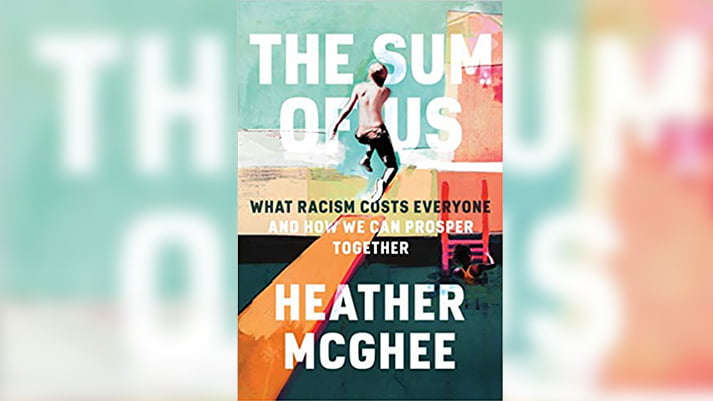
Heather McGhee’s book, The Sum of Us, explores the self-destructive bargain of white supremacy and its rising cost to all of us—including white people. In The Sum of Us, McGhee embarks on a deeply personal journey across the country from Mississippi to Maine, tallying up what we lose when we buy into the zero-sum paradigm–the idea that progress for some of us must come at the expense of others. In April, she joined Sarah Kaplan of the Institute for Gender and Economy for a discussion on these ideas, where they come from, and what we can do moving forward.
One of the best ways to represent McGhee’s central idea is the story of the “drained public pool”. In the 1930s and 40s in America there was a boom in public amenities such as schools and libraries, as well as large public pools. These came about from a new ethos that government should create a higher standard of living. Towns then began excluding Black people from pools and other public amenities, either through law or intimidation. When Black families protested, towns drained public pools rather than integrate them, leading to private or membership-only pools. They destroyed a public good to maintain white status, an attitude in the American economy which has led to the era of inequality we currently see. For example, higher education used to be virtually free until public colleges started to become more diverse. Then anti-government spending ideas began to take hold and everyone is losing out.
What is the narrative of the zero-sum game in racial equality, and where did it come from?
This misconception is that if something is good for people of colour, it will not be good for white people. This is untrue and racial inequality is costing America’s entire economy. Racism is often profitable for some (e.g. the prison-industrial complex), but at immense costs for broader society. It results in loss of productive wealth and harms communities, especially for people of colour.
Historically, America’s original economic policies did mean that profits for white people came entirely at the expense of people of colour. There was a narrow white elite that used the notion of racial hierarchy to create division that ensured white people’s loyalty to them and not to people of colour. This is an idea that has renewed itself in today’s media and political landscape.
If there are so many costs to racial inequality, why aren’t business leaders doing more to stop it?
Many people are often not talking about the overall economy when they don’t support changing inequality. They are talking about the current distribution of power, including their own status relative to others. The existing scarcity model makes people think they need status, but they mistake status with security. If there was more equality, everyone would have security and be able to access things like education and healthcare that are currently inaccessible for many.
How can we think about moving forward?
McGhee puts forth two ideas to move forward with: 1) The solidarity dividend is the idea of rejecting the zero-sum game narrative and making gains through collective action across racial lines. 2) Truth, Racial Healing and Transformation is a community-based framework to transform society so that it is not based on a hierarchy of human value and ensures that people across the country have racial literacy.
Watch Heather McGhee discuss where the idea of a zero-sum game in racial equality comes from.