Tag: Diversity+inclusion

Research briefs, news, and event recaps related to diversity and inclusion.

  • Closing the gender gap in STEM

    Closing the gender gap in STEM

    [fusion_builder_container admin_label=”” hundred_percent=”no” equal_height_columns=”no” menu_anchor=”” hide_on_mobile=”small-visibility,medium-visibility,large-visibility” class=”” id=”” background_color=”” background_image=”” background_position=”center center” background_repeat=”no-repeat” fade=”no” background_parallax=”none” enable_mobile=”no” parallax_speed=”0.3″ video_mp4=”” video_webm=”” video_ogv=”” video_url=”” video_aspect_ratio=”16:9″ video_loop=”yes” video_mute=”yes” video_preview_image=”” border_size=”” border_color=”” border_style=”solid” margin_top=”20″ margin_bottom=”” padding_top=”” padding_right=”” padding_bottom=”” padding_left=””][fusion_builder_row][fusion_builder_column type=”3_4″ layout=”3_4″ spacing=”” center_content=”no” hover_type=”none” link=”” min_height=”” hide_on_mobile=”small-visibility,medium-visibility,large-visibility” class=”” id=”” background_color=”” background_image=”” background_position=”left top” background_repeat=”no-repeat” border_size=”0″ border_color=”” border_style=”solid” border_position=”all” padding_top=”” padding_right=”” padding_bottom=”” padding_left=”” margin_top=”” margin_bottom=”” animation_type=”” animation_direction=”left” animation_speed=”0.3″ animation_offset=”” last=”no”][fusion_text columns=”” column_min_width=”” column_spacing=”” rule_style=”default” rule_size=”” rule_color=”” hide_on_mobile=”small-visibility,medium-visibility,large-visibility” class=”” id=””]

    Introduction

    From education to workplace hiring and retention, the barriers that prevent women from successful careers in STEM are well-documented. For example, only 39% of STEM university graduates in Canada are women, and unfortunately, those graduates still struggle to find work in the field. In fact, women with STEM degrees are more likely to be unemployed and have lower median salaries than men with STEM degrees. In order to address these barriers and promote diversity in STEM, the Institute for Gender and the Economy (GATE) hosted the event, “Women in STEM: A Panel Discussion,” in March 2018.

    The panel was moderated by Sonia Kang, Associate Professor of Organizational Behaviour and Human Resource Management at Rotman. The four panelists were Huda Idrees, Founder and CEO of Dot Health; Andrea Stairs, CEO of eBay Canada; Marisa Sterling, Assistant Dean, Inclusivity and Diversity at the Lassonde School of Engineering, York University; and Jessica Yamoah, Founder of Innovate Inclusion.

    How to help close the gender gap in STEM

    There are several ways companies, organizations, and academic programs can help close the gender gap in STEM. The items listed below were outlined by the panelists during our “Women in STEM” event.

    Create more innovative, inclusive messaging

    The panelists explained that a career in STEM is more than just programming the next mobile application or building new algorithms, it’s also about human impact. Particularly the impact on groups underrepresented in STEM, such as women and visible minorities. Thus, in order to become more appealing to these groups, it may be beneficial for STEM companies to focus on the human impact of technology. Further, STEM can involve and influence fields as varied as the arts, sports, and politics, however STEM organizations and university programs do not always demonstrate this when they are recruiting. STEM can also appear elitist and unwelcoming for many underprivileged communities. As one panelist stated, tech companies are often founded by people who have a lot of privilege and/or money. Therefore, to increase inclusiveness and accessibility, STEM companies should take concrete steps to engage with these communities through local organizations and leaders.

    STEM companies are often founded by people who have a lot of privilege and money, and the messaging often reflects that.

    Place a higher value on “soft” skills 

    Recruiting by STEM companies tend to focus on technical skill requirements (e.g., coding, machine learning, etc.), therefore their employees often lack important soft skills (e.g., teamwork, flexibility, communication, empathy, etc.). These companies should diversify their talent-pool by recruiting for a broader set of skills that may not have been deemed “valuable” in the past. For example, even though someone may be able to use computer programming to create a successful product, this does not mean they can effectively lead or manage a team. Therefore, more diverse and inclusive recruiting might result in attracting candidates who are mid-career managers with work and education experience outside of STEM.

    Further, panelists recommended that “soft” skills be called “transferable” skills instead, as the skills often regarded as “soft” are historically gendered: women are associated with having soft skills, while men are viewed as having more valuable technical skills. This difference in terminology and thus, value, exacerbates the gender gap that already exists within STEM.

    Actively cultivate a more inclusive workplace culture

    Many believe that there is a lack of women in STEM because there aren’t enough women in the pipeline. However, research shows that there are other, more significant, factors at play. In particular, workplace socialization in many of these fields, such as engineering, perpetuate sex-segregation and ultimately, lead many women to exit due to discrimination and bias. Therefore, even though women graduate with STEM degrees, women are not retained in STEM careers. Many people describe this as a ‘leaky pipeline,’ but evidence would suggest that diverse people do not ‘leak’ out, they are pushed out by the culture and practices of organizations. One panelist noted that because tech companies tend to be dominated by men, it is common for them to have a “frat house” culture. If workplaces do not become more inclusive, then people from all genders and backgrounds, including women and minorities, may not want to work there.

    Workplaces should be aware of microaggressions and how they impact retention.

    Workplaces should also be aware of how microaggressions impact retention. Microaggressions are seemingly small acts of hostility or prejudice that make women or other minority groups feel like outsiders, and over time, these microaggressions can force workers to leave. An example of a microaggression is if someone mistakes a woman engineer for a receptionist because of the gendering of these roles. Education and training on systemic bias and discrimination coupled with accountability for progress could help address this issue.

    Encourage allyship in leadership and on boards to help move the dial

    It is crucial to have leaders in STEM who are champions for diversity. When executive teams are all white, heterosexual men, it can be more difficult for women and minorities to breach a discussion about diversity. Therefore, leaders should take the responsibility to identify who is not at the table, make space for them, and amplify their perspectives. Another way leadership can help move the dial is by refusing to participate in situations where there is a clear bias or lack of representation. For example, one panelist stated that she will not be on a corporate board unless other women are also on the board or up for board appointments, indicating that the company takes diversity and inclusion seriously. Ultimately, these types of actions will push companies to think more critically and holistically about what qualifications they are looking for in their board members and leaders.

    Conclusions

    While there has been some progress made in diversifying STEM over the last few decades, STEM companies still have work to do in order to become more accessible to women and other minority groups. As one panelist noted, STEM companies are just like every other business: they need people who can communicate well, be convincing, sell, and lead. Yet STEM hasn’t made itself appealing to everyone, and often appears exclusionary or elitist. As a result, many people are not aware that they could succeed in STEM. Therefore, it is important that STEM companies change how they represent themselves, look beyond narrow qualifications or educational backgrounds, and be proactive in shifting their cultures to be more inclusive.

    For more information about the “Women in STEM” panel event, including videos, click here. 

    [/fusion_text][fusion_separator style_type=”none” hide_on_mobile=”small-visibility,medium-visibility,large-visibility” class=”” id=”” sep_color=”” top_margin=”20″ bottom_margin=”20″ border_size=”” icon=”” icon_circle=”” icon_circle_color=”” width=”” alignment=”center” /][fusion_button link=”https://www.gendereconomy.org/lessons-from-practice/” text_transform=”” title=”” target=”_blank” link_attributes=”” alignment=”” modal=”” hide_on_mobile=”small-visibility,medium-visibility,large-visibility” class=”” id=”” color=”custom” button_gradient_top_color=”#62bd19″ button_gradient_bottom_color=”#62bd19″ button_gradient_top_color_hover=”#00c2e2″ button_gradient_bottom_color_hover=”#00c2e2″ accent_color=”” accent_hover_color=”” type=”” bevel_color=”” border_width=”” size=”” stretch=”yes” shape=”” icon=”” icon_position=”left” icon_divider=”no” animation_type=”” animation_direction=”left” animation_speed=”0.3″ animation_offset=””]See more lessons from practice[/fusion_button][fusion_separator style_type=”none” hide_on_mobile=”small-visibility,medium-visibility,large-visibility” class=”” id=”” sep_color=”” top_margin=”20″ bottom_margin=”20″ border_size=”” icon=”” icon_circle=”” icon_circle_color=”” width=”” alignment=”center” /][fusion_recent_posts layout=”default” picture_size=”fixed” hover_type=”none” columns=”3″ number_posts=”3″ offset=”0″ pull_by=”category” cat_slug=”lessons-from-practice” exclude_cats=”” tag_slug=”” exclude_tags=”” thumbnail=”yes” title=”yes” meta=”no” meta_author=”no” meta_categories=”no” meta_date=”yes” meta_comments=”yes” meta_tags=”no” content_alignment=”” excerpt=”no” excerpt_length=”35″ strip_html=”yes” scrolling=”no” hide_on_mobile=”small-visibility,medium-visibility,large-visibility” class=”” id=”” animation_type=”” animation_direction=”left” animation_speed=”0.3″ animation_offset=”” /][/fusion_builder_column][fusion_builder_column type=”1_4″ layout=”1_4″ spacing=”” center_content=”no” hover_type=”none” link=”” min_height=”” hide_on_mobile=”small-visibility,medium-visibility,large-visibility” class=”” id=”” background_color=”” background_image=”” background_position=”left top” background_repeat=”no-repeat” border_size=”0″ border_color=”” border_style=”solid” border_position=”all” padding_top=”” padding_right=”” padding_bottom=”” padding_left=”” margin_top=”” margin_bottom=”” animation_type=”” animation_direction=”left” animation_speed=”0.3″ animation_offset=”” last=”no”][fusion_title hide_on_mobile=”small-visibility,medium-visibility,large-visibility” class=”briefsummary” id=”” content_align=”left” size=”3″ font_size=”” line_height=”” letter_spacing=”” margin_top=”” margin_bottom=”” margin_top_mobile=”” margin_bottom_mobile=”” text_color=”” style_type=”none” sep_color=””]

    Published

    May 2019

    Prepared by

    Carmina Ravanera

    [/fusion_title][fusion_widget_area name=”avada-custom-sidebar-researchbriefsidebar” title_size=”” title_color=”” background_color=”” padding_top=”” padding_right=”” padding_bottom=”” padding_left=”” hide_on_mobile=”small-visibility,medium-visibility,large-visibility” class=”” id=”” /][/fusion_builder_column][/fusion_builder_row][/fusion_builder_container]

  • Covering in the workplace: A series by Narjis Premjee

    Covering in the workplace: A series by Narjis Premjee

    “Covering” refers to the ways in which a person conceals certain aspects of their identity in public due to a fear of backlash, discrimination, and/or bias. In this podcast, MBA Student Fellow Narjis Premjee interviews people who have covered or uncovered certain aspects of their identity in the workplace, such as their religion, ethnicity, marital status, disabilities, or sexual orientation.

    In this podcast, MBA Student Fellow Narjis Premjee interviews individuals who have covered or uncovered certain aspects of their identity in the workplace, such as their religion, ethnicity, marital status, disabilities, and sexual orientation.

    Listen on Spotify, Apple Podcasts

    Episode 1— Carolyn on defining “covering” at work

    Episode 1 show notes

    Episode 2 — Sean on covering his conversion to Islam

    Episode 2 show notes

    Episode 3 – Anonymous on covering her Jewish faith, marital status, and curly hair

    Episode 3 show notes

    Episode 4 — Marco on covering his sexual orientation

    Episode 4 show notes

    Episode 5 — Priyanka on covering her gender and ethnicity

    Episode 5 show notes

    Episode 6 — Osama on covering his Islamic faith

    Episode 6 show notes

    Episode 7 — Marko on covering his disabilities

    Episode 7 show notes

    Episode 8 — Aamer on covering his Islamic faith

    Episode 8 show notes

    About this series: 

    This podcast was supported by the Institute for Gender and the Economy (GATE) as part of the MBA Student Fellows program, which seeks to engage students in advancing the agenda on gender equality. Find out more here. 

    Learn more about the creator of this series, Narjis Premjee, here. 

    This podcast was edited by Victoria Heath, Mohammad Taqi Premjee and Narjis Premjee. A special thanks to Sarah Kaplan, Victoria Heath, Alyson Colón, Bonnie Lam and all interviewees that took part in this podcast.

    *Disclaimer: This podcast series was prepared by Narjis Premjee, and the opinions expressed in this series are her own and do not necessarily reflect the views of the Institute for Gender and the Economy or the University of Toronto.

    DID YOU LIKE THIS?
    FIND GATE’S OTHER AUDIO AND PODCAST SERIES AND BE SURE TO FOLLOW US ON TWITTERLINKEDIN, AND YOUTUBE FOR MORE KEY INSIGHTS AND RESOURCES.
  • Intersectionality and the implications for workplace gender equity

    Intersectionality and the implications for workplace gender equity

    [fusion_builder_container admin_label=”” hundred_percent=”no” equal_height_columns=”no” menu_anchor=”” hide_on_mobile=”small-visibility,medium-visibility,large-visibility” class=”” id=”” background_color=”” background_image=”” background_position=”center center” background_repeat=”no-repeat” fade=”no” background_parallax=”none” enable_mobile=”no” parallax_speed=”0.3″ video_mp4=”” video_webm=”” video_ogv=”” video_url=”” video_aspect_ratio=”16:9″ video_loop=”yes” video_mute=”yes” video_preview_image=”” border_color=”” border_style=”solid” margin_top=”20″ margin_bottom=”” padding_top=”” padding_right=”” padding_bottom=”” padding_left=”” type=”legacy”][fusion_builder_row][fusion_builder_column type=”3_4″ layout=”3_4″ spacing=”” center_content=”no” hover_type=”none” link=”” min_height=”” hide_on_mobile=”small-visibility,medium-visibility,large-visibility” class=”” id=”” background_color=”” background_image=”” background_position=”left top” background_repeat=”no-repeat” border_color=”” border_style=”solid” border_position=”all” padding_top=”” padding_right=”” padding_bottom=”” padding_left=”” margin_top=”” margin_bottom=”” animation_type=”” animation_direction=”left” animation_speed=”0.3″ animation_offset=”” last=”false” border_sizes_top=”0″ border_sizes_bottom=”0″ border_sizes_left=”0″ border_sizes_right=”0″ first=”true” spacing_right=””][fusion_text columns=”” column_min_width=”” column_spacing=”” rule_style=”default” rule_size=”” rule_color=”” hide_on_mobile=”small-visibility,medium-visibility,large-visibility” class=”” id=””]

    Download this research brief (in English/en Français).
    Download the infographic (in English/en Français).

    Overview

    Intersectionality is a way of understanding how individuals are differently impacted by inequality on the basis of factors such as race, ethnicity, class, gender, age, citizenship, ability, and sexual orientation.[1] Intersectional inequality affects women and visible minorities differently, depending on their social, cultural, and occupational contexts.[2] Evidence suggests that many organizational initiatives promoting diversity and inclusion tend to benefit white women in particular and not other under-represented groups.[3] 

    Inequality affects individuals differently on the basis of factors such as race, age, or gender.

    Consequences of intersectional inequality in the workforce

    We can see unequal workplace outcomes on the basis of intersectionality in the gendered and racialized wage gap in Canada. Visible minority women, especially first-generation immigrants, earn on average $5,000 less than non-visible minority women, and $7,000 less than visible minority men.[4] Compared to any other group, immigrant women—and those from racialized backgrounds—are more likely to be unemployed or underemployed in jobs that do not reflect their education or experience.[5] And spending long periods of time in precarious work can have lasting negative effects on the employment outcomes of racialized immigrant women.[6]

    Visible minority women are more frequently employed in precarious jobs characterized by insecurity, low wages, low protection, and limited benefits.[7] Poverty rates for visible minority families are three times higher than for non-visible minority families, and families who identify as Arab, West Asian, and Korean have poverty rates above 30%.[8]

     Research has documented other types of intersectional inequalities in the workplace. For example, white men often experience a “glass escalator” when working in female-dominated occupations such as nursing and teaching, that enables their promotion through the ranks more quickly.[9] However the same benefits do not extend to visible minority men; Black male nurses are perceived as less skilled than female nurses.[10]

    Solutions to overcoming intersectional inequalities at work

    Some of the traditional methods for addressing organization diversity are not sufficient for addressing intersectional inequalities. For example, bias training in the workplace can create backlash if trainees resent being selected for training and perceive it as punishment for prior behaviour.[11]   

    Management can consider some of the following recommendations as starting points:

    • Be specific in language use: “Diversity” has become a catchall phrase that can be misappropriated, to mean, for example, hiring in order to achieve “diversity of thought,” which may preclude the hiring of women and visible minorities. Management can focus explicitly on addressing gender and racial/ethnic discrimination.[12]
    • Promote sponsorship over mentorship: In sponsorship relationships, mentors typically go beyond providing advice and use their influence to advocate to executives on behalf of their mentee. But high-potential women are over-mentored and under-sponsored relative to their male peers, and subsequently, do not advance as quickly up the ranks. Management can ensure that white male sponsors take on female and visible minority sponsees.[13]
    • Get buy-in from management: Diversity initiatives are more effective when they engage managers in solving problems of underrepresentation and increase managers’ on-the-job contact with female and visible minority workers.[14] Such initiatives should include fostering acceptance and understanding of accents, and of religious differences, two common but overlooked forms of discrimination.[15]

    • Track data on employee demographics: Many firms do not collect data on the diversity of their employees.[16]  This oversight makes it harder to identify underrepresentation along the intersections of race, ethnicity, gender, ability, and sexuality. By tracking demographic data, firms can better determine whether and how they need to alter practices to mitigate discriminatory behaviour.
    • Move beyond your usual networks for recruitment and hiring: Management can post job listings on job sites geared towards helping underrepresented groups find employment, such as The Aboriginal Job Board.[17]  

    References

    [1] Crenshaw, K. (1990). Mapping the margins: Intersectionality, identity politics, and violence against women of color. Stan. L. Rev., 43, 1241.

    Collins, P. H. (2002). Black feminist thought: Knowledge, consciousness, and the politics of empowerment. Routledge.

    [2] Aline Tugend, The Effect of Intersectionality in the Workplace, New York Times: https://www.nytimes.com/2018/09/30/us/the-effect-of-intersectionality-in-the-workplace.html

    [3] Apfelbaum, E. P., Stephens, N. M., & Reagans, R. E. (2016). Beyond one-size-fits-all: Tailoring diversity approaches to the representation of social groups. Journal of Personality and Social Psychology, 111(4), 547.

    [4] Statistics Canada, Visible Minority Women: https://www150.statcan.gc.ca/n1/pub/89-503-x/2010001/article/11527-eng.htm

    Hou, F., & Coulombe, S. (2010). Earnings gaps for Canadian-born visible minorities in the public and private sectors. Canadian Public Policy, 36(1), 29-43.

    [5] Cranford, C. J., Vosko, L. F., & Zukewich, N. (2003). Precarious employment in the Canadian labour market: A statistical portrait. Just labour.

    Fuller, S., & Vosko, L. F. (2008). Temporary employment and social inequality in Canada: Exploring intersections of gender, race and immigration status. Social indicators research, 88(1), 31-50.

    Premji, S., & Shakya, Y. (2017). Pathways between under/unemployment and health among racialized immigrant women in Toronto. Ethnicity & health, 22(1), 17-35.

    [6] Fudge, J., and Strauss, K. (Eds.). (2013). Temporary work, agencies and unfree labour: Insecurity in the new world of work. Routledge

    [7] Creese, G., and B. Wiebe. 2012. ‘Survival Employment’: Gender and Deskilling among African Immigrants in Canada.” International Migration 50 (5): 56 76. doi:10.1111/j.1468-2435.2009. 00531.x.

    Galarneau, D., and R. Morissette. 2009. “Immigrants’ Education and Required Job Skills.” Perspectives on Labour and Income 9 (12): 5–18.

    Picot, G., & Sweetman, A. (2012). Making it in Canada: Immigration outcomes and policies. IRPP study, (29), 1.

    Noack, A. M., and L. F. Vosko. 2011. “Precarious Jobs in Ontario. Mapping Dimensions of Labour Market Insecurity by Workers’ Social Location and Context.” Toronto, Commissioned report by Law Commission of Ontario.

    [8] Block, S., & Galabuzi, G. E. (2011). Canada’s colour coded labour market. Canadian Centre for Policy Alternatives, 1-20.

    [9] Williams, C. L. (1992). The glass escalator: Hidden advantages for men in the “female” professions. Social problems, 39(3), 253-267.

    [10] Wingfield, A. H. (2009). Racializing the glass escalator: Reconsidering men’s experiences with women’s work. Gender & Society, 23(1), 5-26. Wingfield, A. H. (2009). Racializing the glass escalator: Reconsidering men’s experiences with women’s work. Gender & Society, 23(1), 5-26. 7(6), 999-1022.

    [11] Kalev, A., Kelly, E., & Dobbin, F. (2006). Best Practices or Best Guesses? Assessing the Efficacy of Corporate Affirmative Action and Diversity Policies. American Sociological Review, 71(4), 589-617.

    Alyson Colón, Does Diversity Training Work?, Institute for Gender and the Economy: https://www.gendereconomy.org/does-diversity-training-work/

    Sanchez, J., & Medkik, N. (2004). The Effects of Diversity Awareness Training on Differential Treatment. Group & Organization Management, 29(4), 517–536

    [12] Adia Harvey Wingfield, How Organizations are Failing Black Workers and How to do Better, Harvard Business Review: https://hbr.org/2019/01/how-organizations-are-failing-black-workers-and-how-to-do-better

    [13] Ibid

    Ibarra, Herminia, Nancy M. Carter and Christine Silva (2010) https://hbr.org/2010/09/why-men-still-get-more-promotions-than-women

    [14] Dobbin, F., & Kalev, A. (2016). Why diversity programs fail. Harvard Business Review, 94(7), 14.

    [15] Ameeriar, L. (2017). Downwardly Global: Women, Work, and Citizenship in the Pakistani Diaspora. Duke University Press.

    Boyd, Monica and Xingshan Cao. 2009. Immigrant Language Proficiency, Earnings, and Language Policies. Canadian Studies in Population 36(1-2):63-86.

    Derwing, Tracey M. and Erin Waugh. 2012. Language Skills and the Social Integration of Canada’s Adult Immigrants. IRPP Study No. 31.

    Dovidio JF, Kawakami K, Gaertner S. 2002. Implicit and explicit prejudice in interracial interaction. J. Pers. Soc. Psychol. 82(1): 62– 68

    MacDougall, A. (2007). Hearing audible minorities: Accent, discrimination, and the integration of immigrants into the Canadian labour market. Vol. 47 , No.04 pp. 20-39

    [16] Matthew Braga, Canadian tech companies say they value diversity — but what are they doing about it?, cbc.ca: https://www.cbc.ca/news/technology/canada-tech-companies-diversity-reports-2017-1.4194556

    [17] https://aboriginaljobboard.ca/

    [/fusion_text][fusion_separator style_type=”none” hide_on_mobile=”small-visibility,medium-visibility,large-visibility” class=”” id=”” sep_color=”” top_margin=”20″ bottom_margin=”20″ border_size=”” icon=”” icon_circle=”” icon_circle_color=”” width=”” alignment=”center” /][fusion_button link=”https://www.gendereconomy.org/research-briefs/” text_transform=”” title=”” target=”_blank” link_attributes=”” alignment=”” modal=”” hide_on_mobile=”small-visibility,medium-visibility,large-visibility” class=”” id=”” color=”custom” button_gradient_top_color=”#62bd19″ button_gradient_bottom_color=”#62bd19″ button_gradient_top_color_hover=”#00c2e2″ button_gradient_bottom_color_hover=”#00c2e2″ accent_color=”” accent_hover_color=”” type=”” bevel_color=”” size=”” stretch=”yes” icon=”” icon_position=”left” icon_divider=”no” animation_type=”” animation_direction=”left” animation_speed=”0.3″ animation_offset=””]See more research briefs[/fusion_button][fusion_separator style_type=”none” hide_on_mobile=”small-visibility,medium-visibility,large-visibility” class=”” id=”” sep_color=”” top_margin=”20″ bottom_margin=”20″ border_size=”” icon=”” icon_circle=”” icon_circle_color=”” width=”” alignment=”center” /][fusion_recent_posts layout=”default” hover_type=”none” columns=”3″ number_posts=”3″ offset=”0″ pull_by=”category” cat_slug=”research-briefs” exclude_cats=”” tag_slug=”” exclude_tags=”” thumbnail=”yes” title=”yes” meta=”no” meta_author=”no” meta_categories=”no” meta_date=”yes” meta_comments=”yes” meta_tags=”no” content_alignment=”” excerpt=”no” excerpt_length=”35″ strip_html=”yes” scrolling=”no” hide_on_mobile=”small-visibility,medium-visibility,large-visibility” class=”” id=”” animation_type=”” animation_direction=”left” animation_speed=”0.3″ animation_offset=”” /][/fusion_builder_column][fusion_builder_column type=”1_4″ layout=”1_4″ spacing=”” center_content=”no” hover_type=”none” link=”” min_height=”” hide_on_mobile=”small-visibility,medium-visibility,large-visibility” class=”” id=”” background_color=”” background_image=”” background_position=”left top” background_repeat=”no-repeat” border_color=”” border_style=”solid” border_position=”all” padding_top=”” padding_right=”” padding_bottom=”” padding_left=”” margin_top=”” margin_bottom=”” animation_type=”” animation_direction=”left” animation_speed=”0.3″ animation_offset=”” last=”true” border_sizes_top=”0″ border_sizes_bottom=”0″ border_sizes_left=”0″ border_sizes_right=”0″ first=”false”][fusion_title hide_on_mobile=”small-visibility,medium-visibility,large-visibility” class=”briefsummary” id=”” content_align=”left” size=”3″ font_size=”” line_height=”” letter_spacing=”” margin_top=”” margin_bottom=”” margin_top_mobile=”” margin_bottom_mobile=”” text_color=”” style_type=”none” sep_color=”” margin_top_small=”” margin_bottom_small=””]

    Published

    April 23, 2019

    This research brief was funded by the Government of Canada’s Labour Program for the Women in the Workplace Symposium that took place at Rotman on May 09/10, 2019.

    The opinions and interpretations in this publication are those of the author and do not necessarily reflect those of the Government of Canada.

    To see more from this event, check out #Womenintheworkplace.

    Government of Canada logo

    [/fusion_title][fusion_widget_area name=”avada-custom-sidebar-researchbriefsidebar” title_size=”” title_color=”” background_color=”” padding_top=”” padding_right=”” padding_bottom=”” padding_left=”” hide_on_mobile=”small-visibility,medium-visibility,large-visibility” class=”” id=”” /][/fusion_builder_column][/fusion_builder_row][/fusion_builder_container]

  • Expert discussion on “What could a feminist city look like?”

    Expert discussion on “What could a feminist city look like?”

    [fusion_builder_container hundred_percent=”no” equal_height_columns=”no” menu_anchor=”” hide_on_mobile=”small-visibility,medium-visibility,large-visibility” class=”” id=”” background_color=”” background_image=”” background_position=”center center” background_repeat=”no-repeat” fade=”no” background_parallax=”none” parallax_speed=”0.3″ video_mp4=”” video_webm=”” video_ogv=”” video_url=”” video_aspect_ratio=”16:9″ video_loop=”yes” video_mute=”yes” overlay_color=”” video_preview_image=”” border_color=”” border_style=”solid” padding_top=”” padding_bottom=”” padding_left=”” padding_right=”” type=”legacy”][fusion_builder_row][fusion_builder_column type=”1_1″ layout=”1_1″ background_position=”left top” background_color=”” border_color=”” border_style=”solid” border_position=”all” spacing=”yes” background_image=”” background_repeat=”no-repeat” padding_top=”” padding_right=”” padding_bottom=”” padding_left=”” margin_top=”0px” margin_bottom=”0px” class=”” id=”” animation_type=”” animation_speed=”0.3″ animation_direction=”left” hide_on_mobile=”small-visibility,medium-visibility,large-visibility” center_content=”no” last=”true” min_height=”” hover_type=”none” link=”” border_sizes_top=”” border_sizes_bottom=”” border_sizes_left=”” border_sizes_right=”” first=”true”][fusion_text columns=”” column_min_width=”” column_spacing=”” rule_style=”” rule_size=”” rule_color=”” hue=”” saturation=”” lightness=”” alpha=”” content_alignment_medium=”” content_alignment_small=”” content_alignment=”” hide_on_mobile=”small-visibility,medium-visibility,large-visibility” sticky_display=”normal,sticky” class=”” id=”” margin_top=”” margin_right=”” margin_bottom=”” margin_left=”” fusion_font_family_text_font=”” fusion_font_variant_text_font=”” font_size=”” line_height=”” letter_spacing=”” text_transform=”” text_color=”” animation_type=”” animation_direction=”left” animation_color=”” animation_speed=”0.3″ animation_delay=”0″ animation_offset=”” logics=””]Nearly 40 years on from Dolores Hayden’s famous envisioning of a feminist city in her 1980 article “What Would a Non-Sexist City Be Like?”, the city remains deeply inequitable. A 2017 report by the nonprofit organization Social Planning Toronto, highlights several data points that reflect the inequity in our own city of Toronto, including:

    • Indigenous families with children in the City of Toronto experience an extremely high poverty rate of 84%.
    • 37.8% of children in lone-parent families in the Toronto region live in poverty, while the rate for children in female lone-parent households is 40%, more than twice the poverty rate of two-parent families.
    • The gap in child poverty rates across Toronto neighbourhoods remains stark, ranging from 4% in Kingsway South to 60% in Thorncliffe Park.

    Since 1982, the income gap between Toronto’s top 1% of earners and its median earners has doubled, and between 2016 and 2017, the monthly cost of living for a single young person in Toronto increased by an average of $400 (due primarily to the exponential increase in rental prices). High rental and housing prices combined with increases in the costs of childcare and public transit are making it more difficult for Toronto residents to make ends meet, let alone move up the socioeconomic ladder. For those working for minimum wage (frozen at $14/hour in Ontario) as well as part-time or contract work (primarily composed of immigrant and Indigenous women, and visible minorities), the situation is especially dire–and these trends are seen across major cities around the globe.

    To address the issue of access and gender equity in the city and imagine what a feminist city could look like, this event gathered esteemed local urbanists, activists, and writers.

    Feminist City audience and panel

    This discussion featured Kofi Hope, Senior Policy Advisor, Wellesley Institute; Bousfield Distinguished Visitor, Department of Geography and Planning, University of Toronto; Olivia Nuamah, Executive Director, Pride Toronto; Rosemarie Powell, Executive Director, Toronto Community Benefits Network; Brigitte Shim, Professor, John H. Daniels Faculty of Architecture, Landscape, and Design, University of Toronto; Principal, Shim-Sutcliffe Architects; and was moderated by Sarah Kaplan, Director and Professor – Institute for Gender and the Economy, Rotman School of Management; and Matti Siemiatycki, Director and Professor, School of Cities, University of Toronto.

    The conversation explored public policy, decision-making processes, community engagement, and the urban built form, and discussed potential paths forward to creating a more inclusive city.

    In the following videos, panelists answer: What could a feminist city look like?

    [/fusion_text][fusion_separator style_type=”none” hide_on_mobile=”small-visibility,medium-visibility,large-visibility” class=”” id=”” sep_color=”” top_margin=”25″ bottom_margin=”25″ border_size=”” icon=”” icon_circle=”” icon_circle_color=”” width=”” alignment=”center” /][fusion_button link=”https://www.gendereconomy.org/past-events/” text_transform=”” title=”” target=”_blank” link_attributes=”” alignment=”” modal=”” hide_on_mobile=”small-visibility,medium-visibility,large-visibility” class=”” id=”” color=”custom” button_gradient_top_color=”#62bd19″ button_gradient_bottom_color=”#62bd19″ button_gradient_top_color_hover=”#00c2e2″ button_gradient_bottom_color_hover=”#00c2e2″ accent_color=”” accent_hover_color=”” type=”” bevel_color=”” size=”” stretch=”yes” icon=”” icon_position=”left” icon_divider=”no” animation_type=”” animation_direction=”left” animation_speed=”0.3″ animation_offset=””]See more past events[/fusion_button][fusion_separator style_type=”none” hide_on_mobile=”small-visibility,medium-visibility,large-visibility” class=”” id=”” sep_color=”” top_margin=”20″ bottom_margin=”20″ border_size=”” icon=”” icon_circle=”” icon_circle_color=”” width=”” alignment=”center” /][fusion_title margin_top=”” margin_bottom=”” hide_on_mobile=”medium-visibility,large-visibility” class=”” id=”” size=”5″ content_align=”center” style_type=”default” sep_color=””]

    Or register below for these upcoming events

    [/fusion_title][fusion_recent_posts layout=”default” hover_type=”none” columns=”3″ number_posts=”3″ offset=”0″ pull_by=”category” cat_slug=”events” exclude_cats=”past” tag_slug=”” exclude_tags=”” thumbnail=”yes” title=”yes” meta=”no” meta_author=”no” meta_categories=”no” meta_date=”yes” meta_comments=”yes” meta_tags=”no” content_alignment=”” excerpt=”no” excerpt_length=”35″ strip_html=”yes” scrolling=”no” hide_on_mobile=”medium-visibility,large-visibility” class=”” id=”” animation_type=”” animation_direction=”left” animation_speed=”0.3″ animation_offset=”” /][/fusion_builder_column][/fusion_builder_row][/fusion_builder_container]
  • The design of everyday men: A design sprint co-hosted by WIMA and WIMen

    The design of everyday men: A design sprint co-hosted by WIMA and WIMen

    [fusion_builder_container hundred_percent=”no” equal_height_columns=”no” menu_anchor=”” hide_on_mobile=”small-visibility,medium-visibility,large-visibility” class=”” id=”” background_color=”” background_image=”” background_position=”center center” background_repeat=”no-repeat” fade=”no” background_parallax=”none” parallax_speed=”0.3″ video_mp4=”” video_webm=”” video_ogv=”” video_url=”” video_aspect_ratio=”16:9″ video_loop=”yes” video_mute=”yes” overlay_color=”” video_preview_image=”” border_color=”” border_style=”solid” padding_top=”” padding_bottom=”” padding_left=”” padding_right=”” type=”legacy”][fusion_builder_row][fusion_builder_column type=”1_1″ layout=”1_1″ background_position=”left top” background_color=”” border_color=”” border_style=”solid” border_position=”all” spacing=”yes” background_image=”” background_repeat=”no-repeat” padding_top=”” padding_right=”” padding_bottom=”” padding_left=”” margin_top=”0px” margin_bottom=”0px” class=”” id=”” animation_type=”” animation_speed=”0.3″ animation_direction=”left” hide_on_mobile=”small-visibility,medium-visibility,large-visibility” center_content=”no” last=”true” min_height=”” hover_type=”none” link=”” border_sizes_top=”” border_sizes_bottom=”” border_sizes_left=”” border_sizes_right=”” first=”true”][fusion_text columns=”” column_min_width=”” column_spacing=”” rule_style=”” rule_size=”” rule_color=”” hue=”” saturation=”” lightness=”” alpha=”” content_alignment_medium=”” content_alignment_small=”” content_alignment=”” hide_on_mobile=”small-visibility,medium-visibility,large-visibility” sticky_display=”normal,sticky” class=”” id=”” margin_top=”” margin_right=”” margin_bottom=”” margin_left=”” fusion_font_family_text_font=”” fusion_font_variant_text_font=”” font_size=”” line_height=”” letter_spacing=”” text_transform=”” text_color=”” animation_type=”” animation_direction=”left” animation_color=”” animation_speed=”0.3″ animation_delay=”0″ animation_offset=”” logics=””]

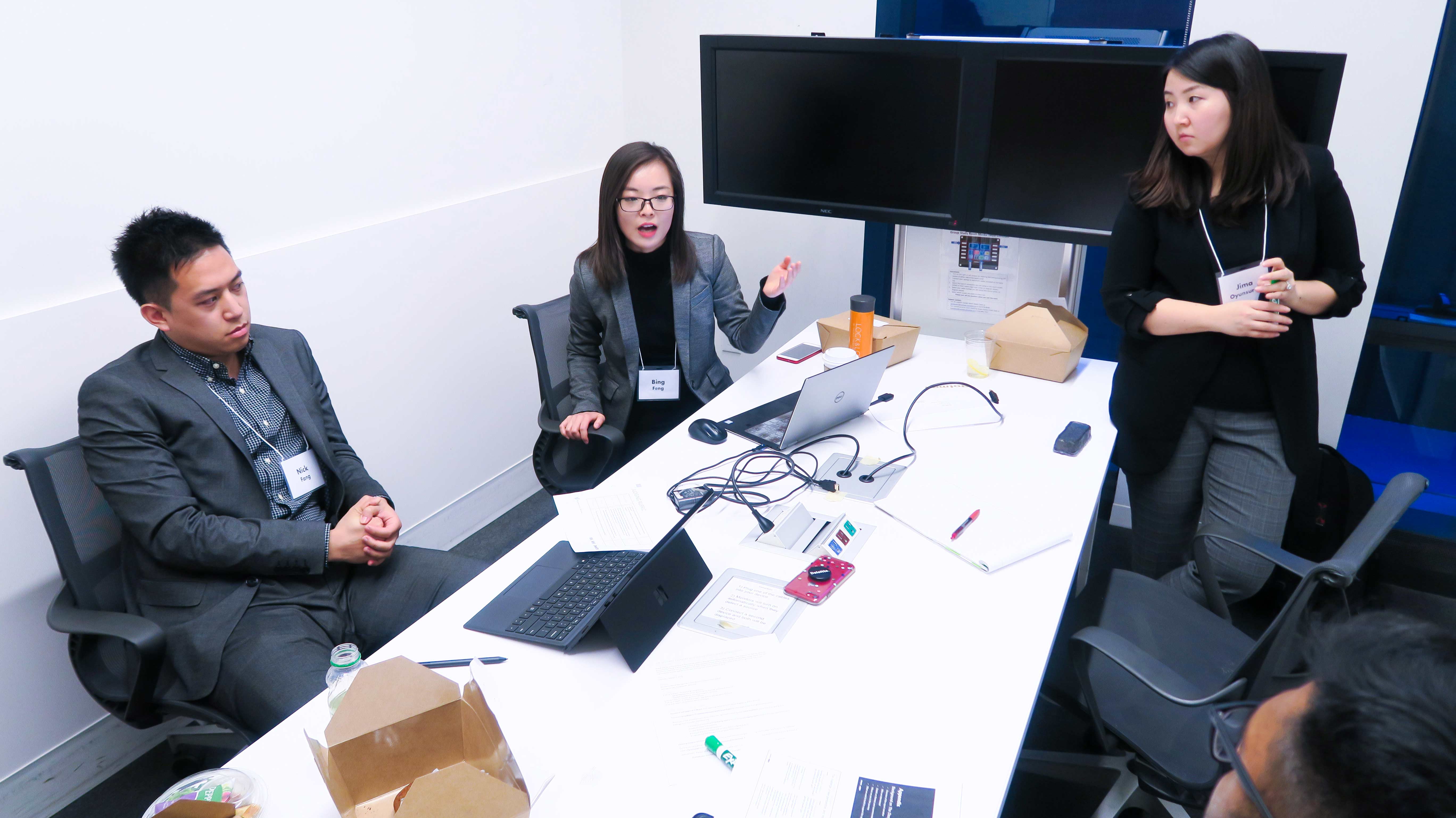
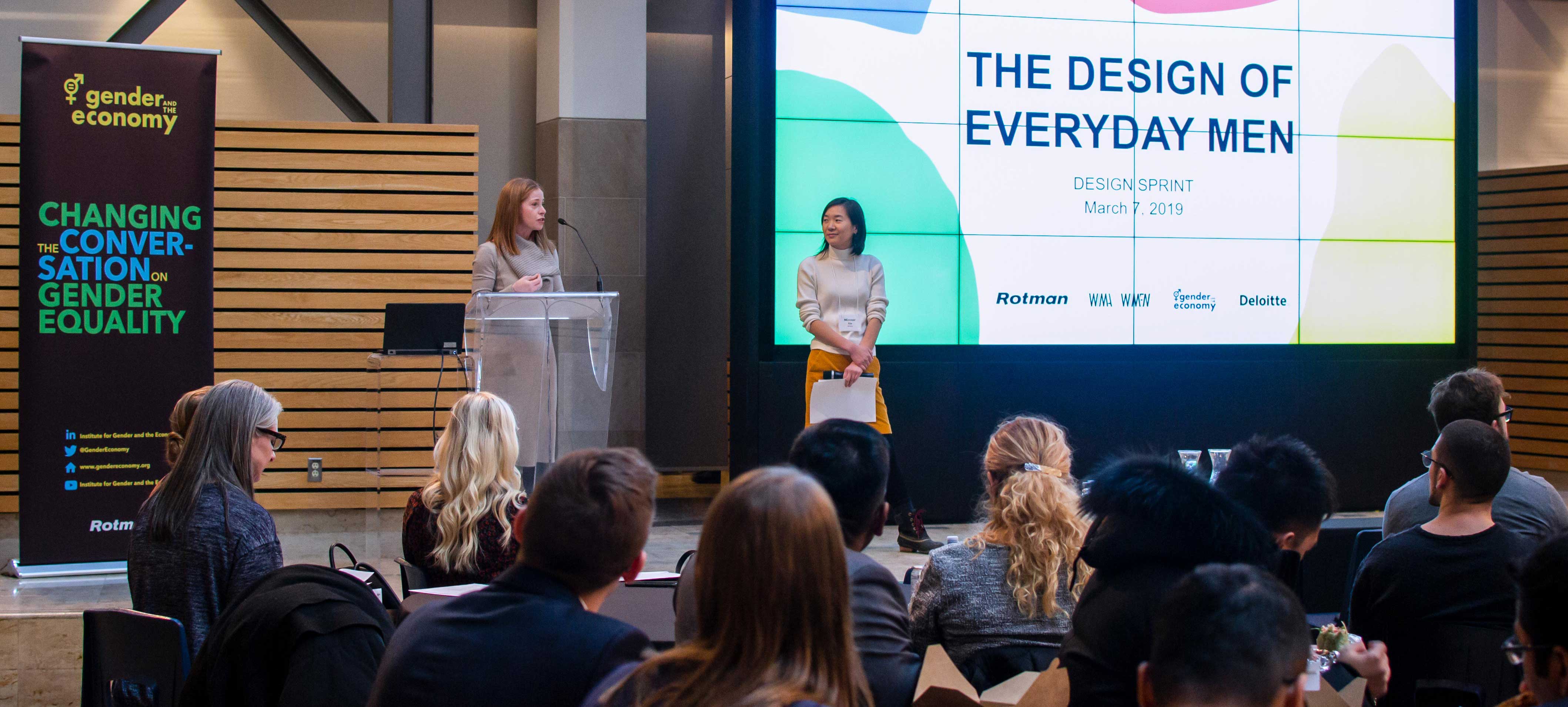
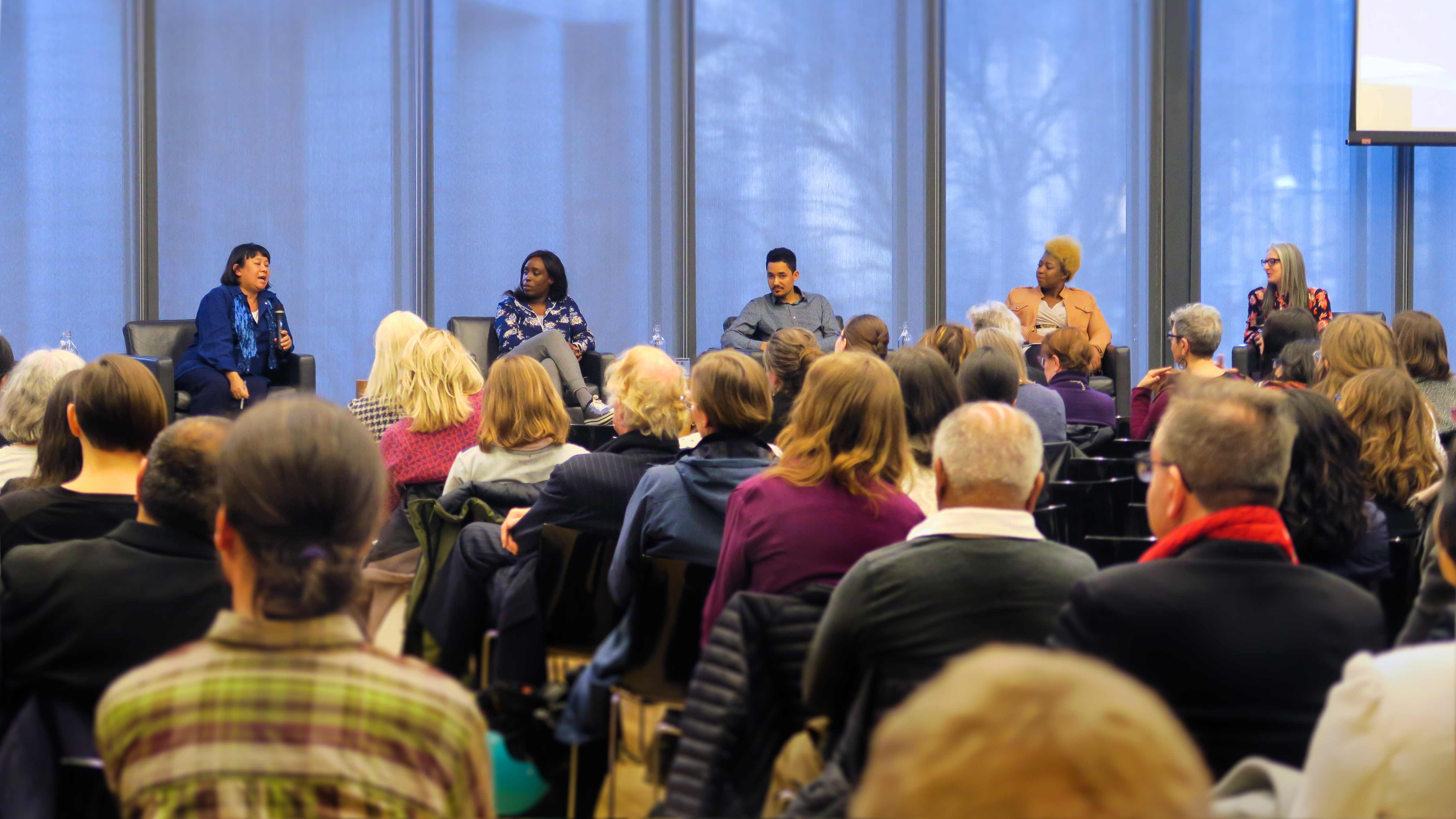
    Rotman student clubs, WIMA and WIMen co-hosted a design sprint with Deloitte and GATE to design a workplace for “everyday men” on March 07, 2019; over 14 teams and 45 students participated.

    Deloitte's Carolyn Lawrence presenting

    The starting point for this design sprint was Deloitte’s report, “The Design of Everyday Men,” which investigates men’s relationships to work, family, and masculinity in a world where default gender roles are changing.

    The insights from this study and other background materials inspired the teams to innovate how work is organized in order to create space for new forms of masculinity, and greater equality for all, based on the following problem statement:

    How might organizations enable and reinforce men to bring their whole selves to work?

    The Finalists

    All of the teams proposed exciting ideas to overcome the barriers in organizations that are prohibiting men from bringing their whole selves to work. However, only three teams were nominated for the finals. Their ideas are outlined below:

    #ShowMEn platform–A digital, integrative platform that would encourage men to bring their full selves to work by giving them a place to share personal photos and stories, as well as participate in team reward initiatives (e.g., fundraising challenge on Mother’s Day). This platform would encourage open communication and mentorship across departments, teams, and leadership. (The winning idea!)

    The year of the shark–An internal campaign that would seek to eradicate “dinosaur” behaviour within senior leadership and the C-suite (e.g., upholding traditional views regarding work-life balance and paternity leave) and encourage “shark” behaviour that would embody more inclusive ideas on what’s acceptable and expected at work in terms of gender roles. It would include awareness, recognition, and accountability components.

    The journal of corporate f@!* ups–An e-newsletter that would be distributed organization-wide aimed at enabling men to feel comfortable sharing and embracing failure at work. It would include three components: 1) compelling stories of failure by fellow employees, 2) reinforcing mechanisms, and 3) role modeling by senior management.

    The winning team comprised of Tanya Adityan, Kyle Christian, Yi Shi, and Asli Zayim. For their prize, they will spend an hour on the trading floor with Derek Flood, RBC’s Head of Canadian Equities. As their prize, this winning team will get a tour of Doblin’s D.Studio and a lunch with the co-chairs of Deloitte’s Inclusion Advisory Council, Pat Daley and Ken Fredeen.

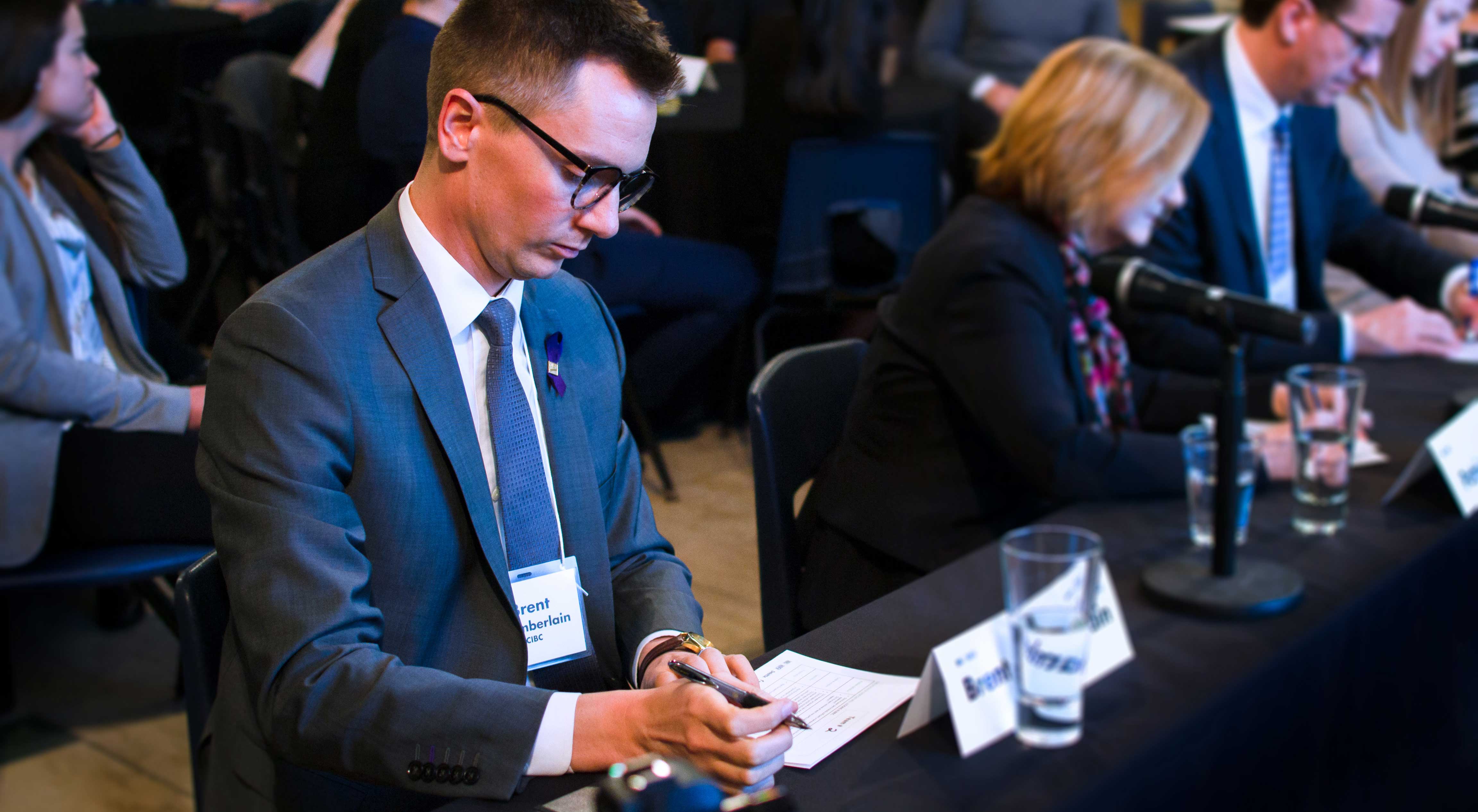
    Judge Brent Chamberlain

    In addition to our finalists, 11 other teams pitched their ideas. These teams identified three areas of opportunity to help encourage men to bring their whole selves to work. Many of the barriers men face at work stem from traditional notions of masculinity and success; these include isolation, fear of failure, lack of mental health considerations, and fear of retribution for prioritizing work-life balance.

    Thank you to all of the participants, coaches, and judges for being a part of this great event!

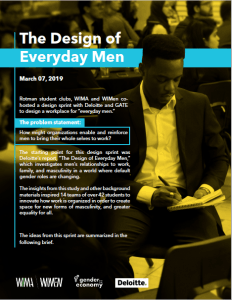
    To see all of the ideas, view or download this short brief.

    Design of Everyday Men Cover[/fusion_text][fusion_separator style_type=”none” hide_on_mobile=”small-visibility,medium-visibility,large-visibility” class=”” id=”” sep_color=”” top_margin=”50″ bottom_margin=”50″ border_size=”” icon=”” icon_circle=”” icon_circle_color=”” width=”” alignment=”center” /][fusion_button link=”https://www.gendereconomy.org/past-events/” text_transform=”” title=”” target=”_blank” link_attributes=”” alignment=”” modal=”” hide_on_mobile=”small-visibility,medium-visibility,large-visibility” class=”” id=”” color=”custom” button_gradient_top_color=”#62bd19″ button_gradient_bottom_color=”#62bd19″ button_gradient_top_color_hover=”#00c2e2″ button_gradient_bottom_color_hover=”#00c2e2″ accent_color=”” accent_hover_color=”” type=”” bevel_color=”” size=”” stretch=”yes” icon=”” icon_position=”left” icon_divider=”no” animation_type=”” animation_direction=”left” animation_speed=”0.3″ animation_offset=””]See more past events[/fusion_button][fusion_separator style_type=”none” hide_on_mobile=”small-visibility,medium-visibility,large-visibility” class=”” id=”” sep_color=”” top_margin=”20″ bottom_margin=”20″ border_size=”” icon=”” icon_circle=”” icon_circle_color=”” width=”” alignment=”center” /][fusion_title margin_top=”” margin_bottom=”” hide_on_mobile=”medium-visibility,large-visibility” class=”” id=”” size=”5″ content_align=”center” style_type=”default” sep_color=””]

    Or register below for these upcoming events

    [/fusion_title][fusion_recent_posts layout=”default” hover_type=”none” columns=”3″ number_posts=”3″ offset=”0″ pull_by=”category” cat_slug=”events” exclude_cats=”past” tag_slug=”” exclude_tags=”” thumbnail=”yes” title=”yes” meta=”no” meta_author=”no” meta_categories=”no” meta_date=”yes” meta_comments=”yes” meta_tags=”no” content_alignment=”” excerpt=”no” excerpt_length=”35″ strip_html=”yes” scrolling=”no” hide_on_mobile=”medium-visibility,large-visibility” class=”” id=”” animation_type=”” animation_direction=”left” animation_speed=”0.3″ animation_offset=”” /][/fusion_builder_column][/fusion_builder_row][/fusion_builder_container]
  • Why the ‘business case’ for hiring more women isn’t working

    Why the ‘business case’ for hiring more women isn’t working

    Written by Sarah Kaplan and Nancy Wilson
    Contributed to The Globe and Mail
    Published March 5, 2019

    As we mark International Women’s Day on Friday, many people – including us – will note that not enough progress has been made on women’s economic inclusion. Many will argue that we need to convince more corporate leaders to support the cause and, to do so, we need to make the business case for investing in diversity. Yet, despite a decade of reports from prominent consulting firms and other organizations making just this case, progress in Canada and around the world has stalled. And this very desire to make the business case might be part of the problem.

    It’s not that there aren’t good business reasons for companies to be more diverse and inclusive. But there are two problems with the obsession with the business case logic. First, requiring a business case implies that women and minorities must do better than the (white, straight, male) status quo to gain entry into opportunities. Second, research has found that a business case mindset risks reducing women and minorities to mere inputs to be measured against the financial bottom line. The social goal of diversity is converted into a commodity to be valued, exploited and, perhaps, discarded if the business case doesn’t pan out.

    The business case can wrap decision-makers in the comfortable numbness of business jargon, focusing on shareholder value creation or profits while minimizing any mention of marginalized communities or the common good. The business case is designed precisely to remove emotion from decision-making, but the latest research points out that the emotional sense of outrage about inequality is what can drive disruptive action. It is no surprise, then, that diversity and inclusion policies are often no more than window dressing or incremental and incomplete.

    If indeed the business case for diversity and inclusion had persuasive power, Corporate Canada would look very different than it does today. In the top 100 companies of the S&P/TSX Composite Index, we find only one female CEO and six women board chairs. Meanwhile, a 2018 benchmarking study on diversity and inclusion revealed a gap between the stated level of support by management and the resources devoted toward implementation of policies in the workplace.

    Diversity and inclusion are regularly discussed as aspirations, or stretch goals. The reality is, equality is codified in the Canadian Charter of Rights and Freedoms, as is freedom from discrimination based on gender, race, ethnicity, and a variety of other factors. Provincial labour laws, such as Ontario’s pay equity and pay transparency acts, protect employees from discrimination, as well.

    Many firms will feel that they have complied fully with these laws, but compliance may only be to the letter of the law and not the spirit. If women are not given the same opportunities to work on projects that lead to promotions; or if women who take advantage of company policies for flexible work are seen as less committed; or if a manager schedules daily meetings before 9 or after 5 making it hard for people with school drop-off and pickup responsibilities to participate; or if hiring managers don’t go the extra mile to include women in short lists for jobs; or if male senior executives refuse to sponsor more junior women for fear of false #MeToo complaints; then organizations are not actually working to achieve gender equality.

    And here’s another research finding: the legal necessity of equality is not only the law of the land, but focusing on it also eliminates the opportunity to distance oneself emotionally from the crux of the issue: fair and equitable treatment of fellow human beings. Our laws bind us as a larger society under a common ethical and moral umbrella. If the cost of equality is having uncomfortable discussions about what is right and wrong, it is time to pay up.

    We are not debating the business case itself. Many are convinced that the case has already been made. However, recent research makes it clear that using the business case as a starting point can be counterproductive. We need to flip the script. Complex social issues such as changing social norms and challenging stereotypes cannot be reduced to a spreadsheet. They can only be tackled with an unreserved, passionate commitment from senior leaders. If someone asks for the business case, don’t bother; they’re looking for a reason to say no or go slow.

    To view this piece on The Globe and Mail’s website, follow this link