Tag: Leadership

Research briefs, news, and event recaps related to leadership.

  • Sarah Kaplan appears before Standing Senate Committee on Social Affairs, Science and Technology

    Sarah Kaplan appears before Standing Senate Committee on Social Affairs, Science and Technology

    On September 28, 2022, Sarah Kaplan was invited to speak before the Standing Senate Committee on Social Affairs, Science and Technology regarding the role of gender-based analysis plus in the policy process.

    You can watch her full testimony, or read her opening remarks here or down below. Read the report, The Role of Gender-based Analysis Plus in the Policy Process.

    Testimony before Standing Senate Committee on Social Affairs, Science and Technology

    Good afternoon.

    It is an honor to appear before this Committee to comment on the role of gender-based analysis plus in the policy process.

    I am a Professor and Director of the Institute for Gender and the Economy at the University of Toronto’s Rotman School of Management. In this role, I promote the use of rigorous academic research to inform policy and practice. To prepare for this testimony, I reviewed the scholarly literature as well as government audits and reports on GBA+.

    I would like to start by emphasizing that the introduction of GBA+ into government policy analysis has been an essential step forward in assuring that policies, regulations and programs are advancing greater equity in Canadian society which has been further reinforced by the Canadian Gender Budgeting Act and the Gender Results Framework introduced in the 2018 Budget. Canadians can be proud that intersectional gender-based analysis is recognized by the Canadian government as a key competency in support of the development of effective programs and policies.

    The promise of GBA+ is that it can not only measure and evaluate policy impacts but also inform policy priorities, shape policy and program design, and guide implementation. Yet, despite considered attention to GBA+, there continue to be opportunities for improvement as it has yet to achieve its promise.

    My review of the literature and audits suggests that although GBA+ is supposed to be used across all government departments and agencies, it is inconsistently applied (with 40% of departments not having a formal GBA+ policy), and often used only late in policy design and evaluation. Only 39% of departments perform it at the critical problem definition stage more than 60% of the time. By only applying GBA+ late in the process, policy makers miss out on opportunities to use intersectional gender-based insights to identify policy priorities and shape policy design. Instead, GBA+ tends to be used to identify impacts after the priorities and policies are established and then to suggest some incremental modifications around the margins that could mitigate gendered, racial or other impacts. Thus, the true potential of GBA+ is missed.

    Why might this be?

    First, the staff charged with GBA+ may not have the skills or the time to use GBA+ in the most appropriate ways, and there is a lack of oversight and engagement by senior staff. While the government and the Canadian College have augmented training, tools and guidance since 2015, the capacity of departments to do GBA+ has still remained a challenge. Much of the training is focused on the technical and administrative processes for GBA+ such as how to fill out the appropriate forms for budget submissions but not on how to engage in GBA+ for policy prioritization and design. At the Institute for Gender and the Economy, we conducted a stakeholder analysis associated with the development of our own Gender Analytics training program and found that many people within the government did not have the knowledge about how to undertake GBA+.

    Second, some of the challenge in assuring effective GBA+ is in the lack of quantified data. The collection of disaggregated data on diverse groups has been slow. However, getting better quantitative data will not automatically lead to better policy. Scholars who have studied GBA+ have pointed out that the current implementation of GBA+ does not include a process for a critical reading of policy or a consideration of how problems are defined. A focus only on numbers may divert attention from consultations with and support of feminist, community, Indigenous and social justice organizations who have originated—and are keepers of—GBA+ knowledge. It risks turning GBA+ into a seemingly “neutral” and bureaucratic methodology without recognizing the ways that power is embedded in the process.

    Third, intersectionality is not yet effectively applied. The “plus” focuses on adding race or income or disability or Indigeneity to gender rather than considering them simultaneously to understand the ways policy impacts (either negative or positive) can be amplified or dampened because of these intersections. Further, gender is often treated as a binary without recognizing the diversity of gender in nonbinary, Two-Spirit, intersex and transgender peoples.

    So, what could be done to improve? Some recommendations that come from this overview include:

    First, reframing GBA+ as central to policy and program planning rather than an add on requirement and monitoring departments and agencies in their appropriate use of GBA+, including making sure the “plus” of intersectionality is foregrounded.

    Second, building capacity in GBA+ including at the most senior levels, not just in service of administrative procedures for completing budget submissions but in how to use GBA+ to set priorities, question assumptions, design policies and programs, and monitor impact.

    Third, engaging more deeply with—and financially supporting—grassroots and academic organizations that hold GBA+ knowledge, involving them in both data collection and the co- design of policies and programs.

    Finally, investing in better collection of intersectional data through Statistics Canada and other mechanisms, while at the same time recognizing that quantified data is not the only important input to a good GBA+ analysis.

    In conclusion, GBA+ holds great promise, but it will be least effective if it is only used as a policy evaluation tool. Its true power will come when the insights generated lead to innovative policies that can overcome many of the impasses faced by efforts to achieve greater equity in society to date.

    Thank you very much. Merci beaucoup.

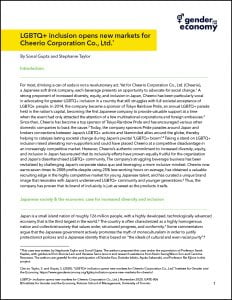
  • LGBTQ+ inclusion opens new markets for Cheerio Corporation Co., Ltd.

    LGBTQ+ inclusion opens new markets for Cheerio Corporation Co., Ltd.

    [fusion_builder_container hundred_percent=”no” equal_height_columns=”no” menu_anchor=”” hide_on_mobile=”small-visibility,medium-visibility,large-visibility” class=”” id=”” background_color=”” background_image=”” background_position=”center center” background_repeat=”no-repeat” fade=”no” background_parallax=”none” parallax_speed=”0.3″ video_mp4=”” video_webm=”” video_ogv=”” video_url=”” video_aspect_ratio=”16:9″ video_loop=”yes” video_mute=”yes” overlay_color=”” video_preview_image=”” border_color=”” border_style=”solid” padding_top=”” padding_bottom=”” padding_left=”” padding_right=”” type=”legacy”][fusion_builder_row][fusion_builder_column type=”1_1″ layout=”1_1″ background_position=”left top” background_color=”” border_color=”” border_style=”solid” border_position=”all” spacing=”yes” background_image=”” background_repeat=”no-repeat” padding_top=”” padding_right=”” padding_bottom=”” padding_left=”” margin_top=”0px” margin_bottom=”0px” class=”” id=”” animation_type=”” animation_speed=”0.3″ animation_direction=”left” hide_on_mobile=”small-visibility,medium-visibility,large-visibility” center_content=”no” last=”true” min_height=”” hover_type=”none” link=”” border_sizes_top=”” border_sizes_bottom=”” border_sizes_left=”” border_sizes_right=”” first=”true”][fusion_text columns=”” column_min_width=”” column_spacing=”” rule_style=”default” rule_size=”” rule_color=”” content_alignment_medium=”” content_alignment_small=”” content_alignment=”” hide_on_mobile=”small-visibility,medium-visibility,large-visibility” sticky_display=”normal,sticky” class=”” id=”” font_size=”” fusion_font_family_text_font=”” fusion_font_variant_text_font=”” line_height=”” letter_spacing=”” text_color=”” animation_type=”” animation_direction=”left” animation_speed=”0.3″ animation_offset=””]

    Overview

    Cheerio Corporation Co., Ltd. is a Japanese beverage company that competes domestically. The company is a family business that has been run by three generations of the Kan family. The case examines how Daisuke Kan, grandson of Cheerio’s founder, used advocacy for LGBTQ+ inclusion as part of his strategy to reach an underserved market and to revitalize the company’s beverages business.

    Course Topics:
    • Corporate social responsibility
    • Diversity & Inclusion
    • LGBTQ+ Inclusion
    • Leadership
    • Marketing
    • Organizational Change

    Introduction:

    For most, drinking a can of soda is not a revolutionary act. Yet for Cheerio Corporation Co., Ltd. (Cheerio), a Japanese soft drink company, each beverage presents an opportunity to advocate for social change. A strong proponent of increased diversity, equity, and inclusion in Japan, Cheerio has been a particularly vocal in advocating for greater LGBTQ+ inclusion in a country that still struggles with full societal acceptance of LGBTQ+ people. In 2014, the company became a sponsor of Tokyo Rainbow Pride, an annual LGBTQ+ parade held in the nation’s capital, becoming the first Japanese company to provide valuable support at a time when the event had only attracted the attention of a few multinational corporations and foreign embassies. Since then, Cheerio has become a top sponsor of Tokyo Rainbow Pride and has encouraged various other domestic companies to back the cause. Today, the company sponsors Pride parades around Japan and brokers connections between Japan’s LGBTQ+ activists and likeminded allies around the globe, thereby helping to catalyze lasting societal change during Japan’s pivotal “LGBTQ+ boom”. Taking a stand on LGBTQ+ inclusion risked alienating non-supporters and could have placed Cheerio at a competitive disadvantage in an increasingly competitive market. However, Cheerio’s authentic commitment to increased diversity, equity, and inclusion in Japan has ensured that its inclusivity efforts have proven equally fruitful for the organization and Japan’s disenfranchised LGBTQ+ community. The company’s struggling beverage business has been revitalized by challenging Japan’s corporate status quo and leveraging a more inclusive mindset. Cheerio now earns seven times its 2010 profits despite using 25% fewer working hours on average, has obtained a valuable recruiting edge in the highly competitive market for young Japanese talent, and has curated a unique brand image that resonates with Japan’s underserved LGBTQ+ community and younger generations. Thus, the company has proven that its brand of inclusivity is just as sweet as the products it sells.

    View and download the full case study

    [/fusion_text][fusion_text columns=”” column_min_width=”” column_spacing=”” rule_style=”default” rule_size=”” rule_color=”” content_alignment_medium=”” content_alignment_small=”” content_alignment=”” hide_on_mobile=”small-visibility,medium-visibility,large-visibility” sticky_display=”normal,sticky” class=”” id=”” font_size=”” fusion_font_family_text_font=”” fusion_font_variant_text_font=”” line_height=”” letter_spacing=”” text_color=”” animation_type=”” animation_direction=”left” animation_speed=”0.3″ animation_offset=””]

    __________________________

    This case was written by:

    This case was written by Stephanie Taylor and Sonal Gupta. The authors prepared this case under the supervision of Professor Sarah Kaplan, with guidance from Bonnie Lam and Vanessa Serra Iarocci and research assistance from Kevin SeongWeon Son and Carmina Ravanera. The authors are grateful for the participation of Daisuke Kan, Daisuke Ishido, Ayaka Sakamaki, and Professor Rie Kijima in this project.

    [/fusion_text][fusion_separator style_type=”none” hide_on_mobile=”small-visibility,medium-visibility,large-visibility” sticky_display=”normal,sticky” class=”” id=”” flex_grow=”0″ top_margin=”10″ bottom_margin=”10″ width=”” alignment=”center” border_size=”” sep_color=”” icon=”” icon_size=”” icon_color=”” icon_circle=”” icon_circle_color=”” /][fusion_button link=”https://www.gendereconomy.org/education/case-studies/” text_transform=”” title=”” target=”_blank” link_attributes=”” alignment_medium=”” alignment_small=”” alignment=”” modal=”” hide_on_mobile=”small-visibility,medium-visibility,large-visibility” sticky_display=”normal,sticky” class=”” id=”” color=”custom” button_gradient_top_color=”#62bd19″ button_gradient_bottom_color=”#62bd19″ button_gradient_top_color_hover=”#00c2e2″ button_gradient_bottom_color_hover=”#00c2e2″ accent_color=”” accent_hover_color=”” type=”” bevel_color=”” border_width=”” border_radius=”” border_color=”” border_hover_color=”” size=”” stretch=”yes” margin_top=”” margin_right=”” margin_bottom=”” margin_left=”” icon=”” icon_position=”left” icon_divider=”no” animation_type=”” animation_direction=”left” animation_speed=”0.3″ animation_offset=””]See more case studies[/fusion_button][fusion_separator style_type=”none” hide_on_mobile=”small-visibility,medium-visibility,large-visibility” sticky_display=”normal,sticky” class=”” id=”” flex_grow=”0″ top_margin=”20″ bottom_margin=”20″ width=”” alignment=”center” border_size=”” sep_color=”” icon=”” icon_size=”” icon_color=”” icon_circle=”” icon_circle_color=”” /][fusion_recent_posts layout=”default” picture_size=”fixed” hover_type=”none” columns=”3″ number_posts=”3″ post_status=”” offset=”0″ pull_by=”category” cat_slug=”case-studies” exclude_cats=”” tag_slug=”” exclude_tags=”” thumbnail=”yes” title=”yes” meta=”no” meta_author=”no” meta_categories=”no” meta_date=”yes” meta_comments=”yes” meta_tags=”no” content_alignment=”” excerpt=”no” excerpt_length=”35″ strip_html=”yes” scrolling=”no” hide_on_mobile=”small-visibility,medium-visibility,large-visibility” class=”” id=”” animation_type=”” animation_direction=”left” animation_speed=”0.3″ animation_offset=”” /][/fusion_builder_column][/fusion_builder_row][/fusion_builder_container]

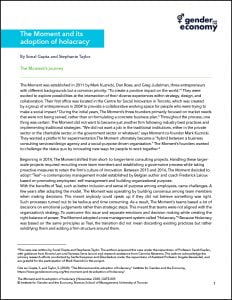
  • The Moment and its adoption of holacracy

    The Moment and its adoption of holacracy

    [fusion_builder_container hundred_percent=”no” equal_height_columns=”no” menu_anchor=”” hide_on_mobile=”small-visibility,medium-visibility,large-visibility” class=”” id=”” background_color=”” background_image=”” background_position=”center center” background_repeat=”no-repeat” fade=”no” background_parallax=”none” parallax_speed=”0.3″ video_mp4=”” video_webm=”” video_ogv=”” video_url=”” video_aspect_ratio=”16:9″ video_loop=”yes” video_mute=”yes” overlay_color=”” video_preview_image=”” border_color=”” border_style=”solid” padding_top=”” padding_bottom=”” padding_left=”” padding_right=”” type=”legacy”][fusion_builder_row][fusion_builder_column type=”1_1″ layout=”1_1″ background_position=”left top” background_color=”” border_color=”” border_style=”solid” border_position=”all” spacing=”yes” background_image=”” background_repeat=”no-repeat” padding_top=”” padding_right=”” padding_bottom=”” padding_left=”” margin_top=”0px” margin_bottom=”0px” class=”” id=”” animation_type=”” animation_speed=”0.3″ animation_direction=”left” hide_on_mobile=”small-visibility,medium-visibility,large-visibility” center_content=”no” last=”true” min_height=”” hover_type=”none” link=”” border_sizes_top=”” border_sizes_bottom=”” border_sizes_left=”” border_sizes_right=”” first=”true”][fusion_text columns=”” column_min_width=”” column_spacing=”” rule_style=”default” rule_size=”” rule_color=”” content_alignment_medium=”” content_alignment_small=”” content_alignment=”” hide_on_mobile=”small-visibility,medium-visibility,large-visibility” sticky_display=”normal,sticky” class=”” id=”” margin_top=”” margin_right=”” margin_bottom=”” margin_left=”” font_size=”” fusion_font_family_text_font=”” fusion_font_variant_text_font=”” line_height=”” letter_spacing=”” text_color=”” animation_type=”” animation_direction=”left” animation_speed=”0.3″ animation_offset=””]

    Overview

    The Moment was established in 2011 as a hybrid between a business consulting services/design agency and a social-purpose driven organization. This case studies how the company adopted Holacracy, a management system which disrupts the traditional hierarchical workplace. Holacracy works by clearly defining explicit roles that are not titles or designations, but sets of responsibilities that entail what decisions can and cannot be authorized by the people who hold them. This case shows how The Moment used Holacracy in order to redistribute power and change structural bias that affects women at work.

    Course Topics:
    • Change management
    • Human resources and organizational theory
    • Leadership
    • Innovation
    • Diversity and inclusion
    • Organization Design

    Introduction

    The Moment was established in 2011 by Mark Kuznicki, Dan Rose, and Greg Judelman, three entrepreneurs with different backgrounds but a common priority: “To create a positive impact on the world.” They were excited to explore possibilities at the intersection of their diverse experiences within strategy, design, and collaboration. Their first office was located in the Centre for Social Innovation in Toronto, which was created by a group of entrepreneurs in 2004 to provide a collaborative working space for people who were trying to make a social impact. During the initial years, The Moment’s three founders primarily focused on market needs that were not being served, rather than on formulating a concrete business plan. Throughout the process, one thing was certain: The Moment did not want to become just another firm following industry best practices and implementing traditional strategies. “We did not want a job in the traditional institutions, either in the private sector or the charitable sector, in the government sector or whatever,” says Moment co-founder Mark Kuznicki. They wanted a platform for experimentation. The Moment ultimately became a “hybrid between a business consulting services/design agency and a social-purpose driven organization.” The Moment’s founders wanted to challenge the status quo by innovating new ways for people to work together.

    Beginning in 2014, The Moment shifted from short- to longer-term consulting projects. Handling these larger-scale projects required recruiting more team members and establishing a governance process while taking proactive measures to retain the firm’s culture of innovation. Between 2015 and 2016, The Moment decided to adopt “Teal”—a contemporary management model established by Belgian author and coach Frederick Laloux based on promoting employees’ self-management and building organizational purpose.

    With the benefits of Teal, such as better inclusion and sense of purpose among employees, came challenges. A few years after adopting the model, The Moment was operating by building consensus among team members when making decisions. This meant anybody could speak up if they did not believe something was right. Such processes turned out to be tedious and time consuming. As a result, The Moment’s teams based a lot of decisions on emotional judgements rather than strategic steps. This meant that teams were not aligned with the organization’s strategy. To overcome this issue and separate emotions and decision making while creating the right balance of power, The Moment adopted a new management system called “Holacracy.” Because Holacracy was based on the same principles as Teal, the transition did not mean discarding existing practices but rather solidifying them and adding a firm statute around them.

    The Moment thumbnail

    View and download the full case study

    [/fusion_text][fusion_text columns=”” column_min_width=”” column_spacing=”” rule_style=”default” rule_size=”” rule_color=”” content_alignment_medium=”” content_alignment_small=”” content_alignment=”” hide_on_mobile=”small-visibility,medium-visibility,large-visibility” sticky_display=”normal,sticky” class=”” id=”” margin_top=”” margin_right=”” margin_bottom=”” margin_left=”” font_size=”” fusion_font_family_text_font=”” fusion_font_variant_text_font=”” line_height=”” letter_spacing=”” text_color=”” animation_type=”” animation_direction=”left” animation_speed=”0.3″ animation_offset=””]

    __________________________

    This case was written by:

    Sonal Gupta and Stephanie Taylor. The authors prepared this case under the supervision of Professor Sarah Kaplan, with guidance from Bonnie Lam and Vanessa Serra Iarocci and research assistance from Carmina Ravanera. The authors are grateful for the participation of Mark Kuznicki in this project.

    Published

    September 2020

    [/fusion_text][fusion_separator style_type=”none” hide_on_mobile=”small-visibility,medium-visibility,large-visibility” sticky_display=”normal,sticky” class=”” id=”” flex_grow=”0″ top_margin=”10″ bottom_margin=”10″ width=”” alignment=”center” border_size=”” sep_color=”” icon=”” icon_size=”” icon_color=”” icon_circle=”” icon_circle_color=”” /][fusion_button link=”https://www.gendereconomy.org/education/case-studies/” text_transform=”” title=”” target=”_blank” link_attributes=”” alignment_medium=”” alignment_small=”” alignment=”” modal=”” hide_on_mobile=”small-visibility,medium-visibility,large-visibility” sticky_display=”normal,sticky” class=”” id=”” color=”custom” button_gradient_top_color=”#62bd19″ button_gradient_bottom_color=”#62bd19″ button_gradient_top_color_hover=”#00c2e2″ button_gradient_bottom_color_hover=”#00c2e2″ accent_color=”” accent_hover_color=”” type=”” bevel_color=”” border_width=”” border_radius=”” border_color=”” border_hover_color=”” size=”” stretch=”yes” margin_top=”” margin_right=”” margin_bottom=”” margin_left=”” icon=”” icon_position=”left” icon_divider=”no” animation_type=”” animation_direction=”left” animation_speed=”0.3″ animation_offset=””]See more case studies[/fusion_button][fusion_separator style_type=”none” hide_on_mobile=”small-visibility,medium-visibility,large-visibility” sticky_display=”normal,sticky” class=”” id=”” flex_grow=”0″ top_margin=”20″ bottom_margin=”20″ width=”” alignment=”center” border_size=”” sep_color=”” icon=”” icon_size=”” icon_color=”” icon_circle=”” icon_circle_color=”” /][fusion_recent_posts layout=”default” picture_size=”fixed” hover_type=”none” columns=”3″ number_posts=”3″ post_status=”” offset=”0″ pull_by=”category” cat_slug=”case-studies” exclude_cats=”” tag_slug=”” exclude_tags=”” thumbnail=”yes” title=”yes” meta=”no” meta_author=”no” meta_categories=”no” meta_date=”yes” meta_comments=”yes” meta_tags=”no” content_alignment=”” excerpt=”no” excerpt_length=”35″ strip_html=”yes” scrolling=”no” hide_on_mobile=”small-visibility,medium-visibility,large-visibility” class=”” id=”” animation_type=”” animation_direction=”left” animation_speed=”0.3″ animation_offset=”” /][/fusion_builder_column][/fusion_builder_row][/fusion_builder_container]

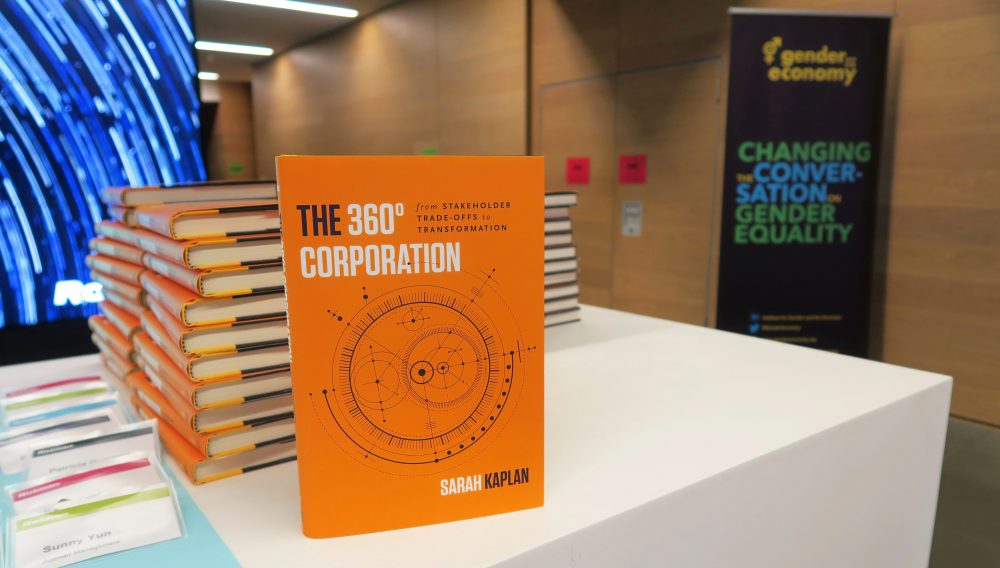
  • Sarah Kaplan on “The 360° Corporation: From Stakeholder Trade-offs to Transformation”

    Sarah Kaplan on “The 360° Corporation: From Stakeholder Trade-offs to Transformation”

    [fusion_builder_container hundred_percent=”no” equal_height_columns=”no” menu_anchor=”” hide_on_mobile=”small-visibility,medium-visibility,large-visibility” class=”” id=”” background_color=”” background_image=”” background_position=”center center” background_repeat=”no-repeat” fade=”no” background_parallax=”none” parallax_speed=”0.3″ video_mp4=”” video_webm=”” video_ogv=”” video_url=”” video_aspect_ratio=”16:9″ video_loop=”yes” video_mute=”yes” overlay_color=”” video_preview_image=”” border_size=”” border_color=”” border_style=”solid” padding_top=”” padding_bottom=”” padding_left=”” padding_right=””][fusion_builder_row][fusion_builder_column type=”1_1″ layout=”1_1″ background_position=”left top” background_color=”” border_size=”” border_color=”” border_style=”solid” border_position=”all” spacing=”yes” background_image=”” background_repeat=”no-repeat” padding_top=”” padding_right=”” padding_bottom=”” padding_left=”” margin_top=”0px” margin_bottom=”0px” class=”” id=”” animation_type=”” animation_speed=”0.3″ animation_direction=”left” hide_on_mobile=”small-visibility,medium-visibility,large-visibility” center_content=”no” last=”no” min_height=”” hover_type=”none” link=””][fusion_text columns=”” column_min_width=”” column_spacing=”” rule_style=”default” rule_size=”” rule_color=”” hide_on_mobile=”small-visibility,medium-visibility,large-visibility” class=”” id=”” animation_type=”” animation_direction=”left” animation_speed=”0.3″ animation_offset=””]

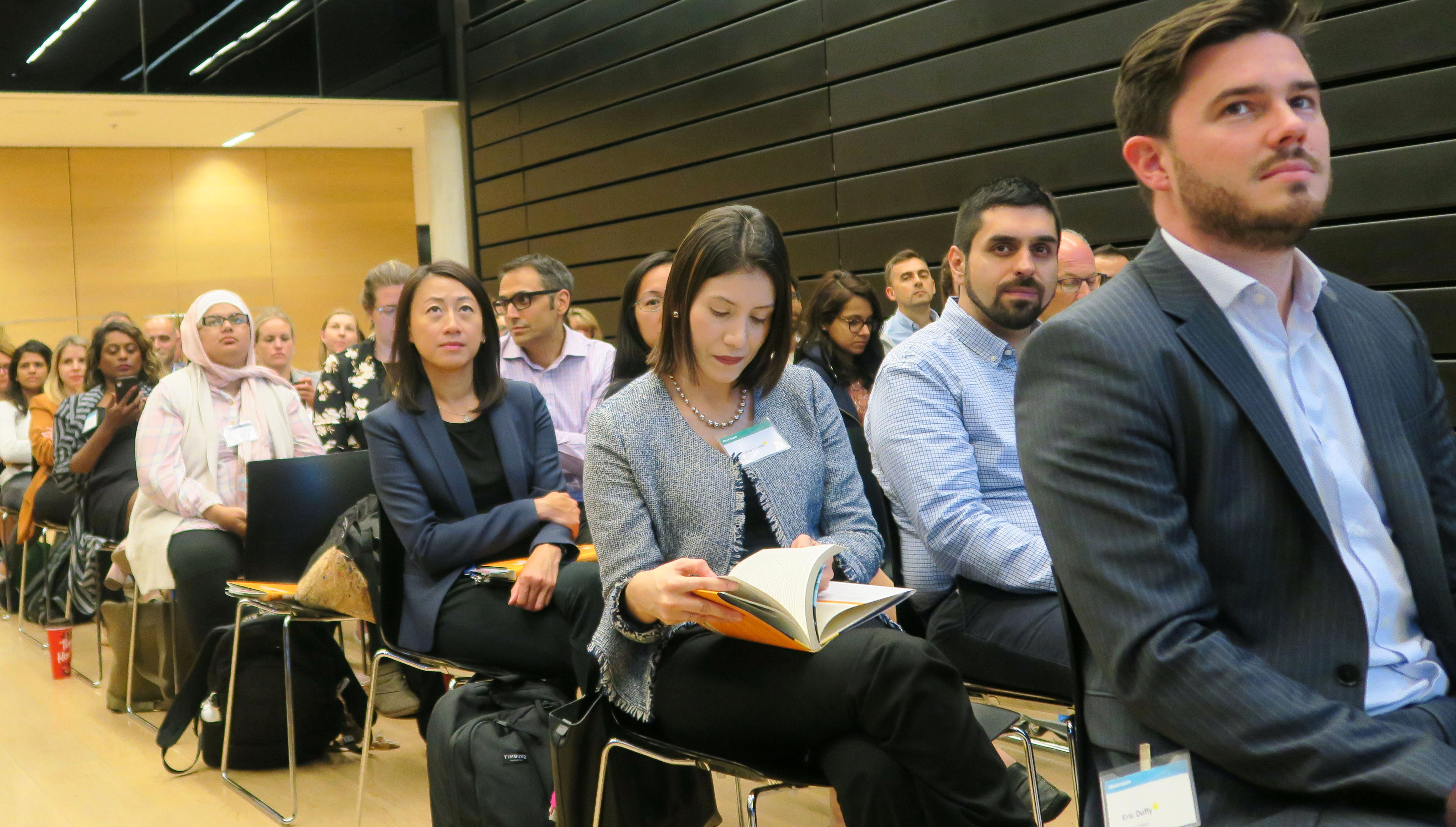
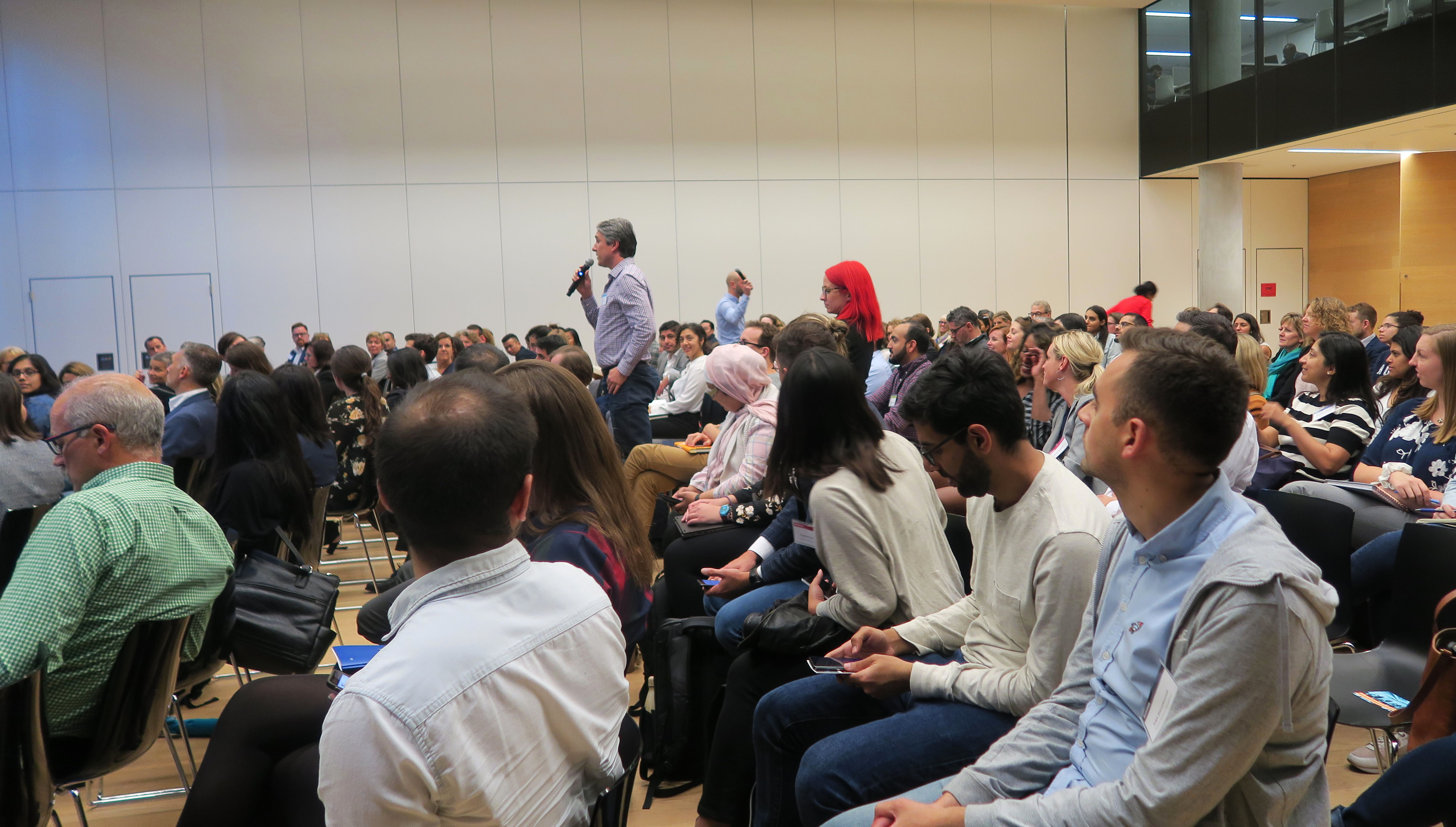
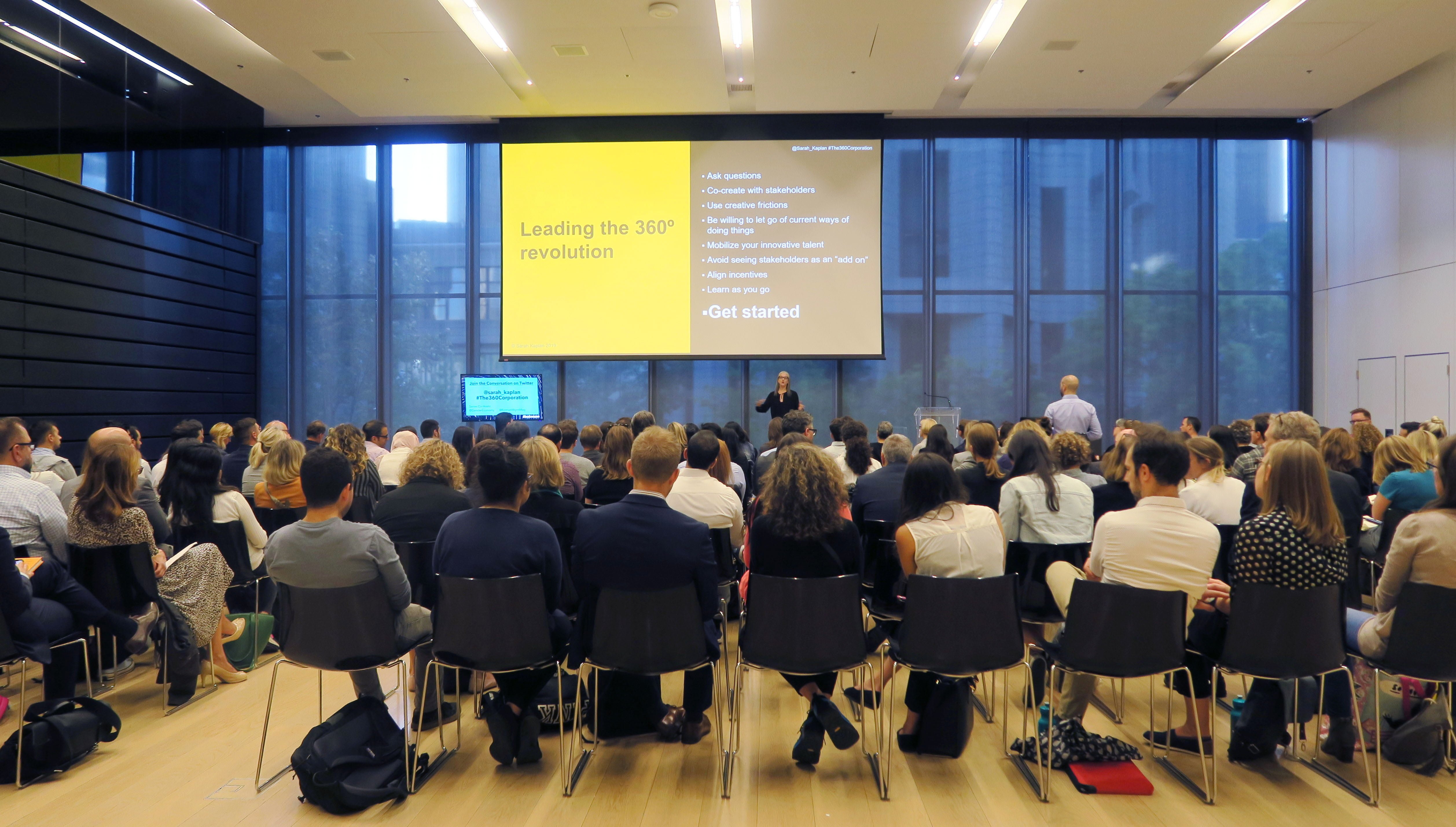
    “We have a lot of crises – gender equality crises, climate crises – that we are all facing. And we need to have a better way to have a conversation about these issues inside organizations. That’s what this book is meant to do,” said Sarah Kaplan, Director of the Institute for Gender and the Economy and author of The 360° Corporation: From Stakeholder Trade-Offs to Transformation.

    In her talk at the Rotman School of Management on September 26, Kaplan said that society is increasingly turning away from the idea that the main responsibility of businesses is to shareholders. For example, 181 CEOs from the Business Roundtable recently signed a statement that businesses must benefit customers, employees, suppliers, and communities, in addition to their shareholders.

    But how do businesses go about doing this effectively? Kaplan’s book points to four mistakes that managers are making when working on stakeholder issues, and discussed the actions organizations can take to make change. These four mistakes are:

    Not knowing how business models create trade-offs

    Organizations are not having enough conversations about their stakeholder trade-offs. For example, do delivery companies recognize the increased pollution and poor labour conditions that come with same-day delivery? Companies also need to examine who isn’t at the table when business decisions are made, and how these people can be invited to the conversation.

    Starting with the business case

    Beginning with a business case for diversity, inclusion, or sustainability gets in the way of progress. Business cases have not led to change over the last few decades because they limit companies to incremental solutions. Instead, Kaplan argued for rethinking trade-offs by targeting existing social and environmental problems first, and demonstrating the business case later on.

    Treating corporate social responsibility as an “add-on”

    Often, corporate social responsibility is done “off the side of someone’s desk”. Kaplan suggested that instead, corporate social responsibility be treated as an opportunity for business transformation. It can play a key role in how businesses function, put out new products and services, and innovate.

    Giving up when a solution isn’t found

    Innovating around trade-offs is difficult but not impossible, and not finding a solution right away cannot be used as an excuse not to act. As Kaplan explained, “Sometimes you have to start just by doing the right thing, and figuring out through experimentation along the way…you’re going to learn, and it’s going to get you somewhere.”

    For more on The 360º Corporation: From Stakeholder Trade-offs to Transformation, click here.

    Watch the video below to learn more. 

    [/fusion_text][fusion_separator style_type=”none” hide_on_mobile=”small-visibility,medium-visibility,large-visibility” class=”” id=”” sep_color=”” top_margin=”50″ bottom_margin=”50″ border_size=”” icon=”” icon_circle=”” icon_circle_color=”” width=”” alignment=”center” /][fusion_button link=”https://www.gendereconomy.org/past-events/” text_transform=”” title=”” target=”_blank” link_attributes=”” alignment=”” modal=”” hide_on_mobile=”small-visibility,medium-visibility,large-visibility” class=”” id=”” color=”custom” button_gradient_top_color=”#62bd19″ button_gradient_bottom_color=”#62bd19″ button_gradient_top_color_hover=”#00c2e2″ button_gradient_bottom_color_hover=”#00c2e2″ accent_color=”” accent_hover_color=”” type=”” bevel_color=”” border_width=”” size=”” stretch=”yes” icon=”” icon_position=”left” icon_divider=”no” animation_type=”” animation_direction=”left” animation_speed=”0.3″ animation_offset=”” border_radius=””]See more past events[/fusion_button][fusion_separator style_type=”none” hide_on_mobile=”small-visibility,medium-visibility,large-visibility” class=”” id=”” sep_color=”” top_margin=”20″ bottom_margin=”20″ border_size=”” icon=”” icon_circle=”” icon_circle_color=”” width=”” alignment=”center” /][fusion_title margin_top=”” margin_bottom=”” hide_on_mobile=”medium-visibility,large-visibility” class=”” id=”” size=”5″ content_align=”center” style_type=”default” sep_color=””]

    Or register below for these upcoming events

    [/fusion_title][fusion_recent_posts layout=”default” hover_type=”none” columns=”3″ number_posts=”3″ offset=”0″ pull_by=”category” cat_slug=”events” exclude_cats=”past” tag_slug=”” exclude_tags=”” thumbnail=”yes” title=”yes” meta=”no” meta_author=”no” meta_categories=”no” meta_date=”yes” meta_comments=”yes” meta_tags=”no” content_alignment=”” excerpt=”no” excerpt_length=”35″ strip_html=”yes” scrolling=”no” hide_on_mobile=”medium-visibility,large-visibility” class=”” id=”” animation_type=”” animation_direction=”left” animation_speed=”0.3″ animation_offset=”” /][/fusion_builder_column][/fusion_builder_row][/fusion_builder_container]

  • Gender-based analysis as a turnaround strategy at McCarthy Uniforms

    Gender-based analysis as a turnaround strategy at McCarthy Uniforms

    [fusion_builder_container hundred_percent=”no” equal_height_columns=”no” menu_anchor=”” hide_on_mobile=”small-visibility,medium-visibility,large-visibility” class=”” id=”” background_color=”” background_image=”” background_position=”center center” background_repeat=”no-repeat” fade=”no” background_parallax=”none” parallax_speed=”0.3″ video_mp4=”” video_webm=”” video_ogv=”” video_url=”” video_aspect_ratio=”16:9″ video_loop=”yes” video_mute=”yes” overlay_color=”” video_preview_image=”” border_size=”” border_color=”” border_style=”solid” padding_top=”” padding_bottom=”” padding_left=”” padding_right=””][fusion_builder_row][fusion_builder_column type=”1_1″ layout=”1_1″ background_position=”left top” background_color=”” border_size=”” border_color=”” border_style=”solid” border_position=”all” spacing=”yes” background_image=”” background_repeat=”no-repeat” padding_top=”” padding_right=”” padding_bottom=”” padding_left=”” margin_top=”0px” margin_bottom=”0px” class=”” id=”” animation_type=”” animation_speed=”0.3″ animation_direction=”left” hide_on_mobile=”small-visibility,medium-visibility,large-visibility” center_content=”no” last=”no” min_height=”” hover_type=”none” link=””][fusion_text columns=”” column_min_width=”” column_spacing=”” rule_style=”default” rule_size=”” rule_color=”” hide_on_mobile=”small-visibility,medium-visibility,large-visibility” class=”” id=””]

    Overview

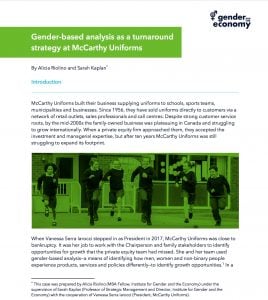
    Written by Alicia Riolino and Sarah Kaplan, Institute for Gender and the Economy

    McCarthy Uniforms is a uniform supplier to schools, sports teams, municipalities, and businesses headquartered in Canada. This case study focuses specifically on how the current President, Vanessa Serra Iarocci, and her team used gender-based analysis to identify growth opportunities in order to save McCarthy Uniforms from bankruptcy between 2017 and 2019.

    This case would be useful for those interested in or teaching courses in:
    • Gender-based analysis
    • Strategic management
    • Leadership
    • Change management

    Introduction

    McCarthy Uniforms built their business supplying uniforms to schools, sports teams, municipalities and businesses. Since 1956, they have sold uniforms directly to customers via a network of retail outlets, sales professionals and call centres. Despite strong customer service roots, by the mid-2000s the family-owned business was plateauing in Canada and struggling to grow internationally. When a private equity firm approached them, they accepted the investment and managerial expertise, but after ten years McCarthy Uniforms was still struggling to expand its footprint.

    When Vanessa Serra Iarocci stepped in as President in 2017, McCarthy Uniforms was close to bankruptcy. It was her job to work with the Chairperson and family stakeholders to identify opportunities for growth that the private equity team had missed. She and her team used gender-based analysis—a means of identifying how men, women and non-binary people experience products, services and policies differently—to identify growth opportunities. In a short time, they spotted opportunities to innovate on their service delivery and product offering, as well as to market McCarthy Uniforms’ existing gender-friendly practices.

    Since 2017, the solutions identified through gender-based analysis have supported double-digit revenue growth at McCarthy Uniforms by identifying opportunities for innovation within a mature industry and finding ways to grow without compromising service, quality or sustainability.

    To view and download the full case study, follow these instructions.

    [/fusion_text][/fusion_builder_column][/fusion_builder_row][/fusion_builder_container]

  • The origins of the gender gap

    The origins of the gender gap

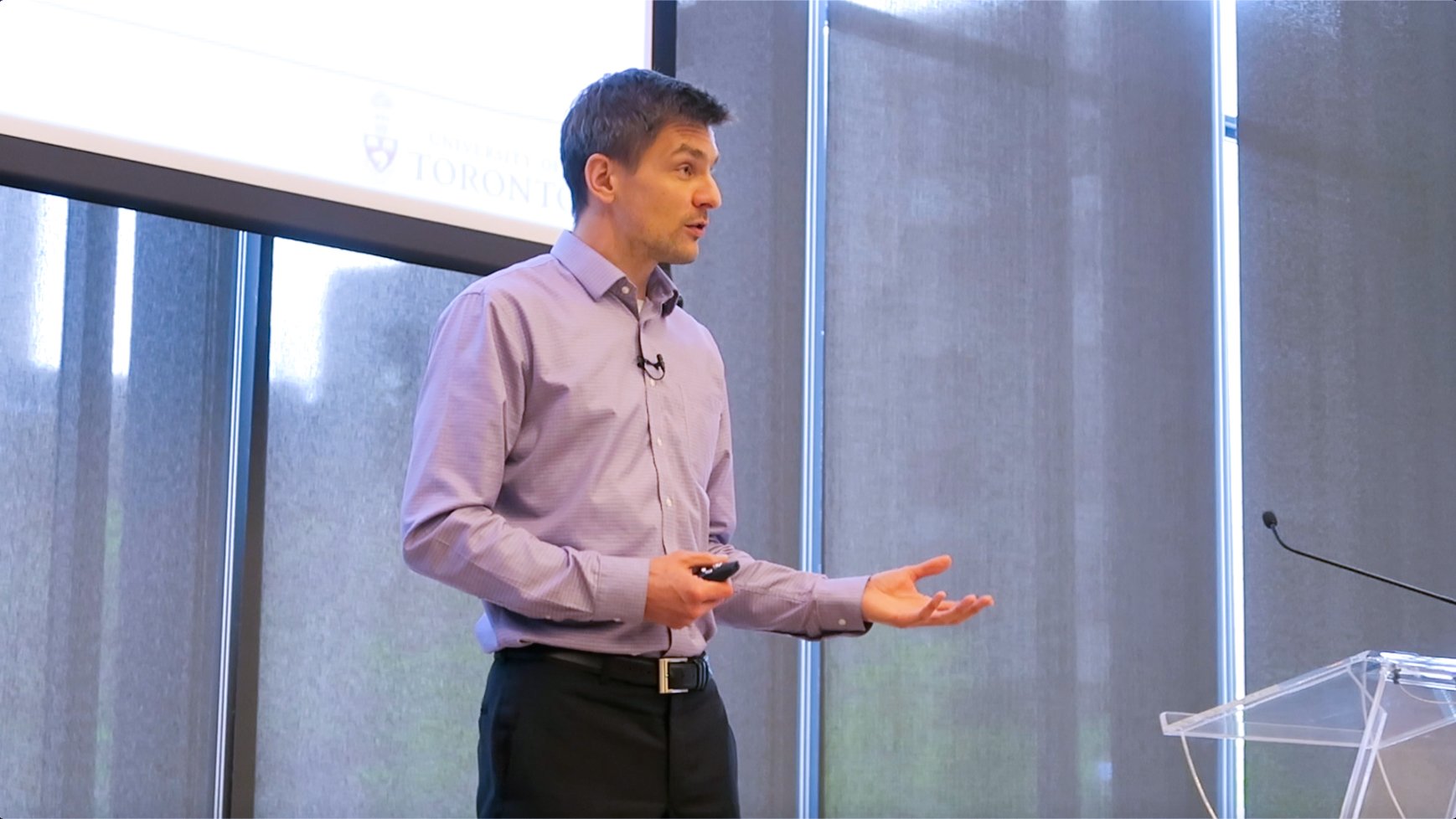
    Speaking at Rotman Management Magazine’s “Short Talks: Art of Change” event in May 2019, Mikhail Simutin, Associate Professor of Finance and Associate Director of the International Centre for Pension Management at Rotman, discusses his GATE-funded research on the origins of the gender gap.

    Click here to view Sarah Kaplan’s talk at “Art of Change.”


  • Women and leadership

    Women and leadership

    [fusion_builder_container admin_label=”” hundred_percent=”no” equal_height_columns=”no” menu_anchor=”” hide_on_mobile=”small-visibility,medium-visibility,large-visibility” class=”” id=”” background_color=”” background_image=”” background_position=”center center” background_repeat=”no-repeat” fade=”no” background_parallax=”none” enable_mobile=”no” parallax_speed=”0.3″ video_mp4=”” video_webm=”” video_ogv=”” video_url=”” video_aspect_ratio=”16:9″ video_loop=”yes” video_mute=”yes” video_preview_image=”” border_size=”” border_color=”” border_style=”solid” margin_top=”20″ margin_bottom=”” padding_top=”” padding_right=”” padding_bottom=”” padding_left=””][fusion_builder_row][fusion_builder_column type=”3_4″ layout=”3_4″ spacing=”” center_content=”no” hover_type=”none” link=”” min_height=”” hide_on_mobile=”small-visibility,medium-visibility,large-visibility” class=”” id=”” background_color=”” background_image=”” background_position=”left top” background_repeat=”no-repeat” border_size=”0″ border_color=”” border_style=”solid” border_position=”all” padding_top=”” padding_right=”” padding_bottom=”” padding_left=”” margin_top=”” margin_bottom=”” animation_type=”” animation_direction=”left” animation_speed=”0.3″ animation_offset=”” last=”no”][fusion_text columns=”” column_min_width=”” column_spacing=”” rule_style=”default” rule_size=”” rule_color=”” hide_on_mobile=”small-visibility,medium-visibility,large-visibility” class=”” id=””]

    Download this research brief (in English/en Français).
    Download the infographic (in English/en Français).

    Overview

    Canada lags behind other developed countries with regard to female representation on corporate boards and in management leadership. Since 2015, firms regulated by the Ontario Securities Commission have been required to disclose annually the number of women on their board of directors and in executive officer positions. Firms that have not adopted ways to promote the representation of women are required to explain their reasons for not doing so.

    Despite the existence of ‘comply or explain’ legislation, there has been slow progress for board representation, and even slower progress for women in executive leadership positions.[1] In 2018, 40.1% of TSX-listed firms reported having no female executive officers, 29.1% reported having one female executive officer, and 30.8% reported having more than one female executive officer. Women filled only 29% of vacated board seats and held 15% of board seats overall. In Canada, only 4% of firms have a female CEO.[2]

    In 2018, women held just 15% of board seats and only 4% of firms had a female CEO in Canada.

    Reasons for slow progress

    Many attribute the lack of female leaders to a “leaky pipeline,” where women opt out of challenging career paths. But research suggests that opting out is not the problem. Instead, workplace cultures and practices that fail to accommodate the realities of care work—for which working mothers remain overwhelmingly responsible—push women out of the workforce or out of advancement to leadership roles.[3]

    Women are also disadvantaged by the stereotype of leadership as a masculine trait.[4] Leadership bias against women has been found in a variety of fields, including entrepreneurship and engineering.[5] Because women do not fit the stereotype of a leader, they are often less respected.[6] For example, when women are promoted to leadership positions in male-dominated and technical occupational fields, they may face backlash. Because managerial positions involve less technical work, an increasing number of women in such positions may validate pervasive stereotypes about women being less technically competent.[7]

    How to fix the problem of representation

    • “Gender blind” vs. “gender aware” approaches to hiring and recruitment: While a gender-blind approach to hiring, such as redacting applicants’ names and other identifying information may help women get interviews, this approach cannot remove biases that are already part of workplace cultures.[8] Research finds that even when firms present pro-diversity values and encourage applications from underrepresented groups, they still exhibit bias in hiring practices.[9] Management can implement diverse team-based hiring so that a single hiring manager is not responsible for hiring decisions. Doing so will help to ensure that hiring is based on agreed upon job criteria and not merely the outcome of one individual’s “gut instinct” about “fit,” which may reflect unconscious biases.[10]
    • Change job descriptions for leadership roles: Job descriptions can be rewritten to reduce biased language and eliminate associations with gender stereotypes. For example, changing “assertiveness,” a term associated with men, to “confidence.”
    • Implement quotas or hard targets: Research shows that the belief that quotas compromise meritocracy is misguided. The implementation of quotas to increase female leadership is not a trade-off on quality.[11] Instead, board governance quality may improve. Specifically, increasing the number of women on corporate boards to three or more enhances the likelihood that women’s ideas are heard, and that boardroom dynamics change.[12]   

    • Sponsorship and mentorship: Whereas workplace mentors provide advice, workplace sponsors advocate on behalf of their sponsees and champion their advancement. Because sponsorship relies on the efforts of senior-level executives, such relationships are less common but more valuable than mentorship relationships.  Women with sponsors are almost twice as likely to believe that being promoted to executive positions is attainable.[13] Promoting sponsorship in addition to mentorship is thus a key intervention for increasing female leadership.
    • Diversity training: Diversity training can help when implemented with buy-in from management, and alongside other efforts to reduce gender inequality.  A key complement to diversity training is clear accountability for what change looks like. Efforts need to be widespread and long-term, otherwise, the mere presence and availability of diversity training can create the illusion that an organization is fair, and management may cease efforts towards truly inclusionary and substantive change.[15]   
    • Educate to dismantle gender stereotypes: Socialization into stereotypical gender roles begins in childhood, as do biased perceptions of women as followers rather than leaders.[16] Solutions aimed at addressing leaky pipelines must involve training for educators of every age group, from preschool to university to onsite job learning.[17]

    References

    [1] Catalyst, Gender Diversity on Boards in Canada: Recommendations for Accelerating Progress, commissioned by the Government of Ontario (2016). https://www.catalyst.org/research/gender-diversity-on-boards-in-canada-recommendations-for-accelerating-progress/#footnote4_g2amjjm

    [2] Canadian Securities Administrators, “Report on Fourth Staff Review of Disclosure regarding Women on Boards and in Executive Officer Positions”: https://www.osc.gov.on.ca/en/SecuritiesLaw_sn_20180927_58-310_staff-review-women-on-boards.html

    Andrew MacDougall and John Valley of Osler, Hoskin & Harcourt, “2018 Diversity Disclosure Practices”: https://www.osler.com/osler/media/Osler/reports/corporate-governance/2018-Diversity-Disclosure-Practices-Women-in-leadership-roles-at-TSX-listed-companies.pdf

    [3] Stone, P. (2008). Opting out?: Why women really quit careers and head home. Univ of California Press.

    Collins, C. (2019). Making Motherhood Work: How Women Manage Careers and Caregiving. Princeton University Press.

    [4] McClean, E. J., Martin, S. R., Emich, K. J., & Woodruff, C. T. (2018). The social consequences of voice: An examination of voice type and gender on status and subsequent leader emergence. Academy of Management Journal, 61(5), 1869-1891.

    Eagly, A.H. & Carli, L. L. (2007). Through the labyrinth: The truth about how women become leaders. Harvard Business Press.

    [5] Yang, T., & Aldrich, H. E. (2014). Who’s the boss? Explaining gender inequality in entrepreneurial teams. American Sociological Review, 79(2), 303-327.

    Cardador, M. T. (2017). Promoted Up But Also Out? The Unintended Consequences of Increasing Women’s Representation in Managerial Roles in Engineering. Organization Science, 28(4), 597-617.

    [6] Desai, S. D., Chugh, D., & Brief, A. P. (2014). The implications of marriage structure for men’s workplace attitudes, beliefs, and behaviors toward women. Administrative Science Quarterly, 59(2), 330-365.

    [7] Cardador, M. T. (2017). Promoted Up But Also Out? The Unintended Consequences of Increasing Women’s Representation in Managerial Roles in Engineering. Organization Science, 28(4), 597-617.

    [8] Goldin, Claudia, and Cecilia Rouse. 2000. “Orchestrating Impartiality: The Impact of “Blind” Auditions on Female Musicians.” American Economic Review, 90 (4): 715-741.

    [9] Kang, S. K., DeCelles, K. A., Tilcsik, A., & Jun, S. (2016). Whitened resumes: Race and self-presentation in the labor market. Administrative Science Quarterly, 61(3), 469-502.

    [10] Rivera, L. A. (2012). Hiring as cultural matching: The case of elite professional service firms. American sociological review, 77(6), 999-1022.

    [11] Besley, T., Folke, O., Persson, T., & Rickne, J. (2017). Gender quotas and the crisis of the mediocre man: Theory and evidence from Sweden. American economic review, 107(8), 2204-42.

    Kim, D., & Starks, L. T. (2016). Gender diversity on corporate boards: Do women contribute unique skills?. American Economic Review, 106(5), 267-7.

    [12] Kramer, V.W., Konrad, A.M., Erkut, S. and Hooper, M.J., 2006. Critical mass on corporate boards: Why three or more women enhance governance. Wellesley, MA: Wellesley Centers for Women.

    Kim, D., & Starks, L. T. (2016). Gender diversity on corporate boards: Do women contribute unique skills?. American Economic Review, 106(5), 267-7

    [13] Naomi Titleman Colla, Sponsorship is an important key to unlocking women’s career potential, The Globe and Mail: https://www.theglobeandmail.com/report-on-business/careers/management/sponsorship-is-an-important-key-to-unlocking-womens-career-potential/article38204533/

    Women of Influence, “What’s holding women back: A look at female ambition in Canada”: https://www.womenofinfluence.ca/2016/01/11/whats-holding-women-back-a-look-at-female-ambition-in-canada/#.XJkhnBNKiV4

    [14] Dobbin, F., & Kalev, A. (2016). Why diversity programs fail. Harvard Business Review, 94(7), 14.

    [15] Alyson Colón, Does diversity training work?, Institute for Gender and the Economy: https://www.gendereconomy.org/does-diversity-training-work/

    [16] Reskin, B. F., & Hartmann, H. I. (Eds.). (1986). Women’s work, men’s work: Sex segregation on the job. National Academies Press.

    [17] Correll, S. J. (2001). Gender and the career choice process: The role of biased self-assessments. American journal of Sociology, 106(6), 1691-1730.

    [/fusion_text][fusion_separator style_type=”none” hide_on_mobile=”small-visibility,medium-visibility,large-visibility” class=”” id=”” sep_color=”” top_margin=”20″ bottom_margin=”20″ border_size=”” icon=”” icon_circle=”” icon_circle_color=”” width=”” alignment=”center” /][fusion_button link=”https://www.gendereconomy.org/research-briefs/” text_transform=”” title=”” target=”_blank” link_attributes=”” alignment=”” modal=”” hide_on_mobile=”small-visibility,medium-visibility,large-visibility” class=”” id=”” color=”custom” button_gradient_top_color=”#62bd19″ button_gradient_bottom_color=”#62bd19″ button_gradient_top_color_hover=”#00c2e2″ button_gradient_bottom_color_hover=”#00c2e2″ accent_color=”” accent_hover_color=”” type=”” bevel_color=”” border_width=”” size=”” stretch=”yes” shape=”” icon=”” icon_position=”left” icon_divider=”no” animation_type=”” animation_direction=”left” animation_speed=”0.3″ animation_offset=””]See more research briefs[/fusion_button][fusion_separator style_type=”none” hide_on_mobile=”small-visibility,medium-visibility,large-visibility” class=”” id=”” sep_color=”” top_margin=”20″ bottom_margin=”20″ border_size=”” icon=”” icon_circle=”” icon_circle_color=”” width=”” alignment=”center” /][fusion_recent_posts layout=”default” hover_type=”none” columns=”3″ number_posts=”3″ offset=”0″ pull_by=”category” cat_slug=”research-briefs” exclude_cats=”” tag_slug=”” exclude_tags=”” thumbnail=”yes” title=”yes” meta=”no” meta_author=”no” meta_categories=”no” meta_date=”yes” meta_comments=”yes” meta_tags=”no” content_alignment=”” excerpt=”no” excerpt_length=”35″ strip_html=”yes” scrolling=”no” hide_on_mobile=”small-visibility,medium-visibility,large-visibility” class=”” id=”” animation_type=”” animation_direction=”left” animation_speed=”0.3″ animation_offset=”” /][/fusion_builder_column][fusion_builder_column type=”1_4″ layout=”1_4″ spacing=”” center_content=”no” hover_type=”none” link=”” min_height=”” hide_on_mobile=”small-visibility,medium-visibility,large-visibility” class=”” id=”” background_color=”” background_image=”” background_position=”left top” background_repeat=”no-repeat” border_size=”0″ border_color=”” border_style=”solid” border_position=”all” padding_top=”” padding_right=”” padding_bottom=”” padding_left=”” margin_top=”” margin_bottom=”” animation_type=”” animation_direction=”left” animation_speed=”0.3″ animation_offset=”” last=”no”][fusion_title hide_on_mobile=”small-visibility,medium-visibility,large-visibility” class=”briefsummary” id=”” content_align=”left” size=”3″ font_size=”” line_height=”” letter_spacing=”” margin_top=”” margin_bottom=”” margin_top_mobile=”” margin_bottom_mobile=”” text_color=”” style_type=”none” sep_color=””]

    Published

    April 23, 2019

    This research brief was funded by the Government of Canada’s Labour Program for the Women in the Workplace Symposium that took place at Rotman on May 09/10, 2019.

    The opinions and interpretations in this publication are those of the author and do not necessarily reflect those of the Government of Canada.

    To see more from this event, check out #Womenintheworkplace.

    Government of Canada logo

    [/fusion_title][fusion_widget_area name=”avada-custom-sidebar-researchbriefsidebar” title_size=”” title_color=”” background_color=”” padding_top=”” padding_right=”” padding_bottom=”” padding_left=”” hide_on_mobile=”small-visibility,medium-visibility,large-visibility” class=”” id=”” /][/fusion_builder_column][/fusion_builder_row][/fusion_builder_container]


  • Why power doesn’t prevent sexual harassment

    Why power doesn’t prevent sexual harassment

    [fusion_builder_container admin_label=”” hundred_percent=”no” equal_height_columns=”no” menu_anchor=”” hide_on_mobile=”small-visibility,medium-visibility,large-visibility” class=”” id=”” background_color=”” background_image=”” background_position=”center center” background_repeat=”no-repeat” fade=”no” background_parallax=”none” enable_mobile=”no” parallax_speed=”0.3″ video_mp4=”” video_webm=”” video_ogv=”” video_url=”” video_aspect_ratio=”16:9″ video_loop=”yes” video_mute=”yes” video_preview_image=”” border_color=”” border_style=”solid” margin_top=”20″ margin_bottom=”” padding_top=”” padding_right=”” padding_bottom=”” padding_left=”” type=”legacy”][fusion_builder_row][fusion_builder_column type=”3_4″ layout=”3_4″ spacing=”” center_content=”no” hover_type=”none” link=”” min_height=”” hide_on_mobile=”small-visibility,medium-visibility,large-visibility” class=”” id=”” background_color=”” background_image=”” background_position=”left top” background_repeat=”no-repeat” border_color=”” border_style=”solid” border_position=”all” padding_top=”” padding_right=”” padding_bottom=”” padding_left=”” margin_top=”” margin_bottom=”” animation_type=”” animation_direction=”left” animation_speed=”0.3″ animation_offset=”” last=”false” border_sizes_top=”0″ border_sizes_bottom=”0″ border_sizes_left=”0″ border_sizes_right=”0″ first=”true” spacing_right=””][fusion_text columns=”” column_min_width=”” column_spacing=”” rule_style=”default” rule_size=”” rule_color=”” hide_on_mobile=”small-visibility,large-visibility” class=”” id=””]

    Summary

    In the popular imagination, sexual harassment in the workplace is generally committed by men in positions of power, like the former Hollywood producer Harvey Weinstein, and directed towards less powerful women under their influence, like aspiring actresses. However, this study uses quantitative and qualitative data to show that women in positions of power (i.e. supervisors) are much more likely to experience workplace sexual harassment than men or less powerful women.

    Having power and authority does not protect women from harassment, it actually increases its likelihood.

    The most common perpetrators of workplace harassment are male co-workers or clients. Powerful women pose a threat to men’s position in the gender hierarchy, which motivates them to undermine those women and their authority through sexual harassment. This research indicates that harassment also becomes more pronounced in male-dominated work sites, including harassment of men who violate gender norms by acting more “feminine” by traditional standards.

    Research

    The authors used quantitative and qualitative data from the Youth Development Study, a longitudinal study begun in 1988 among a cohort of St. Paul, Minnesota public high school students. The authors focus on the surveys conducted in 2003 and 2004 when participants were 29 and 30 years old. They analyzed responses from all working participants who answered questions related to sexual harassment in both years (N=522). The authors looked at whether participants reported any harassing behaviours and whether the participant defined these behaviours as sexual harassment. Supervisory authority was used as a measure of workplace power.

    The survey recorded participants’ sex as either male or female; gender identity was estimated by asking how feminine participants felt they were on a scale of 1 to 5. Logistic regressions and negative binomial regressions were used to analyze the survey data. Open-ended interviews were also conducted with 33 survey respondents (14 men and 19 women) to learn more about their work histories and interactions at work. Respondents were invited to share what they felt was most important based on the researchers’ interest in harassment. 26 interviewees identified as white and most identified as straight; they worked in a range of supervisory and non-supervisory jobs.

    Findings

    Over one-third of the survey-sample reported experiencing at least one harassing behaviour in 2004, including staring, leering, attempts to discuss sex, inappropriate touching, and being shown offensive material. However, only 7% of respondents labelled these behaviours as sexual harassment (11% of females and 1% of males). Even when controlling for past experience of harassment, female supervisors were 138% more likely to experience any type of harassing behaviours and were 3.5 times more likely to label their experiences sexual harassment. Women who supervised more than three people were more likely to experience harassment than those who supervised fewer people. Interviewees felt that this harassment was intended to “put women in their place.”

    Harassment was used as an equalizer against women supervisors, supporting other research showing that harassment is about control and domination, not sexual desire.

    Women’s other identities also affected the likelihood of experiencing sexual harassment. Women of colour experienced a higher rate of harassment than white women and non-supervisors of colour were much more likely than white non-supervisors to experience harassment: 47% of white female supervisors reported at least one harassing behaviour, 29% of white non-supervisors did; 43% of supervisors of colour experienced harassment, and 45% of non-supervisors of colour did.

    Both qualitative and quantitative data showed that men were the most common harassers, whether the victim was male or female. In terms of organizational power, harassers were more commonly co-workers (of equal or subordinate status) or clients, while victims were most commonly female supervisors. The authors see this as evidence that men are threatened by women in positions of power, which drives them to harass female supervisors. Several interviewees agreed, especially female supervisors working in male-dominated fields like construction. Women in male-dominated industries were more likely to label their experiences as sexual harassment, and interview data suggest that women tended to view harassing behaviours as more menacing or degrading in job sites where they were outnumbered. Women supervisors and women in male-dominated fields often felt isolated, which made them more vulnerable to harassment.

    Interviewees reported that women and men who violated gender norms were also more likely to experience harassment—both men who acted more feminine and women working in male-typed jobs.

    Implications

    • Without effective policies, more power in the workplace is not necessarily better for women–Employers need to consider the possibility of backlash against female supervisors and the different forms backlash may take when promoting diversity in their organizational leadership. Especially if the people promoted will remain relatively isolated as the only woman, or person of colour, in the room. Of course, this doesn’t mean women or people of colour shouldn’t be promoted, it means that clear HR policies and procedures should be put in place to protect these individuals from harassment at a systemic level.
    • Anti-harassment policies and training need to move away from the “boss-harasses-the-secretary” stereotype–Training and policies must reflect the reality of more diverse experiences of sexual harassment, including harassment of supervisors by subordinates. This means allowing people to come forward to report incidents of harassment without worrying that their authority will be undermined.

    [/fusion_text][fusion_separator style_type=”none” hide_on_mobile=”small-visibility,medium-visibility,large-visibility” class=”” id=”” sep_color=”” top_margin=”20″ bottom_margin=”20″ border_size=”” icon=”” icon_circle=”” icon_circle_color=”” width=”” alignment=”center” /][fusion_button link=”https://www.gendereconomy.org/research-briefs/” text_transform=”” title=”” target=”_blank” link_attributes=”” alignment=”” modal=”” hide_on_mobile=”small-visibility,medium-visibility,large-visibility” class=”” id=”” color=”custom” button_gradient_top_color=”#62bd19″ button_gradient_bottom_color=”#62bd19″ button_gradient_top_color_hover=”#00c2e2″ button_gradient_bottom_color_hover=”#00c2e2″ accent_color=”” accent_hover_color=”” type=”” bevel_color=”” size=”” stretch=”yes” icon=”” icon_position=”left” icon_divider=”no” animation_type=”” animation_direction=”left” animation_speed=”0.3″ animation_offset=””]See more research briefs[/fusion_button][fusion_separator style_type=”none” hide_on_mobile=”small-visibility,medium-visibility,large-visibility” class=”” id=”” sep_color=”” top_margin=”20″ bottom_margin=”20″ border_size=”” icon=”” icon_circle=”” icon_circle_color=”” width=”” alignment=”center” /][fusion_recent_posts layout=”default” hover_type=”none” columns=”3″ number_posts=”3″ offset=”0″ pull_by=”category” cat_slug=”research-briefs” exclude_cats=”” tag_slug=”” exclude_tags=”” thumbnail=”yes” title=”yes” meta=”no” meta_author=”no” meta_categories=”no” meta_date=”yes” meta_comments=”yes” meta_tags=”no” content_alignment=”” excerpt=”no” excerpt_length=”35″ strip_html=”yes” scrolling=”no” hide_on_mobile=”small-visibility,medium-visibility,large-visibility” class=”” id=”” animation_type=”” animation_direction=”left” animation_speed=”0.3″ animation_offset=”” /][/fusion_builder_column][fusion_builder_column type=”1_4″ layout=”1_4″ spacing=”” center_content=”no” hover_type=”none” link=”” min_height=”” hide_on_mobile=”small-visibility,medium-visibility,large-visibility” class=”” id=”” background_color=”” background_image=”” background_position=”left top” background_repeat=”no-repeat” border_color=”” border_style=”solid” border_position=”all” padding_top=”” padding_right=”” padding_bottom=”” padding_left=”” margin_top=”” margin_bottom=”” animation_type=”” animation_direction=”left” animation_speed=”0.3″ animation_offset=”” last=”true” border_sizes_top=”0″ border_sizes_bottom=”0″ border_sizes_left=”0″ border_sizes_right=”0″ first=”false”][fusion_title hide_on_mobile=”small-visibility,medium-visibility,large-visibility” class=”briefsummary” id=”” content_align=”left” size=”3″ font_size=”” line_height=”” letter_spacing=”” margin_top=”” margin_bottom=”” text_color=”” style_type=”none” sep_color=””]

    Title

    Sexual Harassment, Workplace Authority, and the Paradox of Power

    Authors

    Heather McLaughlin, Christopher Uggen, and Amy Blackstone

    Institutions

    University of Minnesota, University of Maine

    Source

    American Sociological Review

    Published

    2012

    DOI

    10.1177/0003122412451728

    Link

    https://journals.sagepub.com/doi/pdf/10.1177/0003122412451728

    Research brief prepared by

    Rachael Goodman

    [/fusion_title][fusion_widget_area name=”avada-custom-sidebar-researchbriefsidebar” title_size=”” title_color=”” background_color=”” padding_top=”” padding_right=”” padding_bottom=”” padding_left=”” hide_on_mobile=”small-visibility,medium-visibility,large-visibility” class=”” id=”” /][/fusion_builder_column][/fusion_builder_row][/fusion_builder_container]