Tag: Transgender+Nonbinary

Research briefs, news, and event recaps related to trans and nonbinary issues.

  • Authentic enough? Navigating gender expression and social acceptance for transgender employees

    Authentic enough? Navigating gender expression and social acceptance for transgender employees

    [fusion_builder_container hundred_percent=”no” equal_height_columns=”no” hide_on_mobile=”small-visibility,medium-visibility,large-visibility” background_position=”center center” background_repeat=”no-repeat” fade=”no” background_parallax=”none” enable_mobile=”no” parallax_speed=”0.3″ video_aspect_ratio=”16:9″ video_loop=”yes” video_mute=”yes” border_style=”solid” margin_top=”20″ type=”legacy”][fusion_builder_row][fusion_builder_column type=”3_4″ layout=”3_4″ center_content=”no” hover_type=”none” hide_on_mobile=”small-visibility,medium-visibility,large-visibility” background_position=”left top” background_repeat=”no-repeat” border_style=”solid” border_position=”all” animation_direction=”left” animation_speed=”0.3″ last=”false” first=”true” border_sizes_top=”0″ border_sizes_bottom=”0″ border_sizes_left=”0″ border_sizes_right=”0″ background_blend_mode=”overlay” min_height=”” link=””][fusion_text hide_on_mobile=”small-visibility,medium-visibility,large-visibility” sticky_display=”normal,sticky” text_transform=”none” animation_direction=”left” animation_speed=”0.3″ animation_delay=”0″]


    Highlights

    • This research follows 25 transgender employees over a two-year period, exploring their perceptions of colleagues’ reactions to their gender expression and their strategies for managing identity in the workplace.
    • The findings reveal that expressing one’s “authentic self” is a complex and dynamic process, where individuals experiment with and discover genuine expressions of their gender identity while striving for social acceptance in the workplace.
    • Recognizing that gender transition is often a complex, non-linear, and evolving process that may not follow a specific timeframe, organizations should adopt a flexible, long-term approach to fostering a supportive environment for transgender employees.

    Despite increasing attention to transgender experiences in the workplace, little is known about how transgender individuals’ gender expression evolves during their transitions in professional settings. Professors Sophie Hennekam and Jamie Ladge address this gap through an in-depth study of transgender employees’ perceptions of colleagues’ reactions to their gender expression and the strategies they use to navigate their gender identities at work.

    Conducted in the Netherlands, the study involved 25 transgender employees from diverse occupations who participated in four interviews over a two-year period. These interviews captured their reflections on past experiences, current realities, and future aspirations. By documenting these narratives at four intervals throughout the transition process, this research offers insights into how transgender employees’ gender expression evolves over time at different stages of the transition, enriching our understanding of how transgender individuals navigate their evolving identities in a professional context.

    The researchers found that gender expression for transgender employees evolves in a three-stage process, including: initiating, performing, and continuing.

    Initiating transition at work

    The authors identified three key triggers that prompted participants to begin their workplace transitions: 1) a sense of readiness cultivated through personal experiences outside of work, 2) the realization that continuing to express their gender in ways that felt inauthentic was no longer sustainable, 3) a desire to be seen and validated by colleagues in a way that aligned with their self-perception. For many, the decision to transition was accompanied by a sense of inevitability, expressed through sentiments like “I don’t have a choice” and “concealment is not a real option.” At this stage, participants held a clear vision of their “true” or authentic self and expressed a strong desire to embody this identity in their professional lives.

    For many, the decision to transition was accompanied by a sense of inevitability, expressed through sentiments like “I don’t have a choice”…

    Performing: Ongoing self-discovery

    Following the initial stage of expressing their envisioned authentic self, many transgender employees entered the “performing” stage, characterized by changes in physical appearance and behavior to align with their gender expression. During this phase, many engaged in experimentation, exploring different versions of expressing their gender identity.

    While most participants felt their changes were generally accepted – particularly those that conformed to societal norms of male and female behavior – some struggled to experience their gender displays as fully authentic. What initially felt true to them began to shift, leading to a reimagining of their “true self” as they learned more about themselves and responded to feedback from colleagues. This trial-and-error approach was instrumental in their journey toward a gender expression that felt both authentic and socially acceptable.

    Continuing: Authenticity as dynamic

    In the continuing stage, many transgender employees adopted an “authentic enough” gender expression – a balance between personal authenticity and social acceptance. This phase highlights the nonlinear nature of identity transition: there is a dynamic interplay between the desire to express one’s gender authentically and the need to feel accepted by others.

    …there is a dynamic interplay between the desire to express one’s gender authentically and the need to feel accepted by others.

    Authenticity as an evolving process

    These findings challenge the notion that individuals inherently know how to express their authentic selves or that authenticity has a definitive endpoint. Instead, the authors posit that authenticity emerges as an evolving process, shaped through ongoing interactions with others. As Professor Hennekam notes, “People don’t know what it is or how to be authentic… And when they start trying to express it, they may realize that it’s different from what they thought.”

    For transgender employees, gender expression in the workplace is often an evolving journey involving experimentation and adaptation. Rather than arriving at a final, unchanging sense of self, authenticity is better understood as an ongoing process of self-discovery, shaped by personal insights and external feedback.

    Flexible and long-term organizational support

    The study also highlights the importance of organizations viewing gender transition as a non-linear and evolving process. As Professor Hennekam observed, some progressive organizations still tend to frame gender transition as a simple, time-bound progression: “They tend to see it as a process that will be limited in time… as long as [transgender employees] stick perfectly to the plan, things are really okay.”

    However, this rigid perspective can be unsupportive when individuals deviate from expected timelines or experience periods of self-revision. To foster a truly inclusive environment, organizations should adopt a flexible, long-term approach that acknowledges the complexities of transitioning and accommodates its evolving nature.


    ______
    Research brief prepared by:

    Kuan Su

    [/fusion_text][fusion_separator style_type=”none” hide_on_mobile=”small-visibility,medium-visibility,large-visibility” top_margin=”20″ bottom_margin=”20″ alignment=”center” /][fusion_button link=”https://www.gendereconomy.org/research-briefs/” target=”_blank” hide_on_mobile=”small-visibility,medium-visibility,large-visibility” color=”custom” button_gradient_top_color=”#62bd19″ button_gradient_bottom_color=”#62bd19″ button_gradient_top_color_hover=”#00c2e2″ button_gradient_bottom_color_hover=”#00c2e2″ stretch=”yes” icon_position=”left” icon_divider=”no” animation_direction=”left” animation_speed=”0.3″]See more research briefs[/fusion_button][fusion_separator style_type=”none” hide_on_mobile=”small-visibility,medium-visibility,large-visibility” top_margin=”20″ bottom_margin=”20″ alignment=”center” /][fusion_recent_posts layout=”default” hover_type=”none” columns=”3″ number_posts=”3″ offset=”0″ pull_by=”category” cat_slug=”research-briefs” thumbnail=”yes” title=”yes” meta=”no” meta_author=”no” meta_categories=”no” meta_date=”yes” meta_comments=”yes” meta_tags=”no” excerpt=”no” excerpt_length=”35″ strip_html=”yes” scrolling=”no” hide_on_mobile=”small-visibility,medium-visibility,large-visibility” animation_direction=”left” animation_speed=”0.3″ /][/fusion_builder_column][fusion_builder_column type=”1_4″ layout=”1_4″ center_content=”no” hover_type=”none” hide_on_mobile=”small-visibility,medium-visibility,large-visibility” background_position=”left top” background_repeat=”no-repeat” border_style=”solid” border_position=”all” animation_direction=”left” animation_speed=”0.3″ last=”true” first=”false” border_sizes_top=”0″ border_sizes_bottom=”0″ border_sizes_left=”0″ border_sizes_right=”0″ background_blend_mode=”overlay” min_height=”” link=””][fusion_title title_type=”text” rotation_effect=”bounceIn” display_time=”1200″ highlight_effect=”circle” loop_animation=”off” highlight_width=”9″ highlight_top_margin=”0″ title_link=”off” link_target=”_self” hide_on_mobile=”small-visibility,medium-visibility,large-visibility” sticky_display=”normal,sticky” class=”briefsummary” content_align=”left” size=”3″ text_shadow=”no” text_shadow_blur=”0″ text_stroke=”no” text_stroke_size=”1″ text_overflow=”none” gradient_font=”no” gradient_start_position=”0″ gradient_end_position=”100″ gradient_type=”linear” radial_direction=”center center” linear_angle=”180″ style_type=”none” animation_direction=”left” animation_speed=”0.3″ animation_delay=”0″]

    Title

    Free to be me? Evolving gender expression and the dynamic interplay between authenticity and the desire to be accepted at work

    Author

    Sophie Hennekam, Jamie J. Ladge

    Source

    Academy of Management Journal

    Published

    2023

    Link

    https://doi.org/10.5465/amj.2020.1308

    Research brief prepared by

    Kuan Su

    [/fusion_title][fusion_widget_area name=”avada-custom-sidebar-researchbriefsidebar” hide_on_mobile=”small-visibility,medium-visibility,large-visibility” /][/fusion_builder_column][/fusion_builder_row][/fusion_builder_container]

  • More than pronouns: A dialogue on trans-inclusion in the workplace

    More than pronouns: A dialogue on trans-inclusion in the workplace

    [fusion_builder_container hundred_percent=”no” equal_height_columns=”no” hide_on_mobile=”small-visibility,medium-visibility,large-visibility” background_position=”center center” background_repeat=”no-repeat” fade=”no” background_parallax=”none” parallax_speed=”0.3″ video_aspect_ratio=”16:9″ video_loop=”yes” video_mute=”yes” border_style=”solid” type=”legacy”][fusion_builder_row][fusion_builder_column type=”1_1″ layout=”1_1″ background_position=”left top” background_color=”” border_color=”” border_style=”solid” border_position=”all” spacing=”yes” background_image=”” background_repeat=”no-repeat” padding_top=”” padding_right=”” padding_bottom=”” padding_left=”” margin_top=”0px” margin_bottom=”0px” class=”” id=”” animation_type=”” animation_speed=”0.3″ animation_direction=”left” hide_on_mobile=”small-visibility,medium-visibility,large-visibility” center_content=”no” last=”true” min_height=”” hover_type=”none” link=”” border_sizes_top=”” border_sizes_bottom=”” border_sizes_left=”” border_sizes_right=”” first=”true”][fusion_text columns=”” column_min_width=”” column_spacing=”” rule_style=”default” rule_size=”” rule_color=”” content_alignment_medium=”” content_alignment_small=”” content_alignment=”” hide_on_mobile=”small-visibility,medium-visibility,large-visibility” sticky_display=”normal,sticky” class=”” id=”” margin_top=”” margin_right=”” margin_bottom=”” margin_left=”” font_size=”” fusion_font_family_text_font=”” fusion_font_variant_text_font=”” line_height=”” letter_spacing=”” text_color=”” animation_type=”” animation_direction=”left” animation_speed=”0.3″ animation_offset=””]

    Navigating a career can feel complicated and confusing. For trans and nonbinary people, there can be additional barriers in place which make the process even more complex. In this event co-hosted by Career Exploration & Education, Sexual & Gender Diversity Office (SGDO), the Institute for Gender and the Economy (GATE), and U of T Alumni Relations, Jade Pichette, Christine Hsu, and Beena Mistry in conversation with Trick Horan addressed questions, challenges and complications relating to trans and nonbinary inclusion in the workplace. They shared practical suggestions, strategies and resources to support trans and nonbinary students and alumni in their career development, and equip employers and HR professionals with actionable steps towards building a more trans-inclusive workplace.

    This discussion also brought together two recently developed resources for trans and nonbinary inclusion:

    What are some common barriers trans and nonbinary people face in the workplace, and what does a more inclusive workplace look like?

    • While pronouns are important, they are not the whole discussion. Trans and nonbinary inclusive workplace policies need to be in place, such as inclusive benefits policies, ensuring dress codes are not gendered, and data analysis on representation and the experiences of trans and nonbinary employees.
    • Leadership can be a significant barrier, and leaders should model inclusivity in their actions. Trans and nonbinary people often face pressure to get leadership buy-in for support, rather than organizations and leaders taking responsibility. It should not be up to employees, including Employee Resource Groups, to take on this inclusivity work.
    • There are also problems of tokenization. Especially for freelancing or contract work, people may seek to hire people who are trans or nonbinary because they know it is important to do so, but will offer them little to no compensation.
    • Trans and nonbinary people, as all people, are multifaceted. Organizations should focus on who they are and what they do, not on what their gender identity is, and build them up based on their potential.

    What are some ways that trans and nonbinary people can advocate for themselves at work?

    It’s important to have networks of support to ensure you feel safe in your workplace. Having people you trust around you can help if you need to advocate for yourself and your needs. Further, it’s always good to know your legislative rights, and know that it is well within your rights to correct people when needed and defend your decisions.

    WATCH THE PANELISTS DISCUSS BARRIERS TO TRANS AND NONBINARY INCLUSION AT WORK.

    [/fusion_text][fusion_separator style_type=”none” hide_on_mobile=”small-visibility,medium-visibility,large-visibility” sticky_display=”normal,sticky” class=”” id=”” flex_grow=”0″ top_margin=”20″ bottom_margin=”20″ width=”” alignment=”center” border_size=”” sep_color=”” icon=”” icon_size=”” icon_color=”” icon_circle=”” icon_circle_color=”” /][fusion_button link=”https://www.gendereconomy.org/past-events/” text_transform=”” title=”” target=”_self” link_attributes=”” alignment_medium=”” alignment_small=”” alignment=”center” modal=”” hide_on_mobile=”small-visibility,medium-visibility,large-visibility” sticky_display=”normal,sticky” class=”” id=”” color=”custom” button_gradient_top_color=”#62bd19″ button_gradient_bottom_color=”#62bd19″ button_gradient_top_color_hover=”#00c2e2″ button_gradient_bottom_color_hover=”#00c2e2″ accent_color=”” accent_hover_color=”” type=”” bevel_color=”” border_width=”” border_radius=”” border_color=”” border_hover_color=”” size=”” stretch=”yes” margin_top=”” margin_right=”” margin_bottom=”” margin_left=”” icon=”” icon_position=”left” icon_divider=”no” animation_type=”” animation_direction=”left” animation_speed=”0.3″ animation_offset=””]See more past events[/fusion_button][fusion_separator style_type=”none” hide_on_mobile=”small-visibility,medium-visibility,large-visibility” sticky_display=”normal,sticky” class=”” id=”” flex_grow=”0″ top_margin=”20″ bottom_margin=”20″ width=”” alignment=”center” border_size=”” sep_color=”” icon=”” icon_size=”” icon_color=”” icon_circle=”” icon_circle_color=”” /][/fusion_builder_column][/fusion_builder_row][/fusion_builder_container]

  • Transitioning Employers:  A survey of policies and practices for trans inclusive workplaces

    Transitioning Employers: A survey of policies and practices for trans inclusive workplaces

    [fusion_builder_container admin_label=”” hundred_percent=”no” equal_height_columns=”no” menu_anchor=”” hide_on_mobile=”small-visibility,medium-visibility,large-visibility” class=”” id=”” background_color=”” background_image=”” background_position=”center center” background_repeat=”no-repeat” fade=”no” background_parallax=”none” enable_mobile=”no” parallax_speed=”0.3″ video_mp4=”” video_webm=”” video_ogv=”” video_url=”” video_aspect_ratio=”16:9″ video_loop=”yes” video_mute=”yes” video_preview_image=”” border_color=”” border_style=”solid” margin_top=”20″ margin_bottom=”” padding_top=”” padding_right=”” padding_bottom=”” padding_left=”” type=”legacy”][fusion_builder_row][fusion_builder_column type=”3_4″ layout=”3_4″ spacing=”” center_content=”no” hover_type=”none” link=”” min_height=”” hide_on_mobile=”small-visibility,medium-visibility,large-visibility” class=”” id=”” background_color=”” background_image=”” background_position=”left top” background_repeat=”no-repeat” border_color=”” border_style=”solid” border_position=”all” padding_top=”” padding_right=”” padding_bottom=”” padding_left=”” margin_top=”” margin_bottom=”” animation_type=”” animation_direction=”left” animation_speed=”0.3″ animation_offset=”” last=”false” first=”true” border_sizes_top=”0″ border_sizes_bottom=”0″ border_sizes_left=”0″ border_sizes_right=”0″ spacing_right=””][fusion_text columns=”” column_min_width=”” column_spacing=”” rule_style=”default” rule_size=”” rule_color=”” hide_on_mobile=”small-visibility,medium-visibility,large-visibility” class=”” id=”” animation_type=”” animation_direction=”left” animation_speed=”0.3″ animation_offset=””]

    Executive summary

    In 2019, Pride at Work Canada and the Institute for Gender and the Economy at the University of Toronto’s Rotman School of Management partnered to undertake the first Canadian study dedicated to understanding workplace policies and practices for supporting transgender and gender non-conforming people—meaning individuals whose gender identity, or personal experience of gender, differs from their sex assigned at birth. We surveyed 69 organizations in Pride at Work Canada’s membership network (a 58% response rate of all members contacted at the time of the survey), which is made up of organizations who are committed to LGBTQ2+ inclusion. These organizations collectively employ more than 700,000 people across Canada.

    The aim of the study was to document the policies and practices for supporting trans and gender non-conforming people applied by Canada’s large employers. Because all respondents are partners of Pride at Work Canada, we believe the results here represent a best-case scenario as non-partners and non-respondents are likely to have fewer gender-inclusive practices.

    This groundbreaking survey dedicated to gender-inclusive workplace policies and practices in Canada shows that while a substantial portion of organizations surveyed have anti-discrimination policies and training that includes gender identity and gender expression, only a fraction of these organizations have broader inclusion policies aimed at providing equitable professional opportunities for trans and gender non-conforming people. Because trans and gender-non-conforming people experience stigma and stereotypes about how men and women ought to look, they will not have access to or even seek employment in prominent organizations unless those organizations take deliberate steps towards inclusion. This is especially true for people who have gender expressions that do not conform to norms about the physical appearance of men and women, and for those who have experienced multiple forms of discrimination, such as ableism, racism, and sexism in addition to transphobia.

    The survey found that individual accommodations for employees based upon gender identity and gender expression protections do not adequately address the effects of institutionalized stigma, which negatively influence everyday workplace interactions and present barriers to hiring for trans and gender non-conforming people. The report shows how organizations can invest in building a future where all people, including all trans and gender non-conforming individuals, have safe and affirming workplaces.

    DOWNLOAD THE FULL REPORT (IN ENGLISH/EN FRANÇAIS).
    Transitioning Employers Report CoverLa transition des organismes employeurs Report Cover
    DOWNLOAD THE SURVEY RESULTS FOR INCLUSIVE PRACTICES INFOGRAPHIC (IN ENGLISH/EN FRANÇAIS)

    Infographic thumbnailInfographic thumbnail

    DOWNLOAD THE SURVEY RESULTS FOR BASIC ACCOMMODATIONS INFOGRAPHIC (IN ENGLISH/EN FRANÇAIS)

    Infographic thumbnailinfographic thumbnail

    __________________________

    Report written by:

    Bretton Fosbrook, Sarah Kaplan, and Jade Pichette

    [/fusion_text][fusion_separator style_type=”none” hide_on_mobile=”small-visibility,medium-visibility,large-visibility” class=”” id=”” sep_color=”” top_margin=”20″ bottom_margin=”20″ border_size=”” icon=”” icon_circle=”” icon_circle_color=”” width=”” alignment=”center” /][fusion_button link=”https://www.gendereconomy.org/category/policy-briefs/” text_transform=”” title=”” target=”_blank” link_attributes=”” alignment=”” modal=”” hide_on_mobile=”small-visibility,medium-visibility,large-visibility” class=”” id=”” color=”custom” button_gradient_top_color=”#62bd19″ button_gradient_bottom_color=”#62bd19″ button_gradient_top_color_hover=”#00c2e2″ button_gradient_bottom_color_hover=”#00c2e2″ accent_color=”” accent_hover_color=”” type=”” bevel_color=”” size=”” stretch=”yes” icon=”” icon_position=”left” icon_divider=”no” animation_type=”” animation_direction=”left” animation_speed=”0.3″ animation_offset=””]See more policy briefs[/fusion_button][fusion_separator style_type=”none” hide_on_mobile=”small-visibility,medium-visibility,large-visibility” class=”” id=”” sep_color=”” top_margin=”20″ bottom_margin=”20″ border_size=”” icon=”” icon_circle=”” icon_circle_color=”” width=”” alignment=”center” /][fusion_recent_posts layout=”default” picture_size=”fixed” hover_type=”none” columns=”3″ number_posts=”3″ offset=”0″ pull_by=”category” cat_slug=”policy-briefs” exclude_cats=”” tag_slug=”” exclude_tags=”” thumbnail=”yes” title=”yes” meta=”no” meta_author=”no” meta_categories=”no” meta_date=”yes” meta_comments=”yes” meta_tags=”no” content_alignment=”” excerpt=”no” excerpt_length=”35″ strip_html=”yes” scrolling=”no” hide_on_mobile=”small-visibility,medium-visibility,large-visibility” class=”” id=”” animation_type=”” animation_direction=”left” animation_speed=”0.3″ animation_offset=”” /][/fusion_builder_column][fusion_builder_column type=”1_4″ layout=”1_4″ spacing=”” center_content=”no” hover_type=”none” link=”” min_height=”” hide_on_mobile=”small-visibility,medium-visibility,large-visibility” class=”” id=”” background_color=”” background_image=”” background_position=”left top” background_repeat=”no-repeat” border_color=”” border_style=”solid” border_position=”all” padding_top=”” padding_right=”” padding_bottom=”” padding_left=”” margin_top=”” margin_bottom=”” animation_type=”” animation_direction=”left” animation_speed=”0.3″ animation_offset=”” last=”true” first=”false” border_sizes_top=”0″ border_sizes_bottom=”0″ border_sizes_left=”0″ border_sizes_right=”0″][fusion_title title_type=”text” rotation_effect=”bounceIn” display_time=”1200″ highlight_effect=”circle” loop_animation=”off” highlight_width=”9″ highlight_top_margin=”0″ before_text=”” rotation_text=”” highlight_text=”” after_text=”” hide_on_mobile=”small-visibility,medium-visibility,large-visibility” class=”briefsummary” id=”” content_align=”left” size=”3″ font_size=”” animated_font_size=”” fusion_font_family_title_font=”” fusion_font_subset_title_font=”” fusion_font_variant_title_font=”” line_height=”” letter_spacing=”” margin_top=”” margin_bottom=”” margin_top_mobile=”” margin_bottom_mobile=”” text_color=”” animated_text_color=”” highlight_color=”” style_type=”none” sep_color=”” animation_type=”” animation_direction=”left” animation_speed=”0.3″ animation_offset=”” margin_top_small=”” margin_bottom_small=””]

    Authors

    Bretton FosbrookSarah Kaplan, and Jade Pichette

    Published

    April 2020

    [/fusion_title][fusion_widget_area name=”avada-custom-sidebar-researchbriefsidebar” title_size=”” title_color=”” background_color=”” padding_top=”” padding_right=”” padding_bottom=”” padding_left=”” hide_on_mobile=”small-visibility,medium-visibility,large-visibility” class=”” id=”” /][/fusion_builder_column][/fusion_builder_row][/fusion_builder_container]

  • Livestream launch event: Transitioning Employers report

    Livestream launch event: Transitioning Employers report

    [fusion_builder_container hundred_percent=”no” equal_height_columns=”no” menu_anchor=”” hide_on_mobile=”small-visibility,medium-visibility,large-visibility” class=”” id=”” background_color=”” background_image=”” background_position=”center center” background_repeat=”no-repeat” fade=”no” background_parallax=”none” parallax_speed=”0.3″ video_mp4=”” video_webm=”” video_ogv=”” video_url=”” video_aspect_ratio=”16:9″ video_loop=”yes” video_mute=”yes” overlay_color=”” video_preview_image=”” border_color=”” border_style=”solid” padding_top=”” padding_bottom=”” padding_left=”” padding_right=”” type=”legacy”][fusion_builder_row][fusion_builder_column type=”1_1″ layout=”1_1″ background_position=”left top” background_color=”” border_color=”” border_style=”solid” border_position=”all” spacing=”yes” background_image=”” background_repeat=”no-repeat” padding_top=”” padding_right=”” padding_bottom=”” padding_left=”” margin_top=”0px” margin_bottom=”0px” class=”” id=”” animation_type=”” animation_speed=”0.3″ animation_direction=”left” hide_on_mobile=”small-visibility,medium-visibility,large-visibility” center_content=”no” last=”true” min_height=”” hover_type=”none” link=”” first=”true” border_sizes_top=”” border_sizes_bottom=”” border_sizes_left=”” border_sizes_right=””][fusion_text columns=”” column_min_width=”” column_spacing=”” rule_style=”” rule_size=”” rule_color=”” hue=”” saturation=”” lightness=”” alpha=”” content_alignment_medium=”” content_alignment_small=”” content_alignment=”” hide_on_mobile=”small-visibility,medium-visibility,large-visibility” sticky_display=”normal,sticky” class=”” id=”” margin_top=”” margin_right=”” margin_bottom=”” margin_left=”” fusion_font_family_text_font=”” fusion_font_variant_text_font=”” font_size=”” line_height=”” letter_spacing=”” text_transform=”” text_color=”” animation_type=”” animation_direction=”left” animation_color=”” animation_speed=”0.3″ animation_delay=”0″ animation_offset=”” logics=””]In Canada, organizations across sectors have recently begun to acknowledge and attempt to address disparities faced by transgender and gender non conforming people through a variety of trans inclusion practices and policies such as washroom retrofitting, employee resource groups, mentorship programs and targeted hiring. In 2019, Pride at Work Canada and The Institute for Gender at the Economy at the University of Toronto’s Rotman School of Management partnered to conduct the first trans inclusion workplace policies audit across Canada’s large employers, making use of Pride at Work Canada’s partner network. The results show that large employers are taking some of the first steps towards basic accommodations but still have gaps in providing truly inclusive workplaces.

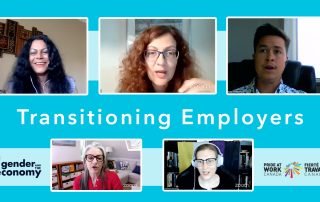
    In celebration of the release of Transitioning Employers: A survey of policies and practices for trans inclusive workplaces (click here to download report and infographics) the Institute for Gender and the Economy and Pride at Work Canada co-hosted a livestream panel discussion. The event was introduced by Sarah Kaplan (she/her), Distinguished Professor and Director, Institute for Gender and the Economy, Rotman School of Management, University of Toronto, moderated by Jade Pichette (they/them), Manager of Programs, Pride at Work Canada, and featured a panel of community and corporate partners including: Laleh Moshiri (she/her), National Director of Diversity and Inclusion, Borden Ladner Gervais LLP, Yasmeen Persad (she/her), Education and Training-Facilitator, The 519, and Kai Scott (he/him), President, TransFocus Consulting.

    Key themes included the significance of being a proactive employer and using inclusion to drive diversity, leveraging gender diversity to spur innovative business practices for trans inclusion, and the intersectional identities that shape experiences for trans people.

    “Trans people are not just trans people. We have so many multi-layered identities and all these different aspects…You might be addressing the trans issues, but you need to look at people from an intersectional lens.”

    – Yasmeen Persad

    In addition to the Transitioning Employers report, the 519’s “Creating Authentic Spaces” toolkit was recommended as a great resource for approaching or reworking inclusion policies.

    IN THE FOLLOWING VIDEOS, PANELISTS DISCUSS HOW EMPLOYERS CAN BETTER ADDRESS TRANS INCLUSION POLICIES:

    [/fusion_text][fusion_text columns=”” column_min_width=”” column_spacing=”” rule_style=”default” rule_size=”” rule_color=”” hide_on_mobile=”small-visibility,medium-visibility,large-visibility” class=”” id=”” animation_type=”” animation_direction=”left” animation_speed=”0.3″ animation_offset=””]

    DOWNLOAD THE “TRANSITIONING EMPLOYERS: A SURVEY OF POLICIES AND PRACTICES FOR TRANS INCLUSIVE WORKPLACE” REPORT AND INFOGRAPHICS  HERE

    [/fusion_text][fusion_separator style_type=”none” hide_on_mobile=”small-visibility,medium-visibility,large-visibility” class=”” id=”” sep_color=”” top_margin=”20″ bottom_margin=”20″ border_size=”” icon=”” icon_circle=”” icon_circle_color=”” width=”” alignment=”center” /][fusion_button link=”https://www.gendereconomy.org/events/” text_transform=”” title=”” target=”_blank” link_attributes=”” alignment=”” modal=”” hide_on_mobile=”small-visibility,medium-visibility,large-visibility” class=”” id=”” color=”custom” button_gradient_top_color=”#62bd19″ button_gradient_bottom_color=”#62bd19″ button_gradient_top_color_hover=”#00c2e2″ button_gradient_bottom_color_hover=”#00c2e2″ accent_color=”” accent_hover_color=”” type=”” bevel_color=”” size=”” stretch=”yes” icon=”” icon_position=”left” icon_divider=”no” animation_type=”” animation_direction=”left” animation_speed=”0.3″ animation_offset=””]See more events[/fusion_button][/fusion_builder_column][/fusion_builder_row][/fusion_builder_container]

  • Working beyond the gender binary

    Working beyond the gender binary

    [fusion_builder_container admin_label=”” hundred_percent=”no” equal_height_columns=”no” menu_anchor=”” hide_on_mobile=”small-visibility,medium-visibility,large-visibility” class=”” id=”” background_color=”” background_image=”” background_position=”center center” background_repeat=”no-repeat” fade=”no” background_parallax=”none” enable_mobile=”no” parallax_speed=”0.3″ video_mp4=”” video_webm=”” video_ogv=”” video_url=”” video_aspect_ratio=”16:9″ video_loop=”yes” video_mute=”yes” video_preview_image=”” border_color=”” border_style=”solid” margin_top=”20″ margin_bottom=”” padding_top=”” padding_right=”” padding_bottom=”” padding_left=”” type=”legacy”][fusion_builder_row][fusion_builder_column type=”3_4″ layout=”3_4″ spacing=”” center_content=”no” hover_type=”none” link=”” min_height=”” hide_on_mobile=”small-visibility,medium-visibility,large-visibility” class=”” id=”” background_color=”” background_image=”” background_position=”left top” background_repeat=”no-repeat” border_color=”” border_style=”solid” border_position=”all” padding_top=”” padding_right=”” padding_bottom=”” padding_left=”” margin_top=”” margin_bottom=”” animation_type=”” animation_direction=”left” animation_speed=”0.3″ animation_offset=”” last=”false” border_sizes_top=”0″ border_sizes_bottom=”0″ border_sizes_left=”0″ border_sizes_right=”0″ first=”true” spacing_right=””][fusion_text columns=”” column_min_width=”” column_spacing=”” rule_style=”default” rule_size=”” rule_color=”” hide_on_mobile=”small-visibility,medium-visibility,large-visibility” class=”” id=”” animation_type=”” animation_direction=”left” animation_speed=”0.3″ animation_offset=””]

    Overview

    Remedying workplace gender inequality continues to be a pressing issue for organizations. Companies are taking bold actions to address gendered gaps in wages and workplace promotions like boardroom gender quotas and targeted recruiting. However, current efforts focus almost exclusively on the challenges cisgender (meaning, individuals who identify with the biological sex assigned at birth) women face. This research brief provides an overview of the academic research on the economic and workplaces experiences of trans and nonbinary people, identifying the gaps and topics where more research is needed.

    Current gender equality efforts often neglect the experiences of the estimated 1.5 million adults in the United States and Canada who identify as transgender.

    This matters because it means that an estimated 1.5 million adults in the United States and Canada who identify as trans (meaning, individuals who may not exclusively identify with the biological sex assigned at birth) are neglected.[1] This neglect impacts the effectiveness of everything from data on the gender pay gap to employment equity initiatives. Research continues to show that trans and nonbinary (meaning, individuals who do not identify exclusively as either a man or woman) people face structural barriers, biases, and discrimination at work because of their gender identity and expression, barriers that are more extreme for racialized and gender non-conforming individuals.[2] Nonetheless, the majority of research on gender inequality at work continues examine inequalities between cisgender men and women.

    Demographics are changing, and so are societal views about gender.

    Researchers estimate as many as 12 percent of millennials, who now comprise more than 35 percent of the United States workforce, identify as trans or nonbinary, more than double those from Generation X.[3] A 2019 Pew Research study found those between the ages of 13 and 21 to be more familiar and accepting of gender diversity. They found 35 percent of those surveyed between 13 and 21 knew someone who used gender-neutral pronouns, and 59 percent believed forms and documents should provide gender options beyond “male” and “female.”[4] Organizations should begin thinking beyond the binary not only to support their current employees but also to prepare for the future.

    What the research tells us about trans and nonbinary workers

    Trans and nonbinary people continue to face overt and subtle discrimination at work.

    From over a decade’s worth of qualitative and survey data on the economic experiences of trans and nonbinary people in the United States and Canada, we know that trans and nonbinary people face social barriers and discrimination while seeking to obtain and sustain employment, issues that are compounded for racialized and Indigenous trans people.[5] These include:

    • Overt discrimination and harassment: Overtly discriminatory practice include employers refusing to use the employees’ preferred pronouns and names in the workplace and on formal documents like job reviews, and government-driven policies such as placing restrictions or limitations on transgender people from changing government-issued IDs.[6]
    • Subtle microaggressions: There are also subtle forms of discrimination that trans people face at work called microaggressions. Microaggressions are statements or behaviours that are not intentionally discriminatory but inflict harm by reflecting power imbalances and stereotypes of marginalized groups.[7] This can include the use of transphobic language, like intentionally calling transgender people by their incorrect gender pronoun, or denying the reality of transphobia, like telling a transgender woman who says she’s experienced discrimination that she is being too sensitive.[8]

    Both overt and subtle discrimination undermines well-being and promotes hypervigilance, negatively impacting workplace outcomes.[9]

    Transgender discrimination threatens employment stability, and begins as early as childhood.

    Structural barriers threaten employment stability for trans and nonbinary workers, including inadequate access to trans-affirming healthcare, housing and services discrimination, bullying and isolation, and lack of social support from family due to identity stigma.[10]

    An Ontario-wide survey from 2010 found discrimination to have had systemic impacts on the employment outcomes of trans people:

    • Fifty percent of trans people earn $15,000 or less per year, even though 71 percent have some form of post-secondary education.[11]
    • The unemployment rate for transgender and gender nonconforming respondents in Ontario has been estimated to be 20 percent, more than double the provincial average.[12]

    More recent data from the U.S. Transgender Discrimination Survey reports:

    • Trans people were four times more likely to have a household income of less than $10,000 per year compared the national average in the U.S.[13]
    • Data from this survey found that racialized transgender women, who contend with intersecting marginalizations, including transmisogyny and racism, are subjected to even higher levels of discrimination and violence at work.[14]

    Structural barriers threaten employment stability for trans and nonbinary workers, including inadequate access to trans-affirming healthcare, housing and services discrimination, bullying and isolation, and lack of social support from family due to identity stigma.

    Transphobia also presents considerable barriers to employment even for those who are not initially economically marginalized, especially for trans women. A 2011 national survey found that 90 percent of trans people surveyed reported experiencing employment discrimination, including being fired, denied a promotion or being harassed.[15] However, this does not include trans people who face discrimination while seeking employment. Discriminatory hiring for transgender people has been commonly reported. The first government-run audit study examining the role of gender identity from applicants in the United States found trans people to be significantly less likely than cisgender people to receive a positive response about a job application across job sectors.[16]

    Family conflict has meant that transgender youth disproportionately make up the homeless population in North America.[17] Estimates suggest that LGBTQ youth make up as much as 40% of the homeless population, whereas approximately five to ten percent of youth identify as LGBTQ.[18] These obstacles are the result of historical inequalities due to discrimination including stigma and negative stereotypes about what it means to be a man or a woman.[19] Transgender and nonbinary individuals who experience identity misclassification can have negative psychological impacts, including feeling stigmatized, having a reduced sense of worth, and anxiety and depression.[20]

    Not all transgender people experience the same kinds of discrimination.

    Though it is important to be aware of the discrimination that trans people face as a community. It is also essential to understand that not all trans and nonbinary people face the same kinds of challenges: research demonstrates that trans women of colour have worse employment outcomes than trans men and nonbinary trans individuals; however, black nonbinary individuals have the worst employment outcomes overall.[21] Population-wide data has shown that individuals who are economically marginalized and gender nonconforming have a higher odds of reporting worse health outcomes than transgender and cisgender men and women.[22]

    Empirical data from a 2019 study in the United States demonstrated that organizational context as well as social and economic location impacts employment outcomes. Across more than 300,000 workers in 28 federal agencies in the United States, LGBT women and people of colour reported more negative experiences, including workplace fairness, employee treatment, and job satisfaction, than cisgender men and white LGBT workers.[23]

    Gender diverse data gaps remain

    Due to historical discrimination, transgender people are not represented in national data and are elsewhere insufficiently represented in data collection.[24] This leaves gaps in the data on the population estimates of trans people, a knowledge gap which subsequently impacts the effectiveness of everything from the gender pay gap to employment equity initiatives. More robust data on trans and nonbinary people is important to make visible an often overlooked community and necessary in order to better inform policy.[25]

    Gender diverse data gaps impact the effectiveness of everything from the gender pay gap to employment equity initiatives. These gaps include:

    Population data: In Canada, for example, pay equity data is calculated from census data based only on biological sex. Current employment equity strategies for the City of Toronto, for example, rely upon census data to evaluate workforce percentage representation against Toronto population estimates. Though trans people are identified as an equity-seeking group, they are bundled into the larger Lesbian, Gay, Bisexual, Trans, Queer, Two-Spirit (LGBTQ2S) communities, who due to discrimination, have been historically excluded from the census. Data from the 2018 City of Toronto public services survey show a 4 percent workforce representation for LGBTQ2S communities; however, since there is no official LGBTQ2 population estimate, and no disaggregation of trans and nonbinary specific data, employment equity for trans people cannot be adequately evaluated.[26]

    Preliminary research from population surveys with gender measures that include options beyond male and female have identified patterns of inequality align with gender identity more than biological sex.[27]

    Subpopulation data: Though surveys are beginning to capture data on trans people, nonbinary individuals are more often excluded from data collection. Due to decades of research and activism, we know more about the workplace experiences of binary transgender people than nonbinary workers. Epidemiological data shows that only a small minority of trans people in Canada reported a “linear transition” from one binary gender to another.[28] Moreover many gender nonconforming and nonbinary individuals do not “transition” from one binary gender to another with medical assistance.[29]

    Since 2014 the U.S. based Behavioral Risk Factors Surveillance System survey (BRFSS) has enabled participants to identify as either transgender man or woman, gender-nonconforming, or a cisgender man or woman.[30] A 2019 study using data from the BRFSS found gender nonconforming respondents to be twice as likely as cisgender men to self-report poor health after controlling for socioeconomic factors.[31]

    Due to historical discrimination, transgender people are not represented in national data and are elsewhere insufficiently represented in data collection. More robust data on trans and nonbinary people is important to make visible an often overlooked community and to better inform policy.

    Longitudinal data: Studies of the outcomes of trans people at work require data collection across periods of time. However, research studying the outcomes of trans people has been limited due to historical stigma. Most studies examine trans people either during or right after their transitions. However, there is little data about the long-term outcomes of trans people. There is potential for recent large-scale transgender health cohort studies, like the largest transgender study being conducted European Network for the Investigation of Gender Incongruence, which follows 2,600 participants across four clinics in Europe, to share and collaborate using their longitudinal economic and employment data.[32]

    Measuring gender identity and expression

    Though best practices on sex and gender data collection are evolving, current recommendations for trans-inclusive measurement suggest a multi-dimensional sex/gender measure that includes items asked to the subgroup of those who indicate their gender identity differs from their sex assigned at birth.[33] This is important for organizations as they continue to build data collections practices for demographic data on their employees.

    There is continued debate not only how but also whether or not it would be beneficial to build more inclusive gender identity measures.

    Survey research has show there is widespread interest in including trans people in the US census from trans communities.[34] However, there are challenges to data collection as well, including how to conduct research given the small size of the trans population; and, how to measure trans communities given changing understandings and meanings of gender identity and expression.[35] Much of the research on trans and nonbinary people’s experiences come from qualitative interviews due in part to a commitment to a person’s individual experience of gender.[36]

    Activists and scholars have also articulated how some people are wary of disclosing their trans identities given the histories of violence and discrimination against trans people in government policies and practices.[37] Other researchers caution that there are currently no processes to ensure that more inclusive gender measures and related policies would prevent further discrimination against trans employees.[38] This means it is essential to ensure data privacy protocols are in place and clear reasons for gathering the data, such as employment equity, if a company plans to capture sex and gender data from their employees.[39]

    The gender binary impacts everyone, not just transgender people

    Organizations should think beyond the gender binary not only to support their trans and nonbinary employees but because the gender binary sustains workplace gender discrimination. This impacts cisgender people as well. Gender stereotypes and work structures influence work experiences, practices, and policies.[40] Recent research demonstrates that men face backlash for straying from masculine gender norms—like displaying empathy or expressing sadness.[41] Additionally, meritocracy and biological differences between men and women are two ways that organizations justify gender inequalities in promotion practices. Ironically, trans women report losing high powered work positions once they come out as a woman.[42] While trans men report being more respected once they are seen as men than when they were perceived as women at work.[43]

    Transgender people are encouraged to enforce the gender binary at work.

    A recent study on transgender workplace discrimination at Stanford University observed that transgender people often had to compromise their authenticity at work in order to “fit in” and avoid discrimination or “maintain their authenticity” and face discrimination and often firing.[44] Research has demonstrated that unsupportive or hostile colleagues means that transgender employees are pressured to hide their gender identity at work.[45] A 2019 Human Rights Campaign survey found that nearly two thirds of non-LGBTQ employees found it “unprofessional” to discuss gender identity at work.[46]

    Addressing gender identity and expression discrimination at work

    Many employers have begun to acknowledge transgender workers by adopting antidiscrimination best practices and policies.  According the Human Rights Campaign, nearly 85 percent of Fortune 500 companies have policies against gender identity discrimination, up from 3 percent in 2002.[47] Additionally, 62 percent of Fortune 500 companies offer transgender-inclusive benefits, up from 0 percent in 2002. In the United States, there are currently no federal protections prohibiting employment discrimination based upon gender identity and gender expression.[48] In 2017, the Canadian Human Rights Act was amended to include workplace protection against discrimination based upon gender identity and expression. Despite protections research suggests a gap exists between the adoption of antidiscrimination policies, often adopted through processes of diffusion to avoid litigation and maintain a positive public image, and the prevention of discrimination against transgender workers.[49] More research is necessary to understand the best mechanisms to better support trans and nonbinary workers.

    Though there is much that we do not know, research suggests that following tools and practices are a good place to begin:

    • Strengthen gender identity and expression protections and prevention measures within organizations if they do not already exist.
    • Do a “gender audit” of your policies and practices to identify when and how you invoke gender.[50] Ensure you are not unintentionally “gender policing” in policies like dress codes.[51]
    • Assume that there are trans and nonbinary people in your organization even when they are not visible.
    • Understand that the employment barriers that transgender people face are distributed unequally.
    • Partner with trans people and community organizations to challenge stereotypes, provide training, and build trans employment pipelines and practices.
    • Hire openly transgender and nonbinary people even if they force you to challenge your own gender biases. Foster a work environment where people can be authentic. This benefits everyone, not just transgender people.

    This research overview was prepared by Bretton Fosbrook under the supervision of Professor Sarah Kaplan.

    References

    [1] Scheim, A. I., & Bauer, G. R. (2015). Sex and gender diversity among transgender persons in Ontario, Canada: results from a respondent-driven sampling survey. The Journal of Sex Research52(1), 1-14.; Flores, A.R., Herman, J. L., Gates, G. J., & Brown, T. N. (2016). “How many adults identify as transgender in the United States?” The Williams Institute.

    [2] Badgett, M. V., Lau, H., Sears, B., & Ho, D. (2007). Bias in the workplace: Consistent evidence of sexual orientation and gender identity discrimination; Dietert, M., & Dentice, D. (2009). Gender identity issues and workplace discrimination: The transgender experience. Journal of Workplace Rights14(1).; Connell, C. (2010). Doing, undoing, or redoing gender? Learning from the workplace experiences of transpeople. Gender & Society24(1), 31-55.

    [3] Fry, R. (April 11, 2018) “Millennials are the largest generation in the U.S. labor force,” Pew Research Center, https://www.pewresearch.org/fact-tank/2018/04/11/millennials-largest-generation-us-labor-force/ Retrieved 18 July 2019; GLAAD. (2017). “Accelerating Acceptance: A Harris Poll survey of Americans’ acceptance of LGBTQ people,” https://www.glaad.org/files/aa/2017_GLAAD_Accelerating_Acceptance.pdf. Retrieved 18 July 2019.

    [4] Parker, K., Graf, N., & Igielnik, R. (2019). Generation Z Looks a Lot Like Millennials on Key Social and Political Issues. Pew Research Center’s Social & Demographic Trends Project.

    [5] Kuper, L. E., Nussbaum, R., & Mustanski, B. (2012). Exploring the diversity of gender and sexual orientation identities in an online sample of transgender individuals. Journal of sex research49(2-3), 244-254.; Badgett, M. V., Lau, H., Sears, B., & Ho, D. (2007). Bias in the workplace: Consistent evidence of sexual orientation and gender identity discrimination; Bauer, G. R., Hammond, R., Travers, R., Kaay, M., Hohenadel, K. M., & Boyce, M. (2009). “I don’t think this is theoretical; this is our lives”: how erasure impacts health care for transgender people. Journal of the Association of Nurses in AIDS Care20(5), 348-361.; Connell, C. (2010). Doing, undoing, or redoing gender? Learning from the workplace experiences of transpeople. Gender & Society24(1), 31-55.

    [6] Bender-Baird, K., 2011. Transgender employment experiences: Gendered perceptions and the law. SUNY Press.

    [7] Sue, D.W. ed., 2010. Microaggressions and marginality: Manifestation, dynamics, and impact. John Wiley & Sons.

    [8] Nadal, K.L., Whitman, C.N., Davis, L.S., Erazo, T. and Davidoff, K.C., 2016. Microaggressions toward lesbian, gay, bisexual, transgender, queer, and genderqueer people: A review of the literature. The Journal of Sex Research53(4-5), pp.488-508.

    [9] Thoroughgood, C. N., Katina B. Sawyer, and Jennica R. Webster. “What lies beneath: how paranoid cognition explains the relations between transgender employees’ perceptions of discrimination at work and their job attitudes and wellbeing.” Journal of Vocational Behavior 103 (2017): 99-112.

    [10] Grant, J.M., Mottet, L., Tanis, J.E., Harrison, J., Herman, J. and Keisling, M., 2011. Injustice at every turn: A report of the National Transgender Discrimination Survey. National Center for Transgender Equality.

    [11] Bauer, G., Nussbaum, N., Travers, R., Munro, L., Pyne, J., Redman, N., Scanlon, K. and Travers, R., 2011. We’ve got work to do: workplace discrimination and employment challenges for trans people in Ontario. Trans PULSE e-Bulletin, 2(1), pp.1-3.

    [12] Bauer, G., Nussbaum, N., Travers, R., Munro, L., Pyne, J., Redman, N., Scanlon, K. and Travers, R., 2011. We’ve got work to do: workplace discrimination and employment challenges for trans people in Ontario. Trans PULSE e-Bulletin, 2(1), pp.1-3.

    [13] James, S.E., Herman, J.L., Rankin, S., Keisling, M., Mottet, L. and Anafi, M.A., 2016. The report of the 2015 US transgender survey. Washington, DC: National Center for Transgender Equality.

    [14] James, S.E., Herman, J.L., Rankin, S., Keisling, M., Mottet, L. and Anafi, M.A., 2016. The report of the 2015 US transgender survey. Washington, DC: National Center for Transgender Equality.

    [15] Grant, J.M., Mottet, L., Tanis, J.E., Harrison, J., Herman, J. and Keisling, M., 2011. Injustice at every turn: A report of the National Transgender Discrimination Survey. National Center for Transgender Equality.

    [16] Rainey, T., Imse, E., & Pomerantz, A. (2015). Qualified and transgender: A report on results of resume testing for employment discrimination based on gender identity. Washington, DC: Office of Human Resources. ohr. dc. gov/sites/default/files/dc/sites /ohr/publication/attachments /Qualifiedan dTransgender_FullReport_1. pdf.

    [17] Public Health Agency of Canada. (2006). Street youth in Canada: Findings from the enhanced surveillance of Canadian street youth, 1999-2003. Ottawa: Government of Canada.

    [18] Abramovich, A. “No safe place to go-LGBTQ youth homelessness in Canada: Reviewing the literature.” Canadian Journal of Family and Youth/Le Journal Canadien de Famille et de la Jeunesse 4, no. 1 (2012): 29-51.

    [19] Westbrook, L. and Schilt, K., 2014. Doing gender, determining gender: Transgender people, gender panics, and the maintenance of the sex/gender/sexuality system. Gender & Society28(1), pp.32-57.

    [20] McLemore, Kevin A. “Experiences with misgendering: Identity misclassification of transgender spectrum individuals.” Self and Identity 14, no. 1 (2015): 51-74.

    [21] Davidson, S., 2016. Gender inequality: Nonbinary transgender people in the workplace. Cogent Social Sciences2(1), p.1236511.

    [22] Lagos, D. (2018). Looking at population health beyond “male” and “female”: implications of transgender identity and gender nonconformity for population health. Demography55(6), 2097-2117.

    [23] Cech, E. A. and Rothwell, W. R. (2019). LGBT Workplace Inequality in the Federal Workforce: Intersectional Processes, Organizational Contexts, and Turnover Considerations. ILR Review, 0019793919843508.

    [24] Greytak, E.A., Gill, A.M., Conron, K.J. and Herman, J.L., 2014. Best Practices for Asking Questions to Identify Transgender and Other Gender Minority Respondents on Population-Based Surveys.

    [25] Brown, T. N. T., Herman, J. L., Park, A. S. (2017). Exploring International Priorities and Best Practices for the Collection of Data about Gender Minorities, Report of Meeting. Los Angeles, CA: The Williams Institute.

    [26] City of Toronto. Report on fostering diversity in the Toronto Public Service. 5 June 2018.

    [27] Lagos, D. (2018). Looking at population health beyond “male” and “female”: implications of transgender identity and gender nonconformity for population health. Demography55(6), 2097-2117.

    [28] Scheim, A.I. and Bauer, G.R., 2015. Sex and gender diversity among transgender persons in Ontario, Canada: results from a respondent-driven sampling survey. The Journal of Sex Research52(1), pp.1-14.

    [29] Matsuno, E. and Budge, S.L., 2017. Non-binary/genderqueer identities: A critical review of the literature. Current Sexual Health Reports9(3), pp.116-120.

    [30] Waite, S., & Denier, N. (2019). A Research note on Canada’s LGBT data landscape: Where we are and what the future holds. Canadian Review of Sociology/Revue canadienne de sociologie56(1), 93-117.

    [31] Lagos, D. (2018). Looking at population health beyond “male” and “female”: implications of transgender identity and gender nonconformity for population health. Demography55(6), 2097-2117

    [32] Reardon, S. (2019). The largest study involving transgender people is providing long-sought insights about their health. Nature 568, 446-449.

    [33] Bauer, G.R., Braimoh, J., Scheim, A.I. and Dharma, C., 2017. Transgender-inclusive measures of sex/gender for population surveys: Mixed-methods evaluation and recommendations. PloS one12(5), p.e0178043.

    [34] Schilt, K. and Bratter, J., 2015. From multiracial to transgender? Assessing attitudes toward expanding gender options on the US Census. TSQ: Transgender Studies Quarterly2(1), pp.77-100.

    [35] Waite, S., & Denier, N. (2019). A Research note on Canada’s LGBT data landscape: Where we are and what the future holds. Canadian Review of Sociology/Revue canadienne de sociologie56(1), 93-117.

    [36] Schilt, K., & Lagos, D. (2017). The development of transgender studies in sociology. Annual Review of Sociology43, 425-443.

    [37] Spade, D., 2015. Normal life: Administrative violence, critical trans politics, and the limits of law. Duke University Press.

    [38] Munsch, C.L. and Elizabeth Hirsh, C., 2010. Gender variance in the Fortune 500: The inclusion of gender identity and expression in nondiscrimination corporate policy. In Gender and Sexuality in the Workplace (pp. 151-177). Emerald Group Publishing Limited.

    [39] Davis, H.F., 2018. Beyond trans: Does gender matter? NYU Press.

    [40] Padavic, I. and Reskin, B.F., 2002. Women and men at work. Pine Forge Press.

    [41] Mayer, D.M. 2018. How men get penalized for straying from masculine norms. Harvard Business Review. 8 October.

    [42] Griggs, C., 1998. S/he: Changing sex and changing clothes. Berg Publishers.

    [43] Schilt, K., 2010. Just one of the guys?: Transgender men and the persistence of gender inequality. University of Chicago Press.

    [44] Fogarty, A, and L. Zheng. 2018. Gender Ambiguity in the Workplace: Transgender and Gender-diverse Discrimination. ABC-CLIO.

    [45] Brewster, M. E., Velez, B. L., Mennicke, A., & Tebbe, E. (2014). Voices from beyond: A thematic content analysis of transgender employees’ workplace experiences. Psychology of sexual orientation and gender diversity1(2), 159.

    [46] Fidas, D. and L. Cooper, A. (2019) Workplace Divided: Understanding the Climate for LGBTQ Workers Nationwide. (Human Rights Campaign).

    [47] Human Rights Commission (2019) “Corporate Equality Index 2019.” https://assets2.hrc.org/files/assets/resources/CEI-2019-FullReport.pdf?_ga=2.65847022.1178254233.1564417991-505415734.1555082187. Retrieved 21 July 2019.

    [48] United States Equal Employment Opportunity Commission, “What You Should Know About EEOC and the Enforcement Protections for LGBT Workers.”

    [49] Weiss, J. T. 2004. The cutting edge of employment diversity: Transgender human resources policies in U.S. employers (Doctoral dissertation). Boston, MA: Northeastern University.

    [50] Fogg Davis, H. (2018) https://heathfoggdavis.com/building-gender-inclusive-organizations-the-workbook/

    [51] Barry, B. (2017). What happens when men don’t conform to masculine clothing norms at work? Harvard Business Review, 31 August.

    [/fusion_text][fusion_separator style_type=”none” hide_on_mobile=”small-visibility,medium-visibility,large-visibility” class=”” id=”” sep_color=”” top_margin=”20″ bottom_margin=”20″ border_size=”” icon=”” icon_circle=”” icon_circle_color=”” width=”” alignment=”center” /][fusion_button link=”https://www.gendereconomy.org/category/research-overviews/” text_transform=”” title=”” target=”_blank” link_attributes=”” alignment=”” modal=”” hide_on_mobile=”small-visibility,medium-visibility,large-visibility” class=”” id=”” color=”custom” button_gradient_top_color=”#62bd19″ button_gradient_bottom_color=”#62bd19″ button_gradient_top_color_hover=”#00c2e2″ button_gradient_bottom_color_hover=”#00c2e2″ accent_color=”” accent_hover_color=”” type=”” bevel_color=”” size=”” stretch=”yes” icon=”” icon_position=”left” icon_divider=”no” animation_type=”” animation_direction=”left” animation_speed=”0.3″ animation_offset=””]See more research overviews[/fusion_button][fusion_separator style_type=”none” hide_on_mobile=”small-visibility,medium-visibility,large-visibility” class=”” id=”” sep_color=”” top_margin=”20″ bottom_margin=”20″ border_size=”” icon=”” icon_circle=”” icon_circle_color=”” width=”” alignment=”center” /][fusion_recent_posts layout=”default” picture_size=”fixed” hover_type=”none” columns=”3″ number_posts=”3″ offset=”0″ pull_by=”category” cat_slug=”research-overviews” exclude_cats=”” tag_slug=”” exclude_tags=”” thumbnail=”yes” title=”yes” meta=”no” meta_author=”no” meta_categories=”no” meta_date=”yes” meta_comments=”yes” meta_tags=”no” content_alignment=”” excerpt=”no” excerpt_length=”35″ strip_html=”yes” scrolling=”no” hide_on_mobile=”small-visibility,medium-visibility,large-visibility” class=”” id=”” animation_type=”” animation_direction=”left” animation_speed=”0.3″ animation_offset=”” /][/fusion_builder_column][fusion_builder_column type=”1_4″ layout=”1_4″ spacing=”” center_content=”no” hover_type=”none” link=”” min_height=”” hide_on_mobile=”small-visibility,medium-visibility,large-visibility” class=”” id=”” background_color=”” background_image=”” background_position=”left top” background_repeat=”no-repeat” border_color=”” border_style=”solid” border_position=”all” padding_top=”” padding_right=”” padding_bottom=”” padding_left=”” margin_top=”” margin_bottom=”” animation_type=”” animation_direction=”left” animation_speed=”0.3″ animation_offset=”” last=”true” border_sizes_top=”0″ border_sizes_bottom=”0″ border_sizes_left=”0″ border_sizes_right=”0″ first=”false”][fusion_title hide_on_mobile=”small-visibility,medium-visibility,large-visibility” class=”briefsummary” id=”” content_align=”left” size=”3″ font_size=”” line_height=”” letter_spacing=”” margin_top=”” margin_bottom=”” margin_top_mobile=”” margin_bottom_mobile=”” text_color=”” style_type=”none” sep_color=”” margin_top_small=”” margin_bottom_small=””]

    Research overview prepared by

    Bretton Fosbrook, Postdoctoral Fellow

    Published

    October 2019

    [/fusion_title][fusion_widget_area name=”avada-custom-sidebar-researchbriefsidebar” title_size=”” title_color=”” background_color=”” padding_top=”” padding_right=”” padding_bottom=”” padding_left=”” hide_on_mobile=”small-visibility,medium-visibility,large-visibility” class=”” id=”” /][/fusion_builder_column][/fusion_builder_row][/fusion_builder_container]

  • How gender identity and expression protections support employees

    How gender identity and expression protections support employees

    [fusion_builder_container admin_label=”” hundred_percent=”no” equal_height_columns=”no” menu_anchor=”” hide_on_mobile=”small-visibility,medium-visibility,large-visibility” class=”” id=”” background_color=”” background_image=”” background_position=”center center” background_repeat=”no-repeat” fade=”no” background_parallax=”none” enable_mobile=”no” parallax_speed=”0.3″ video_mp4=”” video_webm=”” video_ogv=”” video_url=”” video_aspect_ratio=”16:9″ video_loop=”yes” video_mute=”yes” video_preview_image=”” border_size=”” border_color=”” border_style=”solid” margin_top=”20″ margin_bottom=”” padding_top=”” padding_right=”” padding_bottom=”” padding_left=””][fusion_builder_row][fusion_builder_column type=”3_4″ layout=”3_4″ spacing=”” center_content=”no” hover_type=”none” link=”” min_height=”” hide_on_mobile=”small-visibility,medium-visibility,large-visibility” class=”” id=”” background_color=”” background_image=”” background_position=”left top” background_repeat=”no-repeat” border_size=”0″ border_color=”” border_style=”solid” border_position=”all” padding_top=”” padding_right=”” padding_bottom=”” padding_left=”” margin_top=”” margin_bottom=”” animation_type=”” animation_direction=”left” animation_speed=”0.3″ animation_offset=”” last=”no”][fusion_text columns=”” column_min_width=”” column_spacing=”” rule_style=”default” rule_size=”” rule_color=”” hide_on_mobile=”small-visibility,medium-visibility,large-visibility” class=”” id=””]

    Executive summary

    The concepts of gender identity – a person’s individual experience of gender – and gender expression – a person’s public presentation of gender – can be used as frameworks to think about how people come to work with diverse experiences and needs. Despite anti-discrimination laws that prohibit discrimination on the basis of gender identity and gender expression, transgender and gender nonconforming people face disproportionately high barriers at work simply because of their gender. At the same time, workplaces are increasingly interested in gender-inclusive practices in their organizations. Unfortunately, most employers still struggle with what anti-discrimination protections on the basis of gender identity and gender expression mean for their organizations. Existing research on diversity and inclusion has demonstrated that antidiscrimination laws alone do not lead to greater inclusion. Nevertheless, organizations need knowledge of the legal obligations to not discriminate against and to accommodate employees who are transgender or gender non-conforming. This research brief summarizes: how workplace gender identity and expression protections can be tools to support transgender and gender-nonconforming people in the workplace; the benefits and challenges of using these protections to support transgender inclusion efforts; and the tools needed to move towards greater workplace inclusion of transgender and gender nonconforming people.

    Read and/or download the full policy brief.

    [/fusion_text][fusion_separator style_type=”none” hide_on_mobile=”small-visibility,medium-visibility,large-visibility” class=”” id=”” sep_color=”” top_margin=”20″ bottom_margin=”20″ border_size=”” icon=”” icon_circle=”” icon_circle_color=”” width=”” alignment=”center” /][fusion_button link=”https://www.gendereconomy.org/category/policy-briefs/” text_transform=”” title=”” target=”_blank” link_attributes=”” alignment=”” modal=”” hide_on_mobile=”small-visibility,medium-visibility,large-visibility” class=”” id=”” color=”custom” button_gradient_top_color=”#62bd19″ button_gradient_bottom_color=”#62bd19″ button_gradient_top_color_hover=”#00c2e2″ button_gradient_bottom_color_hover=”#00c2e2″ accent_color=”” accent_hover_color=”” type=”” bevel_color=”” border_width=”” size=”” stretch=”yes” icon=”” icon_position=”left” icon_divider=”no” animation_type=”” animation_direction=”left” animation_speed=”0.3″ animation_offset=”” border_radius=””]See more policy briefs[/fusion_button][fusion_separator style_type=”none” hide_on_mobile=”small-visibility,medium-visibility,large-visibility” class=”” id=”” sep_color=”” top_margin=”20″ bottom_margin=”20″ border_size=”” icon=”” icon_circle=”” icon_circle_color=”” width=”” alignment=”center” /][fusion_recent_posts layout=”default” picture_size=”fixed” hover_type=”none” columns=”3″ number_posts=”3″ offset=”0″ pull_by=”category” cat_slug=”policy-briefs” exclude_cats=”” tag_slug=”” exclude_tags=”” thumbnail=”yes” title=”yes” meta=”no” meta_author=”no” meta_categories=”no” meta_date=”yes” meta_comments=”yes” meta_tags=”no” content_alignment=”” excerpt=”no” excerpt_length=”35″ strip_html=”yes” scrolling=”no” hide_on_mobile=”small-visibility,medium-visibility,large-visibility” class=”” id=”” animation_type=”” animation_direction=”left” animation_speed=”0.3″ animation_offset=”” /][/fusion_builder_column][fusion_builder_column type=”1_4″ layout=”1_4″ spacing=”” center_content=”no” hover_type=”none” link=”” min_height=”” hide_on_mobile=”small-visibility,medium-visibility,large-visibility” class=”” id=”” background_color=”” background_image=”” background_position=”left top” background_repeat=”no-repeat” border_size=”0″ border_color=”” border_style=”solid” border_position=”all” padding_top=”” padding_right=”” padding_bottom=”” padding_left=”” margin_top=”” margin_bottom=”” animation_type=”” animation_direction=”left” animation_speed=”0.3″ animation_offset=”” last=”no”][fusion_title hide_on_mobile=”small-visibility,medium-visibility,large-visibility” class=”briefsummary” id=”” content_align=”left” size=”3″ font_size=”” line_height=”” letter_spacing=”” margin_top=”” margin_bottom=”” margin_top_mobile=”” margin_bottom_mobile=”” text_color=”” style_type=”none” sep_color=””]

    Authors

    Elliot Fonarev

    Published

    September 2019

    [/fusion_title][fusion_widget_area name=”avada-custom-sidebar-researchbriefsidebar” title_size=”” title_color=”” background_color=”” padding_top=”” padding_right=”” padding_bottom=”” padding_left=”” hide_on_mobile=”small-visibility,medium-visibility,large-visibility” class=”” id=”” /][/fusion_builder_column][/fusion_builder_row][/fusion_builder_container]

  • The work of trans inclusion: A case study of Amazon’s Trans-Affirmative Action  Program

    The work of trans inclusion: A case study of Amazon’s Trans-Affirmative Action Program

    [fusion_builder_container hundred_percent=”no” equal_height_columns=”no” menu_anchor=”” hide_on_mobile=”small-visibility,medium-visibility,large-visibility” class=”” id=”” background_color=”” background_image=”” background_position=”center center” background_repeat=”no-repeat” fade=”no” background_parallax=”none” parallax_speed=”0.3″ video_mp4=”” video_webm=”” video_ogv=”” video_url=”” video_aspect_ratio=”16:9″ video_loop=”yes” video_mute=”yes” overlay_color=”” video_preview_image=”” border_color=”” border_style=”solid” padding_top=”” padding_bottom=”” padding_left=”” padding_right=”” type=”legacy”][fusion_builder_row][fusion_builder_column type=”1_1″ layout=”1_1″ background_position=”left top” background_color=”” border_color=”” border_style=”solid” border_position=”all” spacing=”yes” background_image=”” background_repeat=”no-repeat” padding_top=”” padding_right=”” padding_bottom=”” padding_left=”” margin_top=”0px” margin_bottom=”0px” class=”” id=”” animation_type=”” animation_speed=”0.3″ animation_direction=”left” hide_on_mobile=”small-visibility,medium-visibility,large-visibility” center_content=”no” last=”true” min_height=”” hover_type=”none” link=”” border_sizes_top=”” border_sizes_bottom=”” border_sizes_left=”” border_sizes_right=”” first=”true”][fusion_text columns=”” column_min_width=”” column_spacing=”” rule_style=”default” rule_size=”” rule_color=”” hue=”” saturation=”” lightness=”” alpha=”” content_alignment_medium=”” content_alignment_small=”” content_alignment=”” hide_on_mobile=”small-visibility,medium-visibility,large-visibility” sticky_display=”normal,sticky” class=”” id=”” margin_top=”” margin_right=”” margin_bottom=”” margin_left=”” fusion_font_family_text_font=”” fusion_font_variant_text_font=”” font_size=”” line_height=”” letter_spacing=”” text_transform=”none” text_color=”” animation_type=”” animation_direction=”left” animation_speed=”0.3″ animation_offset=””]

    Overview

    This case was prepared by Bretton Fosbrook (Postdoctoral Fellow, Institute for Gender and the Economy) and Sarah Kaplan (Professor of Strategic Management and Director, Institute for Gender and the Economy).

    This case study examines Amazon Studios’ Trans-Affirmative Action Program utilized on the set of the television series Transparent. The Trans-Affirmative Action Program aimed to hire, train, and support trans people at every level of the production—from producers and actors to writers and directors—showing the systemwide effort that must be undertaken to make workplace inclusion effective.

    This case would be useful for those interested in or teaching courses in:
    • Diversity and inclusion
    • Transgender inclusion
    • Human resources
    • Media industry
    • Organizational change

    Introduction

    Responding to a rising tide of visibility and acceptance of trans and gender nonconforming people, organizations have begun to acknowledge the discrimination trans people face at work. The 2015 U.S. Transgender Survey found the unemployment rate for transgender people to be three times higher than the general workforce in the United States, and four times higher for transgender people of color. For employed transgender people surveyed, researchers found more than three-quarters experienced workplace discrimination, everything from verbal harassment to sexual violence. Companies from IBM to Salesforce have been quick to respond to the calls for greater transgender inclusion by promoting their workplace inclusion practices, including non-discrimination policies, transition guidelines, washroom policies, and trans-inclusive medical benefits coverage.

    While these efforts are a good way to begin improving the working conditions for trans and gender nonconforming employees already within an organization, there are many obstacles that continue to prevent transgender people from entering organizations. These obstacles are the result of historical inequalities due to discrimination including stigma and negative stereotypes about how ‘men’ and ‘women’ ought to look.

    The acclaimed Amazon Studios television series Transparent is one workplace that has attempted to overcome the obstacles faced by transgender people that prevent them from being hired and thriving at work. As a model for transgender workplace inclusion, Transparent’s Trans-Affirmative Action Program differentiated itself by making significant efforts to address the structural barriers and discrimination trans and gender nonconforming people face while seeking to obtain and sustain safe and respectful employment.

    Trans inclusion: Amazon’s Trans-Affirmative Action Program

    View and download the full case study

    [/fusion_text][/fusion_builder_column][/fusion_builder_row][/fusion_builder_container]

  • Lee Airton on “Gender: Your Guide”

    Lee Airton on “Gender: Your Guide”

    [fusion_builder_container hundred_percent=”no” equal_height_columns=”no” menu_anchor=”” hide_on_mobile=”small-visibility,medium-visibility,large-visibility” class=”” id=”” background_color=”” background_image=”” background_position=”center center” background_repeat=”no-repeat” fade=”no” background_parallax=”none” parallax_speed=”0.3″ video_mp4=”” video_webm=”” video_ogv=”” video_url=”” video_aspect_ratio=”16:9″ video_loop=”yes” video_mute=”yes” overlay_color=”” video_preview_image=”” border_color=”” border_style=”solid” padding_top=”” padding_bottom=”” padding_left=”” padding_right=”” type=”legacy”][fusion_builder_row][fusion_builder_column type=”1_1″ layout=”1_1″ background_position=”left top” background_color=”” border_color=”” border_style=”solid” border_position=”all” spacing=”yes” background_image=”” background_repeat=”no-repeat” padding_top=”” padding_right=”” padding_bottom=”” padding_left=”” margin_top=”0px” margin_bottom=”0px” class=”” id=”” animation_type=”” animation_speed=”0.3″ animation_direction=”left” hide_on_mobile=”small-visibility,medium-visibility,large-visibility” center_content=”no” last=”true” min_height=”” hover_type=”none” link=”” border_sizes_top=”” border_sizes_bottom=”” border_sizes_left=”” border_sizes_right=”” first=”true”][fusion_text columns=”” column_min_width=”” column_spacing=”” rule_style=”” rule_size=”” rule_color=”” hue=”” saturation=”” lightness=”” alpha=”” content_alignment_medium=”” content_alignment_small=”” content_alignment=”” hide_on_mobile=”small-visibility,medium-visibility,large-visibility” sticky_display=”normal,sticky” class=”” id=”” margin_top=”” margin_right=”” margin_bottom=”” margin_left=”” fusion_font_family_text_font=”” fusion_font_variant_text_font=”” font_size=”” line_height=”” letter_spacing=”” text_transform=”” text_color=”” animation_type=”” animation_direction=”left” animation_color=”” animation_speed=”0.3″ animation_delay=”0″ animation_offset=”” logics=””]“This book is very much a manual on how to stop being a part of the ‘gender police,’” began Lee Airton, assistant professor at Queens University, at our recent event co-hosted by The Letters commemorating the International Day of Pink.

    Airton’s book, Gender: Your Guide–A Gender-Friendly Primer on What to Know, What to Say, and What to Do in the New Gender Culture, is a manual for those looking to navigate the changing landscape of gender norms and support gender inclusion. Airton hopes that by helping people understand how gender norms impact them—both positively and negatively—they can change their habits through empathy and understanding. In fact, they (Airton uses they/them pronouns) explained, gender is a process of socialization into rigid categories that limit everyone. As they stated, “Nobody is outside of this problem. We all experience it, and we all participate in it.” Furthermore, Airton stresses the importance of recognizing that gender norms are not universal; gender norms vary even on at a local level. They change school-by-school, neighbourhood-by-neighbourhood, and city-by-city. To promote gender inclusion, it is essential that we respect and try to understand the fluidity of gender.

    Nobody is outside of this problem. We all experience it, and we all participate in it.

    [fusion_gallery layout=”” picture_size=”” columns=”2″ column_spacing=”” gallery_masonry_grid_ratio=”” gallery_masonry_width_double=”” hover_type=”” lightbox=”none” lightbox_content=”none” bordersize=”” bordercolor=”” border_radius=”” hide_on_mobile=”small-visibility,medium-visibility,large-visibility” class=”” id=””][fusion_gallery_image image=”https://www.gendereconomy.org/wp-content/uploads/2019/04/LeeAirton_Crowd2-1200×675.jpg” image_id=”5589|1200″ link=”” linktarget=”_self” /][fusion_gallery_image image=”https://www.gendereconomy.org/wp-content/uploads/2019/04/LeeAirton_Crowd3-1200×675.jpg” image_id=”5591|1200″ link=”” linktarget=”_self” /][fusion_gallery_image image=”https://www.gendereconomy.org/wp-content/uploads/2019/04/AudienceMember-1200×675.jpg” image_id=”5598|1200″ link=”” linktarget=”_self” /][fusion_gallery_image image=”https://www.gendereconomy.org/wp-content/uploads/2019/04/TheLetters-1200×674.jpg” image_id=”5599|1200″ link=”” linktarget=”_self” /][/fusion_gallery]

    During the discussion, Airton outlined a few key takeaways:
    Anticipate mistakes

    We all make mistakes on gender pronouns because this requires a significant cognitive shift. However, we have to be willing to make that shift and be open to correction.

    Set an example

    If you’re in a position of power (e.g. a professor or manager), set an example by openly declaring your preferred pronoun, making it OK and safe for others to do the same.

    Be self-aware

    We know more about gender than we think we do. We need to realize how we participate in the process of constructing and maintaining gender norms.

    Airton ended the discussion by reiterating the purpose of their book: “[It’s] all about calling you in to get on board by saying this is happening to everyone. We’re all part of ‘gender.’”

    Watch the video below to learn more about how we all play a part in gender policing, and how we can stop.

    [/fusion_text][fusion_separator style_type=”none” hide_on_mobile=”small-visibility,medium-visibility,large-visibility” class=”” id=”” sep_color=”” top_margin=”20″ bottom_margin=”20″ border_size=”” icon=”” icon_circle=”” icon_circle_color=”” width=”” alignment=”center” /][fusion_button link=”https://www.gendereconomy.org/past-events/” text_transform=”” title=”” target=”_blank” link_attributes=”” alignment=”” modal=”” hide_on_mobile=”small-visibility,medium-visibility,large-visibility” class=”” id=”” color=”custom” button_gradient_top_color=”#62bd19″ button_gradient_bottom_color=”#62bd19″ button_gradient_top_color_hover=”#00c2e2″ button_gradient_bottom_color_hover=”#00c2e2″ accent_color=”” accent_hover_color=”” type=”” bevel_color=”” size=”” stretch=”yes” icon=”” icon_position=”left” icon_divider=”no” animation_type=”” animation_direction=”left” animation_speed=”0.3″ animation_offset=””]See more past events[/fusion_button][fusion_separator style_type=”none” hide_on_mobile=”small-visibility,medium-visibility,large-visibility” class=”” id=”” sep_color=”” top_margin=”20″ bottom_margin=”20″ border_size=”” icon=”” icon_circle=”” icon_circle_color=”” width=”” alignment=”center” /][fusion_title margin_top=”” margin_bottom=”” hide_on_mobile=”medium-visibility,large-visibility” class=”” id=”” size=”5″ content_align=”center” style_type=”default” sep_color=””]

    Or register below for these upcoming events

    [/fusion_title][fusion_recent_posts layout=”default” hover_type=”none” columns=”3″ number_posts=”3″ offset=”0″ pull_by=”category” cat_slug=”events” exclude_cats=”past” tag_slug=”” exclude_tags=”” thumbnail=”yes” title=”yes” meta=”no” meta_author=”no” meta_categories=”no” meta_date=”yes” meta_comments=”yes” meta_tags=”no” content_alignment=”” excerpt=”no” excerpt_length=”35″ strip_html=”yes” scrolling=”no” hide_on_mobile=”medium-visibility,large-visibility” class=”” id=”” animation_type=”” animation_direction=”left” animation_speed=”0.3″ animation_offset=”” /][/fusion_builder_column][/fusion_builder_row][/fusion_builder_container]