Author: Gender and the Economy

  • Double standards in evaluation

    Double standards in evaluation

    [fusion_builder_container admin_label=”” hundred_percent=”no” equal_height_columns=”no” menu_anchor=”” hide_on_mobile=”small-visibility,medium-visibility,large-visibility” class=”” id=”” background_color=”” background_image=”” background_position=”center center” background_repeat=”no-repeat” fade=”no” background_parallax=”none” enable_mobile=”no” parallax_speed=”0.3″ video_mp4=”” video_webm=”” video_ogv=”” video_url=”” video_aspect_ratio=”16:9″ video_loop=”yes” video_mute=”yes” video_preview_image=”” border_size=”” border_color=”” border_style=”solid” margin_top=”20″ margin_bottom=”” padding_top=”” padding_right=”” padding_bottom=”” padding_left=””][fusion_builder_row][fusion_builder_column type=”3_4″ layout=”3_4″ spacing=”” center_content=”no” hover_type=”none” link=”” min_height=”” hide_on_mobile=”small-visibility,medium-visibility,large-visibility” class=”” id=”” background_color=”” background_image=”” background_position=”left top” background_repeat=”no-repeat” border_size=”0″ border_color=”” border_style=”solid” border_position=”all” padding_top=”” padding_right=”” padding_bottom=”” padding_left=”” dimension_margin=”” animation_type=”” animation_direction=”left” animation_speed=”0.3″ animation_offset=”” last=”no”][fusion_text columns=”” column_min_width=”” column_spacing=”” rule_style=”default” rule_size=”” rule_color=”” class=”” id=””]

    Summary

    Are women held to a different standard than men in real-world evaluative situations? While lab-based evidence of double standards in evaluation exists, some have argued that competitive pressure in the market resolves any bias by creating a disincentive to favor candidates based on gender. However, even in this competitive setting where users are highly motivated to seek recommendations that yield the highest returns, this paper demonstrates that evaluators in a financial market setting do use gender to rank candidates (preferencing men) and that gender preferences led average-quality men to be given the benefit of the doubt while average-quality women were penalized. The researchers also disproved the wildly held belief that women are more risk-averse than men, observing the excess return volatility, expected return, investment horizon, and short position of investment recommendations to find that women and men are similarly risk-loving.

    Research

    Evaluations take place frequently in the course of a person’s career (e.g. hiring, performance assessments) and they have a significant impact on economic outcomes. However, evaluations in real-world settings are more of an art than a science and when information is lacking or uncertain, evaluators often rely on other indicators to determine expected quality.

    Research has shown that gender is associated with widely held beliefs about expected performance and is often used as one such indicator of quality.

    Research has also shown that gender is used in evaluations even when information about the actual quality of an individual is known. This identifies the double standard bias that arises when women are held to a higher standard and indeed must outperform men (who, research has shown, are generally expected to be more competent) in order to receive similar evaluations and recognition. Thus, the standards by which men and women are judged differently has far-reaching effects and contributes to both social and economic inequality.

    This paper uses a field-based study to determine whether double standards exist in real-world evaluations and explores when and how gender informs evaluations. The study used data from a private online knowledge-sharing platform used by buy-side investment professionals. Users of the platform submit investment recommendations and also evaluate the recommendations submitted by other users. In this competitive setting, users are highly motivated to select the best recommendations in order to earn the highest returns and the subsequent performance in the financial markets is unbiased.

    The study found that users clicked on the submissions of recommenders with male names (e.g. Matthew) 33% more often than those with obviously female names (e.g. Mary). Average-performing men were preferred over similarly performing women and even in the top-performing quartile, men received more page views. In fact, women had to be the cream of the crop (in the top 10%) of users for their page views to equal those of men with a similar performance level. This finding provides evidence that women are indeed held to a double standard of evaluation.

    In order to categorize by gender, each recommender was given a female name score from 0 (Matthew) to 99 (Mary), signifying how likely it was that the name belonged to a woman. Interestingly, the study found that even men with more feminine sounding names (and higher female name scores) received relatively fewer page views than their counterparts with more masculine sounding names. The study also observed users’ behavior after they have clicked on a submission and more information about the recommendation is provided.

    Once evaluators have reviewed the submission in full, the feedback they provide reveals no significant difference between the evaluation of performance for male and female recommenders.

    The researchers also examined whether some inherent difference in the female recommenders’ behavior may be influencing their evaluation. While ruling out any systematic gender differences, they paid special attention to risk-aversion behavior given its relevance to the financial services industry and the pervasiveness of perceived female risk-aversion. The study examined the excess return volatility, expected return, investment horizon, and short position of investment recommendations and declaratively showed that women and men act in similarly risk-loving ways.

    Implications

    • Hiring and evaluation processes – Many organizations and companies are now exploring how to be gender-blind in their hiring and evaluation processes. For example, many symphony orchestras have adopted blind auditions where the musicians play behind a screen as they are evaluated – this has directly contributed to significant gains in female musicians’ representation in this highly competitive field.
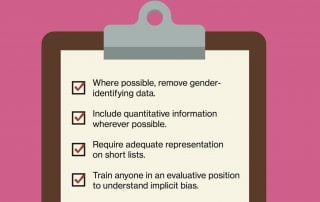
    • Remove applicants’ names – Another practice many companies are increasingly adopting is to remove applicants’ names or use only initials when generating long-lists for consideration. While it is best practice to ensure that the short-list is intentionally diverse, the generation of the long-list in a gender-blind way can aid in this effort.
    • Recognize gender bias – This study demonstrates that even in the most competitive settings, gender bias still influences decision-making. Meritocracy cannot be assumed, even in situations where there is a financial disincentive to be gender-biased. Gender is considered a salient characteristic now in part because women are so underrepresented – increasing the representation of women at all levels could help to reduce this bias.

    [/fusion_text][fusion_separator style_type=”none” hide_on_mobile=”small-visibility,medium-visibility,large-visibility” class=”” id=”” sep_color=”” top_margin=”20″ bottom_margin=”20″ border_size=”” icon=”” icon_circle=”” icon_circle_color=”” width=”” alignment=”center” /][fusion_button link=”https://www.gendereconomy.org/research-briefs/” text_transform=”” title=”” target=”_blank” link_attributes=”” alignment=”” modal=”” hide_on_mobile=”small-visibility,medium-visibility,large-visibility” class=”” id=”” color=”custom” button_gradient_top_color=”#62bd19″ button_gradient_bottom_color=”#62bd19″ button_gradient_top_color_hover=”#00c2e2″ button_gradient_bottom_color_hover=”#00c2e2″ accent_color=”” accent_hover_color=”” type=”” bevel_color=”” border_width=”” size=”” stretch=”yes” shape=”” icon=”” icon_position=”left” icon_divider=”no” animation_type=”” animation_direction=”left” animation_speed=”0.3″ animation_offset=””]See more research briefs[/fusion_button][fusion_separator style_type=”none” hide_on_mobile=”small-visibility,medium-visibility,large-visibility” class=”” id=”” sep_color=”” top_margin=”20″ bottom_margin=”20″ border_size=”” icon=”” icon_circle=”” icon_circle_color=”” width=”” alignment=”center” /][fusion_recent_posts layout=”default” hover_type=”none” columns=”3″ number_posts=”3″ offset=”0″ pull_by=”category” cat_slug=”research-briefs” exclude_cats=”” tag_slug=”” exclude_tags=”” thumbnail=”yes” title=”yes” meta=”no” meta_author=”no” meta_categories=”no” meta_date=”yes” meta_comments=”yes” meta_tags=”no” content_alignment=”” excerpt=”no” excerpt_length=”35″ strip_html=”yes” scrolling=”no” hide_on_mobile=”small-visibility,medium-visibility,large-visibility” class=”” id=”” animation_type=”” animation_direction=”left” animation_speed=”0.3″ animation_offset=”” /][/fusion_builder_column][fusion_builder_column type=”1_4″ layout=”1_4″ spacing=”” center_content=”no” hover_type=”none” link=”” min_height=”” hide_on_mobile=”small-visibility,medium-visibility,large-visibility” class=”” id=”” background_color=”” background_image=”” background_position=”left top” background_repeat=”no-repeat” border_size=”0″ border_color=”” border_style=”solid” border_position=”all” padding_top=”” padding_right=”” padding_bottom=”” padding_left=”” dimension_margin=”” animation_type=”” animation_direction=”left” animation_speed=”0.3″ animation_offset=”” last=”no”][fusion_title margin_top=”” margin_bottom=”” hide_on_mobile=”small-visibility,medium-visibility,large-visibility” class=”briefsummary” id=”” size=”3″ content_align=”left” style_type=”none” sep_color=””]

    Title

    Pursuing Quality: How Search Costs and Uncertainty Magnify Gender-based Double Standards in a Multistage Evaluation Process

    Authors

    Tristan Botelho, Mabel Abraham

    Institutions

    Yale School of Management and Columbia University

    Source

    Administrative Science Quarterly

    Published

    February 2017

    DOI

    10.1177/0001839217694358

    Research brief prepared by

    Celeste Jalbert

    [/fusion_title][fusion_widget_area name=”avada-custom-sidebar-researchbriefsidebar” title_size=”” title_color=”” background_color=”” padding_top=”” padding_right=”” padding_bottom=”” padding_left=”” hide_on_mobile=”small-visibility,medium-visibility,large-visibility” class=”” id=”” /][/fusion_builder_column][/fusion_builder_row][/fusion_builder_container]

  • Crowdfunding as activism

    Crowdfunding as activism

    [fusion_builder_container admin_label=”” hundred_percent=”no” equal_height_columns=”no” menu_anchor=”” hide_on_mobile=”small-visibility,medium-visibility,large-visibility” class=”” id=”” background_color=”” background_image=”” background_position=”center center” background_repeat=”no-repeat” fade=”no” background_parallax=”none” enable_mobile=”no” parallax_speed=”0.3″ video_mp4=”” video_webm=”” video_ogv=”” video_url=”” video_aspect_ratio=”16:9″ video_loop=”yes” video_mute=”yes” video_preview_image=”” border_size=”” border_color=”” border_style=”solid” margin_top=”20″ margin_bottom=”” padding_top=”” padding_right=”” padding_bottom=”” padding_left=””][fusion_builder_row][fusion_builder_column type=”3_4″ layout=”3_4″ spacing=”” center_content=”no” hover_type=”none” link=”” min_height=”” hide_on_mobile=”small-visibility,medium-visibility,large-visibility” class=”” id=”” background_color=”” background_image=”” background_position=”left top” background_repeat=”no-repeat” border_size=”0″ border_color=”” border_style=”solid” border_position=”all” padding_top=”” padding_right=”” padding_bottom=”” padding_left=”” dimension_margin=”” animation_type=”” animation_direction=”left” animation_speed=”0.3″ animation_offset=”” last=”no”][fusion_text columns=”” column_min_width=”” column_spacing=”” rule_style=”default” rule_size=”” rule_color=”” class=”” id=””]

    Summary

    We already know that women receive a tiny portion of total venture capital funding and many attribute this, in part, to homophily (the idea that “like is attracted to like”) as male venture capitalists primarily invest in founders who are similar to them. The authors of this paper were curious if female founders experienced this in other funding venues, and found that on crowdfunding platforms like Kickstarter, female-led projects in industries like technology were significantly more likely to achieve their fundraising goals than male-led projects. They also found that female funders, in particular, are far more likely to invest in female (vs. male) founders, particularly in industries where women have traditionally been underrepresented. However, the authors attribute this not just to an affinity for founders of the same gender, but rather an intentional activism–suggesting that this intention can help to change the discriminatory fundraising situation for female founders.

    How, then, does homophily impact individual choice about who we support and when? While we know that shared characteristics such as gender, class, race, and ethnicity can influence who we like, we also know that individual traits, as well as broader group identities, are at play.

    This paper demonstrates that in addition to similarity, perceptions of shared structural limitations and the desire to help overcome them, may also influence who we like.

    Research

    The barriers that female entrepreneurs face in raising capital, particularly VC funding, is well documented: between 1 and 6% of VC-backed companies have female founders (whereas 40% of all American businesses are founded by women). One reason for this is the makeup of the industry itself, only 14% of all venture capitalists are women, and male venture capitalists have mostly male networks which reduce their exposure to female entrepreneurs. Crowdfunding, however, is open to anyone with internet access and any amount (no matter how small) of money to invest in a project. Research has shown that homophily, in addition to bias and human capital differences, helps to explain choices made in venture capital (VC) and as researchers look at more non-traditional forms (e.g. crowdfunding) of venture funding.

    So how does homophily work? In “mindless” or “choice” homophily, we develop networks of people like us, which can create an unintentional echo chamber where similar people interact with similar people (“induced” homophily). In “activist” homophily, we intentionally choose to affiliate with similar people because we identify shared barriers and wish to help others overcome them. The current academic literature focuses on homophily generally but this paper seeks to uncover how different types of homophily operate in different contexts. To explore how homophily influences the funding of female-led ventures, the researchers used lab-based experiments and then validated their findings with real-world data from the crowdfunding platform, Kickstarter. What’s interesting is that homophily shows up differently in crowdfunding versus traditional venture capital–why?

    The lab-based experiment and real-world data were used to determine that:

    1. Women are more likely to support people similar to them,
    2. When women believe that another person faces similar barriers and limitations to them, they are often motivated to help that person overcome them, and
    3. Women are more likely to raise funds in fields where they are underrepresented and the greater the number of female funders, the more successful the female-led venture is in meeting their fundraising goal.

    The lab-based experiment used a representative Kickstarter project and assigned a male or female founder to the profile. The participants were asked a series of questions to determine how similar they perceived the founder to be to themselves, whether they believed they faced shared barriers with the founder, and gauged whether the participant felt it was important to them to help that founder succeed. At the end of the study, the participants were given an additional $1 in compensation and asked how much they would like to contribute to the project they had just read about.

    The results showed that both women and men are more likely to support projects with founders similar to themselves and that for women, this support was primarily characterized as “activist” homophily.

    To further validate these findings and to consider behaviour across different fields, the authors used data from 1,250 Kickstarter projects across gaming, technology, film, fashion, and children’s books. The gaming and technology projects had predominantly male founders, the film projects were a relatively equal split, and the fashion and children’s books projects had predominantly female founders. The results showed that while the proportion of female funders is much higher in fashion, children’s books, and even film, the proportion of female funders who fund female-led projects is disproportionately higher in technology (the gaming sample was too small to determine accurately). The results also showed that female-led projects in technology were significantly more like to achieve their fundraising goals than male-led projects.

    While the findings present strong evidence of “activist” choice homophily, the authors are clear that its influence will vary depending on the context and the perception of shared structural barriers.

    Implications

    • Venture CapitalHiring more women with decision-making authority around funding choices would expand the network of entrepreneurs the VC has access to, but this will not necessarily lead to an increase in the number of female-led ventures that are funded. Gaining a critical mass of women in the business of funding start-ups should give more opportunities to a wider range of ventures and improve the deal-flow for VC firms.
    • Business The Kickstarter evidence shows that there are many women-led businesses not getting funding via traditional venues, but more non-traditional funding options would enrich the mix of businesses across industries. Because funders have a tremendous impact on the vision, culture, and practices of new companies, more female founders could have a significant impact on the landscape of start-ups and business as we know it.
    • FundraisingFemale entrepreneurs should be aware that crowdfunding may offer more “democratized” access to funders, particularly in fields where women are underrepresented. However, they should also be aware that crowdfunding does not provide the same benefits (e.g. mentorship, access to preferential funding) that traditional investors provide.

    [/fusion_text][fusion_separator style_type=”none” hide_on_mobile=”small-visibility,medium-visibility,large-visibility” class=”” id=”” sep_color=”” top_margin=”20″ bottom_margin=”20″ border_size=”” icon=”” icon_circle=”” icon_circle_color=”” width=”” alignment=”center” /][fusion_button link=”https://www.gendereconomy.org/research-briefs/” text_transform=”” title=”” target=”_blank” link_attributes=”” alignment=”” modal=”” hide_on_mobile=”small-visibility,medium-visibility,large-visibility” class=”” id=”” color=”custom” button_gradient_top_color=”#62bd19″ button_gradient_bottom_color=”#62bd19″ button_gradient_top_color_hover=”#00c2e2″ button_gradient_bottom_color_hover=”#00c2e2″ accent_color=”” accent_hover_color=”” type=”” bevel_color=”” border_width=”” size=”” stretch=”yes” shape=”” icon=”” icon_position=”left” icon_divider=”no” animation_type=”” animation_direction=”left” animation_speed=”0.3″ animation_offset=””]See more research briefs[/fusion_button][fusion_separator style_type=”none” hide_on_mobile=”small-visibility,medium-visibility,large-visibility” class=”” id=”” sep_color=”” top_margin=”20″ bottom_margin=”20″ border_size=”” icon=”” icon_circle=”” icon_circle_color=”” width=”” alignment=”center” /][fusion_recent_posts layout=”default” hover_type=”none” columns=”3″ number_posts=”3″ offset=”0″ pull_by=”category” cat_slug=”research-briefs” exclude_cats=”” tag_slug=”” exclude_tags=”” thumbnail=”yes” title=”yes” meta=”no” meta_author=”no” meta_categories=”no” meta_date=”yes” meta_comments=”yes” meta_tags=”no” content_alignment=”” excerpt=”no” excerpt_length=”35″ strip_html=”yes” scrolling=”no” hide_on_mobile=”small-visibility,medium-visibility,large-visibility” class=”” id=”” animation_type=”” animation_direction=”left” animation_speed=”0.3″ animation_offset=”” /][/fusion_builder_column][fusion_builder_column type=”1_4″ layout=”1_4″ spacing=”” center_content=”no” hover_type=”none” link=”” min_height=”” hide_on_mobile=”small-visibility,medium-visibility,large-visibility” class=”” id=”” background_color=”” background_image=”” background_position=”left top” background_repeat=”no-repeat” border_size=”0″ border_color=”” border_style=”solid” border_position=”all” padding_top=”” padding_right=”” padding_bottom=”” padding_left=”” dimension_margin=”” animation_type=”” animation_direction=”left” animation_speed=”0.3″ animation_offset=”” last=”no”][fusion_title margin_top=”” margin_bottom=”” hide_on_mobile=”small-visibility,medium-visibility,large-visibility” class=”briefsummary” id=”” size=”3″ content_align=”left” style_type=”none” sep_color=””]

    Title

    Activist Choice Homophily and the 
Crowdfunding of Female Founders

    Authors

    Jason Greenberg, Ethan Mollick

    Institutions

    New York University,
    University
of Pennsylvania

    Source

    Administrative Science Quarterly

    Published

    November 2016

    Link

    http://asq.sagepub.com/content/
    early/2016/11/04/000183921667
    8847.abstract

    Research brief prepared by

    Celeste Jalbert

    [/fusion_title][fusion_widget_area name=”avada-custom-sidebar-researchbriefsidebar” title_size=”” title_color=”” background_color=”” padding_top=”” padding_right=”” padding_bottom=”” padding_left=”” hide_on_mobile=”small-visibility,medium-visibility,large-visibility” class=”” id=”” /][/fusion_builder_column][/fusion_builder_row][/fusion_builder_container]

  • Meritocracy: From Myth to Reality

    Meritocracy: From Myth to Reality

    Our frames of reference and procedures contain implicit biases that devalue women’s contributions and reinforce the privileges of dominant groups. Here’s what to do about it. By Professor Sarah Kaplan, Rotman School of Management.

  • 16 Days of Activism Against Gender-Based Violence

    16 Days of Activism Against Gender-Based Violence

    [fusion_builder_container hundred_percent=”no” equal_height_columns=”no” menu_anchor=”” hide_on_mobile=”small-visibility,medium-visibility,large-visibility” class=”” id=”” background_color=”” background_image=”” background_position=”center center” background_repeat=”no-repeat” fade=”no” background_parallax=”none” parallax_speed=”0.3″ video_mp4=”” video_webm=”” video_ogv=”” video_url=”” video_aspect_ratio=”16:9″ video_loop=”yes” video_mute=”yes” overlay_color=”” video_preview_image=”” border_color=”” border_style=”solid” padding_top=”” padding_bottom=”” padding_left=”” padding_right=”” type=”legacy”][fusion_builder_row][fusion_builder_column type=”1_1″ layout=”1_1″ background_position=”left top” background_color=”” border_color=”” border_style=”solid” border_position=”all” spacing=”yes” background_image=”” background_repeat=”no-repeat” padding_top=”” padding_right=”” padding_bottom=”” padding_left=”” margin_top=”0px” margin_bottom=”0px” class=”” id=”” animation_type=”” animation_speed=”0.3″ animation_direction=”left” hide_on_mobile=”small-visibility,medium-visibility,large-visibility” center_content=”no” last=”true” min_height=”” hover_type=”none” link=”” border_sizes_top=”” border_sizes_bottom=”” border_sizes_left=”” border_sizes_right=”” first=”true”][fusion_text columns=”” column_min_width=”” column_spacing=”” rule_style=”” rule_size=”” rule_color=”” hue=”” saturation=”” lightness=”” alpha=”” content_alignment_medium=”” content_alignment_small=”” content_alignment=”” hide_on_mobile=”small-visibility,medium-visibility,large-visibility” sticky_display=”normal,sticky” class=”” id=”” margin_top=”” margin_right=”” margin_bottom=”” margin_left=”” fusion_font_family_text_font=”” fusion_font_variant_text_font=”” font_size=”” line_height=”” letter_spacing=”” text_transform=”” text_color=”” animation_type=”” animation_direction=”left” animation_color=”” animation_speed=”0.3″ animation_delay=”0″ animation_offset=”” logics=””]Mary Eberts, co-founder of LEAF (Women’s Legal Education and Action Fund), joined Professor Sarah Kaplan, Director, Institute for Gender + the Economy, in an on-stage discussion about gender-based violence.

    This event held on December 5, 2017, was co-hosted by the University of Toronto Faculty of Law.

    About the conversation

    As UN Women states, “From 25 November, the International Day for the Elimination of Violence against Women, to 10 December, Human Rights Day, the 16 Days of Activism against Gender-Based Violence Campaign is a time to galvanize action to end violence against women and girls around the world.” Gender-based violence is not only a civil rights issue, it is an economic issue.

    Mary Eberts, co-founder of LEAF (Women’s Legal Education and Action Fund) joined Professor Sarah Kaplan, Director, Institute for Gender + the Economy, in an on-stage discussion about sexual harassment and sexual violence. In it, we highlighted the personal costs to the person affected and her family, the social costs and the costs to organizations. We concluded that the formal legal system does not serve most women well and that other organizations, including unions, schools and employers can and must fill the gaps with their own systematic and fair approaches. We also reflected on the need for fundamental cultural change so that violence against women is eliminated.

    About Mary Eberts

    Educated at Western University and Harvard law schools, Mary Eberts has appeared as counsel to parties and interveners in the Supreme Court of Canada, Courts of Appeal and Superior Courts in Ontario and other provinces, the Federal Court and Court of Appeal, and before administrative tribunals and inquests across Canada. She was instrumental in securing the present language of section 15 of the Charter, and was one of the founders of the Women’s Legal Education and Action Fund (LEAF).  Since 1991, she has been litigation counsel to the Native Women’s Association of Canada (NWAC). In 2014, she was appointed Constitutional Litigator-in-Residence at the University of Toronto’s Faculty of Law.

    Her academic career includes the Gordon Henderson Chair in Human Rights at the University of Ottawa (2004-2005) and the Ariel Sallows Chair in Human Rights at the College of Law, University of Saskatchewan (2011 and 2012), where she taught courses in test case litigation. She has received the Law Society Medal, the Governor-General’s Award in Honour of the Persons’ Case, the Queen’s Diamond Jubilee Medal and several honorary degrees.[/fusion_text][fusion_separator style_type=”none” hide_on_mobile=”small-visibility,medium-visibility,large-visibility” class=”” id=”” sep_color=”” top_margin=”50″ bottom_margin=”50″ border_size=”” icon=”” icon_circle=”” icon_circle_color=”” width=”” alignment=”center” /][fusion_button link=”https://www.gendereconomy.org/events/” text_transform=”” title=”” target=”_blank” link_attributes=”” alignment=”” modal=”” hide_on_mobile=”small-visibility,medium-visibility,large-visibility” class=”” id=”” color=”custom” button_gradient_top_color=”#62bd19″ button_gradient_bottom_color=”#62bd19″ button_gradient_top_color_hover=”#00c2e2″ button_gradient_bottom_color_hover=”#00c2e2″ accent_color=”” accent_hover_color=”” type=”” bevel_color=”” size=”” stretch=”yes” icon=”” icon_position=”left” icon_divider=”no” animation_type=”” animation_direction=”left” animation_speed=”0.3″ animation_offset=””]See more past events[/fusion_button][fusion_separator style_type=”none” hide_on_mobile=”small-visibility,medium-visibility,large-visibility” class=”” id=”” sep_color=”” top_margin=”20″ bottom_margin=”20″ border_size=”” icon=”” icon_circle=”” icon_circle_color=”” width=”” alignment=”center” /][fusion_title margin_top=”” margin_bottom=”” hide_on_mobile=”medium-visibility,large-visibility” class=”” id=”” size=”5″ content_align=”center” style_type=”default” sep_color=””]

    Or register below for these upcoming events

    [/fusion_title][fusion_recent_posts layout=”default” hover_type=”none” columns=”3″ number_posts=”3″ offset=”0″ pull_by=”category” cat_slug=”events” exclude_cats=”past” tag_slug=”” exclude_tags=”” thumbnail=”yes” title=”yes” meta=”no” meta_author=”no” meta_categories=”no” meta_date=”yes” meta_comments=”yes” meta_tags=”no” content_alignment=”” excerpt=”no” excerpt_length=”35″ strip_html=”yes” scrolling=”no” hide_on_mobile=”medium-visibility,large-visibility” class=”” id=”” animation_type=”” animation_direction=”left” animation_speed=”0.3″ animation_offset=”” /][/fusion_builder_column][/fusion_builder_row][/fusion_builder_container]

  • Not all women’s entrepreneurship is created equal

    Not all women’s entrepreneurship is created equal

    [fusion_builder_container admin_label=”” hundred_percent=”no” equal_height_columns=”no” menu_anchor=”” hide_on_mobile=”small-visibility,medium-visibility,large-visibility” class=”” id=”” background_color=”” background_image=”” background_position=”center center” background_repeat=”no-repeat” fade=”no” background_parallax=”none” enable_mobile=”no” parallax_speed=”0.3″ video_mp4=”” video_webm=”” video_ogv=”” video_url=”” video_aspect_ratio=”16:9″ video_loop=”yes” video_mute=”yes” video_preview_image=”” border_size=”” border_color=”” border_style=”solid” margin_top=”20″ margin_bottom=”” padding_top=”” padding_right=”” padding_bottom=”” padding_left=””][fusion_builder_row][fusion_builder_column type=”3_4″ layout=”3_4″ spacing=”” center_content=”no” hover_type=”none” link=”” min_height=”” hide_on_mobile=”small-visibility,medium-visibility,large-visibility” class=”” id=”” background_color=”” background_image=”” background_position=”left top” background_repeat=”no-repeat” border_size=”0″ border_color=”” border_style=”solid” border_position=”all” padding_top=”” padding_right=”” padding_bottom=”” padding_left=”” dimension_margin=”” animation_type=”” animation_direction=”left” animation_speed=”0.3″ animation_offset=”” last=”no”][fusion_text columns=”” column_min_width=”” column_spacing=”” rule_style=”default” rule_size=”” rule_color=”” class=”” id=””]

    Summary

    Do institutional arrangements like paid leave, subsidized childcare, and part-time employment encourage or discourage female entrepreneurship and are differences in these arrangements correlated with the growth-orientation of the ventures women do start? Research suggests that work-family conflict may entice more women to business ownership, but as a “Plan B” relative to standard employment when standard employment options are not feasible/desirable, and predominantly in less growth-oriented ventures, thereby reinforcing the gender gap in entrepreneurial representation and status.

    Research

    Work-family conflict is well-documented as a key factor in women’s decisions to pursue entrepreneurship as business ownership offers many women greater flexibility and autonomy. The institutional policies that contribute to work-family tensions disproportionately affect women because women are still expected to be responsible for caregiving. Therefore the question of whether these policies are associated with women’s aggregate representation in entrepreneurship is an important one. Of particular relevance is the question of whether women are compelled to entrepreneurship as a fallback or “Plan B” when work-family conflict is severe and what influence this has on the type of businesses women start.

    Work-family conflict may entice more women to business ownership but as a “Plan B” relative to standard employment.

    Using data from the Global Entrepreneurship Monitor (GEM) surveys conducted in 24 industrialized countries over an eight-year period and matched to several national-level indicators, Thébaud examined; 1) the impact of specific policies around paid-leave, child-care, and part-time work; 2) the motivations of women who choose to pursue entrepreneurship; and 3) the growth-orientation of women-owned businesses.

    Thébaud finds that in countries where public childcare is available, fewer women turn to entrepreneurship. However, when women have access to subsidized childcare and ample part-time jobs, they are also far less likely to report choosing business ownership as their fallback given an unsatisfactory employment situation–thus, there is no need for the “Plan B.”

    In contexts where women were offered moderate lengths of paid leave and generous childcare provisions, Thébaud also found that women who did pursue business ownership were more likely to build innovative, higher-growth companies that ultimately contribute more to their country’s economic health–thus, increasing women’s relative status among the population of entrepreneurs.

    However, when these policies are lacking and work-life conflicts are high, women are far more likely to run lower-growth, lower-status firms. So, while women’s overall representation in entrepreneurship may be higher numerically in this context, their status is not higher.

    Research also shows that the types of businesswomen who start companies are often segregated into competitive, crowded, and non-lucrative industries like retail, food service, and interpersonal care. These lower-growth, lower-status companies contribute to significant financial instability in women’s careers, making entrepreneurship a fairly fraught “Plan B.” Additionally, many women shift to entrepreneurship as their fallback career during their childbearing years; when these work-life conflicts are most pronounced (it’s a time when many women have less management experience and fewer network ties which presents further challenges for young business owners).

    Thus, women’s entrepreneurship is not always a desirable outcome as many pursue it simply because corporations are not allowing them to achieve a satisfactory work-family balance.

    Thébaud also found that not all work-family policies influence gender gaps in business ownership similarily. For example, the relative availability of part-time work, in contrast to childcare and paid leave, is not linked to gender gaps in business ownership, high-growth or otherwise. Thébaud finds that only work-life policies which support women in a way that does not otherwise marginalize them are linked to women’s greater representation in high-growth, entrepreneurial ventures.

    Also notable is the relevance of cultural values on these research findings. In countries with policies like paid leave and subsidized childcare, which signal that women’s participation in the workforce is encouraged, women were more likely to report pursuing entrepreneurship as a career-building opportunity versus a “Plan B.” Thébaud also found that business ownership was higher in countries where entrepreneurship was a highly valued pursuit.

    Implications

    • Recognize the gaps Not all women’s entrepreneurship is the same and, in fact, increasing women’s entrepreneurship is not always a desirable outcome. In contexts where women’s entrepreneurship is higher risk and less lucrative, safety nets should be implemented. In order to promote women in high growth ventures that contribute to their financial stability (rather than detract from it), government policies that support moderate lengths of paid family leave and generous childcare provisions need to be in place.
    • Implement supportive family leave and childcare policies – To resolve persistent work-family conflicts, many women will pursue their own ventures. While women have traditionally borne the caregiving burden, men are increasingly interested in participating equally at home–thus, supportive family leave and childcare policies have implications for a company’s entire workforce (not just women).

    [/fusion_text][fusion_separator style_type=”none” hide_on_mobile=”small-visibility,medium-visibility,large-visibility” class=”” id=”” sep_color=”” top_margin=”20″ bottom_margin=”20″ border_size=”” icon=”” icon_circle=”” icon_circle_color=”” width=”” alignment=”center” /][fusion_button link=”https://www.gendereconomy.org/research-briefs/” text_transform=”” title=”” target=”_blank” link_attributes=”” alignment=”” modal=”” hide_on_mobile=”small-visibility,medium-visibility,large-visibility” class=”” id=”” color=”custom” button_gradient_top_color=”#62bd19″ button_gradient_bottom_color=”#62bd19″ button_gradient_top_color_hover=”#00c2e2″ button_gradient_bottom_color_hover=”#00c2e2″ accent_color=”” accent_hover_color=”” type=”” bevel_color=”” border_width=”” size=”” stretch=”yes” shape=”” icon=”” icon_position=”left” icon_divider=”no” animation_type=”” animation_direction=”left” animation_speed=”0.3″ animation_offset=””]See more research briefs[/fusion_button][fusion_separator style_type=”none” hide_on_mobile=”small-visibility,medium-visibility,large-visibility” class=”” id=”” sep_color=”” top_margin=”20″ bottom_margin=”20″ border_size=”” icon=”” icon_circle=”” icon_circle_color=”” width=”” alignment=”center” /][fusion_recent_posts layout=”default” hover_type=”none” columns=”3″ number_posts=”3″ offset=”0″ pull_by=”category” cat_slug=”research-briefs” exclude_cats=”” tag_slug=”” exclude_tags=”” thumbnail=”yes” title=”yes” meta=”no” meta_author=”no” meta_categories=”no” meta_date=”yes” meta_comments=”yes” meta_tags=”no” content_alignment=”” excerpt=”no” excerpt_length=”35″ strip_html=”yes” scrolling=”no” hide_on_mobile=”small-visibility,medium-visibility,large-visibility” class=”” id=”” animation_type=”” animation_direction=”left” animation_speed=”0.3″ animation_offset=”” /][/fusion_builder_column][fusion_builder_column type=”1_4″ layout=”1_4″ spacing=”” center_content=”no” hover_type=”none” link=”” min_height=”” hide_on_mobile=”small-visibility,medium-visibility,large-visibility” class=”” id=”” background_color=”” background_image=”” background_position=”left top” background_repeat=”no-repeat” border_size=”0″ border_color=”” border_style=”solid” border_position=”all” padding_top=”” padding_right=”” padding_bottom=”” padding_left=”” dimension_margin=”” animation_type=”” animation_direction=”left” animation_speed=”0.3″ animation_offset=”” last=”no”][fusion_title margin_top=”” margin_bottom=”” hide_on_mobile=”small-visibility,medium-visibility,large-visibility” class=”briefsummary” id=”” size=”3″ content_align=”left” style_type=”none” sep_color=””]

    Title

    Business as Plan B: Institutional Foundations of Gender Inequality in Entrepreneurship across 24 Industrialized Countries

    Authors

    Sarah Thébaud

    Institutions

    University of California,
    Santa Barbara

    Source

    Administrative Science Quarterly

    Published

    June 2015

    DOI

    10.1177/0001839215591627 

    Link

    http://journals.sagepub.com/

    Subject

    Entrepreneurship,
    Work-Family Policies

    Research brief prepared by

    Celeste Jalbert

    [/fusion_title][fusion_widget_area name=”avada-custom-sidebar-researchbriefsidebar” title_size=”” title_color=”” background_color=”” padding_top=”” padding_right=”” padding_bottom=”” padding_left=”” hide_on_mobile=”small-visibility,medium-visibility,large-visibility” class=”” id=”” /][/fusion_builder_column][/fusion_builder_row][/fusion_builder_container]

  • Gender diversity increases corporate board effectiveness

    Gender diversity increases corporate board effectiveness

    [fusion_builder_container admin_label=”” hundred_percent=”no” equal_height_columns=”no” menu_anchor=”” hide_on_mobile=”small-visibility,medium-visibility,large-visibility” class=”” id=”” background_color=”” background_image=”” background_position=”center center” background_repeat=”no-repeat” fade=”no” background_parallax=”none” enable_mobile=”no” parallax_speed=”0.3″ video_mp4=”” video_webm=”” video_ogv=”” video_url=”” video_aspect_ratio=”16:9″ video_loop=”yes” video_mute=”yes” video_preview_image=”” border_size=”” border_color=”” border_style=”solid” margin_top=”20″ margin_bottom=”” padding_top=”” padding_right=”” padding_bottom=”” padding_left=””][fusion_builder_row][fusion_builder_column type=”3_4″ layout=”3_4″ spacing=”” center_content=”no” hover_type=”none” link=”” min_height=”” hide_on_mobile=”small-visibility,medium-visibility,large-visibility” class=”” id=”” background_color=”” background_image=”” background_position=”left top” background_repeat=”no-repeat” border_size=”0″ border_color=”” border_style=”solid” border_position=”all” padding_top=”” padding_right=”” padding_bottom=”” padding_left=”” dimension_margin=”” animation_type=”” animation_direction=”left” animation_speed=”0.3″ animation_offset=”” last=”no”][fusion_text columns=”” column_min_width=”” column_spacing=”” rule_style=”default” rule_size=”” rule_color=”” class=”” id=””]

    Summary

    While the number of women on S&P 1500 boards continues to increase steadily, women remain significantly underrepresented and, as of 2013, not represented at all on 25% of the boards. Many countries outside the US have addressed this inequality by implementing regulations (e.g. quotas, public disclosure), citing evidence that more diverse boards increase firm value. However, the research on this link is mixed. This study isolates the ways in which gender diversity might improve firm value through additional expertise in a particular field or function. The findings show that boards are more effective when they are made up of people with diverse contributions and that women are more likely than men to bring new and unique skills to the board.

    Research

    Building on research that links better advice from a firm’s board with increased firm value, this paper asks: Do women increase a board’s effectiveness, and thus its value, and what is it about their contributions that cause this? Research supports that variation in functional experience contributes to a board’s diversity and produces better quality decisions and more creative, innovative insights. This paper set out to determine whether women are more likely to contribute to the functional diversity on a board–thereby enhancing board effectiveness and increasing firm value.

    Variation in functional experience contributes to a board’s diversity and produces better quality decisions, as well as more more creative, innovative insights.

    Given that women are more significantly underrepresented on smaller boards, this study focused on firms in the S&P SmallCap 60 Index and their disclosure of the functional types represented on their board. The researchers first looked at the newly appointed female board directors and found that women were more likely than men to contribute additional, new, and more distinct types of expertise. Thus, when women join boards, they contribute more than men to the diversity of functional experience present on the board

    Women were more likely than men to contribute additional, new, and more distinct types of expertise.

    The study found that not only do women, on average, possess more types of functional expertise, they are also more likely to bring expertise in the areas of risk management, human resources, sustainability, corporate governance, regulatory/legal/compliance, and political/government. They also noted that of the most underrepresented board skills overall, four of the five (human resources, risk management, sustainability, political/government, and R&D) were more likely to be possessed by women than men.

    These findings demonstrate that increasing female representation on boards will increase board diversity given their new and unique skill contribution. Thus increasing the effectiveness of the board and, in turn, increase firm value.

    Implications

    • Expand recruitment – Women are more likely to bring important and underrepresented skills to corporate boards and steps should be taken to increase their presence. When boards expand their search to increase gender diversity, they will acquire greater functional diversity in key areas which will, in turn, increase the effectiveness of the board.
    • Transparent policies – Policies that require or encourage public disclosure of board composition or set quotas may help increase the diversity on boards.
    • Shift what “good” looks like – Men disproportionately bring experience in finance and operations (“line jobs” that men historically hold) but not human resources, governance, risk management, etc. (“staff jobs” that women have historically taken). Because we have prioritized certain (predominantly male) functions on boards, women who have historically been relegated to certain undervalued functions continue to be underrepresented.

    [/fusion_text][fusion_separator style_type=”none” hide_on_mobile=”small-visibility,medium-visibility,large-visibility” class=”” id=”” sep_color=”” top_margin=”20″ bottom_margin=”20″ border_size=”” icon=”” icon_circle=”” icon_circle_color=”” width=”” alignment=”center” /][fusion_button link=”https://www.gendereconomy.org/research-briefs/” text_transform=”” title=”” target=”_blank” link_attributes=”” alignment=”” modal=”” hide_on_mobile=”small-visibility,medium-visibility,large-visibility” class=”” id=”” color=”custom” button_gradient_top_color=”#62bd19″ button_gradient_bottom_color=”#62bd19″ button_gradient_top_color_hover=”#00c2e2″ button_gradient_bottom_color_hover=”#00c2e2″ accent_color=”” accent_hover_color=”” type=”” bevel_color=”” border_width=”” size=”” stretch=”yes” shape=”” icon=”” icon_position=”left” icon_divider=”no” animation_type=”” animation_direction=”left” animation_speed=”0.3″ animation_offset=””]See more research briefs[/fusion_button][fusion_separator style_type=”none” hide_on_mobile=”small-visibility,medium-visibility,large-visibility” class=”” id=”” sep_color=”” top_margin=”20″ bottom_margin=”20″ border_size=”” icon=”” icon_circle=”” icon_circle_color=”” width=”” alignment=”center” /][fusion_recent_posts layout=”default” hover_type=”none” columns=”3″ number_posts=”3″ offset=”0″ pull_by=”category” cat_slug=”research-briefs” exclude_cats=”” tag_slug=”” exclude_tags=”” thumbnail=”yes” title=”yes” meta=”no” meta_author=”no” meta_categories=”no” meta_date=”yes” meta_comments=”yes” meta_tags=”no” content_alignment=”” excerpt=”no” excerpt_length=”35″ strip_html=”yes” scrolling=”no” hide_on_mobile=”small-visibility,medium-visibility,large-visibility” class=”” id=”” animation_type=”” animation_direction=”left” animation_speed=”0.3″ animation_offset=”” /][/fusion_builder_column][fusion_builder_column type=”1_4″ layout=”1_4″ spacing=”” center_content=”no” hover_type=”none” link=”” min_height=”” hide_on_mobile=”small-visibility,medium-visibility,large-visibility” class=”” id=”” background_color=”” background_image=”” background_position=”left top” background_repeat=”no-repeat” border_size=”0″ border_color=”” border_style=”solid” border_position=”all” padding_top=”” padding_right=”” padding_bottom=”” padding_left=”” dimension_margin=”” animation_type=”” animation_direction=”left” animation_speed=”0.3″ animation_offset=”” last=”no”][fusion_title margin_top=”” margin_bottom=”” hide_on_mobile=”small-visibility,medium-visibility,large-visibility” class=”briefsummary” id=”” size=”3″ content_align=”left” style_type=”none” sep_color=””]

    Title

    Gender Diversity on Corporate Boards: Do Women Contribute Unique Skills?”

    Authors

    Daehyun Kim, Laura T. Starks

    Institutions

    University of Toronto,
    University of Texas at Austin

    Source

    American Economic Review

    Published

    May 2016

    Link

    https://www.aeaweb.org/
    articles?id=10.1257/
    aer.p20161032

    Research brief prepared by

    Celeste Jalbert

    [/fusion_title][fusion_widget_area name=”avada-custom-sidebar-researchbriefsidebar” title_size=”” title_color=”” background_color=”” padding_top=”” padding_right=”” padding_bottom=”” padding_left=”” hide_on_mobile=”small-visibility,medium-visibility,large-visibility” class=”” id=”” /][/fusion_builder_column][/fusion_builder_row][/fusion_builder_container]