Tag: Sexual harassment

Research briefs, news, and event recaps related to sexual harassment.

  • 10th Annual Research Roundtable | May 2025

    10th Annual Research Roundtable | May 2025


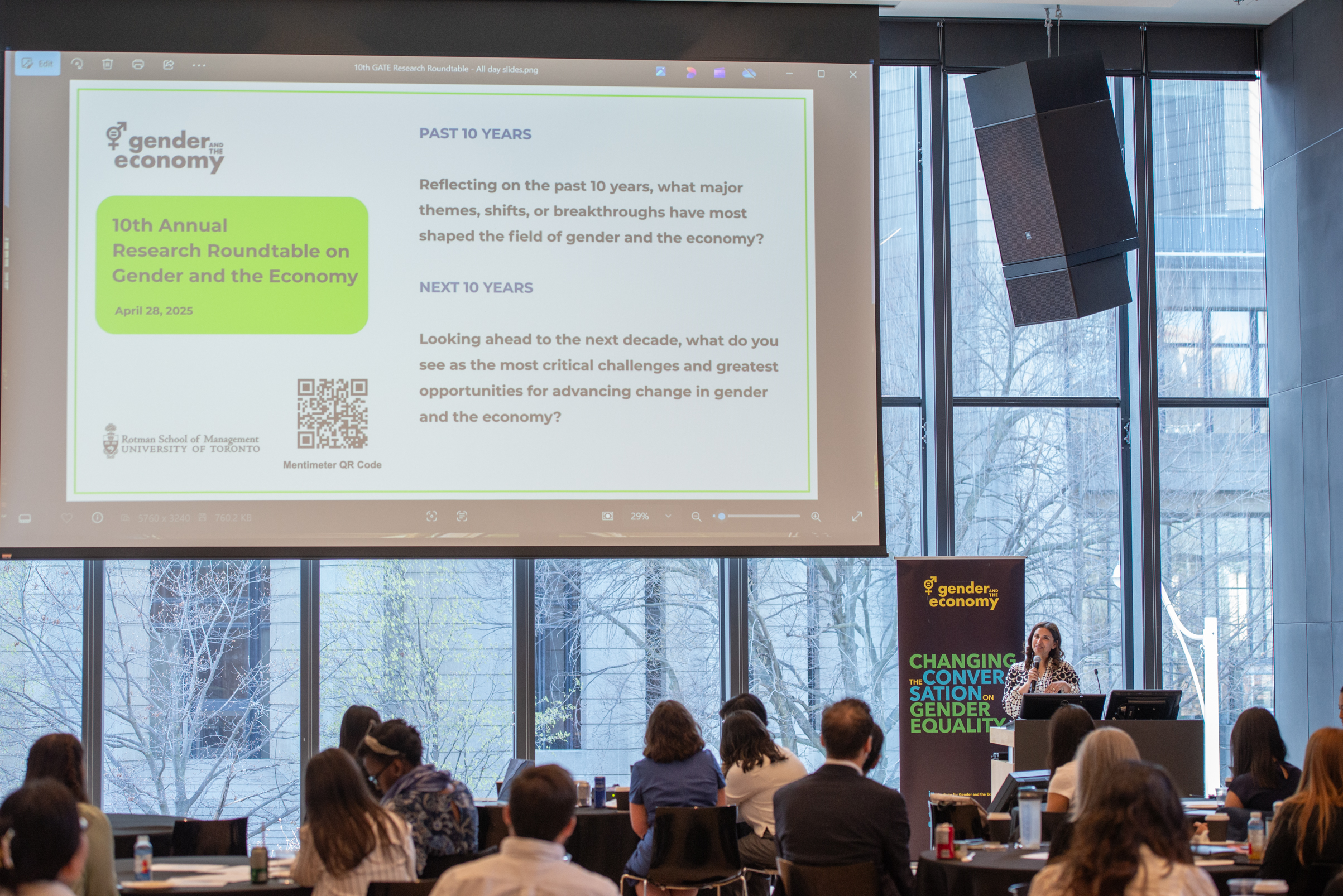
    GATE’s 10th annual research roundtable brought together a multidisciplinary group of emerging and established from across the University of Toronto—each funded through GATE research grants. Attendees shared bold new research, received valuable feedback, and built meaningful connections.

    So, what did we learn?

    We summarized the 10 research snapshots from our funded research on gender and the economy:

    The Effects of an Additional Year without Childcare (Carmen Quezada, Economic Analysis and Policy):

    Using a longitudinal dataset from Chile , this study shows how delaying school entry by one year can boost academic outcomes for children—but at a cost to mothers. Mothers face reduced workforce participation and income, take on the bulk of added childcare responsibilities, and sometimes take on more flexible, but precarious, informal work.

    • Takeaway: Even well-intended policies can deepen gender inequities without systemic childcare support.

    Socio-Economic Pathways of Japanese Women and Non-Binary Migrants in Canada (Izumi Sakamoto, Social Work):

    Study participants revealed key push and pull factors for migration to Canada, with gender-based discrimination and rigid norms pushing women to leave Japan, and better career opportunities, educational access, and LGBTQ+ inclusion pulling them to Canada. Although many migrants found more freedom and institutional support in Canada, they also faced racism, disillusionment, and underemployment.

    • Takeaway: Migration experiences are shaped by the intersections of gender, race, imperial legacies, and false promises of inclusion.

     Institutional Drift, Property Rights, and Economic Development (Rob Gillezeau, Economic Analysis and Policy):

    How have historical treaties shaped economic outcomes for Indigenous nations in Canada? Communities that signed treaties earn $7,000 less on average than those that did not, largely due to lower employment income. This  suggests that privatizing reserve land may worsen inequality, whereas landback initiatives and stronger treaty enforcement could help close the gap.

    • Takeaway: Historical institutions continue to shape economic inequities—and policy choices today can deepen or disrupt that legacy.

    Racial Dynamics and Citations in Economics (Marlene Koffi, Economics):

    This study examines racial disparities in the diffusion of ideas, focusing on how race shapes citation patterns. The findings reveal a consistent citation penalty for non-white authors: papers by non-white economists are cited about 5% less on average, with the gap widening to nearly 10% in top journals.

    • Takeaway: Race continues to shape the flow of ideas in economics, with implications for equity, innovation, and knowledge production.

     Circle Teachings as Methodological Guides (Jordyn Hrenyk, GATE Postdoctoral Fellow)

    Drawing from their own experiences as Indigenous scholars working with non-Indigenous collaborators, , the researchers introduce the Sharing Circle as a methodological guide for how to work together.  Circle protocols include: opening the circle in a good way, inviting everyone to participate when and how they want, using a talking stick to create a predictable communication rhythm, and closing the circle only when the Circle Keeper feels the work is done.  Together, these practices support reflexive theorizing and story work.

    • Takeaway: Sharing Circles offer a non-hierarchical and relational approach to research grounded in Indigenous ways of knowing.

    Non-Black Consumer Perceptions of Black Atypicality for  Cosmetic Products (Tosen Nwadei, OBHRM)

    This study examines whether the race of a model who appears on an advertisement for a cosmetic product affects consumers’ assumptions about the product’s intended users. Model race significantly influenced perceptions—but only for more racialized product categories (e.g., shampoo). The results suggest that the perceived racialization of a product significantly shapes whether it is perceived to be “for everyone”.

    • Takeaway: Efforts to increase representation in advertising may be perceived as atypical or exclusionary when consumers racialize the product itself.

    How “Genius” Framing in Creative Job Ads can Decrease the Gender Diversity of Applicant Pools (Grusha Agarwal, OBHRM)  

    This multi-method study examines how language in job ads influences applicant interest and perceptions. While “genius” framing is common in job ads for creative jobs, “explorer” language attracts more applicants—especially those high in openness—and appeals equally to men and women. It also reduces perceptions of masculine workplace culture and signals a more inclusive environment.

    • Takeaway: Job ad language affects both who applies and how inclusive an organization is perceived to be.

    People (Mistakenly) Highlight Disadvantages over Advantages in DEI Communication (Minwen Yang, Marketing)

    This research explores how individuals present themselves in high-stakes contexts like job applications. Across five studies, people were more likely to emphasize disadvantages than advantages in their DEI statements.

    • Takeaway: Applicants often misjudge what DEI messaging is most effective—highlighting advantage may yield better outcomes than emphasizing disadvantage.

    The Impact of Sexual Misconduct on Scientific Production and Gender Diversity (Manuela Collis, Strategy)

    This study explores the broader organizational consequences of sexual misconduct within university departments, focusing on three key outcomes: scientific productivity, collaboration patterns, and gender diversity. Preliminary findings and theorizing suggest that incidents of sexual misconduct reduce women’s sense of belonging and contribute to declines in their scholarly output.

    • Takeaway: Sexual misconduct may have ripple effects that extend beyond individual cases, undermining departmental culture, productivity, and equity in academia.

    Gender, Feedback, and Persistence Following Rejection (Laura Doering, Strategy)

    This study examines how gender and feedback interact to shape persistence following grant rejection—a key concern in addressing gender disparities in academia.  The findings show that after narrowly missing a funding threshold (“near misses”), men and women are equally likely to reapply. However, when the rejection is more severe (“wide misses”), women are significantly less likely to reapply compared to their male counterparts.

    • Takeaway: Gender gaps in persistence may stem not only from rejection itself, but also from the nature and severity of feedback received.

    Download our infographic for 10 TAKEAWAYS from GATE’s 10th Annual Research Roundtable -PDF -12May2025

    [fusion_imageframe image_id=”13934|fusion-1200″ aspect_ratio=”” custom_aspect_ratio=”100″ aspect_ratio_position=”” skip_lazy_load=”” lightbox=”no” gallery_id=”” lightbox_image=”” lightbox_image_id=”” alt=”” link=”https://www.gendereconomy.org/wp-content/uploads/2025/05/10-TAKEAWAYS-from-GATEs-10th-Annual-Research-Roundtable-PNG-12May2025.png” linktarget=”_self” hide_on_mobile=”small-visibility,medium-visibility,large-visibility” sticky_display=”normal,sticky” class=”” id=”” max_width=”” sticky_max_width=”” align_medium=”none” align_small=”none” align=”none” mask=”” custom_mask=”” mask_size=”” mask_custom_size=”” mask_position=”” mask_custom_position=”” mask_repeat=”” style_type=”” blur=”” stylecolor=”” hue=”” saturation=”” lightness=”” alpha=”” hover_type=”none” magnify_full_img=”” magnify_duration=”120″ scroll_height=”100″ scroll_speed=”1″ margin_top_medium=”” margin_right_medium=”” margin_bottom_medium=”” margin_left_medium=”” margin_top_small=”” margin_right_small=”” margin_bottom_small=”” margin_left_small=”” margin_top=”” margin_right=”” margin_bottom=”” margin_left=”” bordersize=”” bordercolor=”” borderradius=”” z_index=”” caption_style=”off” caption_align_medium=”none” caption_align_small=”none” caption_align=”none” caption_title=”” caption_text=”” caption_title_tag=”2″ fusion_font_family_caption_title_font=”” fusion_font_variant_caption_title_font=”” caption_title_size=”” caption_title_line_height=”” caption_title_letter_spacing=”” caption_title_transform=”” caption_title_color=”” caption_background_color=”” fusion_font_family_caption_text_font=”” fusion_font_variant_caption_text_font=”” caption_text_size=”” caption_text_line_height=”” caption_text_letter_spacing=”” caption_text_transform=”” caption_text_color=”” caption_border_color=”” caption_overlay_color=”” caption_margin_top=”” caption_margin_right=”” caption_margin_bottom=”” caption_margin_left=”” animation_type=”” animation_direction=”left” animation_color=”” animation_speed=”0.3″ animation_delay=”0″ animation_offset=”” filter_hue=”0″ filter_saturation=”100″ filter_brightness=”100″ filter_contrast=”100″ filter_invert=”0″ filter_sepia=”0″ filter_opacity=”100″ filter_blur=”0″ filter_hue_hover=”0″ filter_saturation_hover=”100″ filter_brightness_hover=”100″ filter_contrast_hover=”100″ filter_invert_hover=”0″ filter_sepia_hover=”0″ filter_opacity_hover=”100″ filter_blur_hover=”0″]https://www.gendereconomy.org/wp-content/uploads/2025/05/10-TAKEAWAYS-from-GATEs-10th-Annual-Research-Roundtable-PNG-12May2025-1200×1200.png[/fusion_imageframe]

    [fusion_imageframe image_id=”13942|fusion-800″ aspect_ratio=”” custom_aspect_ratio=”100″ aspect_ratio_position=”” skip_lazy_load=”” lightbox=”no” gallery_id=”” lightbox_image=”” lightbox_image_id=”” alt=”” link=”” linktarget=”_self” hide_on_mobile=”small-visibility,medium-visibility,large-visibility” sticky_display=”normal,sticky” class=”” id=”” max_width=”” sticky_max_width=”” align_medium=”none” align_small=”none” align=”none” mask=”” custom_mask=”” mask_size=”” mask_custom_size=”” mask_position=”” mask_custom_position=”” mask_repeat=”” style_type=”” blur=”” stylecolor=”” hue=”” saturation=”” lightness=”” alpha=”” hover_type=”none” magnify_full_img=”” magnify_duration=”120″ scroll_height=”100″ scroll_speed=”1″ margin_top_medium=”” margin_right_medium=”” margin_bottom_medium=”” margin_left_medium=”” margin_top_small=”” margin_right_small=”” margin_bottom_small=”” margin_left_small=”” margin_top=”” margin_right=”” margin_bottom=”” margin_left=”” bordersize=”” bordercolor=”” borderradius=”” z_index=”” caption_style=”off” caption_align_medium=”none” caption_align_small=”none” caption_align=”none” caption_title=”” caption_text=”” caption_title_tag=”2″ fusion_font_family_caption_title_font=”” fusion_font_variant_caption_title_font=”” caption_title_size=”” caption_title_line_height=”” caption_title_letter_spacing=”” caption_title_transform=”” caption_title_color=”” caption_background_color=”” fusion_font_family_caption_text_font=”” fusion_font_variant_caption_text_font=”” caption_text_size=”” caption_text_line_height=”” caption_text_letter_spacing=”” caption_text_transform=”” caption_text_color=”” caption_border_color=”” caption_overlay_color=”” caption_margin_top=”” caption_margin_right=”” caption_margin_bottom=”” caption_margin_left=”” animation_type=”” animation_direction=”left” animation_color=”” animation_speed=”0.3″ animation_delay=”0″ animation_offset=”” filter_hue=”0″ filter_saturation=”100″ filter_brightness=”100″ filter_contrast=”100″ filter_invert=”0″ filter_sepia=”0″ filter_opacity=”100″ filter_blur=”0″ filter_hue_hover=”0″ filter_saturation_hover=”100″ filter_brightness_hover=”100″ filter_contrast_hover=”100″ filter_invert_hover=”0″ filter_sepia_hover=”0″ filter_opacity_hover=”100″ filter_blur_hover=”0″]https://www.gendereconomy.org/wp-content/uploads/2025/05/SQ7_3651-800×532.jpg[/fusion_imageframe]

    [fusion_gallery order_by=”desc” limit=”” pagination_type=”” load_more_btn_text=”” layout=”” picture_size=”” aspect_ratio=”” custom_aspect_ratio=”100″ aspect_ratio_position=”” gallery_masonry_grid_ratio=”” gallery_masonry_width_double=”” lightbox=”yes” lightbox_content=”” lightbox_id=”” margin_top=”” margin_right=”” margin_bottom=”” margin_left=”” hide_on_mobile=”small-visibility,medium-visibility,large-visibility” class=”” id=”” columns_medium=”0″ columns_small=”0″ columns=”3″ column_spacing=”” hover_type=”” bordersize=”” bordercolor=”” hue=”” saturation=”” lightness=”” alpha=”” border_radius=”” load_more_btn_span=”no” button_alignment=”center” load_more_btn_hover_color=”” load_more_btn_color=”” load_more_btn_hover_bg_color=”” load_more_btn_bg_color=”” caption_style=”off” caption_title_tag=”2″ fusion_font_family_caption_title_font=”” fusion_font_variant_caption_title_font=”” caption_title_size=”” caption_title_line_height=”” caption_title_letter_spacing=”” caption_title_transform=”” caption_title_color=”” caption_background_color=”” fusion_font_family_caption_text_font=”” fusion_font_variant_caption_text_font=”” caption_text_size=”” caption_text_line_height=”” caption_text_letter_spacing=”” caption_text_transform=”” caption_text_color=”” caption_border_color=”” caption_overlay_color=”” caption_align_medium=”none” caption_align_small=”none” caption_align=”none” caption_margin_top=”” caption_margin_right=”” caption_margin_bottom=”” caption_margin_left=”” parent_dynamic_content=””][fusion_gallery_image image=”https://www.gendereconomy.org/wp-content/uploads/2025/05/SQ5_6841-1.jpg” image_id=”13952″ aspect_ratio_position=”” masonry_image_position=”” image_title=”” image_caption=”” link=”” linktarget=”_self” /][fusion_gallery_image image=”https://www.gendereconomy.org/wp-content/uploads/2025/05/SQ5_6793.jpg” image_id=”13939″ aspect_ratio_position=”” masonry_image_position=”” image_title=”” image_caption=”” link=”” linktarget=”_self” /][fusion_gallery_image image=”https://www.gendereconomy.org/wp-content/uploads/2025/05/SQ5_6730.jpg” image_id=”13937″ aspect_ratio_position=”” masonry_image_position=”” image_title=”” image_caption=”” link=”” linktarget=”_self” /][fusion_gallery_image image=”https://www.gendereconomy.org/wp-content/uploads/2025/05/SQ7_3701.jpg” image_id=”13943″ aspect_ratio_position=”” masonry_image_position=”” image_title=”” image_caption=”” link=”” linktarget=”_self” /][fusion_gallery_image image=”https://www.gendereconomy.org/wp-content/uploads/2025/05/IMG_8880-scaled.jpg” image_id=”13950″ aspect_ratio_position=”” masonry_image_position=”” image_title=”” image_caption=”” link=”” linktarget=”_self” /][fusion_gallery_image image=”https://www.gendereconomy.org/wp-content/uploads/2025/05/IMG_8900-scaled.jpg” image_id=”13947″ aspect_ratio_position=”” masonry_image_position=”” image_title=”” image_caption=”” link=”” linktarget=”_self” /][fusion_gallery_image image=”https://www.gendereconomy.org/wp-content/uploads/2025/05/IMG_8887-scaled.jpg” image_id=”13949″ aspect_ratio_position=”” masonry_image_position=”” image_title=”” image_caption=”” link=”” linktarget=”_self” /][fusion_gallery_image image=”https://www.gendereconomy.org/wp-content/uploads/2025/05/IMG_8941-scaled.jpg” image_id=”13948″ aspect_ratio_position=”” masonry_image_position=”” image_title=”” image_caption=”” link=”” linktarget=”_self” /][fusion_gallery_image image=”https://www.gendereconomy.org/wp-content/uploads/2025/05/IMG_8969-scaled.jpg” image_id=”13945″ aspect_ratio_position=”” masonry_image_position=”” image_title=”” image_caption=”” link=”” linktarget=”_self” /][fusion_gallery_image image=”https://www.gendereconomy.org/wp-content/uploads/2025/05/IMG_8898-scaled.jpg” image_id=”13946″ aspect_ratio_position=”” masonry_image_position=”” image_title=”” image_caption=”” link=”” linktarget=”_self” /][fusion_gallery_image image=”https://www.gendereconomy.org/wp-content/uploads/2025/05/IMG_8957-scaled.jpg” image_id=”13944″ aspect_ratio_position=”” masonry_image_position=”” image_title=”” image_caption=”” link=”” linktarget=”_self” /][/fusion_gallery]

  • Addressing himpathy: How organizations can navigate bias in sexual assault allegations

    Addressing himpathy: How organizations can navigate bias in sexual assault allegations

    [fusion_builder_container hundred_percent=”no” equal_height_columns=”no” hide_on_mobile=”small-visibility,medium-visibility,large-visibility” background_position=”center center” background_repeat=”no-repeat” fade=”no” background_parallax=”none” enable_mobile=”no” parallax_speed=”0.3″ video_aspect_ratio=”16:9″ video_loop=”yes” video_mute=”yes” border_style=”solid” margin_top=”20″ type=”legacy”][fusion_builder_row][fusion_builder_column type=”3_4″ layout=”3_4″ center_content=”no” hover_type=”none” hide_on_mobile=”small-visibility,medium-visibility,large-visibility” background_position=”left top” background_repeat=”no-repeat” border_style=”solid” border_position=”all” animation_direction=”left” animation_speed=”0.3″ last=”false” first=”true” border_sizes_top=”0″ border_sizes_bottom=”0″ border_sizes_left=”0″ border_sizes_right=”0″ background_blend_mode=”overlay” min_height=”” link=””][fusion_text hide_on_mobile=”small-visibility,medium-visibility,large-visibility” sticky_display=”normal,sticky” text_transform=”none” animation_direction=”left” animation_speed=”0.3″ animation_delay=”0″]

    In 2018, the US Congress and the public witnessed the polarizing hearings involving then-Supreme Court nominee Brett Kavanaugh and Christine Blasey Ford, during which Blasey Ford made a detailed and credible testimony accusing Kavanaugh of sexual assault. Despite these serious allegations, her testimony was followed by an outpouring of sympathy for Kavanaugh and anger towards Blasey Ford.[i] And Blasey Ford is not alone in this experience. The public expression of sympathy toward the accused predator, a phenomenon that philosopher and professor Kate Manne terms “himpathy,” is also present in lower profile cases of sexual misconduct accusation.

    This study explores himpathy, who is more likely to experience himpathy, and what managers in an organization can do to navigate it at work. The researchers find that individuals who value loyalty, authority, and purity more than the average person are more likely to see the victim seeking justice as disloyal to the organization. In a case of sexual misconduct allegations, managers are advised to stay neutral and refrain from language that could be interpreted as the victim being disloyal. Furthermore, they should form an investigative committee with diverse backgrounds to ensure biases stay out of the decision-making process.

    …individuals who value loyalty, authority, and purity more than the average person are more likely to see the victim…as disloyal to the organization.

    Himpathy, as defined by Manne, refers to “excessive sympathy shown toward male perpetrators of sexual violence.”[ii] Himpathy is often expressed in an angry tone, and the language used to express those sympathies is usually linked to the victim and takes the form of gaslighting. One typical example of himpathy is somebody asking on their social media account why the victim wants to hurt the accused’s career. Another example is death threats, which Blasey Ford received long after the testimony. Many of these actions are clearly meant to hurt the victim, yet they are hard to take action against. This is to say, himpathy is not merely an opinion; it may cause additional harm to the victim and create a workplace environment that allows for misconduct to continue.

    Professors Samantha J. Dodson, Rachel D. Goodwin, Jesse Graham, and Kristina A. Diekmann explored the factors behind himpathy in this study. The researchers studied thousands of tweets after the #MeToo movement and paired this with experimental and survey evidence. Their research highlights that individuals exhibiting himpathy often prioritize group-focused moral values such as loyalty, authority, and purity. This emphasis on group cohesion can extend to organizations or institutions. Using that lens, reporting a colleague’s misconduct is viewed as morally wrong, leading to undue sympathy for the accused, lower perceptions of the victim’s credibility, and decreased desires to punish the perpetrator.

    …himpathy is not merely an opinion; it may cause additional harm to the victim and create a workplace environment that allows for misconduct to continue.

    What are some strategies for workplace interventions? The researchers offer two key insights. Firstly, respond judiciously. Recognize that most individuals have sympathy for the victim. However, there will be a small but vocal group that may sway the situation, and if given decision-making power, will make biased decisions. Thus, refraining from depicting the victim as disloyal, inferior, or impure will not validate the himpathy perspective. Dodson explains that while a manager’s sympathy towards the victim may not sway someone who feels himpathy, it still may prevent the himpathetic group from growing louder, potentially averting further adverse effects on the victim before the misconduct (in the vast majority of cases) is confirmed.

    Secondly, when forming investigative committees for alleged misconduct, ensure that the committee consists of multiple people and comes with diverse perspectives, given the sensitive and emotional nature of sexual misconduct. Dodson and colleagues also recommend adding protective measures for the committee, such as anonymity or legal immunity, which can shield committee members from pressure exerted by himpathetic leaders within the organization.

    Dodson and colleagues’ pioneering work sheds light on the existence and dynamics of himpathy, but further research is required to better understand the different forms himpathy can take and how they affect the victim. For example, a death threat will have an entirely different impact on the victim than a social media user publicly questioning the victim’s credibility, or someone close to the victim discouraging them from coming forward because it could ruin the perpetrator’s career. We should also try to understand the reasons for the perpetrator’s behavior. This is particularly important and fruitful in the workplace since it is more clearly and closely governed than society as a whole. Dodson hopes that organizations will see the benefits this research could offer and open their doors and databases for such studies.

    References

    [i] Stolberg, Sheryl Gay. 2018. “Kavanaugh’s Nomination in Turmoil as Accuser Says He Assaulted Her Decades Ago.” The New York Times, September 16, 2018. https://www.nytimes.com/2018/09/16/us/politics/brett-kavanaugh-christine-blasey-ford-sexual-assault.html; “Kavanaugh’s Accuser Struggled to Come Forward, Friends Say.” 2018. AP News. September 19, 2018. https://apnews.com/article/44f88e604eae493e84d02a13eaa8c1c9.; Italie, Hillel. 2023. “Christine Blasey Ford, Who Testified against Justice Brett Kavanaugh, Will Release a Memoir in 2024.” AP News. September 13, 2023. https://apnews.com/article/christine-blasey-ford-memoir-b87467b11e59d2ce74767b6dc8ce6adb.

    [ii] Manne, K. (2017, p 338). Down girl: The logic of misogyny. Oxford University Press.

    ______
    Research brief prepared by:

    Manuela R. Collis

    [/fusion_text][fusion_separator style_type=”none” hide_on_mobile=”small-visibility,medium-visibility,large-visibility” top_margin=”20″ bottom_margin=”20″ alignment=”center” /][fusion_button link=”https://www.gendereconomy.org/research-briefs/” target=”_blank” hide_on_mobile=”small-visibility,medium-visibility,large-visibility” color=”custom” button_gradient_top_color=”#62bd19″ button_gradient_bottom_color=”#62bd19″ button_gradient_top_color_hover=”#00c2e2″ button_gradient_bottom_color_hover=”#00c2e2″ stretch=”yes” icon_position=”left” icon_divider=”no” animation_direction=”left” animation_speed=”0.3″]See more research briefs[/fusion_button][fusion_separator style_type=”none” hide_on_mobile=”small-visibility,medium-visibility,large-visibility” top_margin=”20″ bottom_margin=”20″ alignment=”center” /][fusion_recent_posts layout=”default” hover_type=”none” columns=”3″ number_posts=”3″ offset=”0″ pull_by=”category” cat_slug=”research-briefs” thumbnail=”yes” title=”yes” meta=”no” meta_author=”no” meta_categories=”no” meta_date=”yes” meta_comments=”yes” meta_tags=”no” excerpt=”no” excerpt_length=”35″ strip_html=”yes” scrolling=”no” hide_on_mobile=”small-visibility,medium-visibility,large-visibility” animation_direction=”left” animation_speed=”0.3″ /][/fusion_builder_column][fusion_builder_column type=”1_4″ layout=”1_4″ center_content=”no” hover_type=”none” hide_on_mobile=”small-visibility,medium-visibility,large-visibility” background_position=”left top” background_repeat=”no-repeat” border_style=”solid” border_position=”all” animation_direction=”left” animation_speed=”0.3″ last=”true” first=”false” border_sizes_top=”0″ border_sizes_bottom=”0″ border_sizes_left=”0″ border_sizes_right=”0″ background_blend_mode=”overlay” min_height=”” link=””][fusion_title title_type=”text” rotation_effect=”bounceIn” display_time=”1200″ highlight_effect=”circle” loop_animation=”off” highlight_width=”9″ highlight_top_margin=”0″ title_link=”off” link_target=”_self” hide_on_mobile=”small-visibility,medium-visibility,large-visibility” sticky_display=”normal,sticky” class=”briefsummary” content_align=”left” size=”3″ text_shadow=”no” text_shadow_blur=”0″ text_stroke=”no” text_stroke_size=”1″ text_overflow=”none” gradient_font=”no” gradient_start_position=”0″ gradient_end_position=”100″ gradient_type=”linear” radial_direction=”center center” linear_angle=”180″ style_type=”none” animation_direction=”left” animation_speed=”0.3″ animation_delay=”0″]

    Title

    Moral Foundations, Himpathy, and Punishment Following Organizational Sexual Misconduct Allegations

    Author

    Samantha J. Dodson, Rachael D. Goodwin, Jesse Graham, Kristina A. Diekmann

    Source

    Organization Science

    Published

    2023

    Link

    https://doi.org/10.1287/orsc.2022.1652

    Research brief prepared by

    Manuela R. Collis

    [/fusion_title][fusion_widget_area name=”avada-custom-sidebar-researchbriefsidebar” hide_on_mobile=”small-visibility,medium-visibility,large-visibility” /][/fusion_builder_column][/fusion_builder_row][/fusion_builder_container]

  • We CAN Break Free: What it Takes to Challenge Gender-Based Violence

    We CAN Break Free: What it Takes to Challenge Gender-Based Violence

    [fusion_builder_container hundred_percent=”no” equal_height_columns=”no” hide_on_mobile=”small-visibility,medium-visibility,large-visibility” background_position=”center center” background_repeat=”no-repeat” fade=”no” background_parallax=”none” parallax_speed=”0.3″ video_aspect_ratio=”16:9″ video_loop=”yes” video_mute=”yes” border_style=”solid” type=”legacy”][fusion_builder_row][fusion_builder_column type=”1_1″ layout=”1_1″ background_position=”left top” border_style=”solid” border_position=”all” spacing=”yes” background_repeat=”no-repeat” margin_top=”0px” margin_bottom=”0px” animation_speed=”0.3″ animation_direction=”left” hide_on_mobile=”small-visibility,medium-visibility,large-visibility” center_content=”no” last=”true” hover_type=”none” first=”true” min_height=”” link=”” background_blend_mode=”overlay”][fusion_text columns=”” column_min_width=”” column_spacing=”” rule_style=”” rule_size=”” rule_color=”” hue=”” saturation=”” lightness=”” alpha=”” content_alignment_medium=”” content_alignment_small=”” content_alignment=”” hide_on_mobile=”small-visibility,medium-visibility,large-visibility” sticky_display=”normal,sticky” class=”” id=”” margin_top=”” margin_right=”” margin_bottom=”” margin_left=”” fusion_font_family_text_font=”” fusion_font_variant_text_font=”” font_size=”” line_height=”” letter_spacing=”” text_transform=”none” text_color=”” animation_type=”” animation_direction=”left” animation_speed=”0.3″ animation_offset=””]

    Topic: We CAN Break Free: What it Takes to Challenge Gender-Based Violence : A panel discussion for the 16 Days of Activism against Gender-Based Violence

    Gender-based violence, a public health crisis, has exacerbated during the pandemic. The Canadian Femicide Observatory’s data shows that 173 women and girls were killed by violence in 2021, a sharp increase from 2019. And according to Women and Gender Equality Canada, at least 44% of heterosexual women, 67% of LGB+ women, and 59% of transgender and gender diverse people have experienced some form of psychological, physical, or sexual violence at home, in public, or at work.

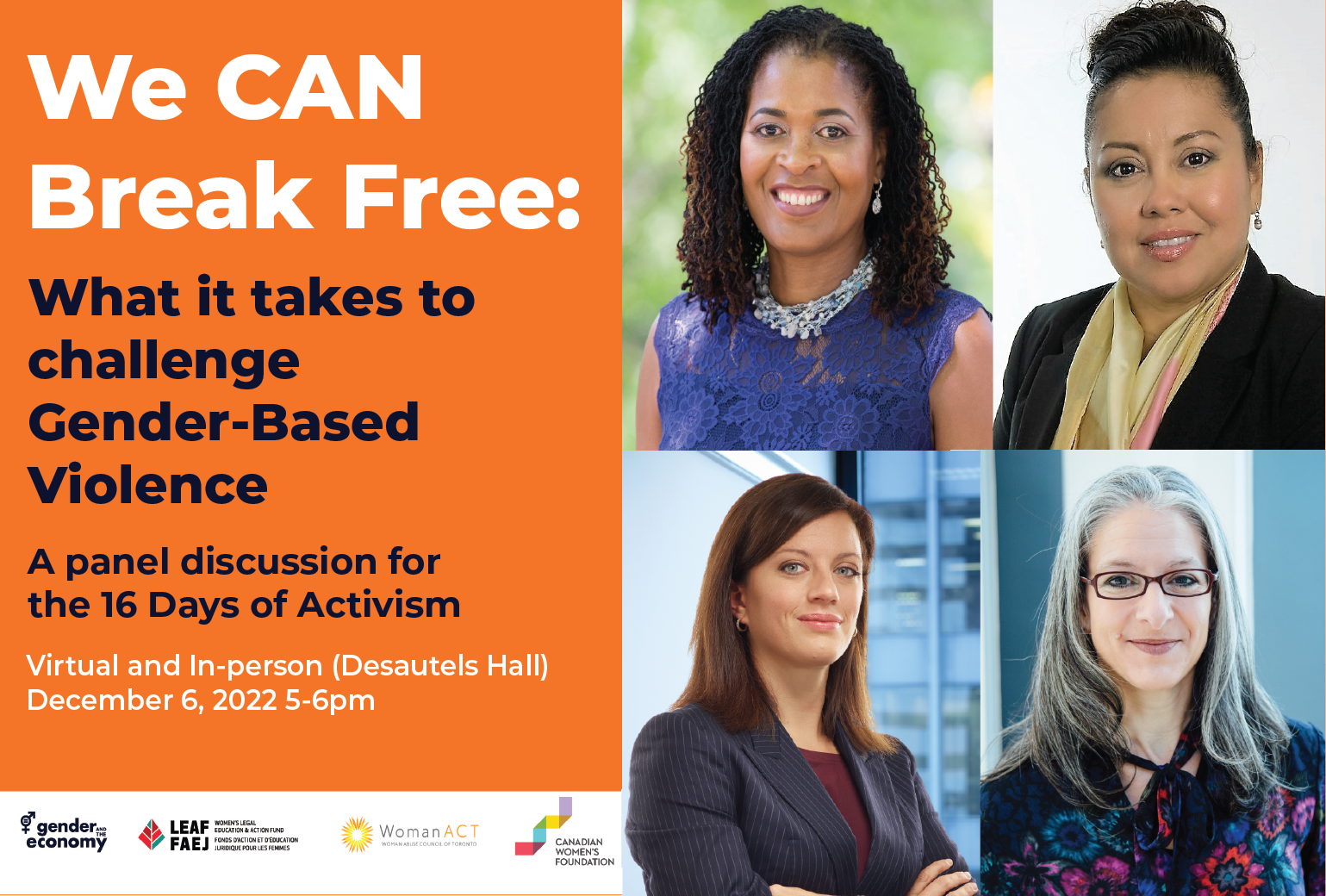
    GATE co-hosted a panel discussion with Canadian Women’s Foundation, Women’s Legal and Education Action Fund (LEAF), and Woman Abuse Council of Toronto (WomanACT) on what it takes to challenge bender-based violence. We heard from three experts in the field— Pam Hrick, Executive Director and General Counsel of LEAF, Paulette Senior, President & CEO of the Canadian Women’s Foundation, and Harmy Mendoza, Executive Director of WomanACT— who debunked some of the biggest myths and explored what individuals, organizations, and communities can do to stop gender-based violence and support victims.

    GBV in the workplace

    Harmy Mendoza highlighted three key suggestions for employers to integrate into the workplace to support survivors of GBV.

    • Accountability: Employers should express their commitment to support survivors of intimate partner violence.
    • Prevention: Employers should have clear and comprehensive policy procedures in place if a GBV situation arises, and ensure their staff are aware of these policies. Training staff in bystander intervention training is also important in showing commitment to supporting survivors.
    • Response: The workplace should have response systems that empower employees by providing informed support services and services that emphasize empathy over judgement.

    Consent and the law

    Pam Hrick spoke on issues around consent and gender-based violence. She emphasized that a real disconnect exists between what the law says consent is and what is practiced in reality. Although the Canadian legal system has a detailed definition of consent, the justice system does not do a good job of dealing with sexual assault and related crimes. She emphasized that it isn’t built to center the needs of survivors; rather, it often revictimizes them. Pam also spoke of alternatives to the legal system that give further choices to survivors. Systems like restorative justice and transformative justice are grounded in community healing and accountability.

    Intersectionality and GBV

    Paulette Senior discussed how there isn’t a “one size fits all” approach to combating gender-based violence. She highlighted that policy solutions should take intersectionality into account, otherwise many people who need help slip through cracks in the system. People exist at the intersections of various identities such as race, gender, sexual identity and more. To help survivors, it’s important to understand their lived experiences.

    “All kinds of ‘isms” get in the way of serving people well. Being able to work through and view the people you’re working with through the intersectional lens, and understanding the experience through which they come to you for service. But also, them standing at the intersection of various identities which could be race, gender, sexual identity, ability or disability, all of that matters in serving people well.” – Paulette Senior

    Watch our panelists share advice on how to challenge gender-based violence

    The panelists offered more resources:

    Learn more about the Signal for help from the Canadian Women’s Foundation and sign up to be a Signal Responder.

    Read the new report by Woman Abuse Council of Toronto (Woman ACT) on intersections between employment and safety among racialized women

    Learn more about sexual assault and consent law from the Women’s Legal Education and Action Fund (LEAF)

    [/fusion_text][fusion_separator style_type=”none” hide_on_mobile=”small-visibility,medium-visibility,large-visibility” top_margin=”20″ bottom_margin=”20″ alignment=”center” /][fusion_button link=”https://www.gendereconomy.org/events/” target=”_blank” hide_on_mobile=”small-visibility,medium-visibility,large-visibility” color=”custom” button_gradient_top_color=”#62bd19″ button_gradient_bottom_color=”#62bd19″ button_gradient_top_color_hover=”#00c2e2″ button_gradient_bottom_color_hover=”#00c2e2″ stretch=”yes” icon_position=”left” icon_divider=”no” animation_direction=”left” animation_speed=”0.3″]See more events[/fusion_button][/fusion_builder_column][/fusion_builder_row][/fusion_builder_container]

  • Guarding against workplace sexual harassment

    Guarding against workplace sexual harassment

    [fusion_builder_container admin_label=”” hundred_percent=”no” equal_height_columns=”no” menu_anchor=”” hide_on_mobile=”small-visibility,medium-visibility,large-visibility” class=”” id=”” background_color=”” background_image=”” background_position=”center center” background_repeat=”no-repeat” fade=”no” background_parallax=”none” enable_mobile=”no” parallax_speed=”0.3″ video_mp4=”” video_webm=”” video_ogv=”” video_url=”” video_aspect_ratio=”16:9″ video_loop=”yes” video_mute=”yes” video_preview_image=”” border_color=”” border_style=”solid” margin_top=”20″ margin_bottom=”” padding_top=”” padding_right=”” padding_bottom=”” padding_left=”” type=”legacy”][fusion_builder_row][fusion_builder_column type=”3_4″ layout=”3_4″ spacing=”” center_content=”no” hover_type=”none” link=”” min_height=”” hide_on_mobile=”small-visibility,medium-visibility,large-visibility” class=”” id=”” background_color=”” background_image=”” background_position=”left top” background_repeat=”no-repeat” border_color=”” border_style=”solid” border_position=”all” padding_top=”” padding_right=”” padding_bottom=”” padding_left=”” margin_top=”” margin_bottom=”” animation_type=”” animation_direction=”left” animation_speed=”0.3″ animation_offset=”” last=”false” first=”true” border_sizes_top=”0″ border_sizes_bottom=”0″ border_sizes_left=”0″ border_sizes_right=”0″ spacing_right=””][fusion_text columns=”” column_min_width=”” column_spacing=”” rule_style=”” rule_size=”” rule_color=”” hue=”” saturation=”” lightness=”” alpha=”” content_alignment_medium=”” content_alignment_small=”” content_alignment=”” hide_on_mobile=”small-visibility,medium-visibility,large-visibility” sticky_display=”normal,sticky” class=”” id=”” margin_top=”” margin_right=”” margin_bottom=”” margin_left=”” fusion_font_family_text_font=”” fusion_font_variant_text_font=”” font_size=”” line_height=”” letter_spacing=”” text_transform=”none” text_color=”” animation_type=”” animation_direction=”left” animation_speed=”0.3″ animation_offset=””]

    Summary

    Although researchers and the media often focus on explicit workplace sexual harassment, such as sexual coercion, many unwanted sexual interactions can be much more ambiguous. Ambiguously sexual interactions have unclear meaning: they could have sexual intent, but they could also be an expression of friendliness or a misguided compliment. This study examined how workers in the tech industry deal with ambiguously sexual interactions. The author found that when interviewees anticipated that ambiguously sexual interactions would evolve into sexual harassment, they engaged in “trajectory guarding”: they monitored and changed their behaviours to avoid harassment from occurring, such as by cutting off contact with the colleague in question or by avoiding staying late at work. The author found that because women had a higher concern of being sexually harassed, women disproportionately engaged in trajectory guarding. Not only does trajectory guarding require time and effort—it can also be detrimental to their careers.

    Research

    Many people understand workplace sexual harassment as involving outright or explicit interactions, such as coercing an employee into sex or making unwelcome sexual advances. However, unwanted sexual interactions in the workplace may often be conveyed in ambiguous ways rather than explicitly. One example is flirtation, which indicates the possibility of a sexual interaction through a behaviour that could also be nonsexual (e.g., making eye contact or leaning in).

    When people are engaged in ambiguous interactions, they aim to understand the trajectory of these interactions – that is, what will happen with this relationship in the longer term. Unwanted, ambiguously sexual interactions in the workplace have an uncertain trajectory, as people do not know whether these interactions will eventually lead to sexual harassment or not.

    Through 84 semi-structured interviews with tech workers, this study examined how workers deal with ambiguously sexual interactions and the resulting consequences. The researcher conducted interviews with 52 women, 29 men, and 3 non-binary people who worked in the tech industry in the San Francisco Bay Area. Interviewees were recruited through LinkedIn, tech-related listservs, the author’s social networks, and snowball sampling.

    Findings

    Types of ambiguously sexual interactions

    A majority of the women interviewees (32 of 52) and some of the men (10 of 29) said that they had experienced ambiguously sexual interactions in professional settings. These interactions took different forms. The first form was showing possible sexual or romantic interest, e.g., a female marketing manager recalled how an older male co-worker asked her for favours and connected with her on her Instagram. The second form was expressing interest in the interviewee’s personal or romantic life, e.g., a female software engineer talked about how a male engineering professor asked her intrusive questions about her boyfriend. The third form was being objectified, e.g., a female user-experience designer recalled being called pretty by a colleague in a meeting.

    These are ambiguous interactions because it is questionable whether they were intended to be sexual as opposed to friendly, or a misguided compliment. There was also little agreement among interviewees about which ambiguously sexual interactions were inappropriate; in fact, some expressed that they did not mind such interactions. Further, some of these interactions escalated into harassment, while others were misunderstandings that never developed further. This ambiguity meant it was difficult for interviewees to know what the best action to take was when faced with such a situation.

    Trajectory guarding

    Women interviewees showed more concern about these ambiguously sexual interactions than men, the latter of whom felt that they could simply “walk away” from uncomfortable behaviour. This aligns with prior research that shows that because women are more likely to experience sexual harassment in their daily lives, they come to expect it more than men. Indeed, ten women in this study, but only one man, recalled instances where ambiguously sexual interactions became explicit harassment. For instance, one woman told of how her manager’s questions about her romantic partner over time became explicitly sexual.

    As such, women disproportionately described engaging in a strategy that the author deemed “trajectory guarding”, in order to avoid future harassment. That is, they monitored and adjusted their behaviours with the person who initiated the interaction. These behaviours included always being on guard; finding ways to express that they were not sexually available (e.g., by saying that they were married); and limiting further interactions, such as by declining meetings in the evenings or acting coldly.

    Trajectory guarding was costly, both for the women’s wellbeing and their careers. It was firstly labour-intensive, especially mentally, to have to constantly monitor the behaviours of themselves and others. Secondly, avoiding certain colleagues and avoiding working late meant that some women came to be perceived as unfriendly and/or not dedicated to their jobs. Because coworkers and managers were not aware of the reasons behind this behaviour, they may have attributed it to a personal deficiency, such as a poor work ethic.

    Implications

    Ambiguously sexual interactions may contribute to gender inequality in the workplace—While it is important for workplaces to focus on preventing explicit sexual harassment, it is also important to be aware of how ambiguously sexual interactions can occur prior to harassment. Because women are disproportionately affected by sexual harassment, women more than men feel the need to act strategically to prevent harassment, such as by limiting interactions with certain colleagues. These strategies in turn may limit women’s career advancement.

    Organizations can educate all employees about ambiguously sexual interactions—During harassment training sessions, organizations can include descriptions of these types of interactions to help everyone understand what they are and how they may particularly affect women.

    The impact of ambiguously sexual interactions can be minimized if people who initiate them respond to cues that sexual attention is unwanted—Sometimes ambiguously sexual interactions do not have any sexual intent, and if those who initiate these interactions immediately cease them when they sense they are unwanted, women will not have to use strategies to avoid future mistreatment. The interaction can instead become a fleeting moment that does not require further attention.

    Trajectory guarding may be a strategy that other marginalized groups use to navigate professional settings—Different marginalized groups may engage in trajectory guarding to protect themselves from mistreatment. For instance, a nonbinary interviewee in this study described purposely minimizing contact with a boss who had made a snide comment about their gender non-conforming appearance. People at all levels of organizations should be aware of the possible impacts of their interactions and how they may contribute to marginalized groups having to take on labour-intensive strategies to navigate their workplaces.

    ________________________

    Research brief prepared by:

    Carmina Ravanera

    [/fusion_text][fusion_separator style_type=”none” hide_on_mobile=”small-visibility,medium-visibility,large-visibility” class=”” id=”” sep_color=”” top_margin=”20″ bottom_margin=”20″ border_size=”” icon=”” icon_circle=”” icon_circle_color=”” width=”” alignment=”center” /][fusion_button link=”https://www.gendereconomy.org/research-briefs/” text_transform=”” title=”” target=”_blank” link_attributes=”” alignment=”” modal=”” hide_on_mobile=”small-visibility,medium-visibility,large-visibility” class=”” id=”” color=”custom” button_gradient_top_color=”#62bd19″ button_gradient_bottom_color=”#62bd19″ button_gradient_top_color_hover=”#00c2e2″ button_gradient_bottom_color_hover=”#00c2e2″ accent_color=”” accent_hover_color=”” type=”” bevel_color=”” size=”” stretch=”yes” icon=”” icon_position=”left” icon_divider=”no” animation_type=”” animation_direction=”left” animation_speed=”0.3″ animation_offset=””]See more research briefs[/fusion_button][fusion_separator style_type=”none” hide_on_mobile=”small-visibility,medium-visibility,large-visibility” class=”” id=”” sep_color=”” top_margin=”20″ bottom_margin=”20″ border_size=”” icon=”” icon_circle=”” icon_circle_color=”” width=”” alignment=”center” /][fusion_recent_posts layout=”default” hover_type=”none” columns=”3″ number_posts=”3″ offset=”0″ pull_by=”category” cat_slug=”research-briefs” exclude_cats=”” tag_slug=”” exclude_tags=”” thumbnail=”yes” title=”yes” meta=”no” meta_author=”no” meta_categories=”no” meta_date=”yes” meta_comments=”yes” meta_tags=”no” content_alignment=”” excerpt=”no” excerpt_length=”35″ strip_html=”yes” scrolling=”no” hide_on_mobile=”small-visibility,medium-visibility,large-visibility” class=”” id=”” animation_type=”” animation_direction=”left” animation_speed=”0.3″ animation_offset=”” /][/fusion_builder_column][fusion_builder_column type=”1_4″ layout=”1_4″ spacing=”” center_content=”no” hover_type=”none” link=”” min_height=”” hide_on_mobile=”small-visibility,medium-visibility,large-visibility” class=”” id=”” background_color=”” background_image=”” background_position=”left top” background_repeat=”no-repeat” border_color=”” border_style=”solid” border_position=”all” padding_top=”” padding_right=”” padding_bottom=”” padding_left=”” margin_top=”” margin_bottom=”” animation_type=”” animation_direction=”left” animation_speed=”0.3″ animation_offset=”” last=”true” first=”false” border_sizes_top=”0″ border_sizes_bottom=”0″ border_sizes_left=”0″ border_sizes_right=”0″][fusion_title title_type=”text” rotation_effect=”bounceIn” display_time=”1200″ highlight_effect=”circle” loop_animation=”off” highlight_width=”9″ highlight_top_margin=”0″ before_text=”” rotation_text=”” highlight_text=”” after_text=”” title_link=”off” link_url=”” link_target=”_self” hide_on_mobile=”small-visibility,medium-visibility,large-visibility” sticky_display=”normal,sticky” class=”briefsummary” id=”” content_align_medium=”” content_align_small=”” content_align=”left” size=”3″ animated_font_size=”” fusion_font_family_title_font=”” fusion_font_variant_title_font=”” font_size=”” line_height=”” letter_spacing=”” text_transform=”” text_color=”” hue=”” saturation=”” lightness=”” alpha=”” animated_text_color=”” text_shadow=”no” text_shadow_vertical=”” text_shadow_horizontal=”” text_shadow_blur=”0″ text_shadow_color=”” margin_top_medium=”” margin_right_medium=”” margin_bottom_medium=”” margin_left_medium=”” margin_top_small=”” margin_right_small=”” margin_bottom_small=”” margin_left_small=”” margin_top=”” margin_right=”” margin_bottom=”” margin_left=”” margin_top_mobile=”” margin_bottom_mobile=”” gradient_font=”no” gradient_start_color=”” gradient_end_color=”” gradient_start_position=”0″ gradient_end_position=”100″ gradient_type=”linear” radial_direction=”center center” linear_angle=”180″ highlight_color=”” style_type=”none” sep_color=”” link_color=”” link_hover_color=”” animation_type=”” animation_direction=”left” animation_speed=”0.3″ animation_offset=””]

    Title

    Trajectory Guarding: Managing Unwanted, Ambiguously Sexual Interactions at Work

    Author

    Chloe Grace Hart

    Source

    American Sociological Review

    Published

    2021

    DOI

    10.1177/0003122421993809

    Link

    https://journals.sagepub.com/doi/abs/10.1177/0003122421993809

    Research brief prepared by

    Carmina Ravanera

    [/fusion_title][fusion_widget_area name=”avada-custom-sidebar-researchbriefsidebar” title_size=”” title_color=”” background_color=”” padding_top=”” padding_right=”” padding_bottom=”” padding_left=”” hide_on_mobile=”small-visibility,medium-visibility,large-visibility” class=”” id=”” /][/fusion_builder_column][/fusion_builder_row][/fusion_builder_container]

  • Susan Fowler on “Whistleblower: My Unlikely Journey to Silicon Valley and Speaking Out Against Injustice”

    Susan Fowler on “Whistleblower: My Unlikely Journey to Silicon Valley and Speaking Out Against Injustice”

    [fusion_builder_container hundred_percent=”no” equal_height_columns=”no” menu_anchor=”” hide_on_mobile=”small-visibility,medium-visibility,large-visibility” class=”” id=”” background_color=”” background_image=”” background_position=”center center” background_repeat=”no-repeat” fade=”no” background_parallax=”none” parallax_speed=”0.3″ video_mp4=”” video_webm=”” video_ogv=”” video_url=”” video_aspect_ratio=”16:9″ video_loop=”yes” video_mute=”yes” overlay_color=”” video_preview_image=”” border_color=”” border_style=”solid” padding_top=”” padding_bottom=”” padding_left=”” padding_right=”” type=”legacy”][fusion_builder_row][fusion_builder_column type=”1_1″ layout=”1_1″ background_position=”left top” background_color=”” border_color=”” border_style=”solid” border_position=”all” spacing=”yes” background_image=”” background_repeat=”no-repeat” padding_top=”” padding_right=”” padding_bottom=”” padding_left=”” margin_top=”0px” margin_bottom=”0px” class=”” id=”” animation_type=”” animation_speed=”0.3″ animation_direction=”left” hide_on_mobile=”small-visibility,medium-visibility,large-visibility” center_content=”no” last=”true” min_height=”” hover_type=”none” link=”” first=”true” border_sizes_top=”” border_sizes_bottom=”” border_sizes_left=”” border_sizes_right=””][fusion_text columns=”” column_min_width=”” column_spacing=”” rule_style=”default” rule_size=”” rule_color=”” content_alignment_medium=”” content_alignment_small=”” content_alignment=”” hide_on_mobile=”small-visibility,medium-visibility,large-visibility” sticky_display=”normal,sticky” class=”” id=”” margin_top=”” margin_right=”” margin_bottom=”” margin_left=”” font_size=”” fusion_font_family_text_font=”” fusion_font_variant_text_font=”” line_height=”” letter_spacing=”” text_color=”” animation_type=”” animation_direction=”left” animation_speed=”0.3″ animation_offset=””]

    Susan Fowler was just twenty-five years old when her blog post titled “Reflecting on One Very, Very Strange Year at Uber,” describing the sexual harassment and retaliation she experienced at Uber riveted the nation. Her post would eventually lead to the ousting of Uber’s powerful CEO, and its ripples extended far beyond that. Her courageous choice to attach her name to the post inspired other women to speak publicly about their experiences. In the year that followed, an unprecedented number of women came forward and Fowler was recognized by Time Magazine as one of the “Silence Breakers” who ignited the #MeToo movement.

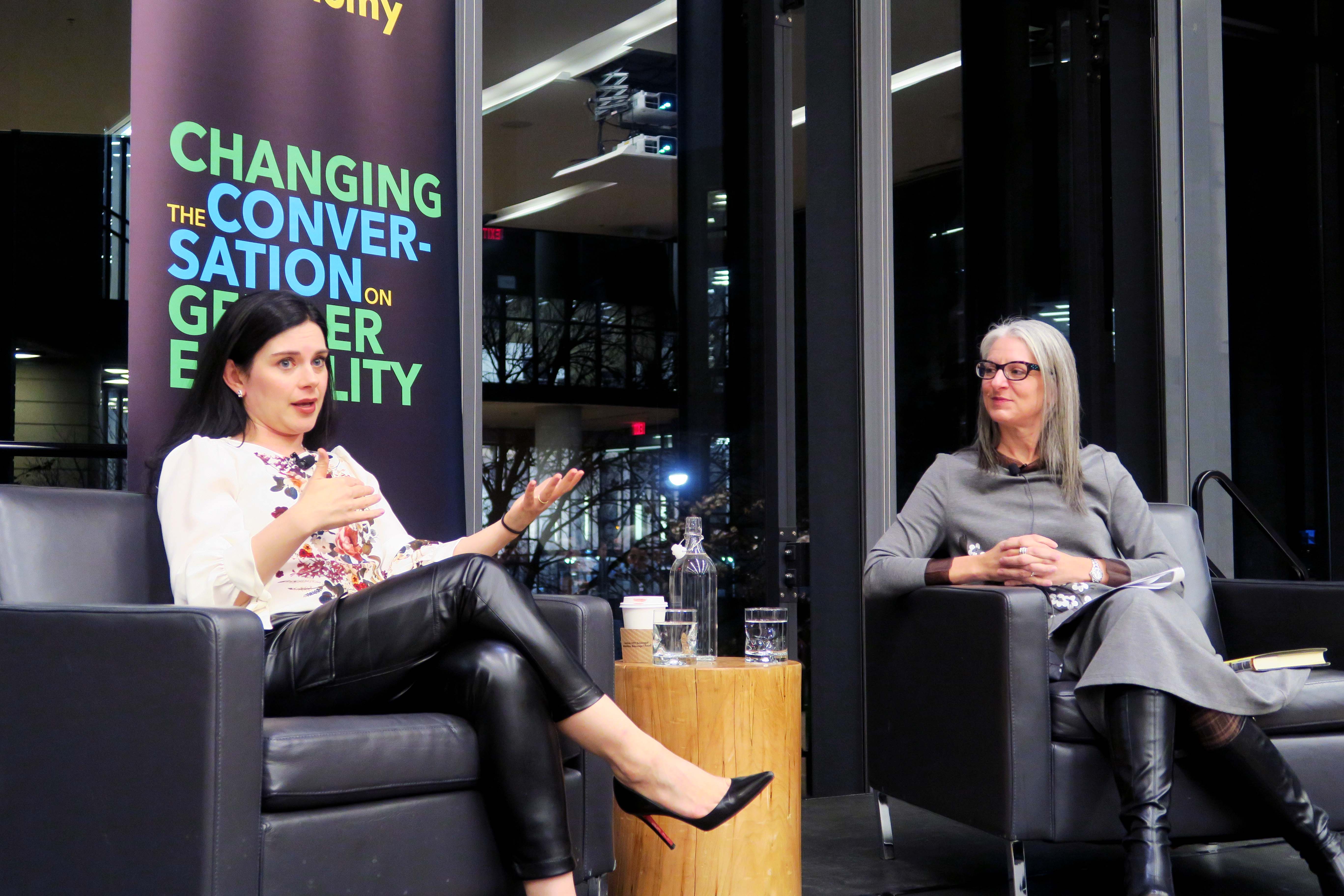
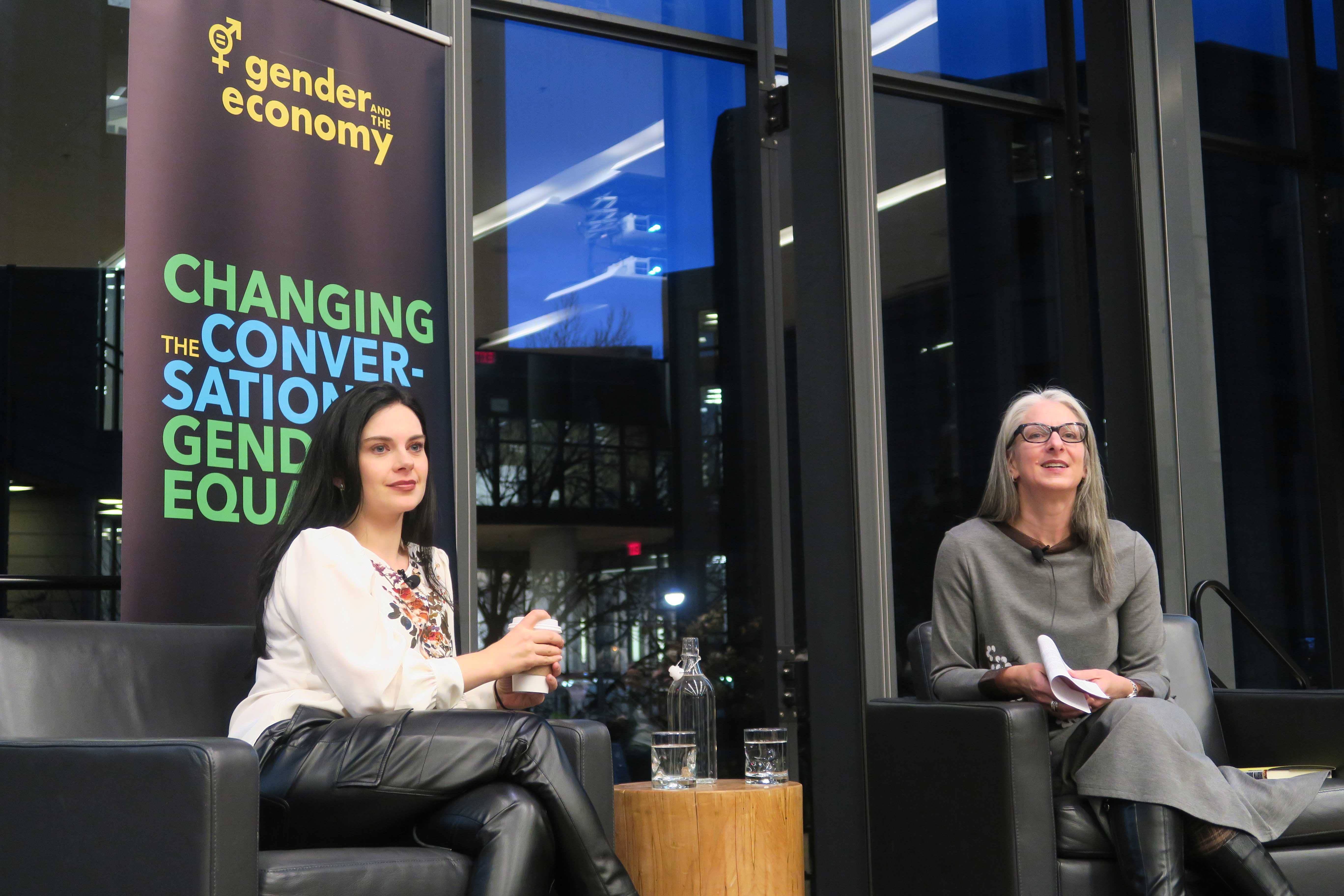
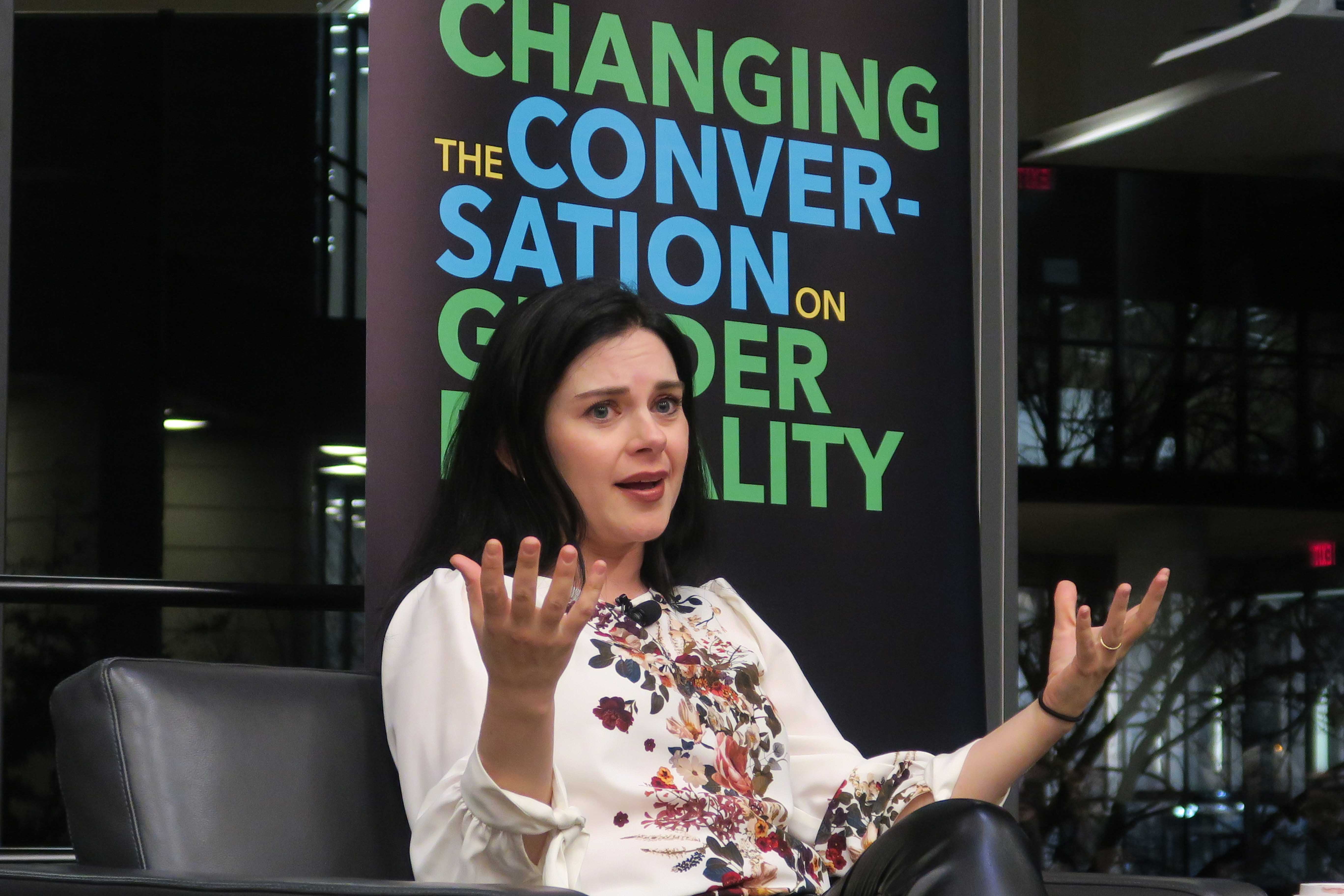
    In conversation with Phanikiran Radhakrishnan, Associate Professor, Teaching Stream, University of Toronto Scarborough, Department of Management, Fowler, writer and former Technology Op-Ed Editor, New York Times and author discussed her book, “Whistleblower: My Unlikely Journey to Silicon Valley and Speaking Out Against Injustice”. Fowler detailed the retaliation she faced from sexual harassment reporting and drew from her personal experience to offer advice for evaluating prospective workplaces. Although there is now a light on harassment issues, incidents within organizations are often not made public because of restrictive NDAs. While you may not know everything about a company, Fowler stressed that it is important to know your rights as well as who to escalate things to. “One of the most powerful things you can do to protect yourself is find ways to educate yourself about what your legal rights are.”

    Although there is now a light on harassment issues, incidents within organizations are often not made public because of restrictive NDAs.

    How does pay inequity link to harassment?

    It is a red flag – if there is pay inequity, there are probably underlying problems that will raise the likelihood of other forms of discrimination, such as harassment.

    What if the sexual harasser is considered a “high performer”?

    Upon reporting her manager for harassment, Fowler was told he would not be removed because he was considered a high performer. A sexual harasser is never a high performer, according to Fowler. “Not only are they harming other employees, they are a huge liability to the company. That is not being a high performer.”

    How can people support those experiencing harassment?

    • It’s never a bad idea to stand up for someone at work. Susan became isolated at Uber and was told to sit alone. Colleagues came to sit with her to show their support, offering a much needed morale boost.
    • Isolated incidents of harassment happen everywhere, but the key is that it should not become systemic, and it shouldn’t be covered up.
    Watch Fowler discuss the red flags you should be looking out for when researching an organization.

    [/fusion_text][fusion_separator style_type=”none” hide_on_mobile=”small-visibility,medium-visibility,large-visibility” class=”” id=”” sep_color=”” top_margin=”20″ bottom_margin=”20″ border_size=”” icon=”” icon_circle=”” icon_circle_color=”” width=”” alignment=”center” /][fusion_button link=”https://www.gendereconomy.org/past-events/” text_transform=”” title=”” target=”_blank” link_attributes=”” alignment_medium=”” alignment_small=”” alignment=”” modal=”” hide_on_mobile=”small-visibility,medium-visibility,large-visibility” sticky_display=”normal,sticky” class=”” id=”” color=”custom” button_gradient_top_color=”#62bd19″ button_gradient_bottom_color=”#62bd19″ button_gradient_top_color_hover=”#00c2e2″ button_gradient_bottom_color_hover=”#00c2e2″ accent_color=”” accent_hover_color=”” type=”” bevel_color=”” border_color=”” border_hover_color=”” size=”” stretch=”yes” margin_top=”” margin_right=”” margin_bottom=”” margin_left=”” icon=”” icon_position=”left” icon_divider=”no” animation_type=”” animation_direction=”left” animation_speed=”0.3″ animation_offset=””]See more past events[/fusion_button][fusion_separator style_type=”none” hide_on_mobile=”small-visibility,medium-visibility,large-visibility” class=”” id=”” sep_color=”” top_margin=”20″ bottom_margin=”20″ border_size=”” icon=”” icon_circle=”” icon_circle_color=”” width=”” alignment=”center” /][fusion_text columns=”” column_min_width=”” column_spacing=”” rule_style=”default” rule_size=”” rule_color=”” content_alignment_medium=”” content_alignment_small=”” content_alignment=”center” hide_on_mobile=”small-visibility,medium-visibility,large-visibility” sticky_display=”normal,sticky” class=”” id=”” font_size=”” fusion_font_family_text_font=”” fusion_font_variant_text_font=”” line_height=”” letter_spacing=”” text_color=”” animation_type=”” animation_direction=”left” animation_speed=”0.3″ animation_offset=””]

    Or register below for these upcoming events

    [/fusion_text][fusion_recent_posts layout=”default” picture_size=”fixed” hover_type=”none” columns=”3″ number_posts=”3″ post_status=”” offset=”0″ pull_by=”category” cat_slug=”events” exclude_cats=”past” tag_slug=”” exclude_tags=”” thumbnail=”yes” title=”yes” meta=”yes” meta_author=”no” meta_categories=”no” meta_date=”no” meta_comments=”yes” meta_tags=”no” content_alignment=”” excerpt=”no” excerpt_length=”35″ strip_html=”yes” scrolling=”no” hide_on_mobile=”small-visibility,medium-visibility,large-visibility” class=”” id=”” animation_type=”” animation_direction=”left” animation_speed=”0.3″ animation_offset=”” /][/fusion_builder_column][/fusion_builder_row][/fusion_builder_container]

  • Anti-sexual harassment training: does it work?

    Anti-sexual harassment training: does it work?

    [fusion_builder_container admin_label=”” hundred_percent=”no” equal_height_columns=”no” menu_anchor=”” hide_on_mobile=”small-visibility,medium-visibility,large-visibility” class=”” id=”” background_color=”” background_image=”” background_position=”center center” background_repeat=”no-repeat” fade=”no” background_parallax=”none” enable_mobile=”no” parallax_speed=”0.3″ video_mp4=”” video_webm=”” video_ogv=”” video_url=”” video_aspect_ratio=”16:9″ video_loop=”yes” video_mute=”yes” video_preview_image=”” border_color=”” border_style=”solid” margin_top=”20″ margin_bottom=”” padding_top=”” padding_right=”” padding_bottom=”” padding_left=”” type=”legacy”][fusion_builder_row][fusion_builder_column type=”3_4″ layout=”3_4″ spacing=”” center_content=”no” hover_type=”none” link=”” min_height=”” hide_on_mobile=”small-visibility,medium-visibility,large-visibility” class=”” id=”” background_color=”” background_image=”” background_position=”left top” background_repeat=”no-repeat” border_color=”” border_style=”solid” border_position=”all” padding_top=”” padding_right=”” padding_bottom=”” padding_left=”” margin_top=”” margin_bottom=”” animation_type=”” animation_direction=”left” animation_speed=”0.3″ animation_offset=”” last=”false” first=”true” border_sizes_top=”0″ border_sizes_bottom=”0″ border_sizes_left=”0″ border_sizes_right=”0″ spacing_right=””][fusion_text columns=”” column_min_width=”” column_spacing=”” rule_style=”default” rule_size=”” rule_color=”” hide_on_mobile=”small-visibility,medium-visibility,large-visibility” class=”” id=”” animation_type=”” animation_direction=”left” animation_speed=”0.3″ animation_offset=””]

    What is anti-sexual harassment training?

    Organizations have been conducting anti-sexual harassment training for decades. However, with the rise of the #MeToo movement in 2017, conversations about preventing sexual harassment in workplaces have come to the forefront of attention for media and organizations. One Canadian poll found that 43% of women and 12% of men have been subject to sexual harassment at work.[1] Another study discovered that 64% of women and 53% of men believe that sexual harassment happens at their workplace.[2] Today, anti-sexual harassment training is a common method to spread awareness and mitigate this widespread problem. In fact, in the United States, anti-sexual harassment training in workplaces is a USD 10 billion industry[3], and five states legally require employers to provide harassment prevention training to employees.[4] Further, in one survey conducted by the Canadian government in 2017, 43% of survey respondents indicated that they have received training on their workplace’s sexual harassment policy.[5]

    The goals of anti-sexual harassment training are to increase awareness and accuracy of recognizing sexual harassment, as well as to educate employees about the organization’s processes for handling complaints (e.g., the procedures for filing a complaint, as well as organizational responses to complaints). It also aims to sensitize employees to the illegality and offensiveness of sexual harassment, and how it is damaging to employees and the workplace. Training comes in all shapes and sizes: it can be experiential, and can include video, games, group discussions or lectures; training times vary vastly in length, and may even involve multiple sessions.[6] Since anti-sexual harassment training is diverse in its methods and delivery, it should not be characterized uniformly. Nevertheless, considering the popularity of training, it remains important to question what its impacts are. Are anti-sexual harassment training programs useful and effective tools for reducing sexual harassment at work?

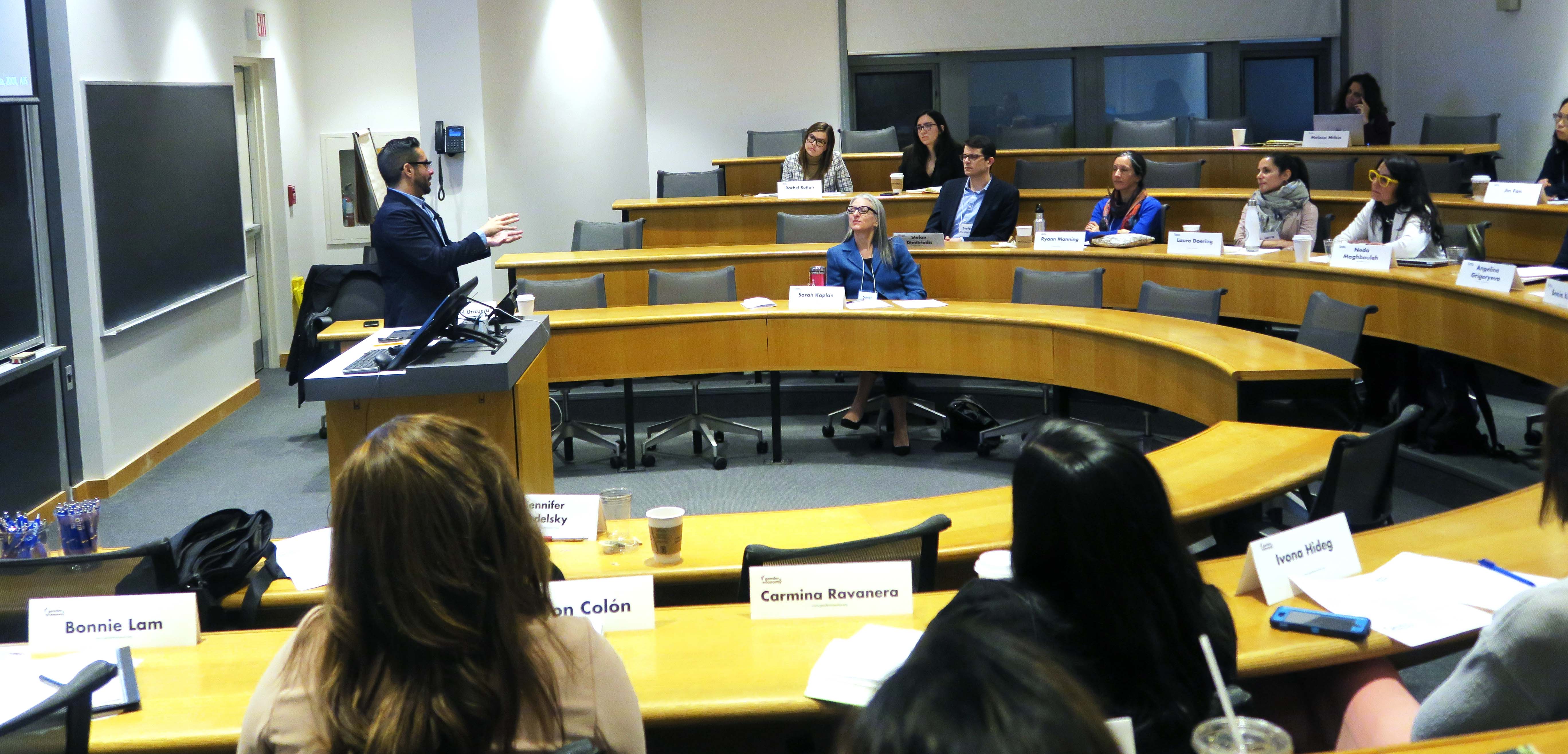
    To debate this question, scholars gathered at the Institute for Gender and the Economy’s Research Roundtable at the Rotman School of Management. In the Oxford-style debate, Professors Ivona Hideg (Lazaridis School of Business and Economics, Wilfrid Laurier University) and Rachel Ruttan (Rotman School of Management, University of Toronto) argued in favour of the effectiveness of anti-sexual harassment training, while Professors Laura Derksen (University of Toronto, Mississauga) and Heidi Matthews (Osgoode Hall Law School, York University) argued against it. Below is a summary of the insights generated from the debate.

    Why anti-sexual harassment training may be effective.

    Research suggests that anti-sexual harassment training can be a useful complement to other anti-sexual harassment measures, particularly in providing education and awareness for employees.

    • It increases knowledge about sexual harassment: Often, employees may be uncertain about what counts as sexual harassment. Training can be useful in that it puts everyone on the same page about what constitutes harassment, while also giving people the language and tools to address it. This is especially important in diverse work environments where employees may come from different cultures and backgrounds. Indeed, research shows that sexual harassment training increases the propensity to identify sexually harassing behaviour, particularly for men.[7] In one study, employees who received training were more likely to indicate that unwanted sexual gestures, touching, and pressure for dates are sexual harassment.[8] Recognizing what counts as sexual harassment is an important first step to changing behaviour.
    • It can result in increased reporting and reduced victim blaming: Evidence indicates that the number of sexual harassment complaints at companies increases after training, suggesting that complainants are more willing to come forward.[9] This should not be seen as a sign that the training is not working, but rather that it is creating a more comfortable space for complainants to speak up without the fear that they may be judged negatively. Moreover, research has found that anti-sexual harassment training is associated with decreased victim-blaming beliefs.[10]
    • It may be most effective in mobilizing bystanders: Although many people may think the goals of anti-sexual harassment training are to decrease perpetrators’ behaviours and increase targets’ willingness to report complaints, research shows that anti-sexual harassment training may function most effectively through bystander effects. Bystander intervention training can increase bystander intentions to intervene, confidence about intervening, as well as their actual rates of intervention.[11] [12] Bystander interventions also mitigate victim blaming and circumvent the potential backlash if targets report harassment themselves.[13] Anti-sexual harassment training for bystanders is thus a crucial tool for supporting people who are targeted with harassment.

    In one study, employees who received training were more likely to indicate that unwanted sexual gestures, touching, and pressure for dates are sexual harassment. Recognizing what counts as sexual harassment is an important first step to changing behaviour.

    • It can produce feelings of safety for employees: Beyond the benefits of the training content itself, offering anti-sexual harassment training may also have the symbolic effect of signalling to employees that they work in an environment where it is safe to come forward, and that the organization is not tolerant of harassment.[14] This can create feelings of inclusivity for employees, particularly women. While anti-sexual harassment training may not be a perfect preventative measure, not having it may also signal a lack of care about a serious workplace issue.

    Why anti-sexual harassment training may not be effective.

    While anti-sexual harassment training has its benefits, other evidence suggests it does not stop sexual harassment and may even create undesirable consequences.

    • It ignores structural problems such as power dynamics and discrimination: Anti-sexual harassment training is often done without parallel interventions in the power dynamics and sex- and gender-based discrimination that comes hand-in-hand with sexual harassment.[15] Without any substantial intervention on power and discrimination, training that focuses only on sexual harassment addresses a small part of a bigger problem, and is less likely to be effective. Indeed, some studies have shown that such training is not effective in changing harassing behaviours or reducing incidents of harassment.[16] [17] Moreover, anti-sexual harassment training has even been shown to entrench problematic gender norms. For instance, one study showed that training reinforced traditional and paternalistic gender stereotypes, because it associated men and women with traditional gender roles.[18]
    • It may be more symbolic than real: Researchers have suggested that anti-sexual harassment training is symbolic, rather than a real effort. Although there is little evidence anti-sexual harassment training actually reduces harassment, companies continue to undertake it, often as a box-checking or compliance exercise.[19] This is because anti-sexual harassment training can be an “easy out” to avoid financial or reputational losses, and the company still looks like it is acting in good faith.[20]

    For example, it is often overlooked that anti-sexual harassment training programs were developed as litigation defense for companies if or when targets might file claims. In the United States under Equal Employment Opportunity law, anti-sexual harassment practices like training can be used to demonstrate a lack of discrimination in the organization, regardless of the content or quality of the training. That is, companies can avoid litigation simply by showing that they have invested in this preventative measure. As a result, training does not directly address the problem of sexual harassment, nor is there an incentive for it to do so. [21][22][23]

    • It can lead to backlash: Anti-sexual harassment training may lead to backlash, especially from men. For example, after training, men may fear making mistakes and become deterred from working with junior women. In turn, this stops men from establishing working relationships with women that could have benefitted women’s career advancement. Further, one study found that men had a reduced willingness to report sexual harassment after anti-sexual harassment training, which may have been a mechanism of self-preservation in the face of a perceived attack on their gender.[24] Other research has shown that employee training on sexual harassment results in decreased numbers of women managers, possibly due to feelings of group threat and backlash from men.[25]
    • It may give wrong ideas about sexual harassment and violence: Anti-sexual harassment training can be viewed as part of a bureaucratic regulation of sex, which some scholars have argued may be counterproductive to addressing sexual violence and sexual harassment because it also regulates “ordinary sex.” That is, definitions of sexual harassment and consent used in workplaces and other institutions tend to be broader than legal definitions, which may in turn flatten complex issues of desire and sex by suggesting that almost any sexual interaction is impermissible, and therefore punishable. It is possible this occurs at the expense of focusing on what sexual harassment and violence entail. By focusing on sexuality and not on power dynamics, the training could veer in unhelpful directions. Evidence suggests that this may result in the targeting of racial minorities who have been and continue to be stereotyped as overly sexual.[26]

    How can organizations conduct anti-sexual harassment training effectively?

    The debate suggested that some anti-sexual harassment training can be more effective than others. Although these training programs may not be perfect right now, the debate also shed light on how they may be improved on in the future. Some insights from research include the following:

    • Be immersive and extensive. Like other training programs, effective anti-sexual harassment training should be in-person and involve interactive experiences or group exercises. This will create more long-term impact than individual training based on, for example, reading company policies or watching a video online.[27] [28] Further, training has been found to be more effective if it is at least four hours long, allows for feedback, and is situationally specific to industries, companies and departments.[29]
    • Recognize that discrimination and power dynamics play a role: Training that fails to take into account how sexual harassment is influenced by discrimination and power dynamics will not fully educate employees on harassment. It should be made clear that sexual harassment is an expression of gender-based discrimination and is used as a means to enforce social and workplace power hierarchies.[30] It should also be emphasized that not only women are targets of sexual harassment, and that men and people who do not identify within the gender binary are also affected. The goal of training should thus be to create a safe environment for everyone.
    • Receive leadership support: Those in power can play an important role in setting the tone. If management constantly shows support for, and reinforces, anti-sexual harassment training, they signal that the training’s message matters to them, and that they will hold harassers accountable. Training should suggest that harassment is everyone’s problem, not just the targets’.[31] [32]
    • Include clear goals, follow-up, and measurement: Training should have clear goals and ensure that intended outcomes are well-defined. Further, discussion and self-assessment around the problem of sexual harassment should be frequent and continuous. Organizations can achieve this by having follow-up or “booster” sessions for their anti-sexual harassment training. Over the long-term, companies can keep track of their progress on these milestones and measure incidences of harassment, making note of changes.[33]

    What else can organizations do to prevent sexual harassment?

    Although anti-sexual harassment training is the most common way to prevent sexual harassment, it is not the only way. Beyond training, the debate suggested that organizations should ensure other processes are in place to prevent sexual harassment and provide support for their employees, such as through the following actions:

    • Create an anti-sexual harassment policy and follow through with it: An anti-sexual harassment policy is important to convey an organization’s commitment to a harassment-free work environment, and the organization’s plans and procedures for handling complaints. It is also crucial that organizations follow through with the policy when complaints arise. This will signal to employees that managers are serious about anti-sexual harassment and will hold harassers accountable.

    Further, research shows that anti-sexual harassment training is more effective when there is a higher representation of women managers, and power is more equally distributed amongst men and women.

    • Provide mental and emotional support for employees: Ensuring that targets have access to crucial services, such as trauma counselling and therapy, can help employee wellbeing while also showing that organizations value their employees.
    • Cultivate a more inclusive workplace culture: Workplaces can make their organizational culture more inclusive outside of anti-sexual harassment training. For example, they can train employees on how to be an ally, reward bystander intervention, and show zero-tolerance for any sexist, racist, or otherwise discriminatory behaviour in day-to-day activities.
    • Change power dynamics: Sexual harassment can arise from exploiting power relationships. Hiring and promoting more women can help transform these dynamics by making the hierarchy more balanced. Further, research shows that anti-sexual harassment training is more effective when there is a higher representation of women managers, and power is more equally distributed amongst men and women.[34]

    Organizations face a legal, moral and business imperative to prevent sexual harassment of their employees. What is debatable is whether anti-sexual harassment training is the right tool with which to do so. On the one hand, conducting training could be effective in educating employees and helping support targets. On the other hand, it is troubling that anti-sexual harassment training does not address the power dynamics and discrimination that cause sexual harassment in the first place, and can simply be lip service for an organization. This debate highlighted good practices for training programs while also demonstrating potential problems organizations should be aware of as they strive to reduce sexual harassment at work.

    __________________________

    Research summary prepared by:

    Carmina Ravanera, Research Associate and Joyce He, Ph.D. Candidate, Organizational Behavior and Human Resource Management, Rotman School of Management, U of T

    References

    [1] Angus Reid Institute (2014). Three-in-ten Canadians say they’ve been sexually harassed at work, but very few have reported this to their employers. Retrieved on December 4, 2019 from http://angusreid.org/wp-content/uploads/2014/12/2014.12.05-Sexual-Harassment-at-work.pdf

    [2] Anderson, B. (2017). Sexual harassment of women is widespread in Canada. Abacus Data. Retrieved on December 4, 2019 from https://abacusdata.ca/sexual-harassment-of-women-is-widespread-in-canada/

    [3] Roehling, M.V. and Huang, J. (2018). Sexual harassment training effectiveness: An interdisciplinary review and call for research. Journal of Organizational Behaviour 39, 134-150.

    [4] Green, J. (14 October, 2019). Sexual harassment training now required for 20 per cent of U.S. workers. Canadian HR Reporter. Retrieved on November 19, 2019 from https://www.hrreporter.com/workplace-law/41292-sexual-harassment-training-now-required-for-20-per-cent-of-us-workers/

    [5] Employment and Social Development Canada (2017). Harassment and Sexual Violence in the Workplace: Public Consultations. Retrieved on November 19, 2019 from https://www.canada.ca/en/employment-social-development/services/health-safety/reports/workplace-harassment-sexual-violence.html

    [6] Magley, V.J. et al. (2013). Changing Sexual Harassment within Organizations via Training Interventions: Suggestions and Empirical Data. In R.J. Burke and C.L. Cooper (Eds.), The Fulfilling Workplace: The Organization’s Role in Achieving Individual and Organizational Health (pp. 225-246). London, UK: Routledge.

    [7] Blakely, G.L. et al. (1998). The Effects of Training on Perceptions of Sexual Harassment Allegations. Journal of Applied Social Psychology 28(1), 71-83.

    [8] Antecol, H. and Cobb-clark, D. (2003). Does Sexual Harassment Training Change Attitudes? A View from the Federal Level. Social Science Quarterly 84(4), 826-842.

    [9] Magley, V.J. et al. (2013). Changing Sexual Harassment within Organizations via Training Interventions: Suggestions and Empirical Data. In R.J. Burke and C.L. Cooper (Eds.), The Fulfilling Workplace: The Organization’s Role in Achieving Individual and Organizational Health (pp. 225-246). London, UK: Routledge.

    [10] Lonsway, K.A. et al. (2008). Sexual Harassment Mythology: Definition, Conceptualization, and Measurement. Sex Roles 58(9-10), 599-615.

    [11] Orchowski, L.M. et al. (2018). Evaluations of Sexual Assault Prevention Programs in Military Settings: A Synthesis of the Research Literature. Military Medicine 183, 421-428.

    [12] Dobbin, F. and Kalev, A. (2019). The promise and peril of sexual harassment programs. Proceedings of the National Academy of Sciences 116(25), 12255-12260.

    [13] Hart, C.G. (2019). The Penalties For Self-Reporting Sexual Harassment. Gender & Society 33(4), 534-559.

    [14] Brown, K. G., & Sitzmann, T. (2011). Training and employee development for improved performance. In Z. Sheldon (Ed.), APA Handbook of Industrial and Organizational Psychology: Selecting and developing members for

    the organization (Vol. 2) (pp. 469–503). Washington, DC, US: American Psychological Association.

    [15] Pina, A., Gannon, T. A., and Saunders, B. (2009). An overview of the literature on sexual harassment: Perpetrator, theory, and treatment issues. Aggression and Violent Behavior, 14, 126-138.

    [16] Magley, V.J. et al. (2013). Changing Sexual Harassment within Organizations via Training Interventions: Suggestions and Empirical Data. In R.J. Burke and C.L. Cooper (Eds.), The Fulfilling Workplace: The Organization’s Role in Achieving Individual and Organizational Health (pp. 225-246). London, UK: Routledge.

    [17] Roehling, M.V. and Huang, J. (2018). Sexual harassment training effectiveness: An interdisciplinary review and call for research. Journal of Organizational Behaviour 39, 134-150.

    [18] Tinkler, J., Gremillion, S. and Arthurs, K. (2015). Perceptions of Legitimacy: The Sex of the Legal Messenger and Reactions to Sexual Harassment Training. Law & Social Inquiry 40(1), 152-174.

    [19] Grossman, J.L. (2003). The Culture of Compliance: The Final Triumph of Form Over Substance in Sexual Harassment Law. Harvard Women’s Law Journal 26, 3-75.

    [20] Bisom-Rapp, S. (2018-2019). Sex Harassment Training Must Change: The Case for Legal Incentives for Transformative Education and Prevention. Stanford Law Review Online, 71, 60-73.

    [21] Edelman, L.B. (2016). Working Law: Courts, Corporations, and Symbolic Civil Rights. Chicago: University of Chicago Press.

    [22] Tippett, E.C. (2018). Harassment Trainings: A Content Analysis. Berkeley Journal of Employment and Labour Law 39, 481-526.

    [23] Krieger, L.H., Best, R.K. and Edelman, L.B. (2015). When “Best Practices” Win, Employees Lose: Symbolic Compliance and Judicial Inference in Federal Equal Employment Opportunity Cases. Law & Social Inquiry 40(4), 843-879.

    [24] Bingham, S.G. and Scherer, L.L. (2001). The Unexpected Effects of a Sexual Harassment Educational Program. The Journal of Applied Behavioral Science 37 (2), 125-153.

    [25] Dobbin, F. and Kalev, A. (2019). The promise and peril of sexual harassment programs. Proceedings of the National Academy of Sciences 116(25), 12255-12260.

    [26] Gerson, J. and Suk, J. (2016). The Sex Bureaucracy. California Law Review 104(4), 881-948.

    [27] Potter, S.J. et al. (2016). Conveying campus sexual misconduct policy information to college and university students: Results from a 7-campus study. Journal of American College Health 64(6), 438-447.

    [28] Perry, E. L., Kulik, C. T., & Schmidtke, J. M. (1998). Individual differences in the effectiveness of

    sexual harassment awareness training. Journal of Applied Social Psychology, 28, 698–723.

    [29] Kalinoski, Z.T., et al. (2012). A meta-analytic evaluation of diversity training outcomes. Journal of Organizational Behavior 34(8), 1076-1104.

    [30] Pina, A., Gannon, T. A., & Saunders, B. (2009). An overview of the literature on sexual harassment: Perpetrator, theory, and treatment issues. Aggression and Violent Behavior, 14, 126-138.

    [31] Dobbin, F. and Kalev, A. (2019). The promise and peril of sexual harassment programs. Proceedings of the National Academy of Sciences 116(25), 12255-12260.

    [32] Buchanan, N.T. et al. (2014). A Review of Organizational Strategies for Reducing Sexual Harassment: Insights from the U.S. Military. Journal of Social Issues 70(4), 687-702.

    [33] Buchanan, N.T. et al. (2014). A Review of Organizational Strategies for Reducing Sexual Harassment: Insights from the U.S. Military. Journal of Social Issues 70(4), 687-702.

    [34] Dobbin, F. and Kalev, A. (2019). The promise and peril of sexual harassment programs. Proceedings of the National Academy of Sciences 116(25), 12255-12260.

    [/fusion_text][fusion_separator style_type=”none” hide_on_mobile=”small-visibility,medium-visibility,large-visibility” class=”” id=”” sep_color=”” top_margin=”20″ bottom_margin=”20″ border_size=”” icon=”” icon_circle=”” icon_circle_color=”” width=”” alignment=”center” /][fusion_button link=”https://www.gendereconomy.org/category/research-overviews/” text_transform=”” title=”” target=”_blank” link_attributes=”” alignment=”” modal=”” hide_on_mobile=”small-visibility,medium-visibility,large-visibility” class=”” id=”” color=”custom” button_gradient_top_color=”#62bd19″ button_gradient_bottom_color=”#62bd19″ button_gradient_top_color_hover=”#00c2e2″ button_gradient_bottom_color_hover=”#00c2e2″ accent_color=”” accent_hover_color=”” type=”” bevel_color=”” size=”” stretch=”yes” icon=”” icon_position=”left” icon_divider=”no” animation_type=”” animation_direction=”left” animation_speed=”0.3″ animation_offset=””]See more research overviews[/fusion_button][fusion_separator style_type=”none” hide_on_mobile=”small-visibility,medium-visibility,large-visibility” class=”” id=”” sep_color=”” top_margin=”20″ bottom_margin=”20″ border_size=”” icon=”” icon_circle=”” icon_circle_color=”” width=”” alignment=”center” /][fusion_recent_posts layout=”default” picture_size=”fixed” hover_type=”none” columns=”3″ number_posts=”3″ offset=”0″ pull_by=”category” cat_slug=”research-overviews” exclude_cats=”” tag_slug=”” exclude_tags=”” thumbnail=”yes” title=”yes” meta=”no” meta_author=”no” meta_categories=”no” meta_date=”yes” meta_comments=”yes” meta_tags=”no” content_alignment=”” excerpt=”no” excerpt_length=”35″ strip_html=”yes” scrolling=”no” hide_on_mobile=”small-visibility,medium-visibility,large-visibility” class=”” id=”” animation_type=”” animation_direction=”left” animation_speed=”0.3″ animation_offset=”” /][/fusion_builder_column][fusion_builder_column type=”1_4″ layout=”1_4″ spacing=”” center_content=”no” hover_type=”none” link=”” min_height=”” hide_on_mobile=”small-visibility,medium-visibility,large-visibility” class=”” id=”” background_color=”” background_image=”” background_position=”left top” background_repeat=”no-repeat” border_color=”” border_style=”solid” border_position=”all” padding_top=”” padding_right=”” padding_bottom=”” padding_left=”” margin_top=”” margin_bottom=”” animation_type=”” animation_direction=”left” animation_speed=”0.3″ animation_offset=”” last=”true” first=”false” border_sizes_top=”0″ border_sizes_bottom=”0″ border_sizes_left=”0″ border_sizes_right=”0″][fusion_title hide_on_mobile=”small-visibility,medium-visibility,large-visibility” class=”briefsummary” id=”” content_align=”left” size=”3″ font_size=”” line_height=”” letter_spacing=”” margin_top=”” margin_bottom=”” margin_top_mobile=”” margin_bottom_mobile=”” text_color=”” style_type=”none” sep_color=”” margin_top_small=”” margin_bottom_small=””]

    Research summary prepared by

    Carmina Ravanera, Research Associate and Joyce He, Ph.D. Candidate, Organizational Behavior and Human Resource Management, Rotman School of Management, U of T

    Published

    November 27, 2019

    [/fusion_title][fusion_widget_area name=”avada-custom-sidebar-researchbriefsidebar” title_size=”” title_color=”” background_color=”” padding_top=”” padding_right=”” padding_bottom=”” padding_left=”” hide_on_mobile=”small-visibility,medium-visibility,large-visibility” class=”” id=”” /][/fusion_builder_column][/fusion_builder_row][/fusion_builder_container]

  • Robyn Doolittle on “Had It Coming: What’s Fair in the Age of #MeToo?”

    Robyn Doolittle on “Had It Coming: What’s Fair in the Age of #MeToo?”

    [fusion_builder_container hundred_percent=”no” hundred_percent_height=”no” hundred_percent_height_scroll=”no” hundred_percent_height_center_content=”yes” equal_height_columns=”no” menu_anchor=”” hide_on_mobile=”small-visibility,medium-visibility,large-visibility” status=”published” publish_date=”” class=”” id=”” border_color=”” border_style=”solid” margin_top=”” margin_bottom=”” padding_top=”” padding_right=”” padding_bottom=”” padding_left=”” gradient_start_color=”” gradient_end_color=”” gradient_start_position=”0″ gradient_end_position=”100″ gradient_type=”linear” radial_direction=”center center” linear_angle=”180″ background_color=”” background_image=”” background_position=”center center” background_repeat=”no-repeat” fade=”no” background_parallax=”none” enable_mobile=”no” parallax_speed=”0.3″ background_blend_mode=”none” video_mp4=”” video_webm=”” video_ogv=”” video_url=”” video_aspect_ratio=”16:9″ video_loop=”yes” video_mute=”yes” video_preview_image=”” filter_hue=”0″ filter_saturation=”100″ filter_brightness=”100″ filter_contrast=”100″ filter_invert=”0″ filter_sepia=”0″ filter_opacity=”100″ filter_blur=”0″ filter_hue_hover=”0″ filter_saturation_hover=”100″ filter_brightness_hover=”100″ filter_contrast_hover=”100″ filter_invert_hover=”0″ filter_sepia_hover=”0″ filter_opacity_hover=”100″ filter_blur_hover=”0″ type=”legacy”][fusion_builder_row][fusion_builder_column type=”1_1″ layout=”1_1″ spacing=”” center_content=”no” link=”” target=”_self” min_height=”” hide_on_mobile=”small-visibility,medium-visibility,large-visibility” class=”” id=”” hover_type=”none” border_color=”” border_style=”solid” border_position=”all” border_radius=”” box_shadow=”no” dimension_box_shadow=”” box_shadow_blur=”0″ box_shadow_spread=”0″ box_shadow_color=”” box_shadow_style=”” padding_top=”” padding_right=”” padding_bottom=”” padding_left=”” margin_top=”” margin_bottom=”” background_type=”single” gradient_start_color=”” gradient_end_color=”” gradient_start_position=”0″ gradient_end_position=”100″ gradient_type=”linear” radial_direction=”center center” linear_angle=”180″ background_color=”” background_image=”” background_image_id=”” background_position=”left top” background_repeat=”no-repeat” background_blend_mode=”none” animation_type=”” animation_direction=”left” animation_speed=”0.3″ animation_offset=”” filter_type=”regular” filter_hue=”0″ filter_saturation=”100″ filter_brightness=”100″ filter_contrast=”100″ filter_invert=”0″ filter_sepia=”0″ filter_opacity=”100″ filter_blur=”0″ filter_hue_hover=”0″ filter_saturation_hover=”100″ filter_brightness_hover=”100″ filter_contrast_hover=”100″ filter_invert_hover=”0″ filter_sepia_hover=”0″ filter_opacity_hover=”100″ filter_blur_hover=”0″ last=”true” first=”true” border_sizes_top=”0″ border_sizes_bottom=”0″ border_sizes_left=”0″ border_sizes_right=”0″][fusion_text columns=”” column_min_width=”” column_spacing=”” rule_style=”” rule_size=”” rule_color=”” hue=”” saturation=”” lightness=”” alpha=”” content_alignment_medium=”” content_alignment_small=”” content_alignment=”” hide_on_mobile=”small-visibility,medium-visibility,large-visibility” sticky_display=”normal,sticky” class=”” id=”” margin_top=”” margin_right=”” margin_bottom=”” margin_left=”” fusion_font_family_text_font=”” fusion_font_variant_text_font=”” font_size=”” line_height=”” letter_spacing=”” text_transform=”” text_color=”” animation_type=”” animation_direction=”left” animation_color=”” animation_speed=”0.3″ animation_delay=”0″ animation_offset=”” logics=””]Canada has the most progressive sexual assault laws in the developed world, yet the system is failing victims at every stage. To commemorate the 16 Days of Activism Against Gender-Based Violence, GATE hosted investigative journalist and author of Had it Coming: What’s Fair in the Age of #MeToo?, Robyn Doolittle, on November 27, at the Rotman School of Management.

    Doolittle began the conversation by reflecting on her own experience with rape culture during the 2003 Kobe Bryant sexual assault trial and how at the time, she herself, questioned the alleged victim’s motives. Rape culture is cemented by a foundation of skepticism and blame. In order to dismantle this, she believes that we must interrogate our own views and question why we have them.

    “As a culture we aren’t very good at having nuanced, complicated discussions about gender-based violence.”

    Is the justice system rigged against sexual assault victims?

    At the time of the 2014 Jian Ghomeshi trials, Doolittle’s investigation found that Canada’s laws are actually some of the best in the world, and Canada has an affirmative consent standard. Doolittle explains that in Canada “you do not need to say no for it to be a sexual assault. You need to indicate yes”.

    The issue of “consent” figures largely in Doolittle’s work: not only is the public confused about what it means, but an astounding number of police officers and judges themselves do not understand Canadian consent law. Further compounding this issue, many of the professionals who deal directly with assault cases do not have a thorough understanding of trauma, and how trauma can affect memory and behaviour. According to Doolittle, “the laws are not the problem. It’s that they are not being enforced and why aren’t they being enforced”.

    Does workplace culture enable harassment?

    According to a finding in Doolittle’s new book, 94% of post #MeToo executives think harassment is not a problem for their organization, despite evidence to the contrary. Doolittle suggests that companies are afraid to open themselves up to liability if they acknowledge the “bad actors”. Organizations believe that it is better for the bottom line to dismiss the problem.

    “If you don’t deal with all the little things on the way to the really bad things, the bad things aren’t going to fix themselves.”

    In order for organizations to move forward in the age of #MeToo, Doolittle believes that they must chip away at their culture, introduce more women, and offer better reporting systems.

    To see more of this event, view the video below.

    [/fusion_text][fusion_separator style_type=”none” hide_on_mobile=”small-visibility,medium-visibility,large-visibility” class=”” id=”” sep_color=”” top_margin=”20″ bottom_margin=”20″ border_size=”” icon=”” icon_circle=”” icon_circle_color=”” width=”” alignment=”center” /][fusion_button link=”https://www.gendereconomy.org/past-events/” text_transform=”” title=”” target=”_blank” link_attributes=”” alignment=”” modal=”” hide_on_mobile=”small-visibility,medium-visibility,large-visibility” class=”” id=”” color=”custom” button_gradient_top_color=”” button_gradient_bottom_color=”” button_gradient_top_color_hover=”#00c2e2″ button_gradient_bottom_color_hover=”#00c2e2″ accent_color=”” accent_hover_color=”” type=”” bevel_color=”” border_color=”” border_hover_color=”” size=”” stretch=”yes” icon=”” icon_position=”left” icon_divider=”no” animation_type=”” animation_direction=”left” animation_speed=”0.3″ animation_offset=””]See more past events[/fusion_button][fusion_separator style_type=”none” hide_on_mobile=”small-visibility,medium-visibility,large-visibility” class=”” id=”” sep_color=”” top_margin=”20″ bottom_margin=”20″ border_size=”” icon=”” icon_circle=”” icon_circle_color=”” width=”” alignment=”center” /][fusion_title title_type=”text” rotation_effect=”bounceIn” display_time=”1200″ highlight_effect=”circle” loop_animation=”off” highlight_width=”9″ highlight_top_margin=”0″ before_text=”” rotation_text=”” highlight_text=”” after_text=”” hide_on_mobile=”medium-visibility,large-visibility” class=”” id=”” content_align=”center” size=”5″ font_size=”” animated_font_size=”” line_height=”” letter_spacing=”” margin_top=”” margin_bottom=”” margin_top_mobile=”” margin_bottom_mobile=”” text_color=”” animated_text_color=”” highlight_color=”” style_type=”default” sep_color=”” margin_top_small=”” margin_bottom_small=””]

    Or register below for these upcoming events

    [/fusion_title][fusion_recent_posts layout=”default” picture_size=”fixed” hover_type=”none” columns=”3″ number_posts=”3″ post_status=”” offset=”0″ pull_by=”category” cat_slug=”events” exclude_cats=”past” tag_slug=”” exclude_tags=”” thumbnail=”yes” title=”yes” meta=”no” meta_author=”no” meta_categories=”no” meta_date=”yes” meta_comments=”yes” meta_tags=”no” content_alignment=”” excerpt=”no” excerpt_length=”35″ strip_html=”yes” scrolling=”no” hide_on_mobile=”medium-visibility,large-visibility” class=”” id=”” animation_type=”” animation_direction=”left” animation_speed=”0.3″ animation_offset=”” /][/fusion_builder_column][/fusion_builder_row][/fusion_builder_container]

  • 4th Annual Research Roundtable | November 2019

    4th Annual Research Roundtable | November 2019

    [fusion_builder_container hundred_percent=”no” hundred_percent_height=”no” hundred_percent_height_scroll=”no” hundred_percent_height_center_content=”yes” equal_height_columns=”no” menu_anchor=”” hide_on_mobile=”small-visibility,medium-visibility,large-visibility” status=”published” publish_date=”” class=”” id=”” border_color=”” border_style=”solid” margin_top=”” margin_bottom=”” padding_top=”” padding_right=”” padding_bottom=”2px” padding_left=”” gradient_start_color=”” gradient_end_color=”” gradient_start_position=”0″ gradient_end_position=”100″ gradient_type=”linear” radial_direction=”center center” linear_angle=”180″ background_color=”” background_image=”” background_position=”center center” background_repeat=”no-repeat” fade=”no” background_parallax=”none” enable_mobile=”no” parallax_speed=”0.3″ background_blend_mode=”none” video_mp4=”” video_webm=”” video_ogv=”” video_url=”” video_aspect_ratio=”16:9″ video_loop=”yes” video_mute=”yes” video_preview_image=”” filter_hue=”0″ filter_saturation=”100″ filter_brightness=”100″ filter_contrast=”100″ filter_invert=”0″ filter_sepia=”0″ filter_opacity=”100″ filter_blur=”0″ filter_hue_hover=”0″ filter_saturation_hover=”100″ filter_brightness_hover=”100″ filter_contrast_hover=”100″ filter_invert_hover=”0″ filter_sepia_hover=”0″ filter_opacity_hover=”100″ filter_blur_hover=”0″ type=”legacy”][fusion_builder_row][fusion_builder_column type=”1_1″ layout=”1_1″ spacing=”” center_content=”no” link=”” target=”_self” min_height=”” hide_on_mobile=”small-visibility,medium-visibility,large-visibility” class=”” id=”” hover_type=”none” border_color=”” border_style=”solid” border_position=”all” border_radius=”” box_shadow=”no” dimension_box_shadow=”” box_shadow_blur=”0″ box_shadow_spread=”0″ box_shadow_color=”” box_shadow_style=”” padding_top=”” padding_right=”” padding_bottom=”” padding_left=”” margin_top=”” margin_bottom=”” background_type=”single” gradient_start_color=”” gradient_end_color=”” gradient_start_position=”0″ gradient_end_position=”100″ gradient_type=”linear” radial_direction=”center center” linear_angle=”180″ background_color=”” background_image=”” background_image_id=”” background_position=”left top” background_repeat=”no-repeat” background_blend_mode=”none” animation_type=”” animation_direction=”left” animation_speed=”0.3″ animation_offset=”” filter_type=”regular” filter_hue=”0″ filter_saturation=”100″ filter_brightness=”100″ filter_contrast=”100″ filter_invert=”0″ filter_sepia=”0″ filter_opacity=”100″ filter_blur=”0″ filter_hue_hover=”0″ filter_saturation_hover=”100″ filter_brightness_hover=”100″ filter_contrast_hover=”100″ filter_invert_hover=”0″ filter_sepia_hover=”0″ filter_opacity_hover=”100″ filter_blur_hover=”0″ last=”true” first=”true” border_sizes_top=”0″ border_sizes_bottom=”0″ border_sizes_left=”0″ border_sizes_right=”0″][fusion_text columns=”” column_min_width=”” column_spacing=”” rule_style=”” rule_size=”” rule_color=”” hue=”” saturation=”” lightness=”” alpha=”” content_alignment_medium=”” content_alignment_small=”” content_alignment=”” hide_on_mobile=”small-visibility,medium-visibility,large-visibility” sticky_display=”normal,sticky” class=”” id=”” margin_top=”” margin_right=”” margin_bottom=”” margin_left=”” fusion_font_family_text_font=”” fusion_font_variant_text_font=”” font_size=”” line_height=”” letter_spacing=”” text_transform=”” text_color=”” animation_type=”” animation_direction=”left” animation_color=”” animation_speed=”0.3″ animation_delay=”0″ animation_offset=”” logics=””]On November 12, 2019, GATE was excited to once again convene research scholars to discuss the latest findings on gender and the economy. The event included a keynote address from Miguel M. Unzueta, Senior Associate Dean of MBA Programs and Professor of Management and Organizations at the UCLA Anderson School of Management, on “Defining Diversity: How Contemporary Diversity Rhetoric Might Be Undermining Equity”.

    WATCH A CLIP OF MIGUEL M. UNZUETA’S KEYNOTE BELOW.

    THE ROUNDTABLE ALSO INCLUDED AN IDEA BLITZ FEATURING THE FOLLOWING RESEARCH TOPICS:

    • ‘Like a Nervous Condition’: How Syrian Refugee Mothers Experience Parental Strain in Early Retirement
    • Closing the Gender Gap in Entrepreneurial Business Performance: How Institutional Affiliations Benefit Women Entrepreneurs in Developing Countries
    • Gender and Financial Management in Families
    • A Care Manifesto: (Part)-Time for All

    [/fusion_text][fusion_gallery lightbox=”yes” hide_on_mobile=”small-visibility,medium-visibility,large-visibility”][fusion_gallery_image image=”https://cdn.gendereconomy.org/wp-content/uploads/2019/11/IMG_1563-edited.jpg” image_id=”6641″ link=”” linktarget=”_self” /][fusion_gallery_image image=”https://cdn.gendereconomy.org/wp-content/uploads/2019/11/IMG_1607.jpg” image_id=”6649|medium” link=”” linktarget=”_self” /][fusion_gallery_image image=”https://cdn.gendereconomy.org/wp-content/uploads/2019/11/IMG_1660-edited.jpg” image_id=”6645″ link=”” linktarget=”_self” /][fusion_gallery_image image=”https://cdn.gendereconomy.org/wp-content/uploads/2019/11/IMG_1591-edited.jpg” image_id=”6642|medium” link=”” linktarget=”_self” /][fusion_gallery_image image=”https://cdn.gendereconomy.org/wp-content/uploads/2019/11/IMG_1639-edited.jpg” image_id=”6644|medium” link=”” linktarget=”_self” /][fusion_gallery_image image=”https://cdn.gendereconomy.org/wp-content/uploads/2019/11/IMG_1612-edited.jpg” image_id=”6648|medium” link=”” linktarget=”_self” /][/fusion_gallery][fusion_text columns=”” column_min_width=”” column_spacing=”” rule_style=”default” rule_size=”” rule_color=”” hide_on_mobile=”small-visibility,medium-visibility,large-visibility” class=”” id=”” animation_type=”” animation_direction=”left” animation_speed=”0.3″ animation_offset=””]


    During the roundtable, GATE also hosted an Oxford debate examining the following proposition: Anti-sexual-harassment training programs are useful and effective tools for reducing sexual harassment at work. The debate was moderated by GATE faculty research fellow, Sonia K. Kang, and featured leading scholars, including; Ivona Hideg (Lazaridis School of Business & Economics, Wilfred Laurier University), Rachel Ruttan (Rotman School of Management, University of Toronto), Laura Derksen (University of Toronto, Mississauga), and Heidi Matthews (Osgoode Hall Law School, York University).

    Read the research overview from this roundtable debate, “Anti-sexual harassment training: does it work?,” here!

    Woman standing doing a presentation in office with one seated male attendee

    [/fusion_text][fusion_separator style_type=”none” hide_on_mobile=”small-visibility,medium-visibility,large-visibility” class=”” id=”” sep_color=”” top_margin=”20″ bottom_margin=”20″ border_size=”” icon=”” icon_circle=”” icon_circle_color=”” width=”” alignment=”center” /][fusion_button link=”http://whttps://www.gendereconomy.org/past-events/” title=”” target=”_blank” link_attributes=”” alignment=”” modal=”” hide_on_mobile=”small-visibility,medium-visibility,large-visibility” class=”” id=”” color=”custom” button_gradient_top_color=”#62bd19″ button_gradient_bottom_color=”#62bd19″ button_gradient_top_color_hover=”#00c2e2″ button_gradient_bottom_color_hover=”#00c2e2″ accent_color=”” accent_hover_color=”” type=”” bevel_color=”” size=”” stretch=”yes” icon=”” icon_position=”left” icon_divider=”no” animation_type=”” animation_direction=”left” animation_speed=”0.3″ animation_offset=”” border_radius_top_left=”2px” border_radius_top_right=”2px” border_radius_bottom_right=”2px” border_radius_bottom_left=”2px”]See more past events[/fusion_button][fusion_title title_type=”text” rotation_effect=”bounceIn” display_time=”1200″ highlight_effect=”circle” loop_animation=”off” highlight_width=”9″ highlight_top_margin=”0″ before_text=”” rotation_text=”” highlight_text=”” after_text=”” hide_on_mobile=”small-visibility,medium-visibility,large-visibility” class=”” id=”” content_align=”left” size=”5″ font_size=”” animated_font_size=”” line_height=”” letter_spacing=”” margin_top=”” margin_bottom=”” margin_top_mobile=”” margin_bottom_mobile=”” text_color=”” animated_text_color=”” highlight_color=”” style_type=”default” sep_color=”” margin_top_small=”” margin_bottom_small=””]


    OR REGISTER BELOW FOR THESE UPCOMING EVENTS.

    [/fusion_title][fusion_recent_posts layout=”default” hover_type=”none” columns=”3″ number_posts=”3″ offset=”0″ pull_by=”category” cat_slug=”events” exclude_cats=”past” tag_slug=”” exclude_tags=”” thumbnail=”yes” title=”yes” meta=”no” excerpt=”no” excerpt_length=”35″ strip_html=”yes” hide_on_mobile=”small-visibility,medium-visibility,large-visibility” class=”” id=”” animation_type=”” animation_direction=”left” animation_speed=”0.3″ animation_offset=”” /][/fusion_builder_column][/fusion_builder_row][/fusion_builder_container]

  • How women are penalized at work for reporting sexual harassment

    How women are penalized at work for reporting sexual harassment

    [fusion_builder_container admin_label=”” hundred_percent=”no” equal_height_columns=”no” menu_anchor=”” hide_on_mobile=”small-visibility,medium-visibility,large-visibility” class=”” id=”” background_color=”” background_image=”” background_position=”center center” background_repeat=”no-repeat” fade=”no” background_parallax=”none” enable_mobile=”no” parallax_speed=”0.3″ video_mp4=”” video_webm=”” video_ogv=”” video_url=”” video_aspect_ratio=”16:9″ video_loop=”yes” video_mute=”yes” video_preview_image=”” border_color=”” border_style=”solid” margin_top=”20″ margin_bottom=”” padding_top=”” padding_right=”” padding_bottom=”” padding_left=”” type=”legacy”][fusion_builder_row][fusion_builder_column type=”3_4″ layout=”3_4″ spacing=”” center_content=”no” hover_type=”none” link=”” min_height=”” hide_on_mobile=”small-visibility,medium-visibility,large-visibility” class=”” id=”” background_color=”” background_image=”” background_position=”left top” background_repeat=”no-repeat” border_color=”” border_style=”solid” border_position=”all” padding_top=”” padding_right=”” padding_bottom=”” padding_left=”” margin_top=”” margin_bottom=”” animation_type=”” animation_direction=”left” animation_speed=”0.3″ animation_offset=”” last=”false” border_sizes_top=”0″ border_sizes_bottom=”0″ border_sizes_left=”0″ border_sizes_right=”0″ first=”true” spacing_right=””][fusion_text columns=”” column_min_width=”” column_spacing=”” rule_style=”default” rule_size=”” rule_color=”” hide_on_mobile=”small-visibility,medium-visibility,large-visibility” class=”” id=””]

    Summary

    Why does sexual harassment at work often go unreported? This experimental study demonstrates that women are penalized in terms of advancement opportunities when they self-report sexual harassment. Specifically, they are perceived as having insufficient social skills, morality, and warmth, which in turn affects their likelihood of promotion. However, if a coworker reports a woman’s sexual harassment, the woman’s advancement opportunities are not significantly affected. This finding suggests that bystander support means that victims don’t have to manage sexual harassment alone or jeopardize their professional advancement by reporting it. This study also found that bias against women who self-report sexual harassment reduced after the #MeToo movement started, which may suggest that activism can change gender biases and stereotyping.

    Bystander support means that victims don’t have to manage sexual harassment alone or jeopardize their professional advancement by reporting it.

    Research

    This study investigates what may deter women from reporting sexual harassment at work. Prior research has shown that there are common myths about women who report sexual harassment, including that women are fabricating their claims, that they have ulterior motives (e.g. to gain attention or money), that sexual attention is normal or flattering, and that it is the responsibility of the victim to stop harassment. These myths suggest that women who report sexual harassment are violating social norms. Therefore, the author of this study hypothesized that a woman who reports her sexual harassment at work will face normative discrimination: people would perceive her as having poor social and interpersonal qualities, which would then affect her advancement opportunities. On the other hand, having a coworker report the sexual harassment would not have the same effect, because the coworker would dispel the notion that the woman is lying or that the situation is not serious.

    This study consisted of survey experiments with 924 U.S. residents over the age of 18, recruited through Amazon Mechanical Turk. Participants were 50% men, 49.5% women, and 0.5% other genders. Five experiments took place in late 2017 and early 2018, unintentionally coinciding with the beginning of the #MeToo movement. The survey asked participants to imagine they were a manager considering the promotion of a fictional employee named Sarah Carter, and showed them a performance review. The review included one of the four randomly assigned conditions:

    • Sarah experienced nonsexual harassment and reported it herself
    • Sarah experienced nonsexual harassment and a coworker reported it
    • Sarah experienced sexual harassment and reported it herself
    • Sarah experienced sexual harassment and a coworker reported it

    Other than these conditions, the performance reviews were identical. This allowed the author to control for the effect of sexual harassment compared to other types of harassment, as well as the effect of a coworker reporting versus self-reporting. The survey then asked participants to rate their likelihood of promoting Sarah Carter, and to rate her on various traits like competence, morality, warmth, and social skills.

    Findings

    The employee who self-reported sexual harassment faced a significant penalty in terms of promotion opportunity: receiving the lowest likelihood of promotion. On the other hand, the employee whose coworker reported her sexual harassment did not receive a significant penalty. The gender of survey participants did not change this outcome: women were just as likely as men to penalize the employee who self-reported sexual harassment.

    The survey participants also viewed the self-reporting employee as significantly less moral, warm, and socially skilled than the employee whose coworker reported her sexual harassment, which mediated the penalty in promotion opportunity. In other words, participants perceived that the self-reporting employee was violating norms of how women should act, which in turn made them less likely to promote her. The author found that the employee’s perceived morality accounted for 40% of the effect on her promotion likelihood; her perceived warmth accounted for 83% of the effect; and her perceived social skills accounted for 90% of the effect. However, survey participants did not view the employee who self-reported sexual harassment as significantly less competent at her job.

    Participants perceived that the self-reporting employee was violating norms of how women should act, which in turn made them less likely to promote her.

    Notably, although participants exhibited bias against women who self-report sexual harassment at the beginning of the #MeToo movement (October, November, and December 2017), this bias declined over time: the study’s last experiments in January and February 2018 showed no bias. While it cannot be determined whether the #MeToo movement was the cause of the decline, this result may suggest that activism and awareness can affect perceptions of women who self-report sexual harassment.

    Implications

    • Employees should be encouraged to report harassment directed at their colleagues—This study suggests that women who experience sexual harassment face a double bind at work: if they self-report, they will be subject to bias that affects their advancement; if they do not, they have to experience their situation alone. However, if coworkers report women’s sexual harassment, women are not penalized. While this suggests that peer support can help women report without career repercussions, it does not change that women are penalized for speaking out on their own.
    • Organizations can increase awareness to transform bias against women who self-report sexual harassment—Although it is uncertain whether the rise of the #MeToo movement caused a reduction in bias over the five months of the study, it is possible that raised awareness and the media attention on the issue helped change people’s perceptions of women who self-report sexual harassment. This suggests that social activism and organizational awareness can have an important effect on gender bias and stereotyping.
    • Clearer guidelines and tools should be created for bystanders to report sexual harassment—Many employees are unsure of who they should report inappropriate behaviour to, how to do so, and what details should be included in the report. Therefore, organizations should develop effective reporting tools, such as anonymous tip lines, and introduce specific reporting guidelines that detail what information should be reported so that an investigation can be conducted.
    • Employee evaluations and promotions should be checked for bias against employees who self-report harassment—This study found that employees who self-report harassment often face significant penalties in terms of promotion opportunities due to the bias held against them by their fellow employees. In order to mitigate this penalty, those in charge of employee evaluations and promotions should be aware of this potential bias, and ensure any evaluations are based solely on job-related criteria like skill levels and achievements.

    [/fusion_text][fusion_separator style_type=”none” hide_on_mobile=”small-visibility,medium-visibility,large-visibility” class=”” id=”” sep_color=”” top_margin=”20″ bottom_margin=”20″ border_size=”” icon=”” icon_circle=”” icon_circle_color=”” width=”” alignment=”center” /][fusion_button link=”https://www.gendereconomy.org/research-briefs/” text_transform=”” title=”” target=”_blank” link_attributes=”” alignment=”” modal=”” hide_on_mobile=”small-visibility,medium-visibility,large-visibility” class=”” id=”” color=”custom” button_gradient_top_color=”#62bd19″ button_gradient_bottom_color=”#62bd19″ button_gradient_top_color_hover=”#00c2e2″ button_gradient_bottom_color_hover=”#00c2e2″ accent_color=”” accent_hover_color=”” type=”” bevel_color=”” size=”” stretch=”yes” icon=”” icon_position=”left” icon_divider=”no” animation_type=”” animation_direction=”left” animation_speed=”0.3″ animation_offset=””]See more research briefs[/fusion_button][fusion_separator style_type=”none” hide_on_mobile=”small-visibility,medium-visibility,large-visibility” class=”” id=”” sep_color=”” top_margin=”20″ bottom_margin=”20″ border_size=”” icon=”” icon_circle=”” icon_circle_color=”” width=”” alignment=”center” /][fusion_recent_posts layout=”default” hover_type=”none” columns=”3″ number_posts=”3″ offset=”0″ pull_by=”category” cat_slug=”research-briefs” exclude_cats=”” tag_slug=”” exclude_tags=”” thumbnail=”yes” title=”yes” meta=”no” meta_author=”no” meta_categories=”no” meta_date=”yes” meta_comments=”yes” meta_tags=”no” content_alignment=”” excerpt=”no” excerpt_length=”35″ strip_html=”yes” scrolling=”no” hide_on_mobile=”small-visibility,medium-visibility,large-visibility” class=”” id=”” animation_type=”” animation_direction=”left” animation_speed=”0.3″ animation_offset=”” /][/fusion_builder_column][fusion_builder_column type=”1_4″ layout=”1_4″ spacing=”” center_content=”no” hover_type=”none” link=”” min_height=”” hide_on_mobile=”small-visibility,medium-visibility,large-visibility” class=”” id=”” background_color=”” background_image=”” background_position=”left top” background_repeat=”no-repeat” border_color=”” border_style=”solid” border_position=”all” padding_top=”” padding_right=”” padding_bottom=”” padding_left=”” margin_top=”” margin_bottom=”” animation_type=”” animation_direction=”left” animation_speed=”0.3″ animation_offset=”” last=”true” border_sizes_top=”0″ border_sizes_bottom=”0″ border_sizes_left=”0″ border_sizes_right=”0″ first=”false”][fusion_title hide_on_mobile=”small-visibility,medium-visibility,large-visibility” class=”briefsummary” id=”” content_align=”left” size=”3″ font_size=”” line_height=”” letter_spacing=”” margin_top=”” margin_bottom=”” margin_top_mobile=”” margin_bottom_mobile=”” text_color=”” style_type=”none” sep_color=”” margin_top_small=”” margin_bottom_small=””]

    Title

    The Penalties for Self-Reporting Sexual Harassment

    Author

    Chloe Grace Hart

    Source

    Gender & Society

    Published

    2019

    DOI

    10.1177/0891243219842147

    Link

    https://journals.sagepub.com/doi/10.1177/0891243219842147

    Research brief prepared by

    Carmina Ravanera

    [/fusion_title][fusion_widget_area name=”avada-custom-sidebar-researchbriefsidebar” title_size=”” title_color=”” background_color=”” padding_top=”” padding_right=”” padding_bottom=”” padding_left=”” hide_on_mobile=”small-visibility,medium-visibility,large-visibility” class=”” id=”” /][/fusion_builder_column][/fusion_builder_row][/fusion_builder_container]